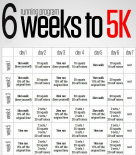
A sub 20 minute 5K means holding 4:00 per kilometre (6:26 per mile) for the whole run. This free plan gets you there with three hard sessions a week, proper rest between them, and target paces you reset every few weeks. It suits someone with about three hours a week to run who wants to take tens of seconds off a parkrun PB. Sub 19 uses exactly the same training; it is just harder to achieve.
This post contains:
- A repeatable seven-day plan with target paces (below).
- A link to a personalised 5K plan if you want one built around you.
- A list of caveats that will stop you getting injured.
- Quick answers to the most common sub 20 questions.
If you have a race this weekend rather than a few months to train, read my 100+ tips for a faster 5K instead.
Can you realistically run a sub 20 5K?
For most people, running 5K in under 20 minutes is an achievement. For top athletes, and even for fairly casual club runners, it is a routine time. How hard it will be for you depends mostly on your age and sex, which is why age grading exists: it compares your time with the best possible performance for someone of your age and sex.
Most people can reach a 70% age grade with some hard work and time. An 80% age grade is extremely hard and, if you are averagely fit now, will probably take you several years of steady improvement. If you are a competitive type looking for a 5K goal, an 80% age-graded 5K is a real test.
Here is roughly what a 20:00 5K represents:
| Category | Approximate age grade for 20:00 | How hard? |
|---|---|---|
| Men 20 to 24 | 64% | Very achievable from a good fitness base |
| Men 35 to 39 | 67% | Achievable |
| Men 45 to 49 | 71% | Achievable with hard work |
| Women 20 to 24 | 73% | Hard |
| Women 35 to 39 | 75% | Hard |
| Women 45 to 49 | 82% | Very, very hard |
These figures are approximate. Your parkrun results email shows your own age grade for every run, which is the easiest way to track where you stand. For a fuller answer on timescales, see how long it might take you to run sub 20.
Before you start
If you can’t run non-stop for an hour, however slowly, this plan is not for you yet. You need an endurance base first, and that very simply means you can run at an unchanging speed in heart rate zone 2 for an hour while still holding a conversation.
I’m not claiming this, or any, plan can perform miracles. If you currently run 5K flat out in 25 minutes, this plan will not take you to sub 20 in three months. It will make you faster, but you will soon struggle because you lack the endurance base.
Sub 20 5K plan: the weekly schedule
The three hard sessions (days 1, 4 and 6) all work, and they should all leave you exhausted. If a session isn’t exhausting, go faster or cut the rest periods. If you are short of time but dedicated, do those three sessions and nothing else. Always rest the day after a hard session, ideally for two days. Make every fourth or fifth week slightly easier than the three before it, and take at least two days off before a race. Rest matters far more than you think.
Always start a new week at day 1 and forget any sessions you missed.
The example paces assume your next target is 20:00, or 4:00/km. Set them from your next interim target rather than your ultimate goal (see caveat 4).
| Day | Session | Example pace for a 20:00 target |
|---|---|---|
| 1 | 3 to 4 x 1K at 5 to 10 seconds per km faster than your next race target, with 3 minutes rest between efforts. If you can’t hit the pace, your sights are set too high for now. | 3:50 to 3:55/km |
| 2 or 3 | Optional slow, easy recovery run of 40 to 75 minutes. Focus on technique, for example by nudging your cadence slightly higher. You should be able to hold a conversation throughout. 5:00/km is not slow for you; 6:00/km is. | About 6:00/km |
| 4 | 5 minutes at 30 seconds per km or more slower than race pace, then 3 minutes at about 10 seconds per km slower than race pace, then repeat both with no rest. Rest for 6 minutes, then do all four efforts again (5+3+5+3, rest 6, 5+3+5+3). If you can’t finish it, your target is too ambitious or you ran day 2 too fast. | 4:30/km, then 4:05 to 4:15/km |
| 5 | Adaptation and recovery day. Do deep stretches to increase your range of motion. | No running |
| 6 | 8 x 1 minute faster than your day 1 pace, with 60 to 90 seconds rest. You can extend the rest to 2.5 minutes if you raise the pace. Aim for the same top speed on every rep. | 3:40/km or faster |
| 7 | Rest, or a 60-minute run at the edge of where you can just about speak (4 repeats of 10 minutes in heart rate zone 2 plus 5 minutes in zone 3, no rest). Alternatively, do 3 x 15 minutes at race pace plus 30 seconds per km with 5 minutes rest, which approximates a sweet-spot run. If you are tired, which is likely, run 60 minutes entirely in zone 2. | About 4:30/km for the 15-minute blocks |
| Every 5 to 6 weeks | Retest your 5K after a three-day taper and reset your training paces from the result. Taper properly for your big race. | Race effort |
A watch that runs structured workouts makes the interval days far easier, because it beeps you through each rep and rest. Entry-level Garmins such as the Forerunner 70 and Forerunner 170 do this well, and Fit File Forge has a free library of classic interval sessions you can send straight to Garmin Connect. The running watches hub covers the alternatives.
Here’s what Mr parkrun, Mike Trees, thinks: my parkrun masterclass with Mike Trees, one of the very best veteran 5K runners.
Personalise your training
- Personalised 5K training plan: sub 20, sub 23, sub 25
- Personalised 10K training plan: sub 40, sub 45, sub 50
Read the caveats below, otherwise you will get injured. If you are not closing in on 20 minutes after two months on this plan, give yourself a longer timeframe and check that your training paces are right. If your improvement stops on this or any other plan, change your training straight away, because similar inputs always give similar outputs. After two months of continuous hard effort you will probably be mentally tired too. Take a rest, change your approach, and look back at your data to see how hard you really worked and how well you rested.
This plan is a little short on recovery time, and on strength, conditioning and flexibility work.
Caveats
1: Do you think the plan has too few miles and no long slow run? Plodding along in heart rate zone 1 will not help you much, other than for recovery or technique. Zone 1 is too slow even for a long slow run. The plan assumes you already have an endurance base, and it won’t work well without one.
2: If a sub 20 minute 5K is a bigger achievement for your age group, make the day 7 long run a higher priority so that you actually do it every week.
3: If you are a long way off 20 minutes, the long runs will help most, and this plan may not be for you yet. I would say 23 minutes for younger runners and 25 minutes for over-30s is quite a way off. You need to focus more on mileage and running economy, but you probably know best.
4: Your target race pace is your next interim target, not your ultimate sub 20 goal. Set it just a little faster than you can run now, say 10 to 20 seconds off your current 5K time.
5: Ideally, change the stimulus week on week. Make the plan a little harder each week by resting slightly less or running slightly faster. Every four to six weeks, really ease off for a week and rest more, then start again. I left this out of the schedule to keep it straightforward.
Don’t forget to have a look at the best shoes for crossfit training
6: Don’t be swayed by marathon runners telling you to do lots of long slow runs. They are right for marathons, but you are training your body’s systems differently. More long slow runs are of no big, immediate benefit to your next 5K PB, as long as your endurance base is already in place. One way to see it is that long runs put miles in the tank, and this plan spends those banked miles on more intense training. The zone 2 runs above shouldn’t feel that slow either. Long slow runs do build every athlete’s endurance base and several other physiological adaptations, so they have their place.
7: Take on protein, carbohydrate and water straight after every session. Protein repairs, carbohydrate refuels and water rehydrates. A glass of milk and a banana will do nicely, and whey protein is even better. A sensible diet will take seconds off your 5K more easily than extra training.
8: Running technique matters, but don’t try to change it much in the next three months or you’ll get injured. Over the longer term running efficiency is very important. If you are currently below 85 steps per minute per foot (170 total), you could aim to raise your cadence towards 90 (180) over a few weeks.
9: If the sessions are nearly impossible even with the maximum rest, base your paces on your last PB instead. Many plans set paces from what you have recently achieved rather than what you want to achieve, and that is no bad thing. Sessions also become impossible when you leave less than two days between hard efforts, or run the other sessions too fast.
10: This is a hard plan. Keep it up for longer than two or three months and you may well get injured, and your body will adapt to the fixed stimulus. Lengthen your timeframe, perhaps with just two hard sessions a week and some easier runs, and be realistic.
I never said it was an easy plan, just a straightforward one.
More free plans are here.
Quick answers
What pace do I need for a sub 20 5K?
You need to average faster than 4:00 per kilometre, or 6:26 per mile. Holding exactly 4:00/km gives 20:00, so aim for about 3:58/km to leave a few seconds in hand.
How do I train for a sub 20 5K?
Build an endurance base first, so that you can run for an hour non-stop. Then do three hard sessions a week: 1K repeats slightly faster than race pace, a broken tempo session just slower than race pace, and short one-minute intervals well above race pace. Rest the day after each hard session, ease off every fourth or fifth week, and retest your 5K every five to six weeks.
What intervals help you run a sub 20 5K?
The key session is 3 to 4 x 1K at 3:50 to 3:55 per kilometre with 3 minutes rest. Add 8 x 1 minute at 3:40/km or faster with 60 to 90 seconds rest to build speed.
How long does it take to get from 25 minutes to sub 20?
For most runners it takes longer than three months, because the gap is mainly an endurance gap. Build mileage and running economy first, then use this plan once you are within a minute or two of 20 minutes.
Is a sub 20 5K good?
Yes. For a young man it is an achievable club-runner time of about 64% age grade, while for a woman aged 45 to 49 it is roughly an 82% age grade, which is very hard.
Last Updated on 30 September 2026 by the5krunner
Small things I always use
- Garmin 90-degree charging adapter: Charges your Garmin from any USB-C cable. Essential when travelling. I use one.
- Body Glide: The blue anti-chafe stick swimmers and runners carry. I use it.
- Speedo earplugs: Fewer ear infections and no cold-water dizziness. I use them.
- Dryrobe Advance: My winter changing robe for open-water swims. I use one. A cheaper option is the AONYIYI changing robe.
- Maurten: Race fuel that stays easy on the stomach. I use them.
- Garmin charging puck: The quickest way to top up before a session. I use one.
- Injinji: Toe socks that stop rubbing, so you run more. I use them.
- Ultimate toe protectors: Stop black toenails on long runs. They work. I use them.
- Compressport R2 v2 calf sleeves: My calf sleeves of choice. I use them.
- Cellucor C4: My pre-workout before hard sessions.
- TPU tubes: Schwalbe Aerothan, Tubolito and Pirelli SmarTube. Light, tiny spares. I use all three.
- G8 insoles: Adjustable insoles that are good. I use them.
- Cycplus Cube: A 97g electric pump that gets a road tyre rideable in two minutes. I carry one. 5% off with code THE5KRUNNER.
Watches and sensors
- Polar H10: My daily driver for waking HRV.
- Polar Verity Sense: My backup arm-worn HR sensor.
- Nomad bedside charger: Charges my iPhone and Apple Watch overnight. I use it, and many of their bands.
- Train.Red: The best muscle oxygen sensor I’ve used.
- Tymewear: Accurate heart rate and reliable ventilatory zones. I use it to pace endurance rides over an hour.
- Garmin Forerunner 970: A pro-grade triathlon watch. I use this.
- Apple Watch Ultra 4: My daily smartwatch. No phone needed on rides.
- Garmin Fenix 9 Pro: I’ve just bought one.
On the bike
- Continental GP5000 for everyday riding, and Aero 111 on the front for special occasions.
- Helmets: Specialized S-Works Evade 3 for road riding, and Rudy Project Wing for TT-style races. I use both.
- Ravemen FR300: A front light that mounts under your Garmin or Wahoo. I use one.
- Wahoo TRACKR Radar: I use it on one bike and Varia on the other. They perform the same.
- Garmin Varia RTL515: Radar that warns you of cars from behind. I use this model.
- Wahoo ELEMNT Roam 3: The bike computer that’s easy to use. I use mine on most rides.
- Favero Assioma Pro RS2: Accurate power pedals that swap easily between bikes. I use this model.
Home and indoor training
- NPE Runn: Makes my basic treadmill smart, sending more accurate speed and distance to my watch and Zwift. I use it.
- Google Wifi: Keeps Zwift connected in my pain cave. I use it.
- Apple TV 4K: Zwift on the big screen. I use two.
- Google Nest Doorbell (wired, 2nd gen): My video doorbell, running in both Google Home and Apple Home. I use it.
Health, recovery and sleep
- FreeStyle Libre 3 Plus: Shows how my blood sugar responds to diet.
- hDrop: Measures my sweat loss in summer and indoors.
- Fourth Frontier Zone: Checks my heart under load in hard sessions.
- Oura Ring 5: My partner’s recovery tracker of choice.
- Kineon MOVE+: Red light therapy for niggles. It works.
- Eight Sleep: A cooling mattress cover my partner and I use nightly.
Reader-Powered Content

This content is not sponsored. It’s mostly me behind the labour of love, which is this site, and I appreciate everyone who supports it.
Support the site: Follow (free, fewer ads) · Subscribe (paid, ad-free) · Buy Me A Coffee ❤️
Written by real people, with AI assistance. Fact-checked and verified for originality. See the Editorial Policy. FTC: Affiliate Disclosure — some links pay commission. As an Amazon Associate, I earn from qualifying purchases.
tfk is the founder and author of the5krunner, an independent endurance sports technology publication. With 20 years of hands-on testing of GPS watches and wearables, and competing in triathlons at an international age-group level, tfk provides in-depth expert analysis of fitness technology for serious athletes and endurance sport competitors. ID

Hi, I recently ran my first marathon (Snowdonia) and would like to keep up the running but focus on something where the training is less time-consuming – hence I ended up here! I tested my 5k time last week – it’s 21:36. I’m 43, male. I probably only have enough time for 2 sessions per week since I plan to start triathlon training after Christmas. My question is, which of the sessions should I do. I was thinking of doing the 5x1K every week as the first session and then alternating between the 12x1min and the 5/3/5/3×2 for the second. Does this sound sensible?
Thanks,
Al
yes !
I run 27 min will this plan help me in 3 months?
in the caveats I say that you should be already at 23 minutes. instead focus on some 60 minute runs and some 1km repetitions and on the odd parkrun every few weeks.
Going to start this plan tomorrow, I only started running a few months ago and got to running 5k’s consistently in the 20:30’s to 20:50’s range in weeks, I then started going on running forum’s and got sucked in to the lots of long slow miles idea which I don’t even enjoy doing, its boring and not for me. I don’t want to run half or full marathon’s.
I want to run a few times each week for exercise and enjoyment and 10k will be the longest distance I will ever race.
I will keep you up dated with how I get on!
the long runs DO help efficiency. but in a short term plan I would focus on various types of speedier stuff if you want to improve quickly.
Is the 3x1600m, the most important of these runs each week?
it would depend on your strengths/weaknesses. but ‘yes’ would be the best answer I could most helpfully give.
If you asked me yesterday, I would have said my legs have more to give at the end of a 5k but my breathing struggles the last 1000-1200m. Typically my 5k splits are about 3:45, 3:55, 4;10, 4:20, 4:20 give or take a second or two. This gives an average of about 4:06 and a time of 20:30, I have tried running closer to my average splits (4:05) twice but ended up in the low 21’s. I lack endurance I guess!
Anyway I did plan on doing the 3x1600m today but I would have done this along a very open riverside cycle path (its the only flat safe place to do it) and it was just to windy down there so I tried the 535365353. I set my target times at 4:30(5) and 4:10(3) which is using a target 5k time that is my current pb of 20:30 just to get used to the method of the run for the first time of doing it.
Anyway the first 5353 was no problem took the 6 minute break which is not good for me, I struggle to get going after a rest period. On my second set the first 5 was okay then I did struggle to get to pace for the 3 but did manage it although it was nice to drop back to the 5 pace again but just didn’t have it in my legs to get back to speed for the last 3.
Strange thing though my breathing was good at the end going in to the last 3, my breathing didn’t have that gasping I want to stop feel I usually get at the end of a fast 5k, this time it was my legs just didn’t respond to me wanting to go faster,at the end of the run I jogged home for just short of 2k at a snails pace and did my stretches.
Hopefully will do the 1600’s on Christmas Eve and rest on Christmas day!
you are starting off too quick for sure.
rest period 6 minutes: optional of course!! but I suspect you would need it.
aim for paces based on a slightly faster time eg 20:15/20:10
buy some http://goo.gl/s2iH40 beet-it shots from holland and barret and take one an hour before your next hard session or PB attempt. look on this blog for caffeine doses/proplus comments. make sure you taper properly for a PB attempt. I think you are close but not QUITE there yet – thos e3 things may have a significant impact…or not 🙂
Okay thanks, I will aim for 20:10 so 3×1600 around 3:52-3:57 pace and the 1 minute sprints 3:42-3:47 pace then!
I will do the long run on how i feel but try not to go faster than 4:50’s , I will keep it at about 12k/ 60 mins for now as I think adding more distance will have a knock on effect with the following days training!
What are each of the 4 runs looking to develop?
Do you think I would benefit from a heart rate monitor to pace myself better?
Hi,
Interesting article. Thanks.
By way of encouragement to others who are thinking about increasing the mileage, it was a big help to me in reducing my 5k time.
I’ve just turned 40 and started running consistently just over a year ago when I was 39 (but had done a bit here and there before). My ParkRun time was about 31mins on my first attempt, due to fitness levels and ITB pain which slowed me down. I pressed on and after about 8 weeks the ITB pain had gone and my time had gone down to about 27mins.
I began doing another 3-5k run midweek, sometimes two runs and over the next 4-5 months I broke 25mins and then got to 23mins on ParkRun which I do most weeks.
At that point my PB settled at just over 23mins and didn’t really improve. I then began chucking in hill run intervals (sprinting up my road which is on a hill of about 100mtrs and jogging down, repeating this 8-10 times). This was alongside ensuring all my runs were at least 5-8k midweek (still only one or two). My ParkRun time then dropped by another 30seconds within a couple of weeks to 22:27.
It remained at that for another 4 months until I introduced more mileage, going up to 10k for mid weeks runs (instead of the usual 5-8k) and then during one week I took on a 70k in a week challenge which included building unto a half marathon distance.
This all had a massive impact and over the next 3 ParkRuns I took 30 seconds a week off! Dropping my time down to 20:52.
I now run normally between 40-50k a week with a half marathon distance at least every other week.
For me the key thing was increasing my mileage. That was it. I did have a few aches and pains but nothing that a few days rest has not resolved.
I’m now looking at more specific interval training midweek to see if I can get down below 20mins and beyond.
Oh and losing a bit of weight has been a byproduct and no doubt helped as well!
Hi Adam, many thanks for taking the time to comment and well done on your success. You are advocating a high mileage (mostly low HR) route to faster times (see also https://the5krunner.com/2013/01/11/heart-rate-training-zones-benefits/). This will work as low intensity/high mileage will improve your general efficiency which is obviously a good thing. IT takes a little longer to improve that way and, indeed, what you advocate is great ‘base’ training and great to for newer atheltes (hence my comments about suitability for over 23minutes runners – it’s hard to generalise one time over the whole population without having to give non-straightforward suggestions). It’s probably also great training for longer distances. However when you run 5k quickly then you are pushing your lactate threshold and racing in your VO2max zones…surely training at those levels will help? And indeed it does. It has a quicker payback. However it (what I am advocating above) is NOT a recipe for continual longterm improvement. Just general exercise will make your 5k times faster becoming stronger in the gym or faster at 100/200/400m running will make your 5k times faster. However I would advocate specific TRAINING (Ie NOT general exercise) for the event, that is what is above (with all my caveats to be noted). Don’t get me wrong the long stuff is great and, for sure, I do that every week too but in the month leading up to a race my total mileage would drop quite a bit. If anyone else wants to look further there are generally accepted methods to periodise training. Generally speaking the closer you get to race day, your training becomes more like the race effort.
Good plan. I like it:-)
Very honest and infomative.
I’m unclear. Where the program specifies an optional SLOW/EASY run on Day 2 OR 3, does that mean if you do it on Day 2, you then rest on Day 3 (or vice versa)? And if so, that means 2 rest days (2/3 and 5) in the 7 day cycle. ?
do what is on day 2 (nothing) or optionally the long run. do what is on day 3 (nothing) or optionally the long run. The ‘plan’ is changed from time to time. maybe do some weights if there are 2x consecutive rest days.
Thanx. On the day 2/3 easy slow runs, should I be in HR zone 2?
depends who you ask 🙂 I would say yes
What do you mean above when you write, “The first 3 exercises should all be exhausting”? I’m assuming you aren’t referring to Day 1, 2, and 3 since 2/3 are not exhausting.
thanks for spotting that. I do change the 7days content so that comment becomes wrong. I will change it.
I’ve been itching to try this plan, but I was too busy this last 6 months training for the marathon. I finally ran the marathon on Monday in a disappointing time and the DOMS has now subsided, so it’s time for my next target. My PB is 20:24 from just over a year ago, but I’ve struggled for speed recently and I’m probably closer to 23 mins at the moment.
I’m planning on some easy running next week, with a Parkrun on Saturday for a baseline, then get on with your plan unmodified.
I haven’t found much advice online on transitioning to shorter stuff after running a marathon, so I don’t know how sensible this plan is. What do you think?
yep, you’re good to go with the baseline from Saturday.
OK, new plan! Had to stop running for a few weeks due to heel pain (not pf fortunately). Did other cardio in the meantime and finally ran that baseline in just under 21 minutes, which I was pleased with.
I am now going to hit this programme hard for the next few weeks and will report back. I have a 13.1 in mid November, so I will start upping my mileage in six weeks or so.
I will report back, as I know I have found other people’s progress on this thread inspiring.
sure you have your endurance sorted out?
Thanks for a very useful article.
I was wanting to clarify something about the rest and recovery. You mention that it’s critical to rest the day (or preferably two) after the three hard sessions. How is this consistent with the long run on day 7, i.e. shouldn’t day 7 be a rest day, given that day 6 was hard? Or should the long run be slow and easy enough that day 7 still counts as rest?
hi greg. r&r is key. 1. use the recovery advisor on your watch if you have one. 2. use a free app like ithlete or elitehrv to determine your readiness as we are all different in how we recover. rest is perhaps the wrong word: it is ADAPTATION TO THE EXERCISE. as a rule of thumb there should be 2-3 days between hard sessions. hard sessions are often best done when fresh. training after a hard session you will find it hard to hit goals. planning within a 7 day week is difficult because of the odd number of days / the weekend and many other factors 🙂 hope that helps a bit ask me to clarify a specific point if you need to.
I am 45 female. Ran a 20:20 on flat course in May 2015; ran a 20:59 on a hilly XC course saturday. I am not sure if I should try the straight forward plan or the VDOT plan. There is a part of me that thinks my endurance base needs to be better and a bit reluctant on doing 3x speed a week due to fear of injury. Thoughts?
if your goal is sub 20 quickly then you need to so speed sessions. leave 2 days between vo2/speed sessions
i’m average 21,30 5km, how far am I for sub 20’s?
this might help: https://the5krunner.com/2011/11/19/5k-improvement-to-under-20-minutes-how-long-will-it-take-me/
Doesn’t training at maximum effort on Day 6, 7 and Day 1 mean you have 3 consecutive maximum effort training sessions? That can’t be right, can it??
if tired have a rest day and restart on Tuesday as day 1. ideally I wold personally set training as blocks of 3 days. unfortunately a week has 7 days and unfortunately people like to do long runs on sundays.:-)
endurance run and sweetspot run are not max.
Thanks for sharing this plan, it seems to be straightforward and hopefully just as effective 🙂 one question based on my observations – are these 3 exercises meant to be be equally exausting? The 10×1 minute at 10secs/km faster than 4x1km (or 5x1k in my case) seems to be only about 60% of the effort I need to put into the latter. Is it how the plan is designed?
I would re-test your 5k. it does say ‘at least’ and yes those sessions should be fast. fast as you can. this plan cannot be exact as it target different abilities and different physiologies (we are all different and differently trained).
I ran 20:04 the Saturday before the last, then did 5x1k at ~3:48min/km which was 88 suffer score on strava, while 7x1min at 3:30 was only 45 suffer score on strava and felt fairly easy too, do you suggest I rather add more repetitions or speed up the sprints to match the effort?
just to clarify – based on earlier comments I take the plan said 20x1min originally, so not sure what you recommend – increase repetitions or just literally ‘fast as you can’ 10 sprints
as fast as you can
you then will nto be able to do 20
been following this plan for about 4 weeks now, skipped the easy days as I feel a pain in my left hamstring, but nothing that stops me from going full on on the hard days. trying to make it ‘exhausting’ I got the 1k repeats down to 3:38, 1 minute repeats down to 3:10, 535365353 down to 4:10 on 5 mins and 3:50 on 3 mins bits. Hope this will suffice to break 20 mins this or next Sat! fingers crossed 🙂
if you can run those speeds then, for sure, sub20
correction: 1 minute repeats down to 3:16, I wish it was 3:10 😉
you should be WAY UNDER 20 minutes. you have the speed. if you cannot do sub 20 then instead focus more on your 1km reps. failing that work on 15/20 minute reps. failing that do long stuff!
Happy to have discovered this! I’m going through an alteration period because of damage and need to center around short quick for some time to keep the long run beating to a base. This gives me somewhat of a guide.
When I first started running I ran 5k in 29-30min…After 6 months of training I did it in 21:05min…then i plateaued lol every time i try to break that PR, failure! But I still believe I can do it in less than 20min…my goal in fact is 18min…thanks for the workout😀
When I first started running I ran 5k in 29-30min…After 6 months of training I did it in 21:05min…then i plateaued lol every time i try to break that PR, failure! But I still believe I can do it in less than 20min…my goal in fact is 18min…thanks for the workout😀
try more polarised training…long and easy combined with other sessions of short fast intervals
Was a 30:40 10K guy, 14:40 5k and 2:37 marathon back in the day from 1978 to 1994. At 61 now and still competitive I would hope I still have a sub 20 5k in me. Running 35-40 miles p/w, did a 10 X 400m with 400m rest in avg 1:42 recently and 4 X 800m in avg 3:32 with 400m rest. Last race was back in May 2019 with 5 mile performance of 35:15.
yeah you’ll have a sub20 5k in you…easy peasy
Just wanting to express a heartfelt thank you: with a bit of perseverance and repetition I got my parkrun to sub 20 on your plan last year (for reference I’m F39). And then off the back of your personalised coaching plan this year I’ve just done my first Olympic distance duathlon and absolutely loved it. I never EVER would have thought I could hit the times I did if it hadn’t been for your encouragement and support. So-thank you!
thank you…you forgot to say you won over all the combined age groups 😉
😊 that is true. Quite a small field though! it’s all relative and one persons amazing result is another persons steady plod-well, this was an amazing result for me taking into account what point I started from. And an enjoyable experience and not an agonising sufferfest. I would not have had the experience to pace it right on my own which I’m sure made all the difference.
4w/kg is no-one’s steady plod