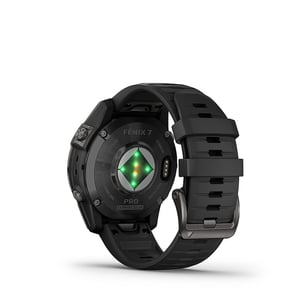
Update 8 November 2026: The Fenix 7 Pro and Epix Pro (Gen 2) launched with Elevate Gen 5 on 31 May 2023. Garmin’s FDA-cleared ECG app reached both on 17 October 2023, with a thumb and finger on the metal ring around the watch face, and it has since spread to the UK and EU. Gen 5 is now in many newer Garmins, but ECG still depends on the model and your country.
Garmin Elevate 5 optical HRM Sensor
Garmin’s ELEVATE-branded optical heart rate monitor has gradually improved its capabilities through various iterations in recent years. We’re now on Gen 5.
We have witnessed the support for optical HR (oHR) during swimming, the inclusion of resting HRV calculations, the implementation of 24×7 per-second recording, and the addition of blood oxygen (SpO2) monitoring.
At first glance, one might assume that the technology has reached its limits. It could certainly become slightly more accurate or save a bit more energy, and perhaps one day we could even obtain HRV data during exercise. But is that all there is to it?
Well, no. These wrist-based optical sensors are set to improve in the years to come. While Garmin may never lead the latest groundbreaking advancements in wrist sensor technology, it will remain competitive.
New Hardware – new Elevate
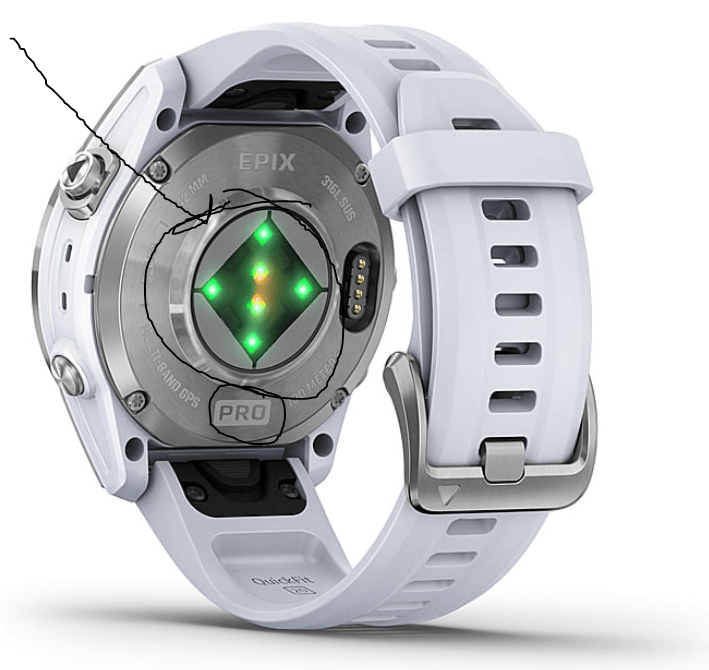
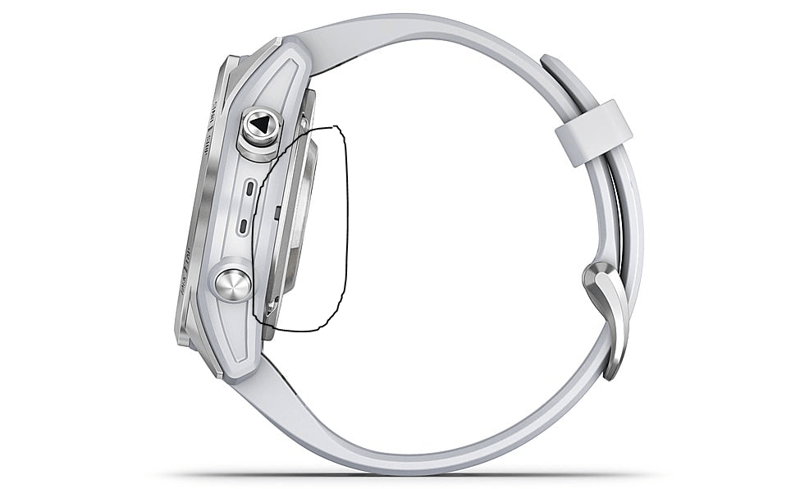
The new ELEVATE Gen 5 model sits wider on your skin than before.

Most strikingly, however, it features six green LEDs, four receptors, two red/orange LEDs, and an electrical isolation ring surrounding it. However, look closer, and you will also see four silver areas adjacent to each of the four sides of the main LED module. We’ll revisit all these points shortly.
Note also that the Start/Stop button retains its appearance from the previous version. Garmin’s ECG instructions have you rest a thumb and finger on the metal ring around the watch face, not the Start/Stop button.
Elevate 5.0 has Skin Temperature Measurement.
Skin temperature is a health and sleep metric that can, for example, help detect sleep stages, ovulation cycles, and illness. So don’t expect to be wowed by knowing your skin temperature, but DO expect more accurate Garmin health and wellness insights.
Skin temperature serves different purposes than core temperature, with the latter being more relevant to athletes during a performance. Athletes seek help acclimating to higher-temperature environments and may want insights into core temperature to prevent overheating, dehydration, and suboptimal performance. However, I am sceptical that Elevate 5 will provide these insights from the start.
Skin temperature sensors can be used in conjunction with sophisticated algorithms to determine core body temperature accurately. These algorithms can improve their accuracy by incorporating HR data from a chest strap. Some, such as the GreenTEG Core, estimate core temperature this way, although an independent study (Verdel and colleagues, Sensors, 2021) found limits of agreement of about ±0.6 °C against rectal temperature.
The silver areas mentioned earlier do not need to be metal to measure temperature.
Will Elevate 5 deliver More Accuracy?
A: Yes, there are modest improvements reported (edit: and that I experienced in my testing)
Previously, issues with hairy skin, darker skin, and motion artefacts have caused accuracy problems with Garmin sensors. However, they can be hard to pinpoint, since they depend on individual users and their exercise habits.
More LEDs should create more data points, which can then be cross-validated to eliminate bad ones and improve accuracy. At least that’s the theory; in reality, it will come down to how well Garmin implements its algorithms, and it hasn’t always had the best record in that department.
One interesting and plausible suggestion below is that Garmin will fire up 2 or 4 of the six green LEDs during workouts for maximum accuracy, but rely on only 2 LEDs for 24×7 HR monitoring. I like that idea, but has Garmin already considered it?
Will Elevate 5 need more power?
a: No, probably not.
Although increased LED use implies higher power consumption, efficiencies elsewhere will almost certainly reduce overall energy requirements. For example, some components within the watch can be merged into one, resulting in energy savings.
Will Elevate 5 be an ECG?
A: Yes, it’s been confirmed as an on-demand ECG
Garmin has already released an ECG on a Venu 2 Plus in January 2023, following years of research and approval/patent processes. The new Elevate sensor will support ECG, though not at launch, and was pending FDA clearance at the time; it arrived on 17 October 2023.
Will Elevate 5 support Afib?
a: Yes, Garmin’s ECG app supports the on-demand detection of atrial fibrillation (AFib) or normal sinus rhythm
Will Elevate 5 support SpO2
A: Yes, v4 already does.
Garmin ECG now Live – Possibly Garmin’s most boring-ever January product announcement
Is Elevate 5 also a GSR?
A: Probably not. But this would be the most interesting addition to a Garmin watch.
Galvanic Skin Response (GSR) sensors, also known as Electrodermal Activity (EDA) sensors, first appeared in consumer wearables with the Basis B1 band in 2013. They measure the electrical conductivity of the skin. GSR sensors are commonly used in fields such as psychology and neuroscience to evaluate an individual’s physiological response to various stimuli. They operate based on the principle that the skin’s electrical conductivity alters when a person experiences emotional or physiological changes. These changes primarily stem from the activity of sweat glands, which are regulated by the autonomic nervous system. While GSR sensors do not directly measure HRV/ANS changes, such data could serve as input for recovery/readiness algorithms, enhancing their accuracy.
Will Garmin try a new sensor technology (GSR) on a new sensor package on its most important watches? A: Garmin is quite a conservative company, so probably not.
Take Out
Garmin’s latest ELEVATE Gen 5 optical heart rate monitor (oHRM) sensor represents another step for the company’s wrist sensor technology. With improvements such as ECG & skin temperature measurement, the Gen 5 sensor should offer enhanced accuracy and valuable insights for users. Supported by clever algorithms and potential integration with HR data from a chest strap, this oHRM sensor demonstrates Garmin’s commitment to staying competitive and delivering comprehensive health information. While supporting features like ECG, the Gen 5 sensor may not include Galvanic Skin Response (GSR) capabilities. Nonetheless, it sets the stage for future advancements in wrist-based metrics and solidifies Garmin’s position as a leader in sports and wellness.
Expect to see it within a month on the Epix 2 Pro and Fenix 7 Pro series.
all the details – new Garmin Fenix 7 Pro, new Elevate, new features, new Epix Pro
More New Features Inbound
Garmin Epix PRO and Fenix 7 PRO Pricing & Model Options Confirmed
Garmin ANT+ Profile Changes in advanced beta – this means new features SOON
Garmin Fenix/Epix – new PRO Models Get Improved displays and improved flashlight
Last Updated on 8 November 2026 by tfk the5krunner
Small things I always use
- Garmin 90-degree charging adapter: Charges your Garmin from any USB-C cable. Essential when travelling. I use one.
- Body Glide: The blue anti-chafe stick swimmers and runners carry. I use it.
- Speedo earplugs: Fewer ear infections and no cold-water dizziness. I use them.
- Dryrobe Advance: My winter changing robe for open-water swims. I use one. A cheaper option is the AONYIYI changing robe.
- Maurten: Race fuel that stays easy on the stomach. I use them.
- Beet It Sport nitrate shots: Beetroot shots I take in the days before a race. I use them.
- Garmin charging puck: The quickest way to top up before a session. I use one.
- Injinji: Toe socks that stop rubbing, so you run more. I use them.
- Ultimate toe protectors: Stop black toenails on long runs. They work. I use them.
- Compressport R2 v2 calf sleeves: My calf sleeves of choice. I use them.
- Cellucor C4: My pre-workout before hard sessions.
- TPU tubes: Schwalbe Aerothan, Tubolito and Pirelli SmarTube. Light, tiny spares. I use all three.
- G8 insoles: Adjustable insoles that are good. I use them.
- Cycplus Cube: A 97g electric pump that gets a road tyre rideable in two minutes. I carry one. 5% off with code THE5KRUNNER.
Watches and sensors
- Polar H10: My daily driver for waking HRV.
- Polar Verity Sense: My backup arm-worn HR sensor.
- Nomad bedside charger: Charges my iPhone and Apple Watch overnight. I use it, and many of their bands.
- Train.Red: The best muscle oxygen sensor I’ve used.
- Tymewear: Accurate heart rate and reliable ventilatory zones. I use it to pace endurance rides over an hour.
- Garmin Forerunner 970: A pro-grade triathlon watch. I use this.
- Apple Watch Ultra 4: My daily smartwatch. No phone needed on rides.
- Garmin Fenix 9 Pro: I’ve just bought one.
On the bike
- Continental GP5000 for everyday riding, and Aero 111 on the front for special occasions.
- Helmets: Specialized S-Works Evade 3 for road riding, and Rudy Project Wing for TT-style races. I use both.
- Ravemen FR300: A front light that mounts under your Garmin or Wahoo. I use one.
- Ravemen FR1000: The light and the computer mount in one unit, so nothing else goes on the bars. Better than mine.
- Ravemen FR1500SE: 1,500 lumens hanging under your Garmin, for proper night rides.
- Ravemen FR1100SE: 1,100 lumens under your Garmin, and up to 46 hours on slow flash.
- Ravemen FR500: A brighter FR300 with the same mount.
- Wahoo TRACKR Radar: I use it on one bike and Varia on the other. They perform the same.
- Garmin Varia RTL515: Radar that warns you of cars from behind. I use this model.
- Wahoo ELEMNT Roam 3: The bike computer that’s easy to use. I use mine on most rides.
- Favero Assioma Pro RS2: Accurate power pedals that swap easily between bikes. I use this model.
Home and indoor training
- NPE Runn: Makes my basic treadmill smart, sending more accurate speed and distance to my watch and Zwift. I use it.
- Google Wifi: Keeps Zwift connected in my pain cave. I use it.
- Apple TV 4K: Zwift on the big screen. I use two.
- Google Nest Doorbell (wired, 2nd gen): My video doorbell, running in both Google Home and Apple Home. I use it.
Health, recovery and sleep
- FreeStyle Libre 3 Plus: Shows how my blood sugar responds to diet.
- hDrop: Measures my sweat loss in summer and indoors.
- Fourth Frontier Zone: Checks my heart under load in hard sessions.
- Kineon MOVE+: Red and infrared light for sore knees, Achilles and other joints after hard training. I use it.
- Oura Ring 5: My partner’s recovery tracker of choice.
- Eight Sleep: A cooling mattress cover my partner and I use nightly.
Reader-Powered Content

This content is not sponsored. It’s mostly me behind the labour of love, which is this site, and I appreciate everyone who supports it.
Support the site: Follow (free, fewer ads) · Subscribe (paid, ad-free) · Buy Me A Coffee
Written by real people, with AI assistance. Fact-checked and verified for originality. See the Editorial Policy. FTC: Affiliate Disclosure — some links pay commission. As an Amazon Associate, I earn from qualifying purchases.
tfk is the founder and author of the5krunner, an independent endurance sports technology publication. With 20 years of hands-on testing of GPS watches and wearables, and competing in triathlons at an international age-group level, tfk provides in-depth expert analysis of fitness technology for serious athletes and endurance sport competitors. See the gear tfk uses. ID

This new sensor looks like the old one, with 4 new LEDs added. I think all 6 LEDs only work during activity to improve accuracy. And only two “old” LEDs will work to measure the pulse 24/7.
Also, I think the new silver areas are designed to measure sweat, because probably we don’t need such a large area to measure temperature.
I’ll bet my trousers, that it’s ECG contact pad. But it seems that they are four separate pads, so maybe it could measure more things like you wrote. We will know more soon.
ty
the 6/4LED comment makes good sense…we shall soon find out !!
I’m pretty sure it will be for skin temp as a minimum. GSR/sweat too…let’s hope so
I don’t understand who is making product decisions in Garmin. First they release FR955, then 9 months later they release its successor 965 (while 955 has still a lot of unresolved issues/bugs). And then in another 3 or so months they release Epix2 Pro models with *NEW* optical HR sensor. If they were little bit more organised, they should have waited for few more months with 965 release and give it the new OHR sensor. Also this could make the release of 965 less painful for lot of 955 users, since it would be delayed few months (at least 12 months after 955). And yes, unfortunately I have bought 955 when it launched.
the answer to Garmin’s incompetencies likes in its bottom line
(the profit line)
I agree – I think they should announce new watches together, now some people (my self included) rush out and buy the 965 and expect that it will be the latest Garmin for a while, and then they release a new pro version .
I was tempted to get the 965 but noticed that none of the latest hardware features were included… it’s really odd for a version bump.
It will be interesting to see if the F7 pro will include some or all of those new features. Will it impact the 965 price since it would look like a previous generation watch.
I wonder if the 4 silver areas might also be for magnetic charging?
Separately, what do you make of the leaked spec sheet showing ‘Power Sapphire’ for epix 2 Pro?
https://www.notebookcheck.net/Garmin-Epix-2-Pro-and-Fenix-7-Pro-series-European-prices-leak-alongside-release-date.719605.0.html
i was going to say ‘typo’but it’s on their source info.
i though epix was solar-free. i could be wrong.
yes, the 4 areas could be multi-purpose including for QI
Hi, how do you finding this article after Fenix 7 pro was released? Do you still believe that there is ECG / skin temperature sensor included in V5?
i believe there are elements of the sensor mechanism in the f7.
as you see from elevate v6 and venu 2+, garmin considers different sensor elements
Great article. How can I determine which heart rate monitor hardware is used in a given watch? Every time I click on a specification for a watch model they only list the wrist heart rate monitor hardware as being “Garmin Elevate™ wrist heart rate monitor.” They don’t specify the version of Elevate. I called the Garmin customer support and they told me that the information I was requesting was not available to the public.
hey Nat
there will be a document somewhere that someone has compiled but I don’t have it.
Gen 5 is only on watches made from this year from Epix Pro and F7 Pro onwards (there probably will be the odd exception to new watches in 2023/24)
Gen 4 was from 2021 when it first started on venu 2 and 945LTE
you can tell by looking at the pictures of the rear as the sensors are visually different