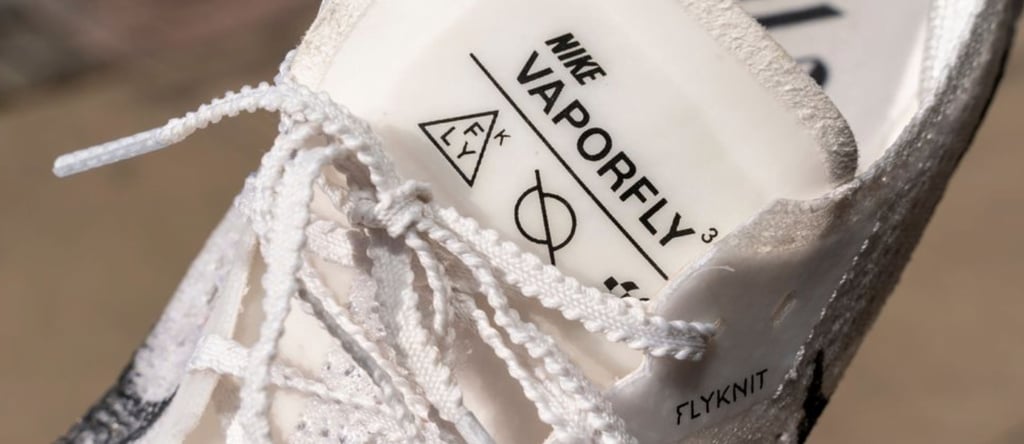
PEBAX Shoes get slower over time – Sorry, Nike
Víctor Rodrigo-Carranza et al. have released a study analysing the energy cost of supershoes but this time around they’ve looked at the difference between supershoe sole materials both when the shoes are new AND after 450km/300 miles of use.
More: Arkema (PEBAX)
More: EVA
Science Source: Wiley
Tip: Save your race shoes for races.
Tip: Perhaps convert your race shoes to training shoes after a hundred miles or so and buy some more supershoes. Make Nike happy.
Results
There were significant differences in RE between conditions (p = 0.01; n2 = 0.17).
There was a significant increase in energy cost in the worn PEBA condition compared with new (15.21 ± 1.01 and 14.87 ± 0.99 W/kg; p < 0.05; ES = 0.54), without differences between worn EVA (15.13 ± 1.14 W/kg; p > 0.05), and new EVA (15.15 ± 1.13 w/kg; ES = 0.02). The increase in energy cost between new and worn was significantly higher for the PEBA shoes (0.32 ± 0.38 W/kg) but without significant increase for the EVA shoes (0.06 ± 0.58 W/kg) (p < 0.01; ES = 0.51) with changes in step frequency and step length. The new PEBA shoes had lower energy cost than the new EVA shoes (p < 0.05; ES = 0.27) with significant differences between conditions in contact time.
Conclusion
There is a clear RE advantage of incorporating PEBA versus EVA in an AFT when the models are new. However, after 450 km of use, the PEBA and EVA shoes had similar RE.
Last Updated on 25 January 2026 by the5krunner
Small things I always use
- Garmin 90-degree charging adapter: Charges your Garmin from any USB-C cable. Essential when travelling. I use one.
- Body Glide: The blue anti-chafe stick swimmers and runners carry. I use it.
- Speedo earplugs: Fewer ear infections and no cold-water dizziness. I use them.
- Dryrobe Advance: My winter changing robe for open-water swims. I use one. A cheaper option is the AONYIYI changing robe.
- Maurten: Race fuel that stays easy on the stomach. I use them.
- Garmin charging puck: The quickest way to top up before a session. I use one.
- Injinji: Toe socks that stop rubbing, so you run more. I use them.
- Ultimate toe protectors: Stop black toenails on long runs. They work. I use them.
- Compressport R2 v2 calf sleeves: My calf sleeves of choice. I use them.
- Cellucor C4: My pre-workout before hard sessions.
- TPU tubes: Schwalbe Aerothan, Tubolito and Pirelli SmarTube. Light, tiny spares. I use all three.
- G8 insoles: Adjustable insoles that are good. I use them.
- Cycplus Cube: A 97g electric pump that gets a road tyre rideable in two minutes. I carry one. 5% off with code THE5KRUNNER.
Watches and sensors
- Polar H10: My daily driver for waking HRV.
- Polar Verity Sense: My backup arm-worn HR sensor.
- Nomad bedside charger: Charges my iPhone and Apple Watch overnight. I use it, and many of their bands.
- Train.Red: The best muscle oxygen sensor I’ve used.
- Tymewear: Accurate heart rate and reliable ventilatory zones. I use it to pace endurance rides over an hour.
- Garmin Forerunner 970: A pro-grade triathlon watch. I use this.
- Apple Watch Ultra 4: My daily smartwatch. No phone needed on rides.
- Garmin Fenix 9 Pro: I’ve just bought one.
On the bike
- Continental GP5000 for everyday riding, and Aero 111 on the front for special occasions.
- Helmets: Specialized S-Works Evade 3 for road riding, and Rudy Project Wing for TT-style races. I use both.
- Ravemen FR300: A front light that mounts under your Garmin or Wahoo. I use one.
- Wahoo TRACKR Radar: I use it on one bike and Varia on the other. They perform the same.
- Garmin Varia RTL515: Radar that warns you of cars from behind. I use this model.
- Wahoo ELEMNT Roam 3: The bike computer that’s easy to use. I use mine on most rides.
- Favero Assioma Pro RS2: Accurate power pedals that swap easily between bikes. I use this model.
Home and indoor training
- NPE Runn: Makes my basic treadmill smart, sending more accurate speed and distance to my watch and Zwift. I use it.
- Google Wifi: Keeps Zwift connected in my pain cave. I use it.
- Apple TV 4K: Zwift on the big screen. I use two.
- Google Nest Doorbell (wired, 2nd gen): My video doorbell, running in both Google Home and Apple Home. I use it.
Health, recovery and sleep
- FreeStyle Libre 3 Plus: Shows how my blood sugar responds to diet.
- hDrop: Measures my sweat loss in summer and indoors.
- Fourth Frontier Zone: Checks my heart under load in hard sessions.
- Oura Ring 5: My partner’s recovery tracker of choice.
- Kineon MOVE+: Red light therapy for niggles. It works.
- Eight Sleep: A cooling mattress cover my partner and I use nightly.
Reader-Powered Content

This content is not sponsored. It’s mostly me behind the labour of love, which is this site, and I appreciate everyone who supports it.
Support the site: Follow (free, fewer ads) · Subscribe (paid, ad-free) · Buy Me A Coffee ❤️
Written by real people, with AI assistance. Fact-checked and verified for originality. See the Editorial Policy. FTC: Affiliate Disclosure — some links pay commission. As an Amazon Associate, I earn from qualifying purchases.
tfk is the founder and author of the5krunner, an independent endurance sports technology publication. With 20 years of hands-on testing of GPS watches and wearables, and competing in triathlons at an international age-group level, tfk provides in-depth expert analysis of fitness technology for serious athletes and endurance sport competitors. ID

Aha, that explains my consistent running deterioration over the last 4 or 5 years. Phew!
Anecdotally, I found my Nike Next% were good for a single season, racing one each for 5km, 10km, half and full Marathon. After the marathon, they didn’t feel as fast.
I wonder what the actual difference would be scientifically after just 80 – 90km, My guess would be that the degradation would be much higher when new.
that sounds anecdotally right to me.
I’m wearing my ‘ancient’ vaporflys now as my round-the-house trainers. they are still nicely springly and comfortable although the sole is just about starting to fall apart. the point of saying that is that they do feel like they should still be runnable in…but this sciecne states they wont be as fast.
the degradation must be in the chemical structure of the foam. ‘springiness’ will be a property that is caused by some chemical bond or molecular structure (A level chemistry…I should know!!! but have long forgotten)