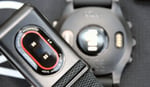
WHOOP Accuracy When I first reviewed the WHOOP band a few years ago it wasn't possible for you to get your data OUT of the WHOOP platform. Whilst that hasn't changed too much in and of itself, WHOOP has enabled the WHOOP strap to broadcast your HR to gym equipment and other sports devices. So it's now pretty straightforward to record a basic HR track from WHOOP on another app or sports watch. Which, once again begs the question How Accurate is the WHOOP 3.0 Strap? Whilst WHOOP continually refines their accuracy algorithms, the basic sensor is the same as in the original WHOOP strap. My original accuracy testing was solely based on wearing the WHOOP in the 'standard' wrist position, WHOOP was kind enough to get me 'behind-the-scenes' access to my HR data and thus my original review from a couple of years ago was probably the only one at the time that was able to demonstrate any kind of comparable data. At the time I said it did the job of making a sufficiently accurate HR/HRV track for the strain and recovery piece that is at the core of WHOOP's platform. I think that was a fair conclusion to draw at the time as it simply was not possible for you, or me, to access the HR data for any other purpose external to WHOOP's platform. Moving on from that I got a WHOOP strap 3.0 sometime last year and have used it on and off since then broadcasting HR to several different cycling and running devices whilst also simultaneously recording HR tracks from other sources including both HR chest straps and other wist based optical HR sensors built into sports watches. However, what I've tried to do this time around is to wear the WHOOP strap further up the forearm. I had two choices - further up the forearm or on the bicep/upper arm. I chose the former solely because I didn't have a strap that would fit my bicep! Why does the wear-position make a difference? Every single optical heart rate device on the market from the lowliest $100 Fitbit to a $1000 Garmin Fenix face the same problem for determining accurate HR: motion artefacts. Optical HRMs sense physical pulses in your veins and arteries rather than electricals signal directly from your heartbeat and many sensors and their algorithms find it difficult to differentiate these pulses that are caused by your heart compared to those that are caused by, say, the pounding of your feet as you run or the twist of your wrist. All these kinds of movements are 'motion artefacts' of some sort and it is a real PITA for the manufacturer to get rid of those and just focus on the true HR. To a large degree, the further away from the wrist you place your optical HR sensor, the more accurate it can be. WHOOP know this, Garmin knows this, Fitbit know this, they all know it and it's no big secret. Indeed WHOOP now sells a band that allows you to wear the WHOOP strap on your bicep and when placed there it should be straightforward for most manufacturers to get a decent reading. So I've used Polar, Scosche, Wahoo and other arm-based oHR straps and they all follow the same pattern for accuracy - if they are far away from your wrist they tend to be 'accurate enough' to properly use. On the other hand, wearing an optical HR strap right on your wrist bone will be a perennial cause of grief. Precisely how you wear it, precisely how you use it and your physiology all make a difference to how accurate it will be on your wrist. Indeed during sport, I found that it's actually pretty hard to get a sensible level of accuracy. My experience of my wrist finds that pretty much all these kinds of devices become random number generators that sometimes generate the right numbers. Garmin's latest ELEVATE sensor is the best for me but it's still not accurate on my wrist. Some of you will have accurate readings from your Polar and others of you will have poor readings from your top-end Garmin. It really is that crazy. Beware anyone that says BRAND X is awesome...they just mean that it is for them. Wear WHOOP further away from your wrist during sport From November 2019 to May 2020, I took a series of readings from WHOOP on the upper forearm (not bicep) DURING SPORT and compared them to a chest strap. the readings were generally alright and would likely be better if worn on the upper arm (bicep) for the reasons just discussed. When you are NOT doing sports you can wear WHOOP or most other optical HR sensors like a normal wristwatch and the readings at low heart rates would be alright too. So that includes for general activity uses and for sleep uses. Indeed sleep analyses require more sensitive HRV readings from your HR strap but, don't worry, most optical HR devices have a good chance of reasonable readings there because you're not moving much and because the HR is low. I didn't do any test of WHOOP's sleep accuracy this time around. WHOOP Accuracy On the Forearm In Sport These charts cover running and cycling and they cover bumpy roads and fairly strenuous efforts for me (170bpm). I did more tests than these but these are representative. With one exception 4 of these 5 are acceptably accurate. [gallery type="rectangular" size="medium" link="file" ids="49996,49997,49994,49993,49995"] WHOOP - So, get to the point, is it accurate? If you are looking for 99% chest-strap levels of accuracy then WHOOP is not as accurate as a chest strap when worn on the forearm (often it is acceptably accurate) You will not use ANY wrist-watch with optical HR and that includes Garmin. Some optical HR band ARE sufficiently accurate on the BICEP/upper arm. I have not tested WHOOP in this scenario and can only suggest it's better there. If you are looking for a broad level of accuracy that allows WHOOP to get your time-in-zone 'about right' for its calculations then wearing WHOOP on the forearm is a sensible idea. https://the5krunner.com/2025/10/31/2026-whoop-5-0-mg-review-discount-accuracy-strain-recovery-athletes/ Must Read: Check out the latest WHOOP Review