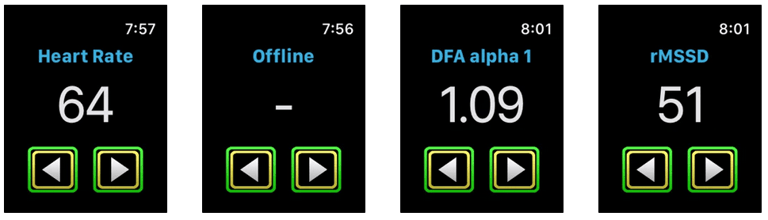
DFA Alpha 1 (DFA a1) - new threshold discovery method with HRV Marco Altini is probably the world's leading expert on HRV & HR usage in sports & fitness physiology and he advises several of the leading sports companies, for example, defining RELATIVE EFFORT for Strava which I talked to him and wrote about (here) a while back. In this article, Altini talks about a new method of determining LT1/AeT during exercise using Detrended Fluctuation Analysis (DFA Alpha 1). You might hear a lot more about this over the coming years. [caption id="attachment_61064" align="aligncenter" width="2460"] Apple Watch is NOT Required but the iOS app IS required.[/caption] To Be Clear - Aerobic Threshold This is NOT the LTHR (LT2, AnT, OBLA) that athletes normally talk about. ANaerobic Threshold: LT2 is the point above which you accumulate lactate problems (Z4/Z5 boundary) Aerobic Threshold: LT1 is the lower point which marks a shift in your energy sources from fat and more markedly toward CARBS. It's the point below which you can still easily hold a conversation whilst working out. (Z2/Z3 boundary). This is the one we are talking about. However, both are really important for endurance athletes and LT1 is also super-important for significant parts of the population who are using exercise as a route to weight loss and general fitness. Indeed these thresholds are SO important as they actually represent REAL 'zones' that exist in your body. Broadly, the other zones that are defined in 5-zone or 7-zone models don't really exist but are useful as a means to place your efforts on a somewhat complex spectrum of physiological responses. Defining Workout Zones Regular readers here have almost certainly defined training zones based on either LT2/LTHR or HRmax. Hopefully, all of you realise that the formulae for HRmax are somewhat imprecise and that a proper LTHR test is actually quite demanding. Furthermore, your tests and training will potentially be significantly impacted by things like fatigue and caffeine. No doubt, you take both of those in equal measure ;-) Well if your LTHR/HRmax is wrong then there's a very good chance that your zone formula comes up with an incorrect value for the lower LT1, Thus your aerobic training could be wrong. It could be wrong because a) it's not aerobic! or b) you could go harder and it would still be aerobic eg My partner runs too fast for aerobic workouts and I probably run too slow for aerobic workouts, we both should know better. Being a personal devotee of 'zones' over the last decade, my advice to myself and others eventually boiled down to using a method of perceived exertion to determine your true Zone 2 against what the models came up with. Not very #scientific. HRV Logger App The HRV logger app does what its name suggests and I would class it as a 'technical app' suitable for those who wish to record and analyse HRV rather than an end-user tool to estimate LT1. That said it DOES estimate LT1 in realtime. It costs $10/£10 You can see in the image to the right the two settings that need to be made. Real-Life Usage Protocol In my tests so far I have found that the Alpha 1 value can suddenly change when running outdoors at less controlled speeds. Whether that is due to the sensitivity of the reading, my lack of pacing or the sampling of the data I'm not sure. The practical recommendation, therefore, is to test this in a highly controlled indoor environment. Have a proper warm-up and progressively increase efforts eg 10w every 2 minutes. You will hit the 0.75 mark relatively quickly as this is not a maximal test. Only the Polar H10 is recommended Only a BLE connection is recommended (ANT+ is more likely to lose packets and impact HRV quality...this is NOT an issue for normal HR when ANT+ is fine) A gentle ramp test is recommended, increasing efforts every 5 minutes (4-6 minutes) My best result was 6bpm lower than I expected and that was after a 3.5-hour workout the previous day, so I was certainly fatigued. Fascinating observation today. After a comment by @altini_marco on possible ANT+ vs bluetooth differences in signal quality I did a comparison of ANT+ vs bluetooth via the same H10 and Garmin watch. Big difference noted, updated my FAQ with more details of this. pic.twitter.com/NehHuc29TT — Bruce Rogers (@bjrmd) February 25, 2021 Please also note that running outdoors will experience impact forces which may distort results (see this research). so a treadmill or bike trainer might be best to test this out for the first few times. Cut-to-the-chase With the most accurate HRV-capable chest strap ie a Polar H10 or Polar H7 you can use Altini's HRV iOS logger to mirror its display to your Apple Watch. The app/watch shows your Alpha1 change in real-time as you workout. Once your Alpha 1 falls to 0.75 then that is your LT1 point. It should correspond to a power or heart rate value that you can then use in your training zones Once your Alpha 1 falls to 0.75 then that is your LT1 point This will probably only work in easy ramp scenarios ie not for interval workouts. Futures Some of the researchers are looking into the possibilities of defining LTHR/LT2 by similar methods. That would be useful for those who train by HR but for those who train by power I think we have the algorithms we need to model FTP. The HRV Logger app is not great as an end-user tool and someone needs to develop a Garmin CIQ app that uses the same algorithm (ping me when you do please) and similarly, some running and cycling recording apps should be googling away right NOW on how to do the math and how to incorporate this into their products. It's public domain information, let's hope someone has patented it as now it's too late if you haven't! With a live metric, it may well prove possible to see how your threshold changes due to fatigue, caffeine or indeed throughout your workout or race. I suspect the some sort of AI/ML tool will be needed to view your exertions in the context of your recent, full workouts. Take Out If Alpha 1 is accurate then this could be one of the biggest 'discoveries' in recent years, one that can impact all of our daily training and its importance should not be underestimated. It could impact the training of EVERY person who reads this article. This method has significant, potential benefits for endurance athletes who should be spending 80% of their training time performing aerobic exercise. It can easily be incorporated into your existing training regimes and could bring immediate efficiencies to your training. This method has the potential to be incorporated into MANY consumer-grade apps and platforms to better guide those seeking weight loss, keeping them closer to LT1 and just below it. Note: I paid for the app myself and get no commission if you buy it Links HRV Logger App Experiences at Runalyze (via @Rui) S Seiler & Tønnessen DFA a1 and exercise intensity FAQ on muscleoxygentraining.com by Bruce Rogers Gronwald, T., Rogers, B., Hoos, O.: Fractal Correlation Properties of Heart Rate Variability: A New Biomarker for Intensity Distribution in Endurance Exercise and Training Prescription?, Frontiers in Physiology, 11, p. 1152, 2020 doi:10.3389/fphys.2020.550572 Rogers, B., Giles, D., Draper, N., Hoos, O., Gronwald, T.: A new detection method defining the aerobic threshold for endurance exercise and training prescription based on fractal correlation properties of heart rate variability, Frontiers in Physiology, 2020 doi:10.3389/fphys.2020.596567