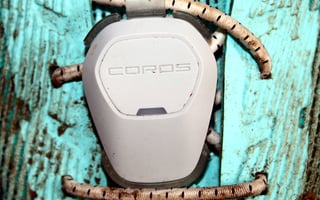
Coros Pod 2 Review This is a great do-everything running pod for Coros watch owners. Well. Do everything so long as it isn't running power. It doesn't support running power in any way but it makes up for that omission with EffortPace. Price when reviewed USA: $99 UK: £99 EUR: €119 Buy Pod 2 Coros Who is Pod 2 aimed at? Coros identifies these runner types as potential customers and I reckon they've hit the nail on the head here providing the runner owns a Coros watch. Urban runners: to improve GPS track quality and data consistency Indoor runners: to get consistent and comparable data inside and outside Road runners: to get accurate instant pace measurement and distance data Trail runners: to manage efforts on hilly terrain with familiar metrics. What is the Coros Pod 2 & What's New? Pod 2 is a running sensor that's used alongside a Coros watch to improve accuracy or give insights into your running technique. It has a few distinct uses. Firstly it can be clipped onto your running shorts to produce industry-standard gait metrics. Alternatively, you can clip it onto the laces of your running shoe where it acts as an old-school running pod to give distance (pace) measurements. There are a few interesting takes on how coros does that and some related smaller-scale features, but that's basically what it is. There is a good dose of cleverness added when Pod 2 interacts with your chosen running mode on the Coros watch. The gait metrics are produced for any kind of run, be it indoor, treadmill, trail or road based. Whereas the performance features primarily work with trail and road running profiles where altitude, distance and the GPS track are all improved by the watch and pod sensors working together. What's also new is the following A newly invented outdoor metric called EffortPace. Essentially it will evolve into running power restated as a pace equivalent. treadmill stride length outside temperature (workout summary only) a charging dock that also has battery storage USB-C charging for the dock new clips for shoes and shorts What's Missing? Three things are missing. Firstly, the inability to work with any other watch. It is unlikely that Garmin, Suunto or Polar will choose to support protocols that Coros implies to be proprietary. And then running power is kinda missing, OK, it's totally missing! Thus Pod 2 is NOT a direct competitor to Stryd. A casual observer would get a distinct impression that Stryd has started to enforce its patent rights... Finally, there is no cache of your running data on the pod, everything is sent to the watch in real-time. Coros Pod 2 Review: Unboxing, Contents, Pairing & Calibration Everything is packaged & presented professionally. Pod 2 will make a good Xmas present as every aspect is very well-presented. You get a very nice quality carry-pouch, although that's probably of limited use, and then there are two shoe clips, a single running shorts clip, a USB-C charger and a cable. [gallery size="medium" ids="76680,76677,76682"] Remember to pair the Pod first to the Coros app for firmware updates. For me, the POD seemed to automatically pair itself to the Coros watch at the same time...cool! There is a one-off, 1-minute calibration where you turn over the Pod in your hands a few times. You can also set the wear position (lace vs shorts) on the watch but the default, automatic setting for that worked for me. There also appears to be an automatic distance calibration that appears on short runs. Thus when I completed a 1km track run, the watch asked if I wanted to calibrate the pod's recorded distance to the actual distance. How to wear the Coros Pod Place the clear, plastic cradle underneath 3 or more laces and clip the pod in. There's plenty of room even for my rounded elastic laces and there's a nice audible click to let you know it's in place. The alternative wearing position for those of you who want the gait metrics is the centre-rear of your running shorts where the grey, plastic cradle easily clips on. [gallery size="medium" columns="2" link="file" ids="76678,76679"] I would say that neither cradle is likely to become easily detached by accident. How to charge the Coros pod The pod itself holds a charge for 28 hours of continuous running and is recharged when placed in the charging dock. Handily the charging dock has its own battery with sufficient capacity to completely charge the Pod 2 a further 5 more times, so you will get WELL over 100 hours before you need to connect to a mains supply. The pod simply and easily clips into the charger and LED charge indicators let you know what's going on. Coros Pod 2 Running Metrics When the Pod 2 is worn on the waist, the pod essentially is in 'gait metrics' mode, and it provides a good set of running insights that describe aspects of the mechanics of how you run. These are similar metrics to those provided by Garmin, Apple and others and there is nothing unusual here. The pieces of data in the chart below can be displayed live on the watch or as charts in the app after you have finished. The phrase "Sensor fusion with Watch" means that Coros use multiple pieces of information to determine the correct value - for example, Altitude probably comes from a 3D-GPS fix from the watch adjusted to changes in barometric pressure on the pod. Gait Metrics Wear on Waist Run Track Run Trail Run Treadmill Ground Contact Time Yes Yes Yes Yes L/R Balance Yes Yes Yes Yes Stride Height Yes Yes Yes Yes Stride Ratio Yes Yes Yes Yes Temperature Yes Yes Yes Yes Altitude Sensor fusion with Watch No Sensor fusion with Watch No Elevation Gain/Loss Sensor fusion with Watch No Sensor fusion with Watch No Ground Contact Time or Stance Time is the time your foot is in contact with the ground and Stride Height is your Vertical Oscillation. You'll find that if you run faster both will decrease but it's hard to specifically train those metrics to get lower. Just run faster! So there's nothing new to see here that hasn't been done before. Now the interesting bit. Performance Metrics When worn as a foot pod, we are essentially in 'Performance' mode where the gait metrics are removed and swapped for increased accuracy and responsiveness, at least more accurate when you compare your stats to those from a GPS source. I've highlighted below, what I consider to be the two interesting metrics, EffortPace and GPS Track Enhancement. EffortPace is very much a work-in-progress for Coros as this measure starts out as a simple grade-adjusted pace but will morph over time to include the effects of other environmental factors and physiological factors like athlete weight. Coros also claims there is a personalised, learning element to its algorithms although I'm not entirely clear on how that could reliably work. GPS Track Enhancement follows on from sensor fusion concepts introduced years ago by Suunto's FusedTrack and which are used without fanfare, by other vendors like Garmin. Essentially your current GPS position has a sense check applied to it based on the movements recorded by the accelerometer. For example, going through a long tunnel would see the algorithm switch entirely over from GPS to the pod. Wear on Foot Run Track Run Trail Run Treadmill Cadence Yes Yes Yes Yes Pace Yes Yes No Yes Temperature Yes Yes Yes Yes Altitude Sensor fusion with Watch No Sensor fusion with Watch No Distance Sensor fusion with Watch Sensor fusion with Watch No Yes EffortPace Sensor fusion with Watch No Sensor fusion with Watch No Elevation Gain/Loss Sensor fusion with Watch No Sensor fusion with Watch No GPS Track Enhancement Sensor fusion with Watch Sensor fusion with Watch No No Stride Length Sensor fusion with Watch Sensor fusion with Watch No Yes Metrics On The Coros App The new metrics can be shown on your Coros Watch as you run in real-time and are added in the same way as other metrics when you customise the screens for each of your sports. [gallery columns="4" size="medium" link="file" ids="76737,76738,76739,76740"] After you've finished your workout you'll see some new numbers in the summary, like a temperature figure, plus some new charts which appear depending on where you were wearing the pod. EffortPace vs Running Power At launch, EffortPace is simply a renamed grade-adjusted pace. In the months following the launch, it will be progressively enhanced to incorporate the effects of environmental factors on pace. Thus pace is restated to take into account environmental difficulty. This is essentially how running power works. However, I would imagine the clear benefit here is that most runners instinctively understand pace or speed more than power. Thus the data is presented in a format that they can work with. If their plan tells them to run at 5:00/km for 20 minutes but the last 10 minutes of that is uphill then the runner always targets EffortPace of 5:00/km rather than reverting to heart rate or 'running a bit slower'. My arguments against EffortPace would be along two lines Let's say your recently adjusted threshold running pace is 4:09/km and you are told to run at 93% of that. How fast do you run? It's a 'hard' calculation that's even fairly hard to do from scratch on a spreadsheet. The calculation for running power is simply 0.93*rCP Post-workout stress/load calculations are more easily made on power numbers than pace numbers. Of course with the right platform or right spreadsheet someone else does the calculations for you and I guess my arguments then don't affect you. Massive Heads Up: Coros continues to support Stryd but is no longer developing the power metric. All its future product development in this area will be focussed on extending the EffortPace measure. Musing & Deeper Dive Into EffortPace Well, it's a mini jump into the shallow end really. At launch, EffortPace is simply graded pace. #Shrug. I did a few cursory tests and went up a slight hill. The EffortPace on Coros was 5 seconds per KM faster than the GPS pace shown on a Garmin. Entirely what I would expect give or take a second or so. Coros plans to introduce other factors into EffortPace as it moves forwards. Thus athlete weight, ground conditions, temperature, air pressure and so on will all be added to adjust your actual GPS/Pod pace to what it should be on hard, level ground. I was involved in a similar project to this a few years back. That project was much wider in scope but required the same perfectly adjusted pace that Coros is trying to achieve, good luck to them! However, Coros has specifically pointed out that this is more than a graded pace or environmentally adjusted pace. They don't want to limit its potential evolution by calling it the latter. Thus they might add in the effects of load-estimated fatigue, a fatigue measure based on HRV, or even somehow adjust for altitude. So you'd get some sort of metabolic-cost adjusted pace. Grandiose plans. Even in the medium term, EffortPace will effectively be Running Power but still stated as pace. And THAT is a great idea as there are WAY more people who want to work in PACE terms rather than WATTS. But once the basics have been accounted for (2023), I suspect the next steps will just introduce too much complication and, like some of Garmin's physiology metrics, some wrong number somewhere in the chain will bring the whole pack of cards tumbling down. Thus, EffortPace could evolve to be something extremely clever but I suspect before long it will evolve into something that's too clever for its own good. Coros Pod 2 Accuracy Review Over 3 days, I looked at quite a few aspects of accuracy albeit superficially for now. These include distance, responsiveness to pace changes and if, or how, the pod can improve a GPS track. Distance Let's start with distance, which should be an easy one at a superficial level. Test 1: over 50% tarmac and 50% medium-firm grass. This should be the fused distance jointly from the Coros Pod 2 and Coros Pace 3 and it seems to tie in with the Apple Watch and Garmin 955+Stryd (set as the source of distance and pace). [caption id="attachment_76701" align="aligncenter" width="1024"] Distance[/caption] My Stryd was correctly calibrated before this test and the 1km auto lap alerts from Coros were well within 5m of those from Stryd/Garmin on this run. Test 2: Running Track I performed an orientation calibration of the Coros pod by flipping it over and twisting it in my hands a few times. I then ran for a km after which I accepted the Coros watch's automatic prompt to calibrate to that distance. As I had the new adidas Prime X out for their first-ever run, I did a full calibration run for Stryd for 8 laps on the inner edge of Lane 2 and calibrated Stryd as per Stryd's instructions. I then ran 1000m on the track and a further 100m in the opposite direction as it was a bit windy. I had Apple Watch 6, Garmin 955 and Coros Apex+Pod 1 all set to indoor mode so there are no GPS tracks to show. These are the figures I got and which I have to say that I am not happy with! I've no idea why both Coros and Stryd/Garmin overran on the second run as I closed the workouts whilst standing stationary on the finish line. Run 1 (metres) Run 2 (metres) Likely Actual 1005 1005 Apple Watch 6 915 916 Coros Apex+Pod 2 (Inside foot) 1010 1070 Stryd + Garmin 955 1010 (inside foot) 1020 The inside foot probably travels a metre ot so less than the outside foot I guess? I have no conclusions here. Test 3: Under bridges, Over Bridges. Does Pod 2 improve Coros's dual-band/multi-frequency GNSS tracks? Answer: No. It's difficult to explain the route of this tricky out-and-back GPS test in any detail. Basically, I went under the river bridge in each direction twice and under the long underpass to the right, twice. Much of the right side of the route also involves running close to a tall building. The results for Garmin/Coros (both Multi-Band) are about as good as I would have expected and consistent with the good results I've had in the past with the best GPS-running watches. Pod 2 was supposed to improve the GPS track. #Shrug maybe it did. But a slightly worse track without the pod would mean that the Coros watch wouldn't have been as good as the Garmin. The Garmin and Coros sets of results were about the same as each other and better than the Apple watch that I excluded from the second of these maps. [gallery size="medium" columns="2" link="file" ids="76729,76777"] Conclusion: The pod either made no difference or made it as good as the Garmin. Vertical Oscillation This data is garbage in the sense that none of the 3 sources matched. I don't know what's going on. Normally these metrics are broadly similar. I was running off-road quite a bit with the dog, so maybe it's her fault. [gallery size="medium" columns="2" ids="76702,76703"] Grand Contact Time/Stance Time There was more agreement here between the three sources but I'm not entirely sure why both Apple and Coros show a low contact time when I'm stationary. Hey ho. [gallery size="medium" columns="2" ids="76704,76705"] Responsiveness & Instant Pace Stryd's reviewer pack makes a notable play about the responsiveness of the pod compared to GPS, so I had to test that claim. The easiest test for responsiveness is to quickly stop running and look at the watches until the current pace shows zero. The Coros pod takes maybe 4ish seconds to hit zero and is a full 1 second slower than the time it takes Stryd Wind to hit zero. The Coros pod's moving average duration couldn't be configured and the Stryd pod was set to instantaneous power, so presumably, all Stryd's other metrics have the same degree of 'instantness'? 'Instant' pace or power is to some degree meaningless and needs to be averaged over a few strides. True instant pace from one footfall to the next varies by the acceleration and deceleration forces in play at the time. Thus what Stryd (and presumably Coros) transmit as instantaneous data is in reality averaged over a few seconds. Anyway. If Stryd is averaging the raw data for 3 seconds and Coros for 4 seconds then both are 'instant' enough for me. If you want something more instant I imagine there will be too much noise in the data for it to be useful. Coros Pod 2 Specifications Weight: 5.6g 27.1mm (Width) * 33.9mm (Length) * 8.6mm (Thickness) Case material: Fiber-reinforced polymer Battery life: 28 hours of continuous running // 50 days in Standby Mode Battery type: Rechargeable Lithium Battery Water rating: 3 ATM Working Temperature: -10 to 60 ℃ Wireless Connection: Bluetooth (Coros apps on iOS/Android and Coros Watches) Barometric Altimeter Thermometer Geomagnetic Compass Accelerometer Gyroscope Charging Dock Specifications Weight: 17.6g 33.9mm (Width) * 52.1mm (Length) * 15.5 (Thickness) Case material: Fiber-reinforced polymer Battery life: Able to fully charge POD 2 unit 5 times Battery type: Rechargeable Lithium Battery Charging Port: Type-C [wp-review id="76675"] https://the5krunner.com/2022/08/17/which-coros-watch-would-you-like-to-see-next-thoughts-reader-poll/