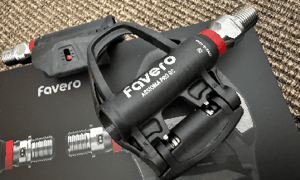
Favero Assioma PRO RS Review: RS2, RS1, and Everything you need to know TL;DR - Lightest, Cheapest, Best. #NoBrainer #NoCompromise. Favero Assioma PRO RS-2 is a dual-sided power meter pedal, designed for road cycling, compatible with the popular Shimano SPD-SL cleats. RS-1 offers single-sided power. It utilises existing spindle technology from the PRO MX off-road pedals, incorporating all key electronics, strain gauges, and a rechargeable battery housed inside the spindle, thereby eliminating the external pods found on the earlier Assioma DUO, DUO Shi, and bePro models. Favero Electronics Srl, Italy, designed and manufactured the pedals in the EU. My current take is that I'm tentatively trusting Assioma PRO RS as my 'prime' power source for all my personal metrics. Take that as a recommendation if you like! Heads Up: I bought these with my own money and have no marketing relationship with the brand. Please purchase the pedals from the links here if you'd like to support independent content creation. Buy Favero Assioma PRO RS-2 Pros Lightweight: the lightest on the road Accuracy: ±1% error, the highest 'normal' level of accuracy. True Left-right metrics - no estimated split or split determined by subtly different capture mechanisms Trust: I was one of the original bePro reviewers and have trusted every Favero product since. Reliability: Whatever I get from the brand works as it should. Other reviewers find the same. These are hassle-free, benchmark-grade power pedals. Pod-less Design: The old pods could sometimes catch your shoes and needed a spacer, they didn't look as sleek as a regular pedal. What was previously in the pods is now within the spindle. Standard Fit: Without a pod, the pedals' left-right dimensions (Q-factor) are more typical Battery & Charging: 60-hour battery life and bespoke magnetic USB-C charging cable Connectivity: The full kitbag of metrics. ANT+, 3x BLE connections; plus comprehensive cycling dynamics Ease of Use: Quick install/setup; excellent app support; easy maintenance, installation-only calibration. Modularity: road or off-road pedal bodies can be swapped on the spindle Cost-Effective: Yes. It's the cheapest power meter pedal. Single-sided is cheaper still. Build Quality: Durable construction, Shimano cleats, high-grade bearings https://open.spotify.com/episode/497NRXsni84R7rUYMvBgG7?si=LbKDMle_QgmCTtPmbWTMtQ Cons Battery Life: 60 hours is lower than Garmin Rally (100–120 hours). No battery longevity tools exist to prolong battery life over the years, eg limiting charge to 80%, warning to charge at 20%. Cleat Compatibility: Only Shimano SPD-SL supported; no Look KEO, but this may be added Charging Clips: A proprietary magnetic clip is required, but the adapter end features a USB-C port. Advanced Metrics Usage: The advanced cycling metrics are unnecessary in my experience Spacer Use: Be mindful that using a spacer to increase the Q-factor may have accuracy issues. Maintenance: It requires occasional servicing like any pedal system, which is not an issue. Crank length must be manually set using the Favero app or on your head unit. If you have more than one bike and different crank lengths, this will be an issue if you forget to swap the pedals over. @PeakTorque notes limited medial torque out of the box (like every other power meter pedal). Dura Ace has zero medial torque. [sc name="scfaveroassiomaprors"][/sc] Comprehensive Spec Sheet with added insights: Favero Assioma PRO RS-2 Pedal Type: Road cycling; Favero pedal body. Shimano SPD-SL cleat compatible. Power Sensor: Dual-sided, measures power from each leg independently. Weight: 123g per pedal (with all electronics, excluding cleats), ie approx. 246g per set Lightest road power meter pedal available Accuracy: ±1% (0–3,000w) Power Calculation System: 30Hz IAV (Instantaneous Angular Velocity-based), measuring full pedal stroke Cycling Dynamics/Advanced Metrics: Power ±1% (0–3,000w) Cadence (10–250 rpm) L/R Power Balance Platform Centre Offset (PCO) - How power is applied to the left/right across each spindle Power Phase (PP) - the angles at which you apply most power Pedal Smoothness (PS) - how evenly you apply power per revolution Torque Effectiveness (TE) - how much useful and useless/negative propulsive power you generate per revolution Rider Position (seated/standing) - some online avatars can use this to make your avatar stand. It's also interesting to understand your maximum power ranges for both standing and seated positions. Gyroscope: Integrated Oval Chainring Compatibility: Yes, but I suggest caution with ovals, having used them extensively. Connectivity: ANT+ (unlimited connections) Bluetooth Smart (3 BLE channels) Full metrics over ANT+; limited metrics over Bluetooth Battery: Type: Rechargeable lithium-ion Life: 60+ hours Lifecycle: 20% capacity loss after ~500 charges or about 30,000 hours Charging: Proprietary magnetic connectors with USB-C Includes dual USB-C cable with two magnetic connectors Pedals require a plug-in/power-up to wake from sleep Thermal Compensation: Yes, Auto-Zero: Yes. Manual calibration is needed on installation or bike swap Waterproofing: IP67-rated; sealed spindle Operating Temp Range: -10°C to +55°C Max Rider Weight: 120 kg Q-Factor: +53mm — standard road Q-factor; nearly identical to 52mm Shimano Dura-Ace Stack Height: 10.5mm + 6mm cleat = 16.5mm — usual range is 14.6mm to 17.3mm (Dura Ace is 13.7mm) Pedal Body Material: Carbon-fibre-reinforced polymer Bearings: Two needle roller bearings per pedal, replaceable Modular Design: Compatible/interchangeable with Assioma PRO MX pedal bodies (off-road) Maintenance: Low-maintenance Tension Adjustment: 28 levels Installation: A 15mm spanner is required Torque: 30–40 Nm (spec: 35 Nm). Tighten HARD by hand Activation and calibration via the Favero Assioma app Favero Assioma PRO RS Accuracy I've completed loads of rides with the RS, but perhaps not so many 'tests' as such! Anyway, here are some various charts, indoors and out, comparing the Assioma RS2 to combinations of KICKR Core, KICKR Bike, 4iiii Precision 3+, and I think I have some more results somewhere from KICKR MOVE (my fave trainer) and Magene P505. The KICKR Move's accuracy might be (is!) out, so I've not included them. My results seem less conclusive than those of Assioma's RS accuracy from other reviewers; some of my comparators are a bit old. However, I've not seen anything that doubts Assioma's accuracy. The comparators might be a bit (or a lot in some cases) inaccurate. [gallery columns="4" size="medium" ids="102055,102056,102057,102058"] I've seen differences to KICKR MOVE and couldn't rule out drivetrain loss and other errors. Then I compared to KICKR Bike (above, ongoing), which has no chain or gears. Then I was surprised that the 4iiii Precision 3+ seem to tie in to Assioma quite closely, the 4iiii seem to be accurate most of the time but not all. My current take is that I'm tentatively trusting Assioma PRO RS as my 'prime' power source for all my personal metrics. Take that as a recommendation if you like! Included in the Box (RS-2 Dual-Sided) Dual-sided power meter pedals Two-way USB-C charging cable 2 magnetic charging connectors Shimano SPD-SL cleats (yellow, 6° float) 4 washers Greasing tools kit Favero Assioma PRO RS-2: Opinion Favero has hit the sweet spot with the latest ASSIOMA—and then added some more sugar. I suspect these pedals will become the most successful of all time. That said, I don't expect many current owners to upgrade unless forced, but most riders prefer Shimano cleats, which will attract new buyers. That convenience, combined with the absence of the slightly unappealing pod, eliminates two key reasons that people may have previously steered clear of Assioma. The modular design is interesting. It is almost certain that Favero plans to offer other pedal bodies. The only real downside is the battery life, and if 60 hours counts as a downside for you, then you have some particular cycling needs. It's also interesting to revisit Favero's IAV, which essentially captures many data points per second, even though your bike computer only records a single value. Garmin is about to start recording 5Hz GNSS data for downhill MTB, and I can't help but think the company might also begin to record 5Hz power data (5Hz heart rate data is already possible for HRV). 5Hz recording might remove statistical anomalies from 0-3 seconds to help you get more precise maximal powers. Perhaps not useful for most of us, but the sprinters will love it, and your CP-curve will look prettier. Also on the subject of IAV, a few years ago I tested it on my turbo trainer on my Tri bike that just so happened to have a circular inner ring and oval outer chainring - Assioma matched the power of Kickr when on the inner ring but not the outer and ever since I've a) used two oval rings! and b) applied a scaling factor (down) when using ovals. I suspect that over-reading power on all power meters is one reason we don't see pros often using ovals (I still think they can improve inefficient pedal stroke mechanics in a TT position - i.e., mine!). Garmin Killer? Market Killer? Favero's issue is that it is not a widely known brand and is not trusted by default. You will undoubtedly see very many ASSIOMAs if you look. However, Favero's name recognition is not on par with that of Shimano, Wahoo, or Garmin, and some people may not consult reviews or conduct thorough research to trust a brand with which they are unfamiliar. Furthermore, buyers of new bikes will increasingly find a great-value pre-installed power meter, and that won't be an ASSIOMA, typically sold in the aftermarket. Don't get me wrong, I think Favero should be an all-brand power meter killer for the consumer market...it just won't be for reasons linked to the inertia behind marketing and commercial factors. Power Meter City (USA) and Sigma in the UK carry stock as of today. [sc name="scfaveroassiomaprors"][/sc] Buy Assioma RS: Global Pricing (RS-2 Dual-Sided) EU: €699 USA: $789 UK: £649 AUD: $1,299 Other Models: RS-1 (Single-sided): €443 / $499 / £399 RS-UP (Upgrade Kit): €433 / $489 / £389 Replacement Pedal Bodies: €59 per pedal / £50 per pedal Favero Assioma PRO RS-2 Review - Take Out These will be my go-to power meters and pedals for the foreseeable future. I'll probably buy another pair to mitigate the minor 'different crank length' problem. SPD-SL is my preferred cleat system, and the lack of that system was always the bug-bear when using Faveros' earlier models. In my experience of using cycling power for over a decade, Favero has proven to be the most reliable and consistent of all those I have tried. Favero Assioma PRO RS-2 is the one to beat. It's light, accurate, reliable, has excellent metrics and connectivity, and looks good. It is almost a no-brainer - except Magene went and spoiled the party with the cheaper P715S. Buy: Favero Assioma PRO RS-2 [sc name="scfaveroassiomaprors"][/sc]