Open SuuntoPlus Launches — Any Developer Can Now Build for Suunto Watches
Suunto has opened its SuuntoPlus platform to any developer who wishes to build apps for its watches. Until now, the SuuntoPlus store has operated as a curated ecosystem in which new apps have arrived either from Suunto itself or from third parties with a prior arrangement with the company. From this week, that changes. The SuuntoPlus Editor is publicly available, the documentation is open, and no relationship with Suunto is required to begin building.
The move is significant when considered against competitor capabilities. Over several years, Suunto has built SuuntoPlus into a credible app store — adding sport apps, watch faces, and integrations with third-party sensors, including muscle oxygen monitors, body temperature sensors, and smart glasses. That store is already reasonably well stocked and actively maintained. What it has lacked is the ability for any individual with an idea and a few hours of free time to add something to it. That restriction is now removed.
How the development tools work
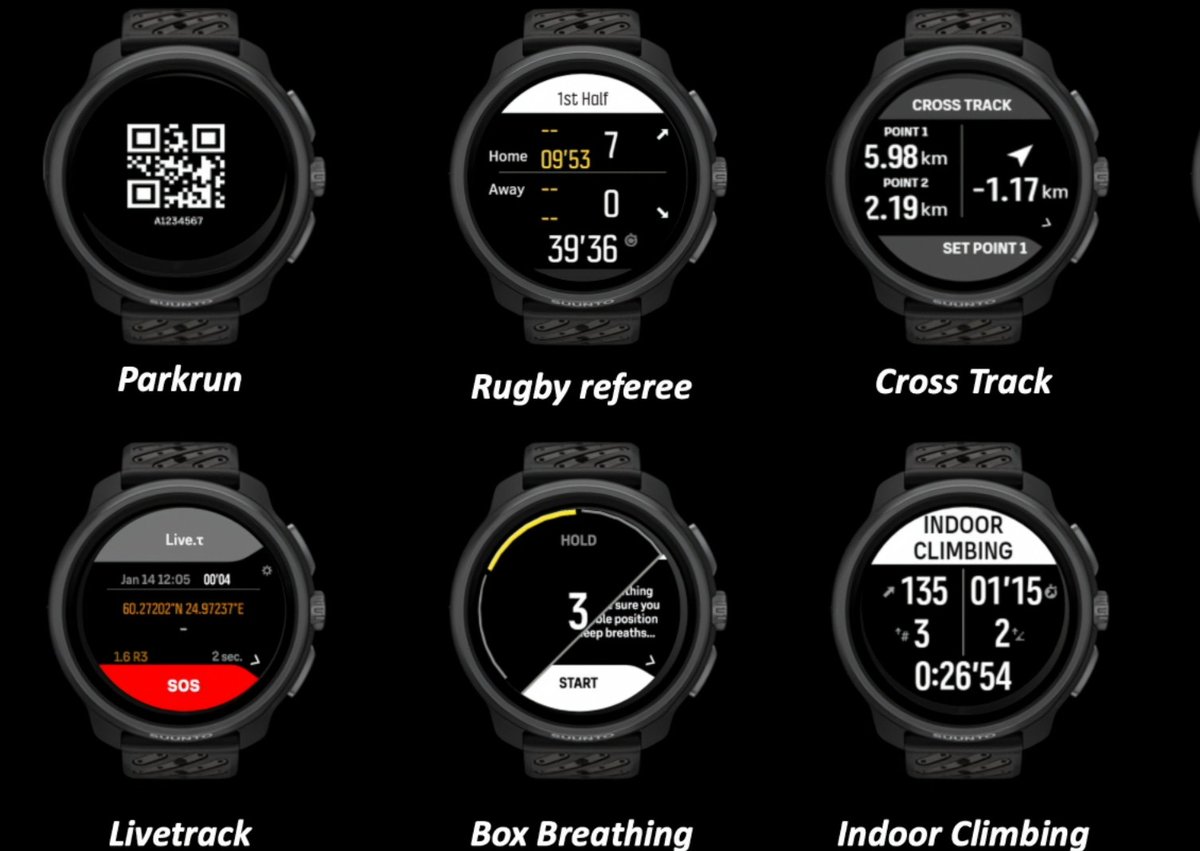
The SuuntoPlus Editor is a free extension, available on the Visual Studio Marketplace as an extension for Visual Studio Code. No registration is required to download or use it. Suunto states the tools are 95% identical to those used internally to develop their own apps.. Apps are written in JavaScript using an HTML interface. Thus, there will be a short learning curve for any developer with basic web experience.
Within the editor, developers can simulate all watch sensor data — GPS, heart rate, power, cadence, altitude and temperature — before testing on a real device.
App settings are made in the Suunto mobile app, and workout data is stored in the activity file and subsequently accessible through the Suunto Cloud API. That last point means anyone can build a companion web service or mobile application alongside their watch app.
How to publish to the SuuntoPlus Store
Building an app does not require a sign-up. Without an account, the app can only be deployed to the developer’s own watch. Publishing to the store, so others can download it, requires the next step.
Join Suunto’s partner programme at suunto.com and sign an API agreement. This grants access to APIzone, through which apps are submitted for review at APIZONE.SUUNTO.COM. Once approved, the app will appear in the SuuntoPlus Store under a dedicated “Made by Suunto Community” section.
The apps launching at open
A university student team built three apps that Suunto used to test the developer tools ahead of the public launch. They give a good idea about the novel kinds of apps that might appear over the coming months.
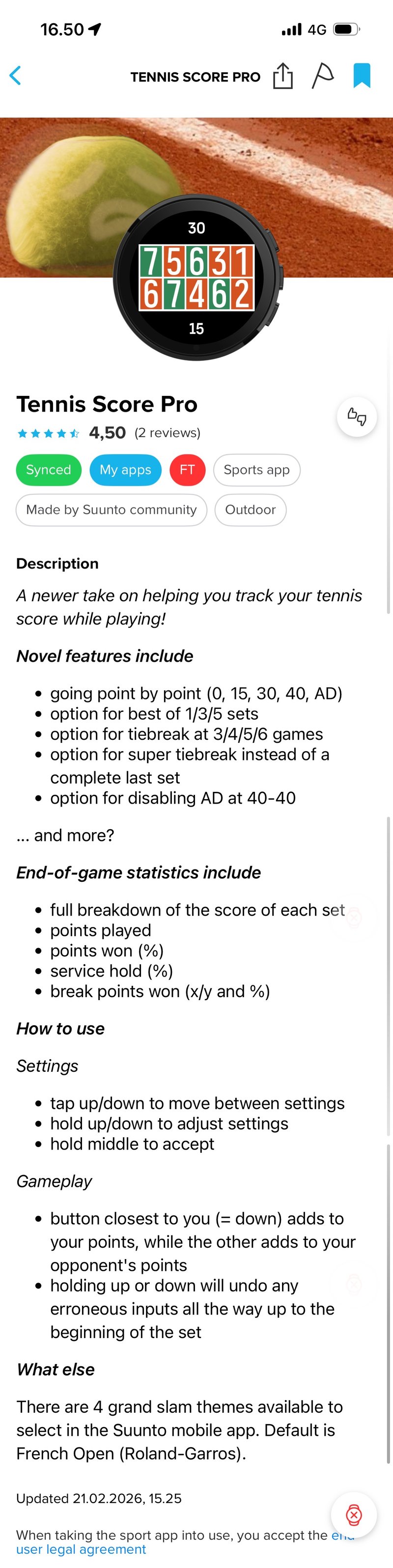
Tennis Score Pro is the most practical example. As you might expect, it tracks point-by-point scoring across a full match, supports best-of-one, three, or five sets, tiebreaks, and super tiebreaks, and delivers end-of-game statistics, including points won, service hold percentage, and break points. The appearance can be spruced up with themes named after Grand Slams – Roland-Garros is the default theme.
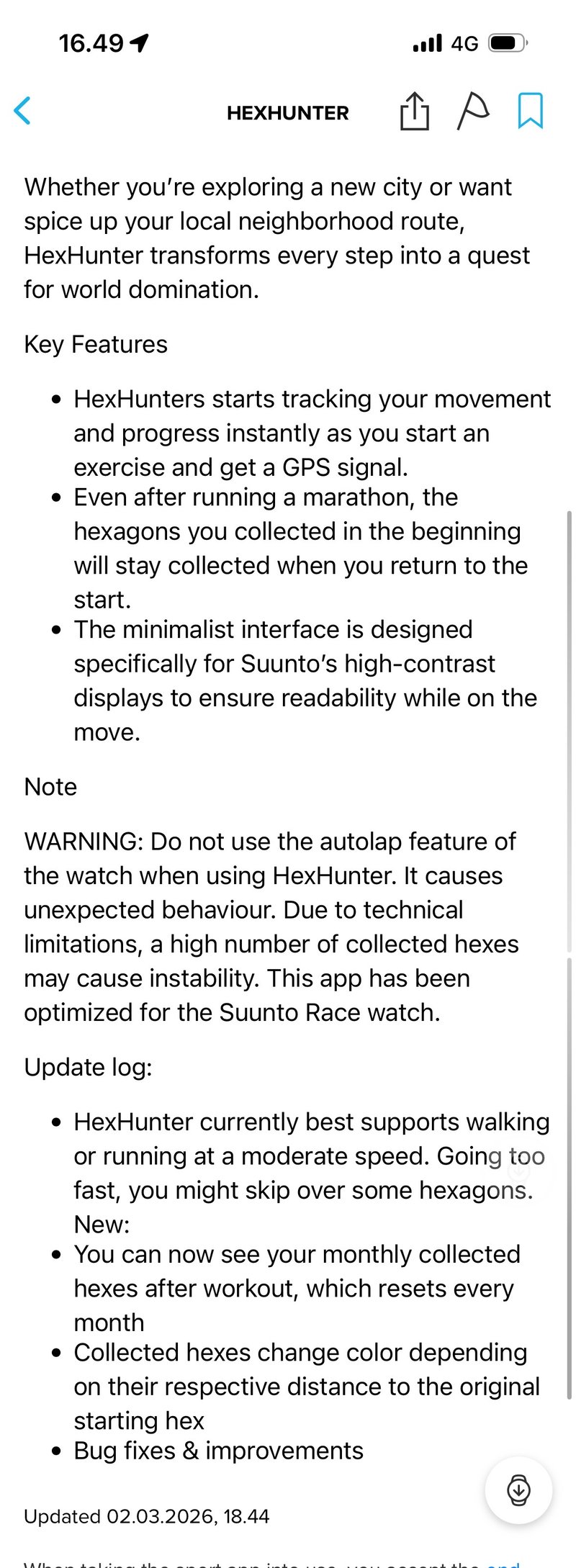
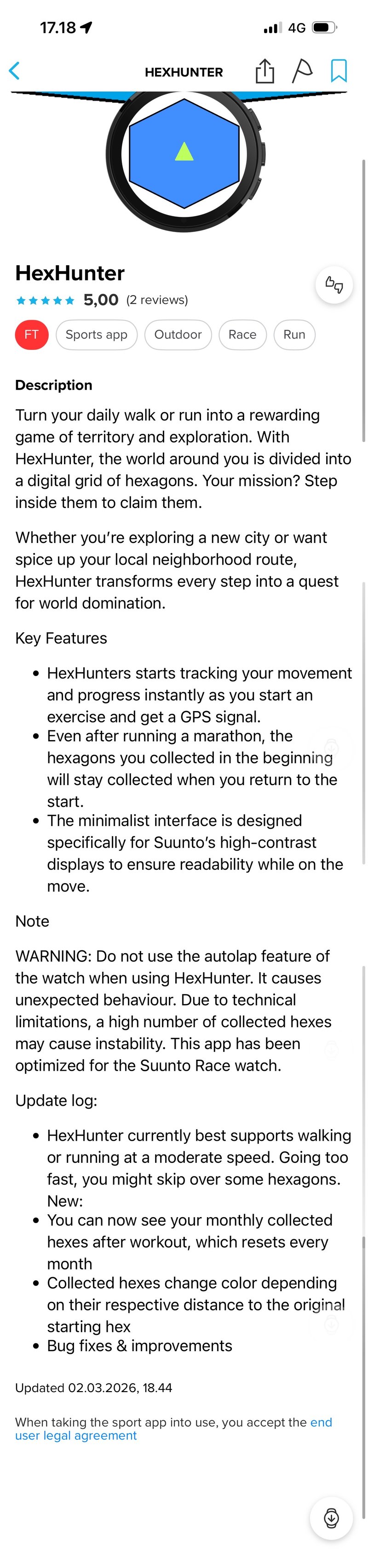
HexHunter is a gamification app that maps the world into a GPS-based hexagonal grid. Runners and walkers claim hexagons by physically entering them while running the watch app, with colour coding indicating distance from the starting point. Monthly totals reset automatically. The app is currently optimised for the Suunto Race watch (disabling autolap is required to use).
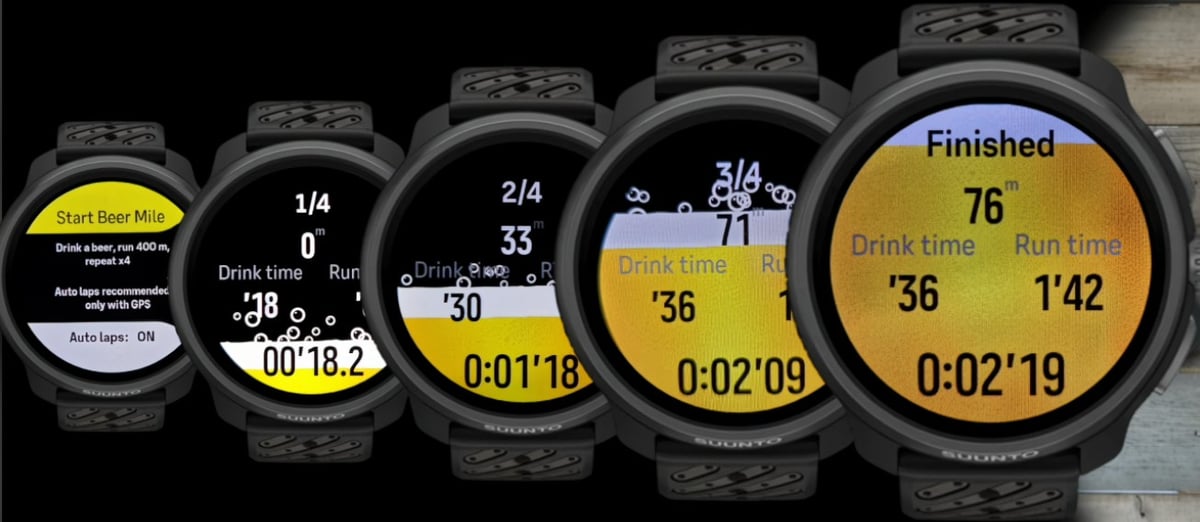
Beer Mile tracks the drink-and-run format mile race – an unpleasnt site on YouTube if you get 5 minutes. 400 metres, one beer, repeat. It is a reasonable demonstration of what the animation interface can achieve during an activity.
Clearly, none of these is a platform integration like TrainingPeaks or Strava. They are niche, personal features built by individuals for a specific purpose. That is precisely the point.
The competitive context
Every major sports watch manufacturer maintains data partnerships with third-party platforms. Strava, TrainingPeaks, Komoot and their equivalents connect to Garmin, Polar, Coros and Suunto alike through varying degrees of formal API arrangements. Suunto has offered these connections for years, and that is not what is new here.
What Garmin has that no other dedicated sports watch maker has matched is Connect IQ: a fully open developer platform through which thousands of apps, data fields, watch faces and widgets have been built by independent developers without any relationship with Garmin. A rugby referee scoring tool, a niche ultramarathon pacing calculator, a sensor integration for an obscure power meter — these exist on Connect IQ because individuals built them for themselves and then shared them. Suunto is now explicitly pursuing the same model.
Assessment
Suunto always claimed that PLUS development was easy, with a short time to get an app working. The feedback I heard from a few developers confirmed their claim. I can only assume the ease of app creation is now passed to the wider development community – that seems to be the case, as a university student team produced three working apps during a short testing period.
The gap with Garmin Connect IQ, however, is substantial. Garmin’s ecosystem has years of momentum, a large developer community, and millions of potential watch owners to use your app.
What Open SuuntoPlus appears designed to attract is a focused enthusiast who has always wanted one specific feature that Suunto has never prioritised — the rugby referee, the beer miler, the urban hexagon hunter. For that audience, the barrier to entry might be low, encouraging developers. Whether enough of those individuals find their way to the platform to transform what a Suunto watch can offer remains to be seen.
Last Updated on 3 October 2026 by tfk the5krunner
Small things I always use
- Garmin 90-degree charging adapter: Charges your Garmin from any USB-C cable. Essential when travelling. I use one.
- Body Glide: The blue anti-chafe stick swimmers and runners carry. I use it.
- Speedo earplugs: Fewer ear infections and no cold-water dizziness. I use them.
- Dryrobe Advance: My winter changing robe for open-water swims. I use one. A cheaper option is the AONYIYI changing robe.
- Maurten: Race fuel that stays easy on the stomach. I use them.
- Beet It Sport nitrate shots: Beetroot shots I take in the days before a race. I use them.
- Garmin charging puck: The quickest way to top up before a session. I use one.
- Injinji: Toe socks that stop rubbing, so you run more. I use them.
- Ultimate toe protectors: Stop black toenails on long runs. They work. I use them.
- Compressport R2 v2 calf sleeves: My calf sleeves of choice. I use them.
- Cellucor C4: My pre-workout before hard sessions.
- TPU tubes: Schwalbe Aerothan, Tubolito and Pirelli SmarTube. Light, tiny spares. I use all three.
- G8 insoles: Adjustable insoles that are good. I use them.
- Cycplus Cube: A 97g electric pump that gets a road tyre rideable in two minutes. I carry one. 5% off with code THE5KRUNNER.
Watches and sensors
- Polar H10: My daily driver for waking HRV.
- Polar Verity Sense: My backup arm-worn HR sensor.
- Nomad bedside charger: Charges my iPhone and Apple Watch overnight. I use it, and many of their bands.
- Train.Red: The best muscle oxygen sensor I’ve used.
- Tymewear: Accurate heart rate and reliable ventilatory zones. I use it to pace endurance rides over an hour.
- Garmin Forerunner 970: A pro-grade triathlon watch. I use this.
- Apple Watch Ultra 4: My daily smartwatch. No phone needed on rides.
- Garmin Fenix 9 Pro: I’ve just bought one.
On the bike
- Continental GP5000 for everyday riding, and Aero 111 on the front for special occasions.
- Helmets: Specialized S-Works Evade 3 for road riding, and Rudy Project Wing for TT-style races. I use both.
- Ravemen FR300: A front light that mounts under your Garmin or Wahoo. I use one.
- Wahoo TRACKR Radar: I use it on one bike and Varia on the other. They perform the same.
- Garmin Varia RTL515: Radar that warns you of cars from behind. I use this model.
- Wahoo ELEMNT Roam 3: The bike computer that’s easy to use. I use mine on most rides.
- Favero Assioma Pro RS2: Accurate power pedals that swap easily between bikes. I use this model.
Home and indoor training
- NPE Runn: Makes my basic treadmill smart, sending more accurate speed and distance to my watch and Zwift. I use it.
- Google Wifi: Keeps Zwift connected in my pain cave. I use it.
- Apple TV 4K: Zwift on the big screen. I use two.
- Google Nest Doorbell (wired, 2nd gen): My video doorbell, running in both Google Home and Apple Home. I use it.
Health, recovery and sleep
- FreeStyle Libre 3 Plus: Shows how my blood sugar responds to diet.
- hDrop: Measures my sweat loss in summer and indoors.
- Fourth Frontier Zone: Checks my heart under load in hard sessions.
- Oura Ring 5: My partner’s recovery tracker of choice.
- Eight Sleep: A cooling mattress cover my partner and I use nightly.
Reader-Powered Content

This content is not sponsored. It’s mostly me behind the labour of love, which is this site, and I appreciate everyone who supports it.
Support the site: Follow (free, fewer ads) · Subscribe (paid, ad-free) · Buy Me A Coffee
Written by real people, with AI assistance. Fact-checked and verified for originality. See the Editorial Policy. FTC: Affiliate Disclosure — some links pay commission. As an Amazon Associate, I earn from qualifying purchases.
tfk is the founder and author of the5krunner, an independent endurance sports technology publication. With 20 years of hands-on testing of GPS watches and wearables, and competing in triathlons at an international age-group level, tfk provides in-depth expert analysis of fitness technology for serious athletes and endurance sport competitors. See the gear tfk uses. ID

Update. Unfortunately the simulator is so low fidelity that many things that work on the simulator don’t on the app. Development degenerates into a tedious cycle of making code changes then downloading to the device to check. I have error handling in my JS code but unfortunately my first app runs for a few minutes then freezes with no error generated. I can’t see any way to access an onboard log file. The documentation is poor with a monolithic and not very well written text. This SDK seems to fight more than assist the developer. Suunto plus has been around for some time so it is hard to make excuses for Suunto. The only thing that has changed is it is now more freely available for development.
I can’t recommend it for casual developers at this time. What a shame.
ty for that feedback. I’d only previously heard positive things.