Garmin Is Surveying Users on New Strength Features: What Their Questions Reveal
Thanks to: @JustinF
Garmin has just circulated a branded research survey asking users to rate eight specifically named strength training concepts on a five-point interest scale. The concepts are:
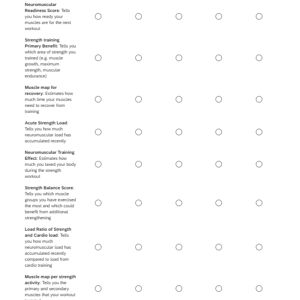
- Neuromuscular Readiness Score (a metric estimating muscle preparedness before strength training),
- Neuromuscular Training Effect (an indicator summarising strength session impact on the neuromuscular system),
- Acute Strength Load (a measurement of muscular load per session),
- Muscle Map for Recovery (a tool projecting individual muscle group recovery times), and
- Strength Balance Score (a score reflecting balance across muscle groups and movement types).
Each concept is broadly described within the survey, complete with a working definition.
These look very much like existing features in late-stage development, and Garmin is testing which ones its audience values before committing resources to building them.
The survey arrives at a specific moment. Garmin has just expanded Fitness Coach to a wide range of devices, introduced expanded Strength PRs, and, as covered in detail here, moved to restrict third-party write access to the strength data layer, leaving its own native features without direct competition.
The direction of travel is clear. What this survey reveals is what the destination looks like with a good degree of certainty.
What Garmin Asked: Breaking Down the Questionnaire
The survey opens with user profiling. It asks how frequently respondents lift, what motivates them, and how important they consider accurate insights into strength training load and recovery.
- Frequency options run from less than weekly to daily.
- Motivations include building muscle and power, supporting performance in a main sport, health and wellbeing, appearance, and weight loss.
The option to specify a sport in an open text field identifies the hybrid athlete, someone who lifts to support running, cycling, HYROX, CrossFit, or triathlon, as a specific user type Garmin wants to understand.
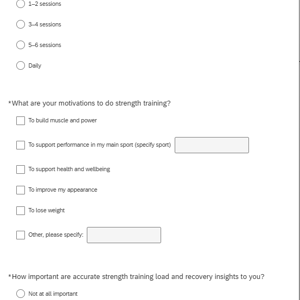
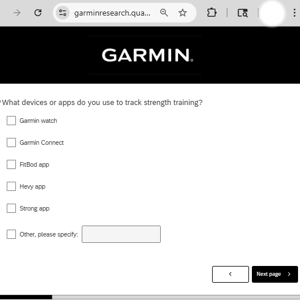
The device and app question lists Garmin watch, Garmin Connect, FitBod, Hevy, and Strong by name – you can manually add newer strength recovery apps like FORMA. Including direct competitors like this is relatively unusual. It tells us Garmin has mapped specifically where its users go when its own platform falls short.
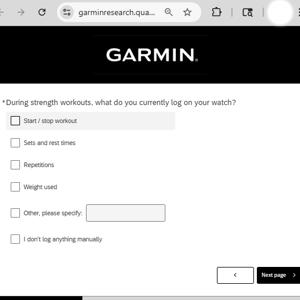
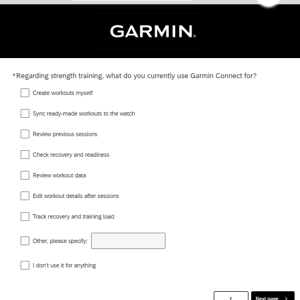
The behavioural questions ask what users currently log on the watch during strength sessions: start and stop only, sets and rest times, reps, weight, or nothing at all. A parallel question asks what they use Garmin Connect for regarding strength training, with options ranging from creating workouts and reviewing previous sessions to checking recovery and readiness and tracking training load. Many of these overlap with what Garmin does well in running and cycling, but provide only partial support for strength training.
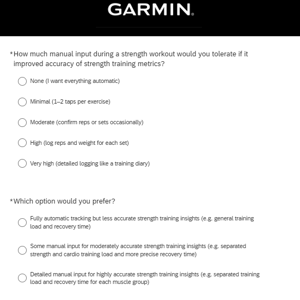
The most analytically interesting questions come later. One asks how much manual input the user would tolerate during a workout if it improved the accuracy of strength-training metrics, with options ranging from fully automatic to detailed logging that resembles a training diary. A second question asks which of three outcomes the user would prefer: fully automatic tracking with general metrics; some manual input for moderately accurate, separately tracked strength and cardio load figures; or detailed manual input for highly accurate per-muscle load and recovery data.
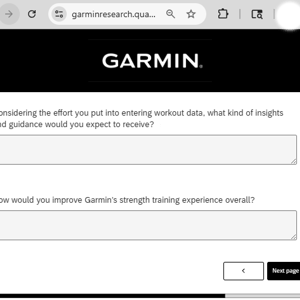
The final section presents the eight named concepts and asks how interesting each is, with an open text field inviting the respondent to explain their ratings or share ideas.
What the Eight Concepts Tell Us
The eight concepts divide into three logical groups.
The first covers session-level outputs: Neuromuscular Training Effect and Strength Training Primary Benefit. Garmin already produces Aerobic Training Effect and Anaerobic Training Effect scores after every cardio session. A Neuromuscular Training Effect would complete the set, giving a strength session a post-workout interpretive summary of the same kind. Strength Training Primary Benefit goes further, classifying the session as a muscle-growth stimulus, a maximum-strength stimulus, or a muscular-endurance stimulus based on rep ranges, load, and rest times. No wearable currently automatically delivers this classification.
The second group includes metrics with structural significance: Acute Strength Load, Muscle Map for Recovery, and Load Ratio of Strength and Cardio Load. Acute Strength Load estimates the immediate muscle workload from a session. Muscle Map for Recovery projects the recovery time required for each muscle group, going beyond showing which muscles were worked. The Load Ratio of Strength and Cardio Load separates neuromuscular load from cardiovascular load, rather than combining both into a single metric as the current Training Load model does. This separation would represent a significant shift in Garmin’s approach to training intelligence for hybrid athletes.
The third group covers readiness and balance: Neuromuscular Readiness Score, Strength Balance Score, and Muscle Map per Strength Activity. The Neuromuscular Readiness Score is most easily understood by existing Garmin users: it is the Training Readiness metric, specifically applied to muscular preparedness rather than overall systemic readiness. The Strength Balance Score monitors the distribution of chronic training by flagging imbalances, such as neglected pulling versus pushing movements or lower hamstring versus quadriceps training volume. This is a longitudinal measure that improves with each session, as data accumulate.
What Garmin Strength Features Currently Do Well and Where It Falls Short
So that explains Garmin’s interest. A short step back to see where its ecosystem currently stands.
What it does well:
- Exercise library: one of the largest native databases in consumer wearables, with automatic muscle group attribution per exercise.
- Strength Coach plans: well-structured progressive programmes using accumulation, intensification, and deload phases, available on Fenix 8, Forerunner 970, and recent Venu and Vivoactive devices.
- Fitness Coach integration: adaptive plans combining cardio and strength, adjusted using Body Battery and HRV data.
- Strength PRs: personal records per exercise added in Q1 2026 across current flagship and mid-tier watches.
- Connect+ Live Activity: real-time heart rate, exercise animations, and rep counts on the phone screen during a session.
- Post-session muscle map: a reliable visual summary of primary and secondary muscles worked, displayed in Garmin Connect after each session.
Where it falls short:
- Training Load undervalues strength: a demanding leg session contributes less to Training Load than a moderate run of similar duration, because EPOC from lifting is lower than EPOC from sustained cardio.
- No neuromuscular recovery modelling: the existing muscle map shows what was worked; it does not estimate readiness for the next session by muscle group.
- No progressive overload memory: the watch does not display the previous session’s weights and reps when logging.
- Automatic rep counting is unreliable: miscounts on exercises with less distinct wrist movement require manual correction mid-set. Rep counting also requires wrist movement, which excludes many machine exercises entirely.
- Third-party write access is closed: no external app can write completed strength session data back into Garmin Connect as a native activity. The addSet() function required to do so does not exist in the Connect IQ SDK. Apps such as LiftTrack and Rack work around this constraint by using alternative means rather than going through it.
The Manual Input Question Is a Tiering Decision
The preference question presents three outcomes: fully automatic with general metrics; semi-manual with separate strength and cardio load, and more precise recovery time; and detailed logging with per-muscle-group load and recovery data. These map almost exactly to a free tier, a Connect+ tier, and a power user tier. Garmin is effectively asking users which level of capability they are willing to pay for and how much friction they will accept to access it.
The pattern is consistent with Garmin’s broader monetisation approach. Live Activity for strength sessions sits behind the Connect+ paywall. Expanded personal records arrived as a free update, but only on current-generation devices. The more sophisticated neuromuscular outputs are strong candidates for Connect+, where the subscription justifies the ongoing analytical infrastructure.
What These Features Could and Could Not Deliver
The constraint was noted on this site when Garmin’s Fitness Coach first launched: the watch cannot automatically measure work without smart weights or smart gym stations. That observation deserves fuller treatment here, because it defines what the planned features can realistically produce.
Accurate measurement of musculoskeletal load requires knowing the load being moved, the velocity of that movement, and the range of motion at the working joint. A wrist sensor can directly measure none of these. The gold standard for strength load measurement is velocity-based training using a barbell-mounted linear positional sensor that directly measures bar displacement rather than inferring it from an accelerometer signal. A 2023 study found that an Apple Watch mounted on the barbell, not the wrist, produced valid mean velocity data for the back squat, with wrist-worn validity slightly lower, and the study was limited to one exercise. The point is that the wrist can serve as a proxy for the working joint and its load, but it is not a direct measurement.
WHOOP’s Passive MSK feature, released in February 2026, is the current benchmark for estimating passive strength loads in a consumer wearable. It derives musculoskeletal load from wrist kinematics and body mass, building on the velocity-based training methodology that came with the PUSH acquisition in 2021. WHOOP validated the algorithm internally across more than 10,000 repetitions and reported 97% repeatability. WHOOP explains its MSK methodology publicly. Garmin’s planned features are more ambitious: per-muscle-group recovery modelling requires attributing load to specific muscles across a wide range of exercises, performed by athletes of different sizes using different weights. The estimation chain is longer, and each step introduces additional uncertainty.
The practical upshot: Garmin’s planned outputs will be more useful than what it currently provides and will be reliable over time for the same user performing the same exercises with consistent weight entry, but they will not be measurement-grade data. Users who want measurement-grade neuromuscular load data use barbell-mounted sensors and structured VBT protocols. That is a wholly different category of tool for a different category of athlete than the typical Garmin owner in a local gym.
Closing Thoughts
The survey is a clear signal that Garmin intends to build a neuromuscular intelligence layer to sit alongside its existing cardiovascular one. Whether it delivers features that perform as described depends on two things it cannot fully control: the accuracy of its sensor-based models across the full range of exercises its users perform, and the willingness of its users to enter the weight data those models need to work well. Both remain open questions. The features appear real. The gap between what they promise and what a wrist sensor can measure is also real, and it is worth keeping both in view.
Quick answers
When will we see this?
I would hope to see this in 2026, but certainly not imminently.
Why can't a Garmin watch simply measure strength training load directly?
Measuring muscular strain accurately requires knowing the load being lifted, the movement velocity, and the range of motion at the working joint. None of these is observable from a wrist sensor alone. The gold-standard method is velocity-based training using a barbell-mounted linear position sensor that measures bar displacement as the tether extends and retracts, thereby producing direct velocity data without algorithmic inference. A Garmin watch observes wrist movements and heart rate. It can apply a biomechanical model to those inputs to produce a load estimate, which improves significantly when the user specifies the exercise and enters the weight lifted. It remains an estimate, not a measurement.
How does WHOOP's approach to strength load compare to what Garmin is planning?
WHOOP’s Passive MSK, introduced in February 2026, is the most technically developed passive strength load system in a mainstream consumer wearable. It derives musculoskeletal load from wrist motion and body mass without requiring the user to log anything, building on velocity-based training methodology acquired with PUSH in 2021. WHOOP validated the algorithm internally across more than 10,000 repetitions and reported 97% repeatability. Garmin’s planned features are more granular: per-muscle-group recovery and a separated cardio and neuromuscular load ratio go beyond what WHOOP currently publishes. Whether Garmin’s models achieve comparable validation will only become clear when independent testing is possible.
Will the new features work as well for dumbbell and cable exercises as for barbell lifts?
For exercises where wrist movement closely tracks the loaded implement, particularly barbell squats and deadlifts, wrist-sensor-based load models perform best. For cable, machine, and dumbbell exercises with complex joint paths, the relationship between wrist movement and actual load velocity is weaker and harder to model reliably. Garmin’s existing exercise recognition already performs inconsistently across movement types, and the same constraint applies to any load estimation built on top of it. Users whose training is predominantly machine-based or cable-based should treat per-muscle load estimates with greater scepticism than users who train primarily with a barbell.
Last Updated on 28 June 2026 by tfk the5krunner
Small things I always use
- Garmin 90-degree charging adapter: Charges your Garmin from any USB-C cable. Essential when travelling. I use one.
- Body Glide: The blue anti-chafe stick swimmers and runners carry. I use it.
- Speedo earplugs: Fewer ear infections and no cold-water dizziness. I use them.
- Dryrobe Advance: My winter changing robe for open-water swims. I use one. A cheaper option is the AONYIYI changing robe.
- Maurten: Race fuel that stays easy on the stomach. I use them.
- Garmin charging puck: The quickest way to top up before a session. I use one.
- Injinji: Toe socks that stop rubbing, so you run more. I use them.
- Ultimate toe protectors: Stop black toenails on long runs. They work. I use them.
- Compressport R2 v2 calf sleeves: My calf sleeves of choice. I use them.
- Cellucor C4: My pre-workout before hard sessions.
- TPU tubes: Schwalbe Aerothan, Tubolito and Pirelli SmarTube. Light, tiny spares. I use all three.
- G8 insoles: Adjustable insoles that are good. I use them.
- Cycplus Cube: A 97g electric pump that gets a road tyre rideable in two minutes. I carry one. 5% off with code THE5KRUNNER.
Watches and sensors
- Polar H10: My daily driver for waking HRV.
- Polar Verity Sense: My backup arm-worn HR sensor.
- Nomad bedside charger: Charges my iPhone and Apple Watch overnight. I use it, and many of their bands.
- Train.Red: The best muscle oxygen sensor I’ve used.
- Tymewear: Accurate heart rate and reliable ventilatory zones. I use it to pace endurance rides over an hour.
- Garmin Forerunner 970: A pro-grade triathlon watch. I use this.
- Apple Watch Ultra 4: My daily smartwatch. No phone needed on rides.
- Garmin Fenix 9 Pro: I’ve just bought one.
On the bike
- Continental GP5000 for everyday riding, and Aero 111 on the front for special occasions.
- Helmets: Specialized S-Works Evade 3 for road riding, and Rudy Project Wing for TT-style races. I use both.
- Ravemen FR300: A front light that mounts under your Garmin or Wahoo. I use one.
- Wahoo TRACKR Radar: I use it on one bike and Varia on the other. They perform the same.
- Garmin Varia RTL515: Radar that warns you of cars from behind. I use this model.
- Wahoo ELEMNT Roam 3: The bike computer that’s easy to use. I use mine on most rides.
- Favero Assioma Pro RS2: Accurate power pedals that swap easily between bikes. I use this model.
Home and indoor training
- NPE Runn: Makes my basic treadmill smart, sending more accurate speed and distance to my watch and Zwift. I use it.
- Google Wifi: Keeps Zwift connected in my pain cave. I use it.
- Apple TV 4K: Zwift on the big screen. I use two.
- Google Nest Doorbell (wired, 2nd gen): My video doorbell, running in both Google Home and Apple Home. I use it.
Health, recovery and sleep
- FreeStyle Libre 3 Plus: Shows how my blood sugar responds to diet.
- hDrop: Measures my sweat loss in summer and indoors.
- Fourth Frontier Zone: Checks my heart under load in hard sessions.
- Oura Ring 5: My partner’s recovery tracker of choice.
- Kineon MOVE+: Red light therapy for niggles. It works.
- Eight Sleep: A cooling mattress cover my partner and I use nightly.
Reader-Powered Content

This content is not sponsored. It’s mostly me behind the labour of love, which is this site, and I appreciate everyone who supports it.
Support the site: Follow (free, fewer ads) · Subscribe (paid, ad-free) · Buy Me A Coffee ❤️
Written by real people, with AI assistance. Fact-checked and verified for originality. See the Editorial Policy. FTC: Affiliate Disclosure — some links pay commission. As an Amazon Associate, I earn from qualifying purchases.
tfk is the founder and author of the5krunner, an independent endurance sports technology publication. With 20 years of hands-on testing of GPS watches and wearables, and competing in triathlons at an international age-group level, tfk provides in-depth expert analysis of fitness technology for serious athletes and endurance sport competitors. ID

How many models do you think these features would come to vs. this being a selling point for new models?
hmmm.
good question.
There is a significnat pent up demand for a wearable that can do strength trainging properly. some of the current wearables and apps do a more than good enouh job for some people. but not all. i think not by a long way.
so if this is done properly with the real value add features in Connect+ (that is what will happen to some degree) then it depends on the takeup of subscriptions for strength. ie if subs are really popular Advanced Strength Training could be passed down to lesser models.
If I had to bet I would say it is like other features and only relesed to newish models. Garmin wants its cake and to eat it. It jsut needs to keep selling us better replacement watches.
This is SUPER exciting!
I agree, it seems major
More interesting info here: https://uspto.report/TM/99661177
Something called “Muscle Battery”
They need to expand their library, easy of program creations and easy of adapting the sessiins on the fly for strength training. It’s also why they list alternatives as even with lifttrack you are limited in the variety you can do and the ease of building routines. Fitbod and Gravl lead for that
Nice breakdown, the muscle-map vs neuromuscular-readiness split is genuinely useful framing.
One technical note on the “alternative means” line where you grouped Rack with LiftTrack: the architectures are quite different. Rack writes a standard FIT activity via the CIQ BLE channel, the same FIT format your readers’ cycling computers use, the same path Wahoo, Suunto, and Coros depend on. We don’t route through Garmin’s cloud addSet() API, which is what blocked Hevy. So the activity that lands in Connect after a Rack session is structurally identical to one a Wahoo bike computer wrote, Training Load, Body Battery, Readiness all behave normally.
I just published a longer technical writeup at rackstrength.com/garmin-activities if useful for the next strength piece. Happy to share more detail.
Cheers,
Noah (Developer, Rack Strength)