Garmin VO2 max: How It Works, Accuracy and Device Support
Garmin VO2 max is an estimated measure of maximal aerobic capacity — the maximum rate at which an athlete’s body can consume oxygen during sustained exercise — expressed in millilitres of oxygen per kilogram of bodyweight per minute (ml/kg/min).
It serves as one of the most widely used indicators of cardiovascular fitness and endurance potential, and Garmin uses it as a foundational input for several other metrics, including Training Status, Race Predictor and Load Focus. The estimate is derived from submaximal exercise data rather than laboratory testing, which makes it accessible but also introduces meaningful error margins that wearers should understand before acting on any single reading.
What the Number Actually Means
A VO2 max value represents the ceiling of an athlete’s aerobic engine. A higher number indicates a greater capacity to deliver and use oxygen at high intensities, which correlates with faster performance across endurance disciplines from 5K running to Ironman-distance triathlon. A lower number indicates a more limited aerobic ceiling, though it does not by itself predict performance — factors such as lactate threshold, running economy and pacing strategy all affect how much of that ceiling a runner can exploit in a race.
Typical values vary significantly by age and sex. Sedentary adult men average roughly 35–40 ml/kg/min; sedentary adult women average roughly 27–31 ml/kg/min. Elite male distance runners commonly measure above 70 ml/kg/min; elite female distance runners above 60 ml/kg/min. Garmin’s own categorisation — Poor, Below Average, Average, Good, Excellent, Superior — is age- and sex-adjusted, meaning a 55-year-old woman rated “Excellent” is being compared against her demographic cohort, not against a 25-year-old man. Interpreting a raw number without that age and sex context leads to incorrect conclusions.
How Garmin Calculates It
Garmin’s VO2 max estimate is produced by Firstbeat Analytics, a Finnish sports science company acquired by Garmin in 2020. The algorithm analyses the relationship between heart rate and pace (for running) or heart rate and power output (for cycling) during a recorded activity. Because heart rate rises predictably with workload in aerobic conditions, the algorithm can extrapolate from submaximal data to estimate the theoretical maximum oxygen uptake.
The calculation requires a GPS-recorded outdoor run or an activity in which pace and heart rate are captured simultaneously under stable aerobic conditions. A run that is too short, too slow, too fast, or conducted in extreme heat without heat-adjusted settings enabled will produce either no update or a degraded estimate. The device needs several minutes of steady-state aerobic effort — broadly, heart rate between approximately 70 and 95 per cent of maximum — before the algorithm has sufficient data to produce a reliable update.
For cycling, a separate VO2 max estimate is maintained and requires a power meter. Heart rate alone is insufficient for estimating power because the relationship between heart rate and power varies widely across individuals without a power reference. The running and cycling estimates are stored independently and may diverge substantially, which reflects genuine physiological differences in sport-specific adaptation rather than an error.
The algorithm does not require an all-out effort. It is specifically designed for submaximal data collection, which is both its practical strength and the source of its primary limitation: it must make assumptions about heart rate response that may not hold when those responses are distorted by factors outside normal training conditions.
What Affects the Reading
Heat is the most common cause of unexpected drops in VO2 max. When ambient temperature rises, heart rate increases disproportionately relative to pace or power output — the body is managing thermal load as well as exercise demand. The algorithm, interpreting an elevated heart rate at a given pace as reduced fitness, may lower the estimated VO2 max. Garmin introduced Heat Acclimation detection on supported devices to partially correct for this, but the correction is not available on all hardware and is not perfectly calibrated. Runners training in summer conditions should expect temporary dips that reverse once cooler weather returns.
Altitude produces a similar distortion. At elevation, the reduced partial pressure of oxygen means the heart rate rises faster than it would at sea level for an equivalent pace, which the algorithm again reads as reduced fitness. Some Garmin devices include altitude acclimatisation detection, but like heat correction, this feature is device-dependent and imperfect.
Wrist-based optical heart rate is a major source of error. The algorithm’s reliability depends on accurate, low-latency heart rate data. Wrist optical sensors perform well during steady aerobic efforts but struggle with high cadence, poor skin contact, arm-swing artefacts, and cold ambient temperatures, which reduce peripheral blood flow. A Garmin HRM-Pro or similar chest strap eliminates most of these error sources and is strongly recommended for runners seeking accurate VO2 max estimates. The difference between wrist and chest strap estimates during the same run can exceed 5 ml/kg/min under unfavourable conditions.
Illness, sleep deprivation and alcohol consumption each elevate resting and exercise heart rate for reasons unrelated to fitness. Running through any of these states will produce an artificially suppressed VO2 max estimate. The metric does not distinguish between an elevated heart rate caused by detraining and one caused by temporary physiological stress — it only measures the relationship between heart rate and speed.
Treadmill running without a footpod or using a fixed treadmill speed does not trigger a VO2 max update on most Garmin devices because the algorithm requires GPS-verified pace. Running with a Garmin footpod can partially address this, but treadmill estimates are generally considered less reliable than outdoor estimates.
How Accurate Is It
Published validation research on Firstbeat-derived VO2 max estimates is moderately encouraging but carries important caveats. A 2019 study by Ramos-Campo et al., published in the International Journal of Sports Physiology and Performance, found mean errors of approximately 5 per cent compared with laboratory-measured VO2 max in trained runners using chest-strap heart rate. A 2021 study by Akubat et al. found similar accuracy in structured running conditions but larger errors in unstructured or interval-heavy sessions.
Accuracy degrades substantially when optical wrist heart rate is used instead of a chest strap, when exercise conditions are thermally stressful, or when the athlete’s heart rate response is atypical — for example, in athletes with very low maximum heart rates or those taking beta-blockers, which blunt heart rate response and render the algorithm’s assumptions invalid. In these populations, the estimate may be systematically biased by 10 ml/kg/min or more.
The distinction between absolute accuracy and trend reliability is operationally important. Even if Garmin’s absolute VO2 max estimate differs from a laboratory measurement by several ml/kg/min, the trend — rising or falling over weeks and months — may still reliably reflect improvements or declines in fitness. For most recreational athletes, tracking directional change is more useful than the absolute number, and the device performs this function reasonably well under consistent testing conditions.
Evidence on the accuracy of cycling VO2 max estimates is more limited and generally shows larger errors, partly because the range of cycling positions, cadences, and power-meter calibration affects the heart rate–power relationship in ways the algorithm cannot fully account for.
Competitor Equivalents
- Polar offers VO2 max estimation through its Polar Running Performance test, which requires a GPS run at a steady pace, and through a separate Cycling VO2 max test with a power meter. Polar publishes its own validation data and uses a distinct algorithm; its estimates are generally considered among the more accurate wrist-based approaches.
- Apple introduced Cardio Fitness (also labelled as VO2 max) in watchOS 7. Apple derives its estimate during any outdoor walk, hike or run above a minimum pace threshold, using a different modelling approach. Apple’s estimates tend to skew lower than laboratory measurements and are broadly considered less precise than Garmin’s running-specific estimate, though Apple’s algorithm is specifically designed for lower-intensity activities and has been validated in a clinical rather than performance context.
- Coros produces a Fitness Level metric that functions analogously to VO2 max and uses a similar heart rate–pace relationship model. Coros does not publish the algorithmic methodology in detail. Reported correlations with laboratory VO2 max are comparable to Garmin’s running estimate in structured testing conditions.
- Suunto displays an estimated VO2 max derived from running data and uses Firstbeat Analytics in some device generations, meaning the underlying methodology is identical to Garmin’s on those devices. Older Suunto devices used a different estimation approach and should not be assumed to be equivalent.
- Wahoo does not currently offer a standalone VO2 max estimate within its watch ecosystem, though cycling power and heart rate data from Wahoo devices can be exported to third-party platforms that calculate VO2 max proxies.
Which Garmin Devices Support It
Running VO2 max is supported on the majority of current Garmin GPS running watches, including all current Forerunner, Fenix, Epix, Enduro, Instinct 2 and vívoactive 5 models. The feature was introduced progressively across the Garmin range from approximately 2015 onward and is now a standard feature on any device with built-in GPS and heart rate monitoring.
Cycling VO2 max requires a paired power meter and is available on Edge cycling computers (Edge 530, 830, 1030 and later) and on wrist devices that support cycling power meter pairing, including the Forerunner 970, Fenix 7 series and Epix series. Devices without power meter support — such as the vívoactive 5 and most entry-level Forerunner models — will not generate a cycling VO2 max estimate.
Heat and altitude acclimation correction, which reduces distortion of the VO2 max estimate in adverse conditions, is available on the Forerunner 955, 965, Fenix 6 series and later, Epix series and Enduro 2 and later. Earlier devices and lower-tier models display the raw estimate without environmental correction.
Where to Find It
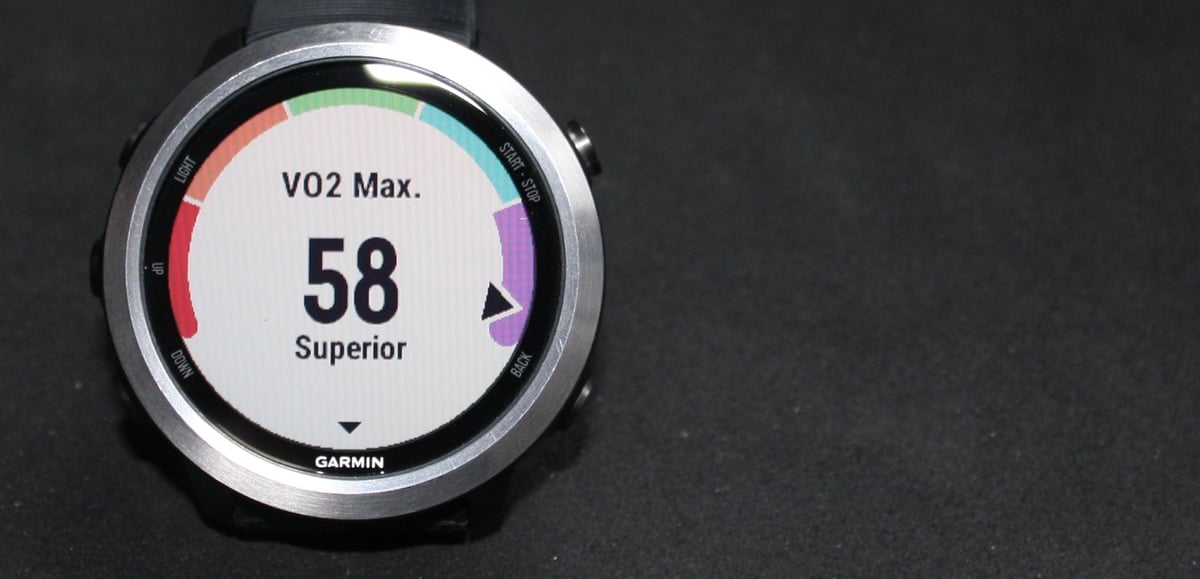
On the watch, Garmin VO2 max is accessible as a dedicated widget that displays the current estimated value alongside a category rating (such as Excellent or Good) and an age- and sex-adjusted percentile. On devices with glanceable widget support, the VO2 max widget can be added to the glance loop for a quick-access summary without opening the full widget. The VO2 max value cannot be added as a data field during a recorded activity because it is a post-activity calculated metric, not a real-time reading.
Some Garmin devices include VO2 max in the Morning Report, a daily summary shown on waking. This typically surfaces the most recently calculated value without additional trend context.
In Garmin Connect mobile, VO2 max is found under the Health Stats section. The app displays the current estimate, historical trend data going back to the earliest available estimate, and the age- and sex-adjusted category. Historical trend data is available without a Garmin Connect Plus subscription.
On Garmin Connect, VO2 max appears in the Health & Fitness Statistics panel. The web interface displays the current value and basic historical trend but provides less graphical detail than the mobile app. No additional subscription is required to view this data on the web interface.
Common Problems and Misreadings
A sudden unexplained drop in VO2 max after a run in hot conditions is one of the most frequently reported issues and almost always reflects the algorithm’s response to a heat-elevated heart rate rather than any genuine change in fitness. The reading typically recovers within one to three sessions conducted in cooler conditions or following a period of heat acclimatisation that the device detects and compensates for.
The VO2 max value not updating despite regular running is typically caused by activities that do not meet the algorithm’s data quality thresholds — specifically, runs that are too short, conducted on a treadmill without footpod data, or where heart rate data was unreliable due to poor optical sensor contact. The algorithm will not update the estimate from a degraded data session and will instead retain the previous value.
A meaningful discrepancy between running and cycling VO2 max estimates is not an error. Sport-specific aerobic adaptation is well-documented in physiology: a trained cyclist may have a substantially higher cycling VO2 max than running VO2 max, or vice versa. The two metrics reflect different muscular adaptations and should not be expected to converge.
The device showing a higher VO2 max than a laboratory test is a common and understandable concern. Garmin’s algorithm tends to perform best in populations whose heart rate response is typical for their age and fitness level. Athletes with atypically efficient cardiovascular systems — very low maximum heart rates, or very low resting heart rates — may receive estimates that overstate laboratory-measured values because the algorithm’s predictive model was not tuned for physiological outliers.
VO2 max dropping during a period of heavy training load is physiologically plausible and does not necessarily indicate a problem. High training loads temporarily suppress heart rate variability and can elevate resting heart rate, which distorts the algorithm’s estimate. This is sometimes called the overreaching signal, and if accompanied by elevated HRV stress scores, it may warrant a recovery day rather than concern about the metric itself.
How to Improve It
VO2 max responds most reliably to training that stresses the cardiovascular system at or near maximal aerobic capacity. High-intensity interval training — specifically efforts at approximately 90 to 100 per cent of maximum heart rate, lasting three to eight minutes per interval, with recovery intervals that allow partial heart rate recovery — has the strongest evidence base for improving measured VO2 max in both trained and untrained populations. This broadly corresponds to a 5K race pace effort for most recreational runners.
Long aerobic runs at moderate intensity (60 to 75 per cent of maximum heart rate) build the stroke volume and mitochondrial density that support a higher VO2 max ceiling over months, even when they do not acutely stress the system at the same intensity as intervals. Neglecting easy running volume in favour of exclusively high-intensity sessions tends to impair recovery and limit the long-term adaptations that underpin a rising VO2 max.
Body composition matters independently of training. Because VO2 max is expressed relative to bodyweight (ml/kg/min), a reduction in body fat at the same absolute aerobic capacity will produce a higher relative VO2 max. This is not a shortcut — the absolute capacity must also improve to sustain race performance — but it explains why athletes who lose weight while maintaining training volume frequently see rising VO2 max values without changing their training structure.
Frequently Asked Questions
- Why does my Garmin VO2 max drop in summer? Heat causes heart rate to rise at any given pace, which the algorithm reads as reduced fitness. Garmin’s Heat Acclimation feature on supported devices partially corrects for this, but not all hardware includes it. The estimate typically recovers once conditions cool or after several weeks of acclimatised running in the heat.
- Can I improve my VO2 max estimate without actually getting fitter? To a degree, yes — using a chest strap instead of wrist optical heart rate, running in cooler conditions, and ensuring sessions meet the minimum data quality thresholds will all produce a more accurate estimate that may be higher than a wrist-HR-based estimate in poor conditions. However, sustained genuine improvement requires cardiovascular adaptation through structured training. (Practical Explainer: how to improve VO2 max)
- Is a Garmin VO2 max estimate accurate enough to use for race planning? Garmin’s Race Predictor uses the VO2 max estimate as one input. The resulting race time predictions are useful as a broad guide but should be cross-referenced with actual training data and race experience. In well-trained athletes running under normal conditions with a chest-strap HR, the predictions are often within 5 per cent of race time. In less controlled conditions, the margin of error is higher.
- Why does my VO2 max not update after every run? The algorithm only updates the estimate when it has sufficient high-quality data from the session. Runs that are too short, use unreliable heart rate data, or fall outside the required intensity range will not trigger an update. The device retains the previous estimate until a qualifying session provides enough data to recalculate.
- Does VO2 max decline with age? Yes. Maximal aerobic capacity typically declines at approximately one per cent per year after the mid-twenties in sedentary adults, and somewhat more slowly in consistently trained athletes. Garmin’s age-adjusted categorisation accounts for this, so an “Excellent” rating at age 50 reflects a different absolute value than “Excellent” at age 25.
Scientific Basis
Ramos-Campo, D.J., et al. (2019). “Validation of heart rate-based indices to assess aerobic fitness in recreational endurance runners.” International Journal of Sports Physiology and Performance. Found that Firstbeat-algorithm-derived VO2 max estimates showed a mean absolute error of approximately 5.4 ml/kg/min against laboratory spirometry in trained runners using chest strap heart rate, establishing the practical accuracy ceiling for the technology under favourable conditions.
Firstbeat Technologies (2014). “Automated Fitness Level (VO2max) Estimation with Heart Rate and Speed Data.” Firstbeat White Paper. The primary technical document describes the submaximal estimation methodology, the role of heart rate–pace regression, and the conditions required for valid data collection. This paper underlies the implementation used in current Garmin devices.
Akubat, I., et al. (2021). “Reliability and validity of a commercially available, automated measure of cardiorespiratory fitness (VO2max) in adolescent cyclists.” European Journal of Sport Science. Found that power-based VO2 max estimates from Firstbeat algorithms showed good reliability (ICC > 0.90) but that absolute accuracy was sensitive to power meter calibration and pacing variability, cautioning against single-session reliance on the figure.
Bassett, D.R. & Howley, E.T. (2000). “Limiting factors for maximum oxygen uptake and determinants of endurance performance.” Medicine & Science in Sports & Exercise, 32(1), 70–84. A foundational review establishing the physiological underpinnings of VO2 max measurement, the relationship between cardiac output, oxygen extraction and aerobic performance, and the limitations of indirect estimation methods that inform interpretation of all wrist-based VO2 max estimates.
How It Connects to Other Features
Garmin VO2 max is the most widely connected metric in the Garmin ecosystem. [LINK: training-status] uses the estimated VO2 max as a baseline against which recent training load is assessed to generate the Productive, Maintaining, Peaking and Unproductive status ratings. Without a valid VO2 max estimate, Training Status cannot function.
[LINK: race-predictor] uses the VO2 max estimate in combination with recent training load data to project finish times for distances from 5K to marathon. The prediction degrades in accuracy when the VO2 max estimate is distorted by environmental or physiological factors.
[LINK: training-readiness] and [LINK: body-battery] are independent of VO2 max and draw on HRV, sleep and stress data instead, meaning they remain functional even when the VO2 max estimate is temporarily suppressed. However, [LINK: load-focus], which categorises training load into anaerobic, high-aerobic, and low-aerobic components, uses the VO2 max estimate to anchor the heart-rate zones that define those categories.
[LINK: hrv-status] operates independently of VO2 max. However, the two metrics are often interpreted together: a falling VO2 max accompanied by a declining HRV status may signal meaningful overreaching or illness, whereas a falling VO2 max alongside a stable HRV status more commonly reflects environmental distortion of the estimate rather than genuine fitness decline.
