Garmin Physiological Measurements: Reference Pages for Every Metric
Reference pages for Garmin’s physiological measurement features — the foundational numbers from which training, recovery and performance metrics are derived.
- Garmin VO2 Max — estimated aerobic capacity, expressed in ml/kg/min, calculated from heart rate and pace or power data during outdoor runs and rides. The single metric from which the largest number of other Garmin features are derived.
- HRV Status — a five-day rolling measure of heart rate variability recorded during sleep, used as a proxy for autonomic nervous system balance and recovery readiness. Feeds directly into Training Readiness and the Morning Report.
- Lactate Threshold — an estimated pace or power output at which blood lactate begins to accumulate rapidly, derived from a guided test run or detected automatically during hard efforts. Used to set heart rate and pace training zones.
- Respiration Rate — breaths per minute measured from wrist-based optical sensors during sleep and, on select devices, during activity. Tracked as a long-term health indicator and used in sleep quality assessment.
- Pulse Ox (SpO2) — blood oxygen saturation estimated by optical sensors, primarily used for altitude acclimatisation monitoring and sleep quality assessment. Accuracy varies significantly with skin tone, movement and ambient light.
- Max Heart Rate —
- Fitness Age —
How These Metrics Connect
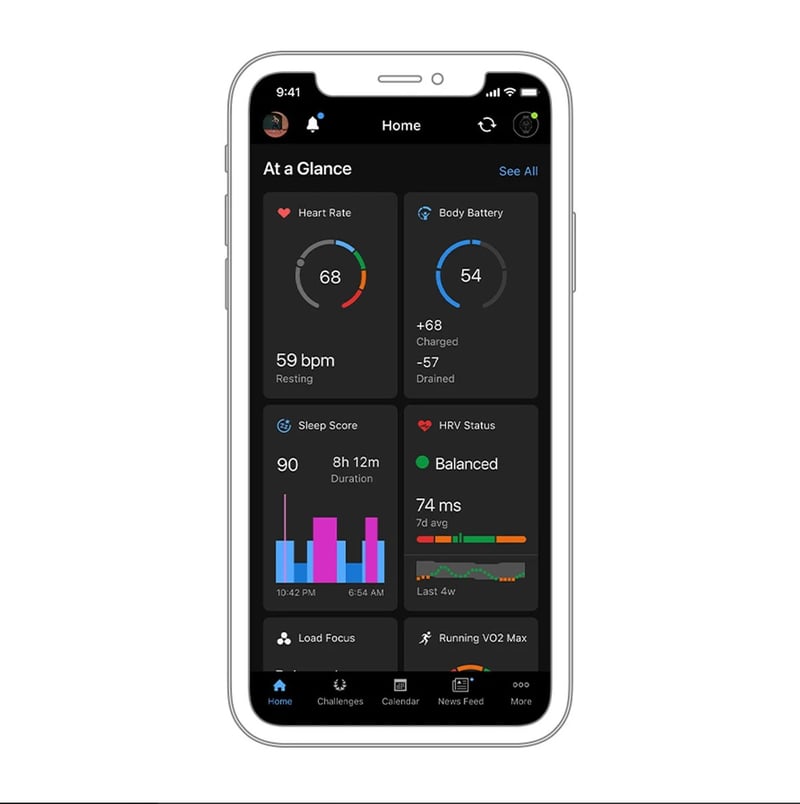
Physiological measurements do not operate independently. VO2 max is the starting point for race predictions, training status assessments and fitness age calculations. HRV Status draws on the same overnight heart rate data as sleep tracking and feeds its output into Training Readiness each morning. The lactate threshold determines the pace and heart-rate zone boundaries that Training Load Focus uses to classify training sessions by intensity.
Pulse Ox and respiration rate are less tightly integrated with training features but contribute to Garmin’s sleep quality scoring and, on devices that support all-day SpO2 monitoring, to the detection of breathing irregularities during sleep.
Understanding how each metric is calculated — and where its inputs can be corrupted by hardware limitations or environmental conditions — is a prerequisite for interpreting the downstream features that depend on it. Each reference page in this section explicitly addresses those dependencies.
About the Firstbeat Analytics Engine
The majority of Garmin’s physiological measurement features are powered by algorithms licensed from Firstbeat Analytics, a Finnish sports science company acquired by Garmin in 2020. Firstbeat’s methods for estimating VO2 max, detecting lactate threshold and calculating EPOC from heart rate data are documented in a series of technical white papers available at firstbeat.com. Where a feature on this site draws on Firstbeat methodology, the relevant white paper is cited in the Scientific Basis section of that page.
Pulse Ox is an exception: the SpO2 estimation algorithm is based on standard photoplethysmography principles rather than Firstbeat’s proprietary sports science methods.
