Max Heart Rate
Formula estimate: ±10–12 bpm. Directly measured: ±1–2 bpm with chest strap.
Calibrating training zones once a verified max is entered from a field or lab test.
Most athletes never reach true max in normal training; auto-detected values are frequently underestimates.
Quick answers
How do I set max heart rate manually on my Garmin?
On the watch, go to Settings, then User Profile, then Heart Rate, and select Max HR. The same field is available in Garmin Connect Mobile under More, then Settings, then User Settings, then Heart Rate. Changes sync to the watch on the next Bluetooth connection.
Should I leave auto-detect on or turn it off?
Leave auto-detect on while the stored value is the age-based default — it will raise the figure as genuine high-intensity efforts are recorded. Turn it off once a verified, manually tested max is entered. An optical artefact spike could otherwise overwrite a known accurate value.
Why does my max heart rate keep changing even when I set it manually?
Editing profile fields — including birth year, height, or weight — can cause Garmin to revert the stored max heart rate to the age-formula default, regardless of the auto-detect setting. After any profile change, check and re-enter the max heart rate in both Garmin Connect and on the watch, then sync to confirm both values match.
Why did my max heart rate drop after I updated my Garmin profile?
Changing birth year, height, or weight in Garmin Connect triggers a recalculation from the 220-minus-age formula, which overwrites the stored value. The stored max does not drop from training data. Re-enter the correct value after any profile edit and verify it has synced correctly to the device.
Max Heart Rate — A Deep Dive
In Practice — Max Heart Rate
Max heart rate is a calibration figure. These observations may help you decide how to maintain an accurate value in the Garmin ecosystem.
- As a standalone metric, I rarely think about this number, but I know it has to be right for everything else to work.
- When I first started training seriously, my max heart rate dropped by several beats over three years. This was normal — it reflected improved stroke volume rather than a genetic decline.
- Over the longer term it has dropped by just under 1 bpm per year, which is normal genetic decline with age. I use that knowledge to occasionally tweak my Garmin settings, but I usually find auto-calculation accurate enough to leave alone.
- Like many athletes, my max heart rate is nothing like the 220-minus-age default. Garmin’s initial default settings use a formula that is more scientifically reliable than that, but it will likely also be wrong.
- I can usually get my cycling max heart rate to within three beats of my running max — which I find a useful difference to note to check my running max is correct.
- When auto-detection is on, I tend to accept Garmin’s periodic upward revisions after races and hard sessions rather than override them.
Garmin Max Heart Rate is the highest heart rate achieved during maximal physical exertion. It is a foundational physiological ceiling: every heart rate zone, training load calculation, and VO2 max estimate on a Garmin device is calibrated against this single figure.
Garmin uses max heart rate primarily to calculate personalised heart rate training zones, which in turn inform Training Effect scores, Training Load distribution, and VO2 max estimation accuracy. The chief limitation is that most athletes never reach their true maximum in a standard workout, so the stored value is frequently underestimated.
What the Number Actually Means
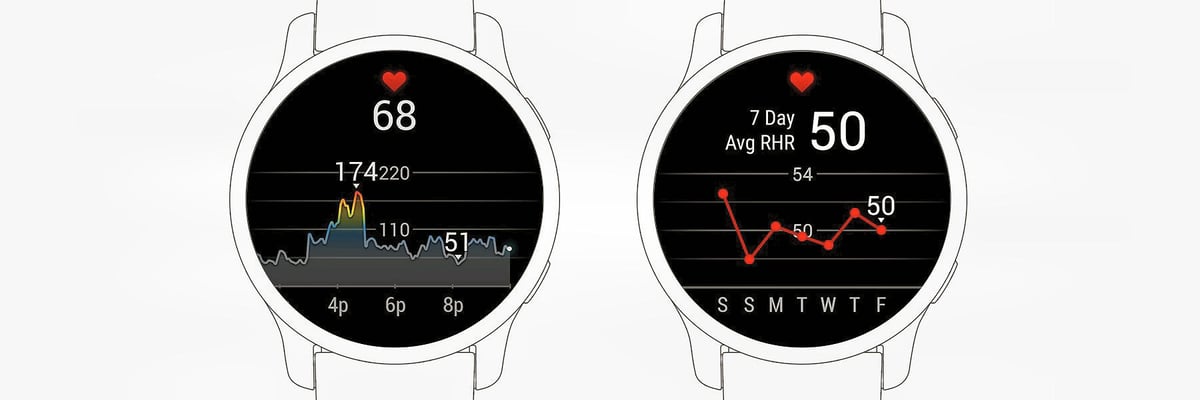
Max heart rate is expressed in beats per minute (bpm) and represents an absolute physiological ceiling rather than a performance target. Two athletes with identical VO2 max values can have max heart rates 20 bpm apart. The figure declines at approximately one beat per minute per year from early adulthood; sex differences exist but are smaller in magnitude than age effects and do not materially alter zone boundaries when an accurate individual value is available.
How Garmin Calculates It
Garmin allows max heart rate to be set via auto-detection from recorded activity data, manual entry of a tested value, or the age-based formula (208 − 0.7 × age) applied to the birth date entered during device setup. The formula is the default on most devices. Auto-detection updates the stored max when a new peak is observed across recorded activities; this update is one-directional — Garmin raises the value from new peaks but never lowers it automatically.
When auto-detection is off, and no manual value has been entered, the formula remains in effect for all downstream calculations. It produces a population average, not an individual measurement. The standard deviation around published estimates is approximately ten to twelve beats per minute, meaning the formula can be materially wrong for a substantial proportion of athletes.
| Age (years) | Estimated HRmax (bpm) — 208 − 0.7 × age | Typical range ± 1 SD (bpm) |
|---|---|---|
| 20 | 194 | 187–201 |
| 25 | 190 | 183–197 |
| 30 | 187 | 180–194 |
| 35 | 184 | 177–191 |
| 40 | 180 | 173–187 |
| 45 | 177 | 170–184 |
| 50 | 173 | 166–180 |
| 55 | 170 | 163–177 |
| 60 | 166 | 159–173 |
| 65 | 163 | 156–170 |
| 70 | 159 | 152–166 |
Source: Tanaka et al, 2001
What Affects the Reading
Heat and humidity raise the heart rate response to any given workload without raising the physiological maximum. An athlete training in hot conditions may record their highest heart rate of the season without a maximal effort; Garmin records this peak and may raise the stored value accordingly, pushing all zone thresholds upward. Optical wrist sensors introduce artefact spikes during high-intensity intervals that can exceed the athlete’s true maximum; using a chest strap during efforts intended to establish or verify max heart rate substantially reduces this risk.
Activity type produces systematically different observed maxima. Running typically produces the highest values; cycling averages five to ten beats lower, and swimming lower again, due to differences in recruited muscle mass, body position, and water cooling. On devices without sport-specific zone support, a single value applied across all activities will produce miscalibrated zones in at least one sport. Illness elevates resting and submaximal heart rate but does not raise true max heart rate.
How Accurate Is It
The age-based formula carries a known margin of error. A meta-analysis by Robergs and Landwehr (2002) found standard deviations of ten to twelve beats per minute around age-predicted values, with some individuals differing from the formula by twenty beats or more — a range large enough to place an athlete in the wrong training zone for every session.
A directly measured max from a graded exercise test to exhaustion is accurate to within the sensor’s measurement error. Chest strap monitors validated against electrocardiography show mean absolute errors of one to two beats per minute under controlled conditions. Optical wrist sensors exhibit higher error under motion artefact. For accurate zone training, a field or laboratory test is the only reliable approach.
Competitor Equivalents
- Polar supports manual entry and auto-detection with sport-specific zones on the Vantage and Grit X series, using a different default formula (211 minus 0.64 × age) that yields slightly different values for athletes over 40.
- Apple Watch estimates the maximum heart rate from workout data for cardio fitness calculations, but does not expose the stored figure to the wearer and does not support manual entry.
- Coros supports manual entry and auto-detection, calculating zones from the stored max using the same percentage-of-maximum method as Garmin; sport-specific zone sets are available on the Vertix 2S and Apex 2 Pro.
- Suunto Race and Suunto Vertical support manual entry and auto-detection using the same 220 minus age default; zones can be based on either maximum heart rate or lactate threshold heart rate, selectable per sport.
- Wahoo ELEMNT stores a single max heart rate value via manual entry only, with no auto-detection from ride data.
Which Garmin Devices Support It
Garmin introduced the max heart rate setting as a manually configurable option on the Forerunner 305 in 2006. [EDITOR: verify before publishing — primary source confirmation of the 305 as the first device with editable HRmax required] Manual entry and zone calculation from the stored value are available across the full current lineup, including the Forerunner 55. Sport-specific heart rate zones — allowing a separate max per sport profile — are available on unified codebase devices: Fenix 8 series (including Fenix E and Enduro 3), Forerunner 970, Forerunner 570, Venu 4, Venu X1, and later models in the same tier. The Forerunner 265, Forerunner 165, and Forerunner 55 use a single global value. Auto-detection is supported on mid-tier and above; the Forerunner 165 and Forerunner 55 rely on manual entry or the formula.
Where to Find It
- On the watch — Settings > User Profile > Heart Rate; the stored value, auto-detect toggle, and manual entry field are all here.
- Garmin Connect Mobile — More > Settings > User Settings > Heart Rate; manual entry and a toggle are available; shows only the currently stored value, no historical trend.
- Garmin Connect Web — account menu > Settings > User Settings; heart rate zone ranges derived from the stored max appear in Health Stats > Heart Rate Zones and update when the stored max changes.
- No subscription required — the setting and downstream zone calculations are available on all Garmin Connect tiers.
Common Problems and Misreadings
An athlete who has never reached true maximal effort during a recorded workout will have an auto-detected value below their physiological maximum. Every zone is then set too low — Zone 2 feels easy, Zone 4 reads as sub-threshold. Enter a verified max from a dedicated field test to correct this; values accumulated from moderate training sessions will always underestimate the ceiling. See FAQ above for detail on how to set the value manually.
Athletes training across multiple sports encounter systematic zone miscalibration on devices that use a single global max. A running max of 185 bpm applied to cycling places easy rides in a zone below their true aerobic demand; the same value applied to swimming exaggerates the perceived difficulty of the session. Configure sport-specific maxima on devices that support them.
The stored max does not automatically trigger a VO2 max recalculation when changed manually. Run an activity that meets the VO2 max update conditions after editing the stored value, then treat the VO2 max figure as reflecting the new calibration.
How to Improve It
Max heart rate is not meaningfully trainable — it is a genetic ceiling that declines with age. The goal is to know it accurately. The most reliable method is a graded exercise test to exhaustion: run at progressively increasing pace over ten to fifteen minutes, finish with a maximal sixty-to-ninety-second sprint, and record the peak from a chest strap. Repeat within two weeks and accept the higher result.
Structured interval sessions designed to elicit maximal cardiovascular stress — four-minute efforts at race pace with short recoveries — typically produce readings within three to five beats of the laboratory maximum and are sufficient for practical zone calibration in most training contexts.
Other Points
A larger heart rate reserve — the gap between resting and max heart rate — is associated with reduced all-cause and cardiovascular mortality. Research by Kodama et al., published in JAMA in 2009, pooled data from 33 cohort studies covering over 100,000 participants and found that each 3.5 ml/kg/min increment in cardiorespiratory fitness was associated with a 13 per cent reduction in all-cause mortality. Max heart rate is one component of that substrate, though the mortality association is driven by fitness capacity rather than the HRmax figure in isolation.
More questions
- How do I set the max heart rate manually on a Garmin? On the watch, go to Settings > User Profile > Heart Rate and select Max. HR. The same field is in Garmin Connect Mobile under More > Settings > User Settings > Heart Rate. Changes sync on the next Bluetooth connection.
- Should auto-detect be on or off? Leave it on while the stored value is the age-based default; it will raise the figure as genuine high-intensity efforts are recorded. Turn it off once a verified, manually tested max is entered — an optical artefact spike could otherwise overwrite a known-accurate value.
- Why does the Garmin show a different max than a phone’s health app? Apple Health and Google Fit calculate or infer max heart rate independently using their own formulas. Garmin’s stored value and third-party platform figures are not synchronised.
- Does max heart rate affect VO2 max on Garmin? Yes. Firstbeat Analytics uses the relationship between heart rate and pace relative to the stored max. An inflated max causes the algorithm to underestimate cardiovascular demand and produce a higher VO2 max figure than is warranted.
- The max heart rate seems lower since hard training started — what does that mean? The auto-detected value cannot drop on its own; Garmin only updates it upward. A lower figure appears only after manual entry or a device reset. Lower peak readings during maximal efforts may reflect cumulative fatigue or improved pacing — run a controlled field test to establish whether the physiological maximum has genuinely changed.
- Can different max heart rates be set for running and cycling? Sport-specific zones, including sport-specific max, are available on the Fenix 8 series, Forerunner 970, Forerunner 570, Venu 4, and Venu X1. Navigate to the sport profile settings for each activity to configure a separate max. On other devices, a single global value applies.
Scientific Basis
Robergs, R.A. & Landwehr, R. (2002). The surprising history of the HRmax = 220-age equation. Journal of Exercise Physiology Online. Found standard deviations of ten to twelve bpm around age-predicted values and substantial individual variation, establishing that the formula is a statistical convenience rather than a measurement tool.
Tanaka, H., Monahan, K.D. & Seals, D.R. (2001). Age-predicted maximal heart rate revisited. Journal of the American College of Cardiology. Proposed the revised formula 208 minus 0.7 × age from a larger dataset; found the revision reduced but did not eliminate individual prediction error.
Firstbeat Analytics (2014). Automated Fitness Level (VO2max) Estimation with Heart Rate and Speed Data. Firstbeat Technologies white paper. Documents how the algorithm uses the ratio of heart rate to exercise intensity relative to stored max heart rate to estimate running VO2 max without a laboratory test.
Achten, J. & Jeukendrup, A.E. (2003). Heart rate monitoring: applications and limitations. Sports Medicine. Reviews the dependency of all percentage-of-maximum zone schemes on the accuracy of the underlying max figure.
How It Connects to Other Features
Max heart rate is the calibration anchor for [LINK: heart-rate-zones] — an incorrect stored maximum offsets every zone boundary and corrupts the Training Load, Training Effect, and [LINK: load-focus] calculations that depend on them. The VO2 max estimate from Firstbeat Analytics is similarly anchored to the stored max; an inflated figure causes the algorithm to underestimate cardiovascular demand. On devices supporting sport-specific zones, max heart rate feeds independently into each sport profile. Lactate threshold heart rate provides a cross-check: for trained athletes, it typically falls between 85 and 95 per cent of maximum, and a ratio outside that range suggests one figure warrants retesting.
Small things I always use
- Garmin 90-degree charging adapter: Charges your Garmin from any USB-C cable. Essential when travelling. I use one.
- Body Glide: The blue anti-chafe stick swimmers and runners carry. I use it.
- Speedo earplugs: Fewer ear infections and no cold-water dizziness. I use them.
- Dryrobe Advance: My winter changing robe for open-water swims. I use one. A cheaper option is the AONYIYI changing robe.
- Maurten: Race fuel that stays easy on the stomach. I use them.
- Beet It Sport nitrate shots: Beetroot shots I take in the days before a race. I use them.
- Garmin charging puck: The quickest way to top up before a session. I use one.
- Injinji: Toe socks that stop rubbing, so you run more. I use them.
- Ultimate toe protectors: Stop black toenails on long runs. They work. I use them.
- Compressport R2 v2 calf sleeves: My calf sleeves of choice. I use them.
- Cellucor C4: My pre-workout before hard sessions.
- TPU tubes: Schwalbe Aerothan, Tubolito and Pirelli SmarTube. Light, tiny spares. I use all three.
- G8 insoles: Adjustable insoles that are good. I use them.
- Cycplus Cube: A 97g electric pump that gets a road tyre rideable in two minutes. I carry one. 5% off with code THE5KRUNNER.
Watches and sensors
- Polar H10: My daily driver for waking HRV.
- Polar Verity Sense: My backup arm-worn HR sensor.
- Nomad bedside charger: Charges my iPhone and Apple Watch overnight. I use it, and many of their bands.
- Train.Red: The best muscle oxygen sensor I’ve used.
- Tymewear: Accurate heart rate and reliable ventilatory zones. I use it to pace endurance rides over an hour.
- Garmin Forerunner 970: A pro-grade triathlon watch. I use this.
- Apple Watch Ultra 4: My daily smartwatch. No phone needed on rides.
- Garmin Fenix 9 Pro: I’ve just bought one.
On the bike
- Continental GP5000 for everyday riding, and Aero 111 on the front for special occasions.
- Helmets: Specialized S-Works Evade 3 for road riding, and Rudy Project Wing for TT-style races. I use both.
- Ravemen FR300: A front light that mounts under your Garmin or Wahoo. I use one.
- Wahoo TRACKR Radar: I use it on one bike and Varia on the other. They perform the same.
- Garmin Varia RTL515: Radar that warns you of cars from behind. I use this model.
- Wahoo ELEMNT Roam 3: The bike computer that’s easy to use. I use mine on most rides.
- Favero Assioma Pro RS2: Accurate power pedals that swap easily between bikes. I use this model.
Home and indoor training
- NPE Runn: Makes my basic treadmill smart, sending more accurate speed and distance to my watch and Zwift. I use it.
- Google Wifi: Keeps Zwift connected in my pain cave. I use it.
- Apple TV 4K: Zwift on the big screen. I use two.
- Google Nest Doorbell (wired, 2nd gen): My video doorbell, running in both Google Home and Apple Home. I use it.
Health, recovery and sleep
- FreeStyle Libre 3 Plus: Shows how my blood sugar responds to diet.
- hDrop: Measures my sweat loss in summer and indoors.
- Fourth Frontier Zone: Checks my heart under load in hard sessions.
- Oura Ring 5: My partner’s recovery tracker of choice.
- Eight Sleep: A cooling mattress cover my partner and I use nightly.
Reader-Powered Content

This content is not sponsored. It’s mostly me behind the labour of love, which is this site, and I appreciate everyone who supports it.
Support the site: Follow (free, fewer ads) · Subscribe (paid, ad-free) · Buy Me A Coffee
Written by real people, with AI assistance. Fact-checked and verified for originality. See the Editorial Policy. FTC: Affiliate Disclosure — some links pay commission. As an Amazon Associate, I earn from qualifying purchases.
