VO2 Max (VO2max)
Within 5% under controlled conditions with chest strap HR
Tracking long-term aerobic fitness trends over weeks and months
Heat, wrist optical HR and illness all suppress the estimate temporarily
Quick answers
Why does my Garmin VO2 max drop in summer?
Heat elevates heart rate at any given pace, which the algorithm reads as reduced fitness and lowers the estimate accordingly. Garmin’s Heat Acclimation feature on supported devices partially compensates for this distortion, and the estimate recovers once conditions cool and qualifying sessions re-establish a baseline.
How accurate is Garmin VO2 max?
Under controlled conditions with accurate maximum heart rate data and chest strap heart rate, Firstbeat’s validation reports a mean absolute percentage error of approximately 5 per cent against laboratory spirometry. Independent studies using wrist optical heart rate or thermally stressful conditions produce larger errors, though trend reliability remains more consistent than absolute accuracy.
Why has my VO2 max stopped updating?
The algorithm requires at least 10 minutes of running at approximately 70 per cent of maximum heart rate, or 20 minutes of steady cycling effort with a paired power meter, to generate an update. Sessions that are too short, too easy, or with unreliable heart rate data yield no update, and the device retains the previous value until a qualifying session provides sufficient data.
Is Garmin VO2 max accurate enough for race planning?
Race Predictor uses VO2 max as one input alongside recent training load to project finish times from 5K to marathon. Predictions are useful as a broad guide and should be cross-referenced with training and race experience. Under controlled conditions with chest-strap HR, predictions are often within 5 per cent of finish time.
VO2 Max — A Deep Dive
When VO2 Max Is Actually Useful
- As athletes, we know that Garmin VO2 max is a decent indicator of outcome. It is reassuring to see the number creep up with committed training — on that basis, it is a useful sense check that training is proceeding correctly.
- Garmin VO2max is a good indicator of healthspan. It is reassuring to see your training paying off to a hopefully longer and healthier life.
- Garmin VO2 max is useful as a track against the effectiveness of your training efforts. Increases of around 1 point per month are relatively easy to achieve.
- Garmin VO2 max numbers should transfer from one device to a replacement or upgrade via Physio TrueUp. Be wary of any drops that coincide with a device change, and let the new readings settle over a few weeks.
- Garmin VO2max accuracy in 2026 can still show significant divergence from likely more accurate alternatives — in my case 4 points, or a 6–8% error, which is more than the literature suggests. However, the Garmin number does seem to trend reasonably even if inaccurate.
Garmin VO2 max is an estimated measure of maximal aerobic capacity — the maximum rate at which an athlete’s body can consume oxygen during sustained exercise — expressed in millilitres of oxygen per kilogram of bodyweight per minute (ml/kg/min).
Garmin uses it as the foundational input for Training Status, Race Predictor and Load Focus. The estimate is derived from submaximal exercise data, which introduces error margins that athletes should understand before acting on any single reading.
What the Number Actually Means
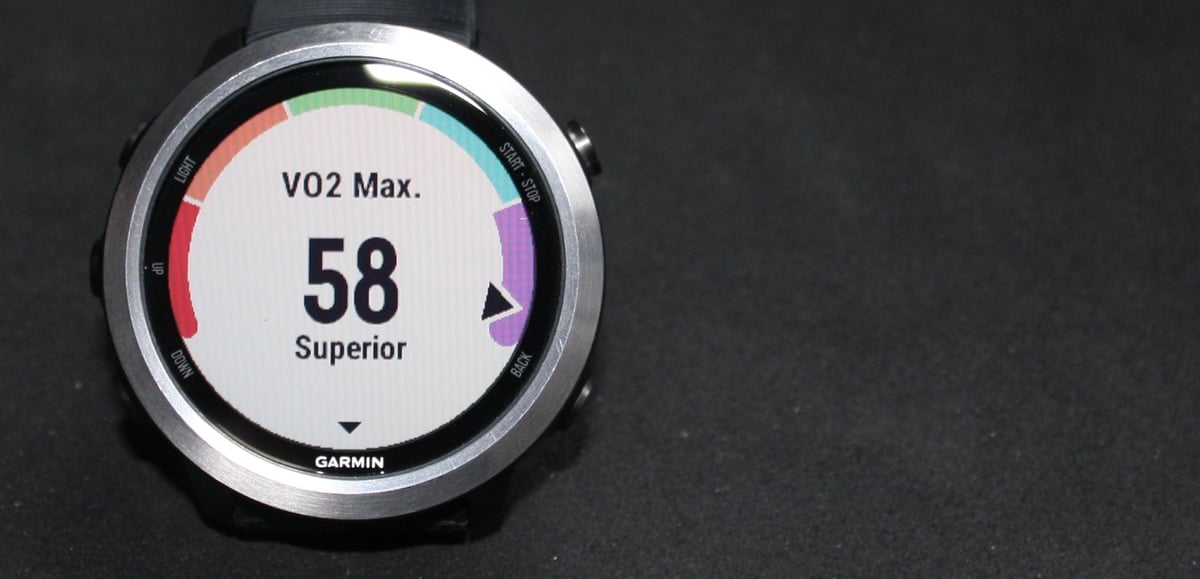
A higher VO2 max indicates a greater capacity to deliver and use oxygen at high intensities. It correlates with faster endurance performance from 5K to Ironman. Factors such as lactate threshold, running economy and pacing strategy all determine how much of that ceiling a runner can exploit in a race.
Garmin’s categorisation — Poor through Superior — is age- and sex-adjusted. A 55-year-old woman rated “Excellent” is compared against her demographic cohort. The raw number requires that the age and sex context be meaningful.
How Garmin Calculates It
Garmin’s estimate is produced by Firstbeat Analytics. The algorithm analyses the relationship between heart rate and pace during a run, or heart rate and power during a cycling activity with a paired power meter.
A qualifying run requires at least 10 minutes with a heart rate of approximately 70 per cent of maximum or higher. A qualifying cycling session requires at least 20 minutes of steady effort with a paired power meter. Sessions below these thresholds yield no update, and the device retains the previous value.
Running and cycling estimates are stored independently. A gap between them reflects genuine sport-specific adaptation.
How to interpret VO2 max
Most keen amateur athletes can improve VO2max to ‘Superior’ for their age and sex. Use this table to compare VO2 max between individuals.
Male:
| Category | Percentile | Men 20–29 | Men 30–39 | Men 40–49 | Men 50–59 | Men 60–69 | Men 70–79 |
|---|---|---|---|---|---|---|---|
| Superior | 95 | 55.4 | 54.0 | 52.5 | 48.9 | 45.7 | 42.1 |
| Excellent | 80 | 51.1 | 48.3 | 46.4 | 43.4 | 39.5 | 36.7 |
| Good | 60 | 45.4 | 44.0 | 42.4 | 39.2 | 35.5 | 32.3 |
| Fair | 40 | 41.7 | 40.5 | 38.5 | 35.6 | 32.3 | 29.4 |
| Poor | 0–40 | <41.7 | <40.5 | <38.5 | <35.6 | <32.3 | <29.4 |
Female:
| Category | Percentile | Women 20–29 | Women 30–39 | Women 40–49 | Women 50–59 | Women 60–69 | Women 70–79 |
|---|---|---|---|---|---|---|---|
| Superior | 95 | 49.6 | 47.4 | 45.3 | 41.1 | 37.8 | 36.7 |
| Excellent | 80 | 43.9 | 42.4 | 39.7 | 36.7 | 33.0 | 30.9 |
| Good | 60 | 39.5 | 37.8 | 36.3 | 33.0 | 30.0 | 28.1 |
| Fair | 40 | 36.1 | 34.4 | 33.0 | 30.1 | 27.5 | 25.9 |
| Poor | 0–40 | <36.1 | <34.4 | <33.0 | <30.1 | <27.5 | <25.9 |
What Affects the Reading
Heat elevates heart rate relative to pace. The algorithm reads this as reduced fitness and lowers the estimate. Garmin’s Heat Acclimation detection on supported devices partially compensates.
Altitude produces the same distortion. Reduced oxygen pressure at elevation causes the heart rate to rise faster than it would at sea level for an equivalent pace.
Wrist optical heart rate introduces meaningful error. The difference between runs can exceed 5 ml/kg/min under poor skin contact, high cadence, or cold conditions. A chest strap produces a more stable estimate.
Illness, poor sleep and alcohol each elevate heart rate for reasons unrelated to fitness. Running through any of these states temporarily suppresses the estimate.
Treadmill sessions require a paired footpod. GPS-verified pace is a prerequisite for the algorithm to generate an update.
How Accurate Is It
Firstbeat’s own validation, under controlled conditions with accurate maximum heart rate data, reports a mean absolute percentage error of approximately 5 per cent against laboratory spirometry. Independent studies using chest strap heart rate typically show errors in the 5–8 per cent range; wrist optical HR and thermally stressful conditions produce larger errors.
Trend reliability is more consistent than absolute accuracy. For most athletes, a rising or falling VO2 max over weeks is a more actionable output than the absolute figure.
Competitor Equivalents
- Polar uses a distinct algorithm and publishes its own validation data. Its estimates are generally considered among the more accurate wrist-based approaches.
- Apple calls its metric Cardio Fitness and derives it from walks, hikes and runs above a minimum pace threshold. Estimates skew lower than laboratory measurements. The algorithm targets a clinical rather than a performance context.
- Coros calls its equivalent Fitness Level and uses a similar heart rate–pace model. The methodology is unpublished.
- Suunto uses Firstbeat Analytics on current devices, making the methodology identical to Garmin’s on those models. Older Suunto devices used a different approach.
- Wahoo offers no standalone VO2 max estimate. Cycling data can be exported to third-party platforms that calculate proxies.
Which Garmin Devices Support It
Garmin introduced VO2 max estimation in 2014 on the Forerunner 620, making it the first consumer GPS watch to estimate maximal aerobic capacity from submaximal running data.
Running VO2 max is available on the Fenix 8 and later models in the same tier, the Forerunner 570 and later models in the same tier, and equivalents across the Enduro, Venu and Instinct lines. The feature was introduced gradually, starting in approximately 2015 and is standard on any current Garmin GPS watch with optical heart rate.
Cycling VO2 max requires a paired power meter. It is available on the Edge 530 and later models in the same tier, and on wrist devices with power meter support, including the Forerunner 970, Fenix 7 and later models in the same tier.
Heat and altitude acclimation correction — which reduces distortion of the estimate in adverse conditions — is available on the Fenix 6 and later models in the same tier, and on the Forerunner 955 and later models in the same tier. Earlier devices and entry-tier watches, such as the Forerunner 165, display the raw estimate without environmental correction.
Where to Find It
On the watch, VO2 max appears as a dedicated widget that shows the current value, category rating, and age- and sex-adjusted percentile. It is available at a glance on supported devices. In Garmin Connect mobile, it sits under Health Stats, with full historical trend data at no subscription cost. Garmin Connect web displays it in the Health and Fitness Statistics panel with less graphical detail than the app.
Common Problems and Misreadings
A sudden drop after a hot run reflects the algorithm’s response to heat-elevated heart rate. The reading recovers within 1 to 3 qualifying sessions under cooler conditions. See FAQ above for detail.
A value that stops updating is caused by sessions that are too short, too easy or with unreliable heart rate data. The device holds the previous value until a qualifying session provides sufficient data. See FAQ above for detail.
The algorithm has been updated several times. Notable changes occurred with the introduction of heat and altitude acclimation on the Forerunner 945 in 2019, and further refinements in 2023 and 2024. Any update can cause the value to shift without changing fitness.
A gap between running and cycling estimates reflects different sport-specific adaptations. The two figures are independent by design.
A reading higher than a laboratory test is common among athletes with atypically low maximum heart rates. Their profiles sit outside the population range the algorithm was tuned for.
A drop during a heavy training block is physiologically plausible. High load temporarily elevates resting heart rate and distorts the estimate. A simultaneous decline in [LINK: hrv-status] may indicate overreaching rather than a metric error.
How to Improve It
VO2 max responds most directly to training at or near maximal aerobic capacity. Intervals of three to eight minutes at approximately 90 to 100 per cent of maximum heart rate, with full recovery between efforts, carry the strongest evidence base.
Long aerobic runs at moderate intensity build stroke volume and mitochondrial density, which support a higher ceiling over months. A programme that prioritises high-volume sessions over exclusively hard sessions impairs the long-term adaptations that raise VO2 max.
Because VO2 max is expressed per kilogram of bodyweight, reducing body fat at the same absolute aerobic capacity raises the relative figure. The absolute capacity must also increase to sustain race performance, which explains why athletes who lose weight while maintaining training volume often see their values rise.
Anecdotally, Garmin’s own data in Connect shows that riding more and farther is associated with a higher VO2max.
Other Points
A 2018 study published in JAMA Network Open, analysing data from 122,007 patients at the Cleveland Clinic over a median of 8.4 years, found that each incremental improvement in cardiorespiratory fitness was associated with a 13 per cent reduction in all-cause mortality, with no upper limit to the benefit — elite fitness levels continued to provide protective effect beyond the 97th percentile (Mandsager et al., JAMA Network Open, 2018).
VO2 max begins to decline within two to four weeks of stopping structured training, with approximately 1 per cent loss per week in the early detraining period (Mujika and Padilla, Medicine and Science in Sports and Exercise, 2001). Consistent training substantially slows the approximately 1 per cent per year age-related decline observed in sedentary adults.
More questions
- Why does my Garmin VO2 max drop in summer? Heat elevates heart rate at any given pace, which the algorithm reads as reduced fitness. Garmin’s Heat Acclimation feature on supported devices partially compensates. The estimate recovers once conditions cool.
- Can I improve my estimate without actually getting fitter? To a degree, a chest strap, cooler conditions, and sessions that meet the minimum data quality thresholds all produce a more accurate, potentially higher estimate. Sustained genuine improvement requires cardiovascular adaptation.
- Is it accurate enough for race planning? [LINK: race-predictor] uses VO2 max as one input. Predictions are useful as a broad guide and should be cross-referenced with training and race experience. Under controlled conditions with chest-strap HR, predictions are often within 5 per cent of finish time.
- Why does it stop updating? The algorithm requires sufficient high-quality data from each session. Runs that are too short, too easy or with unreliable heart rate data yield no update. The device retains the previous value until a qualifying session provides enough data to recalculate.
- Does VO2 max decline with age? Yes, at approximately one per cent per year after the mid-twenties in sedentary adults, and more slowly in trained athletes. Garmin’s age-adjusted categories account for this — an “Excellent” rating at 50 reflects a different absolute value than at 25.
Scientific Basis
Firstbeat Technologies (2014). “Automated Fitness Level (VO2max) Estimation with Heart Rate and Speed Data.” Firstbeat White Paper. Describes the submaximal estimation methodology used in current Garmin devices; reports a mean absolute percentage error of approximately 5 per cent against laboratory spirometry under controlled conditions with accurate maximum heart rate data, across 2,690 validation workouts.
Ramos-Campo, D.J., et al. (2019). “Validation of heart rate-based indices to assess aerobic fitness in recreational endurance runners.” International Journal of Sports Physiology and Performance. Found a mean absolute error of approximately 5.4 ml/kg/min against laboratory spirometry in trained runners using chest strap heart rate.
Ross et al. (2016). “Importance of Assessing Cardiorespiratory Fitness in Clinical Practice.” Circulation, 134, 653–699. The American Heart Association statement establishing cardiorespiratory fitness as an independent predictor of all-cause mortality — the public health rationale underpinning consumer VO2 max features.
How It Connects to Other Features
Training Status uses VO2 max as the baseline against which recent training load is assessed to generate Productive, Maintaining, Peaking and Unproductive ratings. A valid VO2 max estimate is a prerequisite for Training Status to function.
Race Predictor uses VO2 max alongside recent training load to project finish times from 5K to marathon. Environmental or physiological distortion of the estimate degrades the prediction.
[LINK: load-focus] uses VO2 max to anchor the heart rate zones that define anaerobic, high-aerobic and low-aerobic training categories.
Training Readiness and Body Battery draw on HRV, sleep and stress data independently of VO2 max.
[LINK: hrv-status] is best read alongside VO2 max. A falling VO2 max with stable HRV Status points to environmental distortion. A falling VO2 max with declining HRV Status points to overreaching or illness.
