Garmin Vertical Ratio
Accuracy
Reliable at personal trend level at comparable paces; less reliable as an absolute benchmark
Best for
Tracking form consistency across repeated efforts at the same pace
Weakness
Readings are not comparable across different paces or sensor types; difficult to train its improvement
In Brief: A high Vertical Ratio (VR) value is bad and indicates wasted energy moving the body upwards rather than forwards. Comparison between individuals using the Ratio is made more meaningul than Vertical Oscillation, taking into account stride length.
In practice: I rarely look at this metric — I am almost always in the purple zone, so it gives me no signal worth acting on. Where it has been useful is on runs significantly beyond half marathon distance, where a slightly high reading has occasionally flagged something worth investigating; the culprit has consistently been stride length, contracting under fatigue or pace drop rather than any change in vertical movement itself. If you are regularly in green or orange, the ratio is probably worth monitoring; if you are in purple, check the underlying metrics instead.
Quick answers
What is a good vertical ratio on Garmin?
Garmin’s colour gauge places readings below 6.1% in the purple zone, representing approximately the top five percentile of runners, while readings between 7.5 and 8.6% fall in the green zone representing the middle 40%. For most recreational runners, a consistent green reading at a fixed training effort is a reasonable target; reaching purple from an orange baseline typically requires months of sustained changes to cadence and running mechanics.
| Zone | Vertical Ratio | Percentile | What it means |
|---|---|---|---|
| Purple | Below 6.1% | Top 5% | Highly efficient stride — vertical bounce is very small relative to forward distance covered |
| Blue | 6.1–7.4% | 70th–95th | Above average efficiency — typical of trained recreational and competitive runners |
| Green | 7.5–8.6% | 30th–69th | Average range — represents the middle 40% of runners in Garmin’s reference population |
| Orange | 8.7–10.1% | 5th–29th | Below average — more vertical energy than is typical; a cadence or form adjustment may help |
| Red | Above 10.1% | Bottom 5% | High vertical effort relative to forward progress — common at easy paces and in less experienced runners |
What is the difference between vertical ratio and vertical oscillation?
Vertical Oscillation measures the absolute height of the runner’s bounce in centimetres and correlates weakly with height because taller runners naturally produce slightly more torso movement. Vertical Ratio divides that figure by Stride Length to produce a percentage, removing the height bias and making the metric a more consistent basis for comparing running efficiency across runners of different stature.
Why does my vertical ratio look worse when running slowly?
Vertical Ratio falls at faster efforts because stride length grows substantially with speed while vertical oscillation does not increase proportionally, making easy-pace readings appear worse than tempo or race-pace readings from the same runner. Compare readings only from runs of similar pace and intensity — the pace-driven shift in the number does not reflect any change in running form.
How do I improve my vertical ratio on Garmin?
A moderate cadence increase of 5–10% above preferred rate reduces the height of each stride cycle without increasing oxygen consumption, lowering vertical oscillation relative to stride length. Reinforcing hip extension through single-leg strength work — hip hinge and glute activation exercises — supports the mechanical pattern that directs force rearward rather than upward.
Vertical Ratio — A Deep Dive
When Vertical Ratio Is Actually Useful
- On runs beyond 21km, a Vertical Ratio reading outside my normal purple zone has occasionally been the first sign that something in my stride has changed — checking Stride Length in the same activity has confirmed the cause every time. The change in stride length came from fatigue.
- If you are new to running dynamics and trying to decide which metrics to prioritise, this one can wait — Cadence will give you more immediately actionable information.
- Useful as a sanity check when comparing two runners or two sensors: because Vertical Ratio normalises for stride length, it is a fairer cross-runner comparison than Vertical Oscillation alone.
Introduction
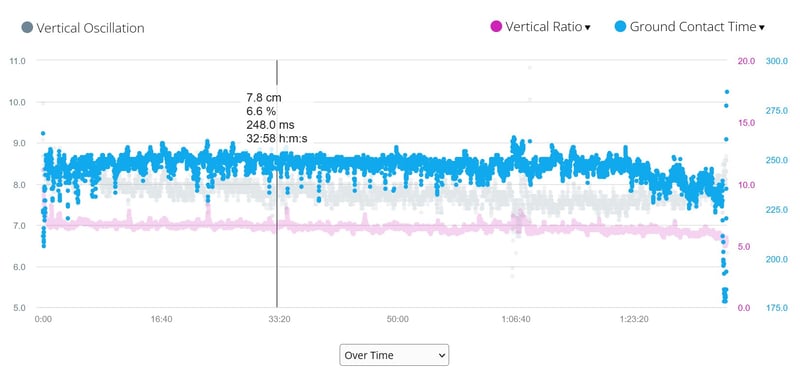
Vertical Ratio measures how much vertical bounce an athlete generates per unit of forward distance covered. Expressed as a percentage, it answers a question that raw vertical movement data cannot: whether the height of each stride is proportionate to the ground covered, or disproportionately large.
Vertical Ratio is calculated by dividing Vertical Oscillation — the vertical displacement of the torso per stride, measured in centimetres — by Stride Length, expressed as a percentage.
A runner covering 1.4 metres per stride with 9.0 cm of vertical bounce produces a Vertical Ratio of approximately 6.4%; the same 9.0 cm of bounce over a 1.1-metre stride produces approximately 8.2%. The stride length difference, not the bounce itself, explains the divergence. Vertical Ratio normalises bounce against forward progress, removing the height-correlation ambiguity that limits Vertical Oscillation in isolation.
The principal limitation of the metric is its pace-dependency: stride length increases substantially as running speed rises while vertical oscillation does not increase proportionally, so readings at easy training pace and race pace are not directly comparable.
What the Number Actually Means
Garmin displays Vertical Ratio on a five-zone colour gauge calibrated against a reference population of runners: purple below 6.1% (top five percentile), blue 6.1 to 7.4%, green 7.5 to 8.6% (middle 40%), orange 8.7 to 10.1%, and red above 10.1% (bottom five percentile). A low value indicates that a large proportion of each stride’s energy is directed horizontally; a high value indicates that vertical displacement is disproportionate relative to the ground covered. Unlike Vertical Oscillation, which correlates weakly with height, Vertical Ratio is not height-dependent, making it a more consistent basis for cross-runner comparison. Age and sex do not independently affect the metric, though both correlate with pace, which influences Vertical Ratio through the stride-length relationship described in the Introduction.
| Zone | Vertical Ratio | Percentile | What it means |
|---|---|---|---|
| Purple | Below 6.1% | Top 5% | Highly efficient stride — vertical bounce is very small relative to forward distance covered |
| Blue | 6.1–7.4% | 70th–95th | Above average efficiency — typical of trained recreational and competitive runners |
| Green | 7.5–8.6% | 30th–69th | Average range — represents the middle 40% of runners in Garmin’s reference population |
| Orange | 8.7–10.1% | 5th–29th | Below average — more vertical energy than is typical; a cadence or form adjustment may help |
| Red | Above 10.1% | Bottom 5% | High vertical effort relative to forward progress — common at easy paces and in less experienced runners |
How Garmin Calculates It
Vertical Ratio is computed from two inputs — Vertical Oscillation and Stride Length — and was introduced as part of the six-metric Running Dynamics suite in 2015 on the Forerunner 630 paired with the HRM-Run chest strap.
Vertical Oscillation is measured by a triaxial accelerometer or a compatible external sensor, capturing peak vertical displacement of the sensor between successive foot strikes. Stride Length is not measured directly: Garmin derives it by dividing GPS-measured pace by cadence. Vertical Ratio is then calculated as Vertical Oscillation divided by Stride Length, with both values expressed in the same unit, multiplied by 100 to produce a percentage. From March 2023, the watch’s own wrist accelerometer computes the metric without an external sensor on supported devices.
The metric updates continuously during a recorded running activity and is not calculated during walking segments. On treadmills, Stride Length relies on the machine’s reported speed rather than GPS, which reduces accuracy in the Vertical Ratio calculation. Garmin calibrates the colour gauge zones using chest-strap reference measurements; absolute values differ by sensor position — chest, waistband pod, and wrist — and the gauge is adjusted accordingly for each type, though Garmin does not publish the wrist-specific zone thresholds separately.
What Affects the Reading
Sensor position is the primary hardware factor: chest-mounted, waistband, and wrist sensors produce different absolute Vertical Ratio values because each occupies a different point on the body. Switching sensor type creates a discontinuity in trend data that does not reflect any change in running form.
Terrain affects Stride Length directly — uphill grades shorten the stride and push Vertical Ratio higher; downhill grades have the opposite effect. Highly cushioned footwear may marginally increase measured Vertical Oscillation at identical effort, though the magnitude has not been independently quantified for Garmin’s sensor system.
Pace is the dominant physiological variable. As running speed increases, stride length grows substantially while vertical oscillation grows only modestly, so Vertical Ratio falls at faster efforts independent of any change in form. Fatigue produces a consistent pattern: cadence falls, stride length shortens, and vertical oscillation tends to rise, collectively raising Vertical Ratio over the course of a long run or race. Both of these patterns are addressed as common misreadings in the section below.
How Accurate Is It
No published peer-reviewed study has validated Garmin’s Vertical Ratio metric against a laboratory reference standard. The group-level relationship between vertical oscillation and running economy is established in the research literature: Tartaruga et al. (2012) found significant negative associations between vertical oscillation and running economy at submaximal speeds in trained distance runners, and Moore (2016) identified vertical oscillation as among the biomechanical variables most consistently linked to running economy across a comprehensive review. At the individual level the relationship is weaker, and the sensor’s position at the chest or wrist does not precisely represent movement at the centre of mass — the biomechanically meaningful location — which limits the metric’s prescriptive value for any single athlete.
Stride Length, the denominator in the Vertical Ratio calculation, introduces additional uncertainty because it is GPS-derived rather than directly measured. Signal degradation under tree cover, in urban canyons, or during the early minutes of a run before GPS lock stabilises propagates error into the denominator. The metric is best interpreted as a relative indicator of within-runner consistency at comparable paces rather than as an absolute benchmark against population norms.
Competitor Equivalents
- Stryd foot pod: measures all the component inputs — vertical oscillation, stride length, cadence — from a foot-mounted sensor compatible with any ANT+ or Bluetooth device; absolute values differ from Garmin’s chest or wrist implementation and no labelled vertical ratio equivalent is available.
- Polar: no native equivalent; vertical oscillation and ground contact time require a paired Stryd foot pod, and no vertical ratio metric is calculated or displayed on any Polar device.
- Apple: Vertical Oscillation and Stride Length are displayed individually from watchOS 9 on Series 6 and later, but no derived vertical ratio is calculated or surfaced within Apple’s interface.
- COROS: Stride Ratio — the direct equivalent — was added via the September 2025 firmware update to six devices including the PACE 3, APEX 2, and VERTIX 2, computed from the wrist accelerometer in Road Run and Track Run modes, without a percentile colour gauge system.
- Suunto: cadence is measured natively on current devices, but vertical oscillation requires a paired Stryd foot pod, and no vertical ratio equivalent is derived.
- Wahoo: produces cycling computers rather than GPS running watches and has no equivalent metric.
Which Garmin Devices Support It
Vertical Ratio is part of the six-metric Running Dynamics suite introduced in 2015. Any Garmin watch that accepts ANT+ running dynamics accessories supports the metric via the HRM-Run, HRM-Tri, HRM-Pro Plus, HRM-600, HRM-Fit, or Running Dynamics Pod. The HRM-Pro Plus must be paired in ANT+ mode; Bluetooth pairing transmits heart rate only and records no running dynamics data.
Native wrist-based Vertical Ratio — without any accessory — became available across compatible Garmin OS devices in March 2023, introduced at launch on the Forerunner 265 and Forerunner 965 and extended by firmware update to the Fenix 7 series, Epix Gen 2, Forerunner 255 series, Forerunner 955 series, Enduro 2, Quatix 7, and MARQ Gen 2 in the same month.
The Forerunner 165, Venu 3, Venu 3S, and Vívoactive 6 support wrist Vertical Ratio but cannot pair an external running dynamics sensor. Verify the current compatibility list against Garmin’s Running Dynamics support FAQ before relying on this list.
Where to Find It
- Activity data field: Running Dynamics category in the activity data field settings; displays as a percentage with colour gauge, updating in real time throughout a recorded run.
- Activity Summary: A single figure Vertical Ratio is shown in the summary for each run workout.
- Garmin Connect app: Activity detail view > Running Dynamics section; displays per-activity data for any run in which dynamics were recorded; no standalone historical trend chart; accessible on the standard Garmin Connect subscription without Connect Plus.
- Garmin Connect web: Activity detail view; Running Dynamics data visible per activity; presentation is more limited than the mobile app and no trend chart is available.
Common Problems and Misreadings
The most frequently observed discrepancy is a Vertical Ratio that reads orange or red during easy runs but improves to green or blue at tempo or race pace. See FAQ above for detail. Tracking Vertical Ratio at a fixed weekly effort — such as an easy run held at a consistent heart rate zone — produces a more meaningful long-term signal than comparing easy and hard sessions directly.
A reading that shifts noticeably when moving from a chest strap to wrist-based measurement does not indicate that form has changed. See FAQ above for detail. A training cycle begun with a chest strap and continued with wrist-only measurement contains a data discontinuity at the point of switch; trend comparisons after that point are unreliable.
A Vertical Ratio that rises progressively over the final kilometres of a long run is a normal physiological response to fatigue rather than a sign of a correctable technique error. As noted in What Affects the Reading, the fatigue pattern — cadence dropping, stride shortening, oscillation increasing — raises the ratio by altering both the numerator and denominator simultaneously. Monitoring this progression across multiple long runs at similar distances is useful for identifying fitness-related fatigue onset; treating it as a real-time form cue to correct mid-run is not supported by how the metric is designed.
How to Improve It
Vertical Ratio is driven by two variables: vertical oscillation and stride length. Reducing oscillation at a given pace, increasing stride length at a given level of oscillation, or both simultaneously lowers the ratio. The most evidence-supported approach to reducing vertical oscillation is a moderate cadence increase: Heiderscheit et al. (2011) demonstrated that increasing step rate 5 to 10% above a runner’s preferred cadence reduced loading at the knee and hip without increasing oxygen consumption. Increments of three to five steps per minute are more likely to produce durable changes than large step changes, which can alter mechanics in unintended ways. Reinforcing hip extension through single-leg strength work — hip hinge variations and glute activation exercises — supports the mechanical pattern that directs force rearward rather than upward.
Some vertical movement is mechanically necessary: the stretch-shortening cycle in the Achilles tendon and plantar fascia stores and returns elastic energy that contributes to forward propulsion. The practical aim is not to minimise Vertical Ratio as far as possible but to ensure that vertical oscillation is proportionate to the stride length sustainable at a given effort — which is precisely what the metric captures.
Scientific Basis
- Tartaruga MP et al., Research Quarterly for Exercise and Sport, 2012 (PMID 22978185): found significant negative associations between vertical oscillation and running economy at submaximal speeds in trained distance runners, providing the primary scientific rationale for treating vertical oscillation — and by extension Vertical Ratio — as a running economy indicator.
- Moore IS, Sports Medicine, 2016 (PMID 26816209): a comprehensive review identifying vertical oscillation as among the modifiable biomechanical variables most consistently associated with running economy, noting that the scope for intervention differs between experienced and recreational runners.
- Heiderscheit BC et al., Medicine and Science in Sports and Exercise, 2011 (PMID 20581720): demonstrated that increasing step rate 5 to 10% above preferred cadence reduced knee and hip loading without increasing oxygen consumption, supporting cadence modification as the primary practical lever for reducing vertical oscillation and improving Vertical Ratio.
- Garmin International, Forerunner 630 Owner’s Manual, 2015: the primary technical document confirming Vertical Ratio as a defined metric within the Running Dynamics suite, specifying the calculation as Vertical Oscillation divided by Stride Length, and establishing the five-zone colour gauge thresholds in use across all subsequent compatible devices. [EDITOR: confirm citation before publishing]
How It Connects to Other Features
Vertical Ratio is derived from Vertical Oscillation and [LINK: stride-length], and changes in either input shift the ratio directly; monitoring all three simultaneously in the Running Dynamics data field gives the clearest view of which variable is driving a change. Cadence interacts with Vertical Ratio through its effect on Stride Length — at any fixed pace, a higher cadence shortens the stride and raises Vertical Ratio if oscillation is unchanged, so cadence adjustments intended to improve the ratio must be paired with attention to vertical movement. Ground Contact Time shares the running economy association that motivates the suite and, read alongside Vertical Ratio, provides a more complete picture of stride mechanics than either metric alone. Garmin’s [LINK: running-economy] feature, introduced with the HRM-600 in 2025, uses the full running dynamics output — including Vertical Oscillation, from which Vertical Ratio is derived — and requires an HRM-600 paired in BLE secure connection mode; earlier accessories do not provide the complete data set that feature requires.
