Garmin Vertical Oscillation
Reliable as a within-runner trend indicator at comparable intensities; individual absolute values unvalidated against motion capture
Detecting gradual form improvements at consistent paces over weeks of training
Does not distinguish elastic rebound from wasteful bounce; shifts with pace regardless of form.
Plain English: Vertical Oscillation is how far your torso moves up or down as you run. Typically, that is 9-12 cm, or 6–9 cm for faster runners. Intuitively, a higher value is seen as a waste of energy.
In practice: I have never found this metric useful, and it is not directly trainable. I have found that VO decreases with running speed and with training, but only because training makes me run faster.
Frequently Asked Questions
What is a good vertical oscillation on Garmin?
Garmin’s colour zones place values below 6.4 cm in the highest-performance band (purple) and values above 11.5 cm in the lowest-performance band (red). For a recreational runner, a figure in the green zone (8.2–9.7 cm) at a moderate pace is typical of someone running with reasonable efficiency. Focus on whether the value trends lower over time at comparable paces rather than on reaching a specific absolute number.
| Colour | Range (chest strap) | Typical runner profile |
|---|---|---|
| Purple | Below 6.4 cm | Fast, highly efficient runners |
| Blue | 6.4–8.1 cm | Experienced, competitive runners |
| Green | 8.2–9.7 cm | Recreational runners with reasonable efficiency |
| Orange | 9.8–11.5 cm | Less experienced or slower runners |
| Red | Above 11.5 cm | Beginner runners or very slow paces |
These apply to chest strap derived measurements only.
Why is my vertical oscillation always in the red?
Red-zone readings are common at easy and slow paces because vertical oscillation rises as speed decreases — this is expected behaviour, not evidence of poor form. The colour zones are calibrated against a mixed reference population, so a recreational runner at an easy pace will frequently sit in the orange or red zones. Check whether the figure improves with faster efforts before concluding form.
How do I improve my vertical oscillation?
Increasing step rate by 5–10% above preferred cadence produces a measurable reduction without increasing oxygen consumption at the same speed. Hip extension drills — A-skips, bounding, and stiff-legged running — reinforce the posterior drive that shifts propulsion toward a more horizontal vector. Consistent aerobic training tends to reduce vertical oscillation due to improved fitness, without deliberate form modifications.
What is the difference between vertical oscillation and vertical ratio?
Vertical oscillation is the raw centimetre figure for torso bounce per stride; vertical ratio divides that figure by stride length to produce a percentage. Vertical ratio removes the effect of height and pace on the raw number, making it a more consistent basis for tracking efficiency improvements over time. Use vertical oscillation as a real-time reference and vertical ratio for trend assessment.
Vertical Oscillation — A Deep Dive
When Vertical Oscillation Is Actually Useful
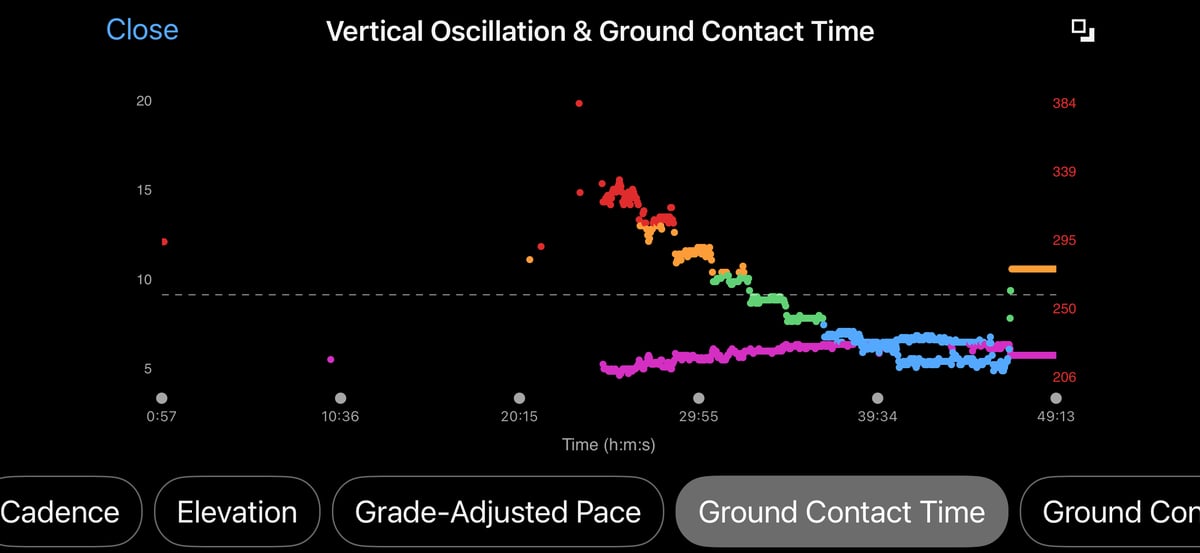
Paavo Nurmi (1930) famously trained to minimise vertical oscillation while running; all my efforts to specifically reduce VO through drills did not work once other factors like speed are accounted for. You can see from the ramp test in the image below that as I run faster my ground contact time falls and stabilises at race-like speeds whereas my VO rises and stabilies at the same speeds before falling at unsustainable speeds. There were some flaws in this experiment as I was wearing supershoes (bouncy, energy return) and I reached the maximum speed of my treadmill and had to increase its incline rather than speed. One reading is that I am not properly directing forwards the energy return from the shoes, the other is that I should invest in a better treadmill.
Introduction
Vertical oscillation measures how much a runner’s torso bounces up and down with each stride, expressed in centimetres. A lower value indicates that less energy is being directed vertically, which is associated with a better running economy.
Vertical oscillation is one of the six running dynamics metrics captured by Garmin’s accelerometer-based system. The watch or connected sensor detects the peak vertical displacement of the torso between successive ground contacts and reports the average figure for each stride. Garmin displays the value alongside a colour-coded gauge calibrated against a reference population of runners, ranging from purple (below 6.4 cm) through green (8.2–9.7 cm) to red (above 11.5 cm). The principal limitation of the metric is that it measures total vertical displacement without distinguishing between the elastic rebound that contributes to forward propulsion and the genuinely wasteful bounce that does not. Some vertical movement is biomechanically necessary for energy storage and return via the Achilles tendon and plantar fascia, and a low figure alone does not confirm efficient running.
How Garmin Calculates It
Garmin’s running dynamics system uses a triaxial accelerometer to detect motion. When the sensor is positioned on the chest — as in the HRM-Run, HRM-Tri, HRM-Pro Plus, HRM-600, and HRM-Fit straps — it directly captures thoracic movement. The Running Dynamics Pod measures the same metric from a waistband position using an identical sensor architecture. On supported devices from the Forerunner 265 generation onwards, the watch’s own wrist accelerometer provides an equivalent reading without any accessory. The calculation identifies the peak vertical sensor displacement between successive foot-strike events and reports the result in centimetres per stride, averaged over a rolling window to smooth out noise from individual strides.
The metric is calculated only during running activity and is not available in walking, cycling, or other activity types. The colour zone boundaries differ between sensor positions: the chest-strap zones (purple below 6.4 cm, red above 11.5 cm) are not the same as those applied to wrist-based or pod-based readings because the absolute displacement measured differs by sensor location. Garmin calibrates each sensor position separately.
What Affects the Reading
Sensor position is the most consequential hardware variable. A chest-mounted strap, a waist-mounted pod, and the wrist-based accelerometer each register different displacement figures for the same runner at the same pace. The three sources are not interchangeable and must not be mixed within a trend dataset; switching sensor types creates a step change in the reported value that reflects a change in sensor location rather than any change in running form. Terrain and footwear introduce smaller effects: highly cushioned shoes marginally increase displacement at ground contact, and soft surfaces such as grass or trail alter push-off mechanics in ways that feed into the measurement. Hills shift the figure as the gradient changes the geometry of each stride.
Pace is the dominant physiological variable. Vertical oscillation rises at slower paces and falls as speed increases, shifting the colour zone by one or two bands between easy and threshold efforts in most runners. This is expected behaviour, not evidence of form changes between sessions. Fatigue produces a characteristic pattern across the dynamics suite: as a run progresses, vertical oscillation increases, ground contact time lengthens, and cadence drops. This is a normal neuromuscular response to sustained effort.
How Accurate Is It
Published research supports the directional claim that lower vertical oscillation is associated with better running economy at the group level. Tartaruga et al. (2012) reported significant negative associations between vertical oscillation and running economy at submaximal speeds in distance runners. Moore (2016) identified vertical oscillation among the modifiable biomechanical variables most consistently associated with running economy in a systematic review, noting that the direction and scope of beneficial gait modification differ between experienced and recreational runners.
At the individual level, the relationship is weaker. The sensor measures displacement at the chest, wrist, or waist — not at the body’s centre of mass — and the quality of that proxy varies with body composition, clothing fit, and strap positioning. No independent peer-reviewed study has validated the absolute accuracy of Garmin’s wrist-based figures against laboratory-grade motion capture. The metric is most reliable as a within-runner trend indicator at comparable intensities: a sustained reduction at the same pace and heart rate over several weeks of training is a meaningful signal; a single comparison against a different runner or a different pace is not.
Competitor Equivalents
- Polar does not measure vertical oscillation from its own sensors; the metric is available on the Vantage V3 and Vantage M3 only via a paired Stryd foot pod, which provides the sensor data rather than Polar’s hardware.
- Apple Watch (Series 6 and later, watchOS 9 and above) measures vertical oscillation natively from the wrist. It presents it in real-time workout views and post-activity summaries in the Fitness and Health apps, without a colour-coded percentile gauge.
- Coros calls the equivalent metric Stride Height, introduced natively via a September 2025 firmware update on the PACE 3, PACE Pro, APEX 2, APEX 2 Pro, VERTIX 2, and VERTIX 2S; absolute values have not been independently validated against Garmin’s implementation.
- Suunto does not measure vertical oscillation natively on any current device; it is available only via a paired Stryd foot pod. [EDITOR: verify against suunto.com before publishing]
- Wahoo does not offer vertical oscillation or equivalent running dynamics metrics on any current device.
Which Garmin Devices Support It
Vertical oscillation via an external accessory has been available on any ANT+ Garmin watch since the feature launched in 2014 with the HRM-Run and Forerunner 620. The HRM-Fit, HRM-Pro, and HRM-Pro Plus must be paired in ANT+ mode rather than Bluetooth to transmit dynamics data; a Bluetooth-only pairing delivers heart rate but no dynamics, including vertical oscillation. Native wrist-based vertical oscillation was introduced in March 2023 and is now available on all current Garmin OS watches with the required accelerometer. The exceptions are the Forerunner 165, Venu 3, Venu 3S, and Vívoactive 6, which support wrist-based vertical oscillation but cannot pair with external running dynamics accessories, making ground contact time balance unavailable on those devices. Verify current compatibility against the Garmin support FAQ before publishing, as firmware updates periodically extend the list.
Where to Find It
- Activity data field — add to any data screen via the activity settings menu on supported devices; displays a live value throughout the run.
- Activity summary on watch — accessible after the run is saved as part of the running dynamics summary screen.
- Garmin Connect app — activity detail view, Running Dynamics section; presents a graphical colour-zone breakdown of vertical oscillation over the course of the run. Historical data is accessible only within individual activity files; vertical oscillation is not aggregated into a standalone trend chart.
- Garmin Connect web — same per-activity breakdown as the app; no separate long-term trend visualisation for running dynamics metrics.
- Widget glance/watch face complication — not available outside an active run.
- Garmin Connect Plus — no subscription required to access vertical oscillation data.
Common Problems and Misreadings
The most common misreading is treating the figure as stable across intensities. As noted in “What Affects the Reading,” vertical oscillation is pace-dependent and rises predictably as effort declines. A figure that climbs across the second half of a long run reflects normal fatigue mechanics, not evidence that form has deteriorated. See FAQ above for details.
A reading that disappears or displays a dash during a run is almost always a pairing issue rather than a hardware fault. The HRM-Pro, HRM-Pro Plus, and HRM-Fit transmit running dynamics only when paired via ANT+. A Bluetooth pairing delivers heart rate but no dynamic data. Check the sensor list in the device settings to confirm the strap is showing as an ANT+ sensor rather than a Bluetooth heart rate monitor.
Cross-runner comparisons of absolute vertical oscillation values are unreliable because taller runners structurally produce higher figures at comparable speeds, independent of efficiency. The Vertical Ratio metric — vertical oscillation divided by stride length — removes this height effect and provides a more consistent basis for comparison across runners of different statures. Runners whose vertical oscillation sits consistently in the orange or red zone at all paces should assess Vertical Ratio before concluding form.
How to Improve It
Increasing the step rate by 5–10% above the preferred cadence reduces vertical displacement at the hip and knee loading without increasing oxygen consumption at the same speed, as demonstrated by Heiderscheit et al. (2011). The mechanism is mechanical: shorter, more frequent strides produce a flatter trajectory. A gradual increase of five steps per minute, sustained over several weeks, produces a measurable reduction in vertical oscillation without disrupting habitual mechanics. Hip extension drills — A-skips, bounding, and stiff-legged running — reinforce posterior drive and shift propulsion toward a more horizontal vector; these adaptations require weeks to months of consistent reinforcement to become automatic at race pace.
Aerobic volume, an appropriate intensity distribution, and strength work are the primary drivers of improvements in running economy. Vertical oscillation reduction follows from those adaptations rather than preceding them. Targeting a low vertical oscillation figure as an explicit goal is not well supported by evidence as a standalone strategy; runners who train consistently tend to show lower values as a consequence of improved fitness and neuromuscular efficiency.
Scientific Basis
Tartaruga MP, Brisswalter J, Peyré-Tartaruga LA, et al. Research Quarterly for Exercise and Sport. 2012. Reported significant negative associations between vertical oscillation and running economy at submaximal speeds in distance runners, providing the primary peer-reviewed basis for the metric as a running economy indicator. DOI: 10.1080/02701367.2012.10599870.
Moore IS. Sports Medicine. 2016. Systematic review identifying vertical oscillation among the modifiable biomechanical variables most consistently associated with running economy, noting that the scope and direction of beneficial gait intervention differ between experienced and recreational runners. DOI: 10.1007/s40279-016-0474-4
Heiderscheit BC, Chumanov ES, Michalski MP, Wille CM, Ryan MB. Medicine and Science in Sports and Exercise. 2011. Demonstrated that increasing step rate 5–10% above preferred cadence reduced vertical displacement and joint loading without increasing oxygen consumption, providing the biomechanical rationale for cadence-based approaches to reducing vertical oscillation. DOI: 10.1249/MSS.0b013e3181ebedf4.
Morin JB, Jeannin T, Chevallier B, Belli A. International Journal of Sports Medicine. 2006. Quantified the relationships between ground contact time, leg stiffness, and running speed, establishing the spring-mass framework within which vertical oscillation’s role in elastic energy return is understood. DOI: 10.1055/s-2005-837569.
How It Connects to Other Features
Vertical oscillation feeds directly into [LINK: vertical-ratio], which divides the figure by stride length to normalise for height and pace; [LINK: stride-length] in turn is derived from GPS pace and cadence rather than from a direct stride measurement. Ground Contact Time (GCT) shares the same accelerometer data source and is mechanically coupled to vertical oscillation through cadence: as step rate rises, GCT falls, and vertical oscillation typically decreases.
Garmin’s Running Economy feature, introduced with the HRM-600 in 2025, requires vertical oscillation as one of four inputs alongside ground contact time, ground contact time balance, and Step Speed Loss, and is only calculated when the HRM-600 is paired in BLE Secure Connection mode, making vertical oscillation a dependency of [LINK: running-economy]. [LINK: running-power] draws from the same sensor hardware, with horizontal and vertical displacement signals contributing to the power estimate.
