Garmin’s Infinity Battery Life: How Watches Got There and How They Will Get Better Still
Most smartwatches have sports mode battery lives measured in hours. Some can boast multi-day lives. Garmin’s very best are measured in weeks — and, in niche cases, some models have infinite battery life.
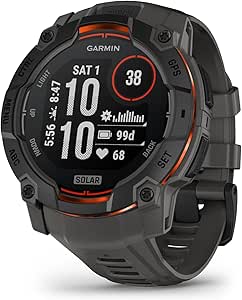
Some Instinct Solar owners will see the infinity symbol. Under the right conditions, this watch gains energy faster than it spends it.
That outcome is the result of decisions made across every layer of the device — the glass, the display, the processor, the radio chips, the firmware, and the battery cell itself. Each of those layers has been optimised to reduce power consumption to a point where a small photovoltaic array embedded in the watch face can tip the balance from depletion to equilibrium.
This article examines how Garmin arrived at that point, what is actually happening inside these watches based on teardowns and deep research, and where the technology is credibly headed. It draws on Garmin’s own product documentation, independent field testing, component datasheets, and teardown analysis. It’s more of an engineering analysis than a product review.
Listen to the discussion
Readers who want to understand how Garmin has achieved infinite battery life modes — and why no competitor has yet managed to replicate them — will find the answer in the interaction among four factors: the display technology, the solar architecture, the internal power management, and the physics of energy harvesting at wrist scale.
The Display Decision: Why Everything Else Depends on This
The most consequential engineering choice in any Garmin solar watch is one that most buyers make without fully understanding its implications: MIP vs AMOLED.
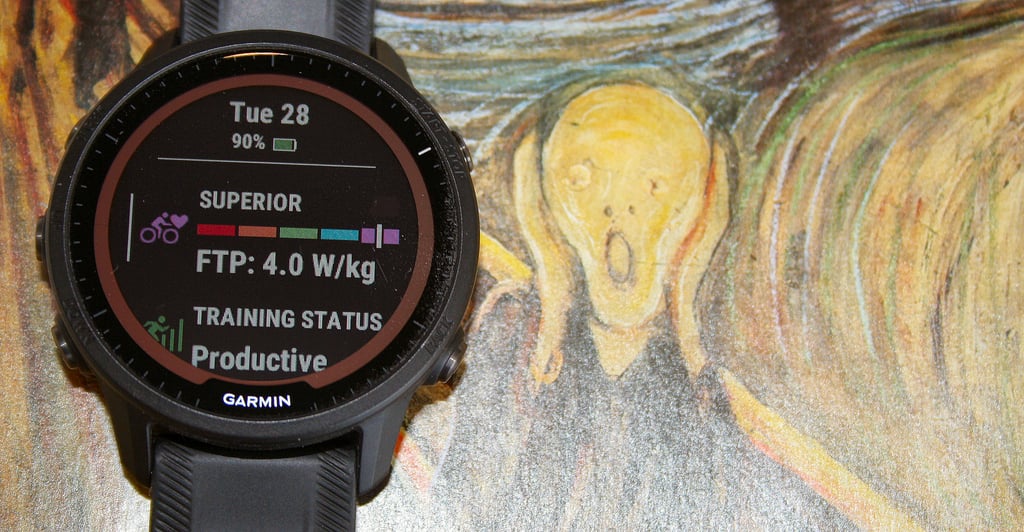
Wearable Memory-in-Pixel (MIP) displays are transflective. They reflect ambient light back through the panel to render an image, becoming easier to read in direct sunlight rather than harder. A MIP display draws power only when its pixels change state — a static watch face or stable running metric costs almost nothing to maintain. This is why MIP watches can idle for weeks.
AMOLED panels work on an entirely different principle. Each pixel generates its own light, producing vivid colour, deep blacks, and the kind of visual richness that makes a MIP display look poor by comparison. Each self-emitting pixel draws power continuously while the display is active. In a device worn on the wrist and glanced at dozens of times a day, that sustained draw is substantial.
| model | display | smartwatch battery | gps battery |
| Fenix 8 51mm AMOLED | amoled | up to 29 days | up to 84 hours |
| Fenix 8 51mm solar | mip + solar | 30 days (48 w/ solar) | 95 hours (149 w/ solar) |
| Instinct 3 50mm AMOLED | amoled | up to 24 days | up to 40 hours |
| Instinct 3 50mm solar | mip + solar | 40 days (unlimited*) | 60 hours (260 hours*) |
| enduro 3 | mip + solar | 36 days (90 w/ solar) | 120 hours (320 w/ solar) |
*assuming 3 hours per day in 50,000 lux conditions.
Garmin has filed patents for solar AMOLED technology, which suggests the company is exploring whether the combination might eventually be viable. For now, there is no commercially produced solution. Every watch model with infinite battery life modes uses an MIP panel.
The Solar Architecture: How Energy Gets In To Feed MIP Displays
Garmin’s entry into solar wearables followed the company’s acquisition of SunPartner Technologies, a French photovoltaic specialist that had developed methods for integrating transparent solar layers into consumer display products. The technology debuted in the Fenix 6 series in 2019 and established a template that Garmin would use for the following five years.
That original design placed a semitransparent solar layer between the display and the cover glass, spanning the entire watch face. The panel used two cell densities: highly efficient cells around the display perimeter, where they did not obstruct the screen, and a much sparser array across the main display area, where transparency was required for readability of on-screen metrics. The central cells operated at roughly 10% photovoltaic efficiency, i.e. only one-tenth of incoming light was available for conversion, with the remainder passing through to the display. Perimeter cells operated at closer to full efficiency. The result was a working solar system. The one visible drawback was a persistent reddish tint across the watch face.
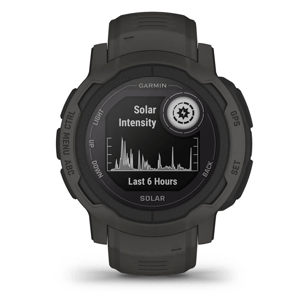
From 2019 through to 2024, this architecture remained essentially unchanged as Garmin extended solar capability across a widening range of products — the Instinct Solar, the Instinct 2 Solar, the Enduro series, and the Edge bike computer range. Each launch brought the technology to new audiences, but the underlying design did not materially change.
A change came with the Fenix 8 Solar and Enduro 3 (2024). Garmin relocated the solar cells entirely off the display area. The new architecture concentrates the photovoltaic array exclusively on the non-screen bezel portions of the watch face, packed at considerably higher density. With no solar material between the eye and the pixels, the reddish tint disappeared. Paired with Power Sapphire – Garmin’s brand of synthetic sapphire crystal, with a theoretical rating of 9 on the Mohs hardness scale and is effectively unscratchable in normal use — the Enduro 3 claimed solar-boosted battery lives of 90 days in smartwatch mode and 320 hours with GPS. Garmin now boasted up to five times the solar charging power of the previous generation. Independent testing supported that figure during daylight sporting activities.
In January 2025, this second-generation solar architecture was introduced to the Instinct 3 Solar, representing the first meaningful hardware upgrade to that series since the original design. Where the Instinct 2 Solar achieved 48 hours of GPS-only tracking with solar contribution, the Instinct 3 Solar impressively reaches 130 hours in the same mode. In Max Battery GPS mode (i.e., with restrictions applied), Garmin officially designates battery life as unlimited with adequate solar exposure — another claim validated in independent real-world testing, with burn rates consistently recorded below 1% per hour in high-drain GPS modes.
Here is a timeline of Garmin’s Solar Tech progression:
| Year | Product | Solar Generation | Key Change |
|---|---|---|---|
| 2019 | Fenix 6 Solar | Gen 1 | First solar Garmin — dual-density panel, reddish tint |
| 2020 | Instinct Solar | Gen 1 | Solar enters the mid-tier lineup |
| 2022 | Instinct 2 Solar | Gen 1 | Broader availability, same core architecture |
| 2024 | Fenix 8 Solar / Enduro 3 | Gen 2 | Bezel-only cells, no tint, Power Sapphire, 5× power |
| 2025 | Instinct 3 Solar | Gen 2 | Gen 2 solar trickles down, unlimited in multiple modes |
The Physics of Harvesting
Understanding what solar actually contributes requires confronting some inconvenient geometry. A photovoltaic cell produces its rated output when sunlight strikes it at a perfect 90-degree angle to the surface. As the angle of incidence changes, output falls. A curved watch face already accepts a roughly 20% reduction relative to a flat panel simply because the light cannot strike every part of the surface at the optimal angle. Another, more significant, variable is wrist orientation: when the solar panel faces sideways relative to the sun, output does not merely dip — it falls to approximately one-sixth of its maximum. The wrist of an active person rarely points directly at the sun for extended periods.
Garmin’s design response to this is to distribute the solar array across multiple panels set at slightly different orientations, so that some useful capture occurs regardless of wrist position. The entire array is then managed by a Power Management Unit running Maximum Power Point Tracking (MPPT) algorithms — the same principle used in rooftop solar installations — which continuously adjusts the electrical operating point of the cells to extract the maximum available power at any given light intensity and angle.
Garmin’s published benchmark for solar contribution is three hours per day at 50,000 lux, equivalent to bright outdoor sunlight at mid-latitudes. Direct sun near the equator at altitude can reach 150,000 lux — two to three times the benchmark. Under genuinely favourable conditions, with the watch left stationary in good sunlight, the Gen 1 architecture could restore approximately 20% of battery capacity per day. Gen 2 improves on this figure.
The charging rate follows a diminishing-returns curve as the battery fills: a lithium-ion cell is more easily charged at lower levels.
It is important to be precise about what solar does and does not do. Solar charging does not meaningfully charge a watch left in the sun; instead, it prevents it from depleting while in use.
Inside the Watch: The Power Architecture
Solar input measured in milliwatts only tips the balance if the watch consuming those milliwatts has been engineered to need very few of them. Thus, the internal architecture of Garmin’s current hardware generation reflects a decade of incremental decisions aimed at exactly that goal.
The Processor
The Fenix 6X Pro, launched in 2019, ran on an NXP Kinetis MK28FN2M0 — a 150 MHz ARM Cortex-M4 processor with 2 MB of flash and 1 MB of SRAM. Garmin’s firmware ran directly on the hardware without an intervening operating system, which eliminated the power overhead that conventional OS layers impose. The 150 MHz clock speed represented a burst ceiling rather than a sustained operating point; normal operation sat well below that figure, with the firmware managing clock scaling aggressively to keep the draw minimal.
By the time of the Fenix 8 in late 2024, the next-generation processor in use was the NXP i.MX RT500 — a dual-core design pairing an ARM Cortex-M33 main core with a Cadence Xtensa DSP, both capable of 200 MHz. The Cortex-M33 brings improved power efficiency at equivalent workloads relative to the M4 (2019), along with TrustZone security extensions relevant to payment functionality. The DSP processes audio from the Fenix 8’s speaker and microphone. Importantly, the RT500 includes a 2D graphics engine and 5 MB of on-chip SRAM, enabling granular power management by selectively shutting down unused memory blocks.
That last capability enabled the elimination of the external Winbond LPDDR RAM, previously used by Fenix 6X Pro to buffer map data. The Fenix 8 now has no external RAM. The on-chip memory has a smaller total capacity, which makes map rendering visibly slower — a deliberate trade-off. Garmin accepted reduced UI responsiveness in exchange for eliminating a power-hungry external component. It is a characteristic Garmin optimisation: snappiness and usability are deliberately sacrificed for endurance.
The upgrade cycle for these component processors is relatively slow and differs from that of smartphones seeking performance. The Cortex-M series is optimised for efficiency, and the same silicon platform routinely spans multiple product generations. A stable platform means firmware improvements in power management compound across generations and flow downward through the product line.
The Shared Platform Dividend
That last point has implications beyond the flagship range. Teardown analysis has shown that mid-tier Garmin watches from the same product generation share the same core silicon as their premium counterparts. The differences between a Forerunner and a Fenix of equivalent vintage come down to peripheries such as NFC, sensor count, storage capacity, and software-enabled features, rather than to different processors.
One positive consequence here is that when Garmin refines power management for the Fenix, those improvements propagate to the Forerunner. A shared codebase on shared silicon means the efficiency gains at the top of the line benefit the entire range. From a battery-engineering standpoint, the investment Garmin makes in its flagship products compounds downward through the lineup with every firmware update. A good thing, for sure.
The Battery Cell and a Detail Worth Noting
The Fenix 6X Pro carried a 420 mAh lithium-ion cell at 3.8V, delivering 1.596 Wh of stored energy. The Fenix 8 Solar in the 51mm case carries a 618 mAh cell at 3.91V, delivering 2.42 Wh — a 47% increase in raw capacity. Combined with the more efficient processor, the elimination of external RAM, consolidated radio chips, and improved GNSS, this capacity increase is what converts the Fenix 6X Pro’s 21-day smartwatch claim into the Fenix 8 Solar’s 48-day-with-solar figure.
One detail from a published teardown of the Fenix 6X Pro is worth noting here. The non-solar variant’s motherboard contained an empty component position near the power management IC, located precisely where a solar charge management chip would sit in the solar variant. As that teardown documented, the non-solar Fenix 6X Pro was designed from the outset to accommodate solar hardware — solar was always intended to be a variant.
| Component | Fenix 6X Pro (2019) | Fenix 8 Solar 51mm (2024) | Change |
|---|---|---|---|
| Main SoC | NXP Kinetis K28F (Cortex-M4, 150 MHz) | NXP i.MX RT500 (Cortex-M33 + DSP, 200 MHz) | Architecture upgrade; integrated DSP and GPU |
| RAM | 16 MB external LPDDR (Winbond) | 5 MB on-chip SRAM (no external) | External chip eliminated; lower total, higher efficiency |
| Storage | 32 GB eMMC | 32 GB eMMC | Same capacity |
| GNSS | Sony CXD5603GF (single-band) | Synaptics SYN4778 (multi-band, 7nm) | Dual-frequency, more constellations |
| BT/Wi-Fi | Two separate chips | Silicon Labs RS9116-B00 (combined) | Consolidated into a single chip |
| PMIC | Maxim MAX20303B | Maxim MAX20360 | Updated, same lineage |
| Battery | 420 mAh, 3.8V (1.596 Wh) | 618 mAh, 3.91V (2.42 Wh) | 47% more capacity |
The Charging Reality
Garmin does not publish official charge-time specifications for its watches. In practice, the current Fenix 8 generation reaches approximately 90% charge in roughly one hour via the proprietary pogo-pin connector, with the final 10% trickle-charging over a further 25 to 30 minutes — a total of around 90 minutes from flat to full. Older models took considerably longer; the Fenix 7 series could take as long as 3 hours.
The proprietary four-pin connector has persisted across the sports watch range through multiple generations, with waterproofing and internal space constraints the implicit justification. The Fenix 8 Pro, launched in late 2025 with LTE connectivity and a MicroLED display, continues to use it.
The absence of a native charge-limit setting is a documented gap. Apple manages this automatically; Garmin does not. In practice, it matters less to MIP Solar owners, whose infrequent charging cadence accumulates far fewer cycles than a device that charges daily. Garmin states its batteries should retain approximately 80% of original capacity after a few years of normal cycling — consistent with Apple’s published 1,000-cycle benchmark.
Battery behaviour has historically been sensitive to firmware updates, with some releases causing drain anomalies that were subsequently resolved. Always-on sync, active Connect IQ applications, and enabled Bluetooth and Wi-Fi during inactivity are owner-controllable variables that can materially shorten real-world battery life compared to the published figures.
Why Solar Wins: The Energy Harvesting Physics
Solar is Garmin’s preferred method for harvesting supplementary energy and the only one that works for wearables.
The comparison across available energy-harvesting technologies is straightforward. Photovoltaic cells produce between 1 and 10 milliwatts per square centimetre under useful light conditions – over 100x ‘better output’ than the alternatives.
Triboelectric generators — which capture energy from friction and movement — produce between 0.01 and 0.1 milliwatts per square centimetre. Piezoelectric generators, which exploit mechanical strain, produce less than 0.01 milliwatts per square centimetre. Thermoelectric generators, which convert temperature differentials in the body into electrical current, produce less than 0.001 milliwatts per square centimetre in a wrist-worn device.
| Technology | Power Output |
|---|---|
| Photovoltaic (solar) | 1–10 mW/cm² |
| Triboelectric (friction) | 0.01–0.1 mW/cm² |
| Piezoelectric (motion) | <0.01 mW/cm² |
| Thermoelectric (body heat) | <0.001 mW/cm² |
The thermoelectric figure is particularly instructive. The concept of charging a smartwatch from body heat surfaces periodically in technology coverage as a near-future prospect. In practice, a thermoelectric generator on a wrist-sized device produces so little current that it cannot offset the power cost of reading the sensor measuring the temperature differential. It is simply not a technology approaching commercial viability for wearables.
Solar has a power density advantage of three to four orders of magnitude over the nearest alternative. On a device with a few square centimetres of harvestable surface, nothing else generates enough energy to matter.
Revisiting what we said earlier: The reason solar works on a Garmin MIP watch but not on an AMOLED watch comes back to the MIP display only drawing power when pixels change. In smartwatch mode, displaying a static face, the display’s power consumption is negligible. A few milliwatts of solar input against a total system draw of perhaps five to ten milliwatts is transformative. The same solar input, against an AMOLED display drawing 50 to 100 milliwatts, is irrelevant.
This analysis sits within the wider sports watch battery life hub.
The Competitive Landscape
Garmin shipped its first solar watch in 2019. Six years later, the competitive response from the broader wearables market has been remarkably thin — and where it has appeared, it has not been sustained.
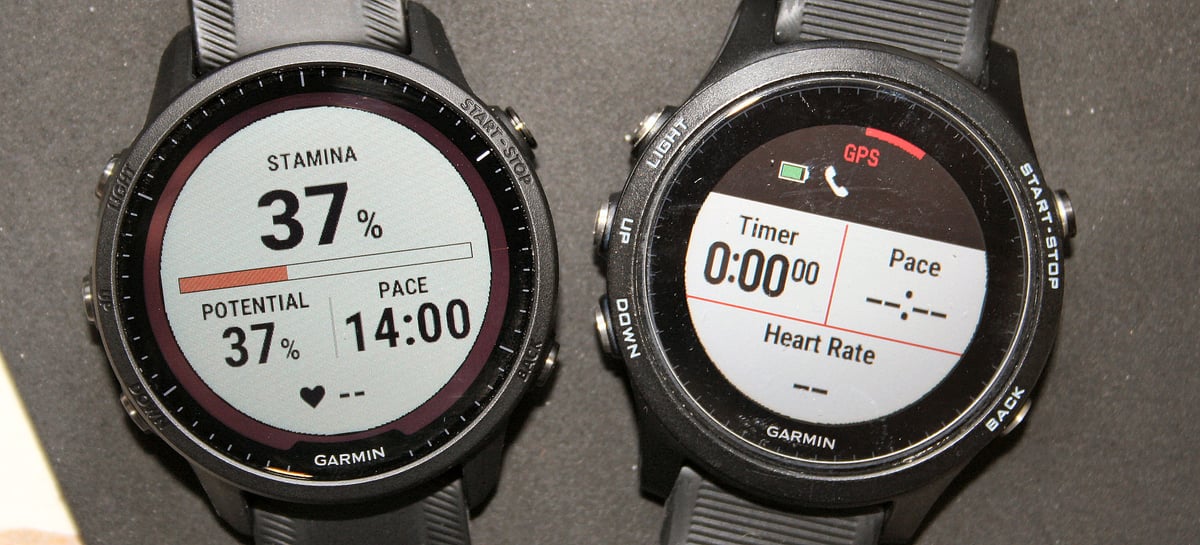
Apple occupies a different design philosophy entirely. The Apple Watch Ultra 3, at $800, delivers approximately 14 hours of GPS recording at full accuracy. Most current Garmin watches offer two to four times that figure without solar. The Enduro 3 offers more than twenty times that with solar in GPS mode. Apple optimises for cellular connectivity, a rich application ecosystem, and deep integration with iPhone. These are legitimate priorities for a large, specific market. Battery life is not among them, and the comparison is not a competitive one in any meaningful sense for the outdoor athlete or endurance competitor for whom Garmin’s solar products are designed. This is a perverse conclusion, given that battery life is the one feature Apple Watch owners want to see meaningfully improved.
Coros is the more genuinely comparable competitor to Garmin in the battery stakes. The company has built a strong reputation for lightweight, long-battery GPS watches. formerly at competitive prices, and it has demonstrated solar capability in a cycling computer context — the DURA bike computer’s solar implementation was technically credible on paper. In practice, the DURA launched with software and reliability issues that prevented it from establishing a real competitive presence. Coros has not shipped a solar watch. Its products compete on the efficiency of their conventional battery architecture and do so effectively, but they have not adopted the integrated solar stack that defines Garmin’s most capable products. At least not yet.
Suunto’s experience is instructive precisely because it illustrates the difficulty. The first-generation Suunto Vertical included solar charging. The second generation removed it, switching to an AMOLED display — a decision that certainly reflects the same physics Garmin has confronted. Solar and AMOLED do not currently coexist productively in a watch.
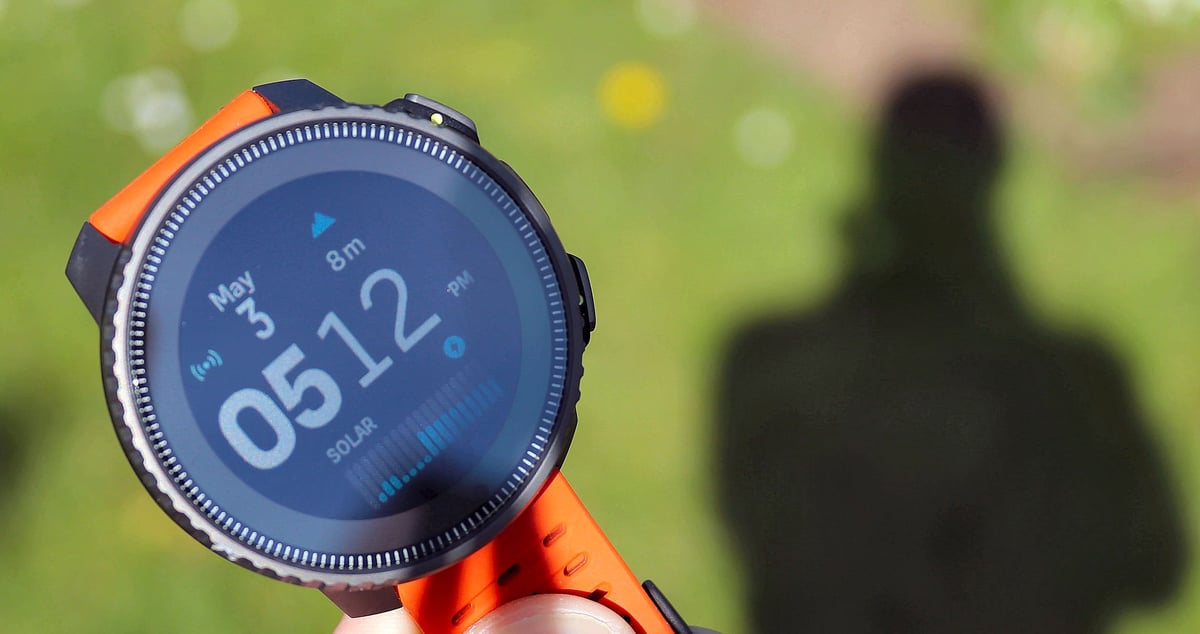
The competitive moat Garmin has established is more than the solar lens. It is the vertical integration of the entire system: the Power Sapphire cover, the MIP display optimised for minimal power draw, the MPPT power management, the elimination of external RAM, the consolidated radio chips, the firmware clock-scaling — all developed and refined in-house over six years and two hardware generations. Replicating one component is feasible for any competitor with sufficient engineering resources. Replicating the stack and validating it across the range of conditions that endurance athletes actually encounter is a multi-year programme. Garmin’s lead is not narrowing at any visible pace.
Where the Technology Goes Next
The trajectory of every component in these watches points in the same direction: lower power consumption. As overall power draw falls, solar’s proportional contribution rises. The Instinct 2 Solar could not achieve unlimited status in GPS modes; the Instinct 3 Solar, drawing less power from a more efficient platform and capturing more from the Gen 2 architecture, can.
The most structurally significant development on the horizon is MicroLED. Garmin’s Fenix 8 Pro (2025) was the first wearable to ship with a MicroLED display. MicroLED offers AMOLED-class visual quality — vivid colour, deep blacks, high brightness — with substantially lower THEORETICAL power consumption.
The transition from the Sony single-band chip in the Fenix 6X Pro to the Synaptics SYN4778 dual-frequency chip in the Fenix 8 delivered both improved accuracy and lower power consumption — a rare instance of a hardware upgrade improving on two dimensions simultaneously. That pattern will continue.
Garmin has also been quietly rationalising solar across its broader product range. Newer Edge bike computers use transmissive LCDs — large, power-hungry screens whose solar input is marginal relative to the total system’s consumption. Garmin has removed the solar option from some of these models, suggesting the technology will be concentrated where it is most effective — endurance watches with MIP displays.
The environmental case is also straightforward. A watch charged once a fortnight accumulates a fraction of the charge cycles of a daily-charge device, extending battery longevity and, with it, the useful life of the watch itself. The sapphire glass that enables solar capture simultaneously provides the scratch resistance that keeps the device in service longer. Fewer replacements mean less manufacturing. These are not marginal considerations.
Who Actually Needs This
If your activities take you away from a power source for multiple consecutive days — ultramarathons, multi-day mountain routes, bikepacking expeditions, extended trail running events — the MIP Solar architecture is the only current technology that allows you to leave the charger at home entirely. A battery pack is the obvious counterargument, and it is a fair one. But a battery pack is additional weight, an additional failure point, and an additional thing to remember. The MIP Solar watch removes the problem rather than managing it.
If your training consists of daily sessions followed by an overnight charge, the solar question does not arise in any meaningful sense. An AMOLED Garmin gives you a considerably richer display experience, and the charging cadence is no worse than any other sports watch on the market. Buy for the screen quality.
Infinite battery life modes represent the culmination of six years of engineering decisions: a French photovoltaic acquisition, a processor architecture change, the elimination of an external RAM chip, a bezel redesign that moved solar cells off the display entirely, and a screen technology that draws power only when something changes. None of those decisions was dramatic in isolation. Together, they produced something no competitor has yet managed to replicate.
Sources: Garmin product documentation (Fenix 8 Series Owner’s Manual, Instinct 3 Solar Series Owner’s Manual); the5krunner independent field testing and analysis (Garmin Solar Technology Deep Dive, Garmin Charger Guide, Battery Charging and Longevity); DC Rainmaker various test results including Instinct 2 Solar, NXP i.MX RT500 product documentation; efp.asia teardown analysis.

For the complete Garmin Fenix series guide, covering all current models, history and buying advice: Garmin Fenix hub.
More: Garmin Instinct Series – all models, prices and 13-year history. For the complete guide to hiking technology, navigation, and off-grid safety, see the .
Last Updated on 3 October 2026 by tfk the5krunner
Small things I always use
- Garmin 90-degree charging adapter: Charges your Garmin from any USB-C cable. Essential when travelling. I use one.
- Body Glide: The blue anti-chafe stick swimmers and runners carry. I use it.
- Speedo earplugs: Fewer ear infections and no cold-water dizziness. I use them.
- Dryrobe Advance: My winter changing robe for open-water swims. I use one. A cheaper option is the AONYIYI changing robe.
- Maurten: Race fuel that stays easy on the stomach. I use them.
- Garmin charging puck: The quickest way to top up before a session. I use one.
- Injinji: Toe socks that stop rubbing, so you run more. I use them.
- Ultimate toe protectors: Stop black toenails on long runs. They work. I use them.
- Compressport R2 v2 calf sleeves: My calf sleeves of choice. I use them.
- Cellucor C4: My pre-workout before hard sessions.
- TPU tubes: Schwalbe Aerothan, Tubolito and Pirelli SmarTube. Light, tiny spares. I use all three.
- G8 insoles: Adjustable insoles that are good. I use them.
- Cycplus Cube: A 97g electric pump that gets a road tyre rideable in two minutes. I carry one. 5% off with code THE5KRUNNER.
Watches and sensors
- Polar H10: My daily driver for waking HRV.
- Polar Verity Sense: My backup arm-worn HR sensor.
- Nomad bedside charger: Charges my iPhone and Apple Watch overnight. I use it, and many of their bands.
- Train.Red: The best muscle oxygen sensor I’ve used.
- Tymewear: Accurate heart rate and reliable ventilatory zones. I use it to pace endurance rides over an hour.
- Garmin Forerunner 970: A pro-grade triathlon watch. I use this.
- Apple Watch Ultra 4: My daily smartwatch. No phone needed on rides.
- Garmin Fenix 9 Pro: I’ve just bought one.
On the bike
- Continental GP5000 for everyday riding, and Aero 111 on the front for special occasions.
- Helmets: Specialized S-Works Evade 3 for road riding, and Rudy Project Wing for TT-style races. I use both.
- Ravemen FR300: A front light that mounts under your Garmin or Wahoo. I use one.
- Wahoo TRACKR Radar: I use it on one bike and Varia on the other. They perform the same.
- Garmin Varia RTL515: Radar that warns you of cars from behind. I use this model.
- Wahoo ELEMNT Roam 3: The bike computer that’s easy to use. I use mine on most rides.
- Favero Assioma Pro RS2: Accurate power pedals that swap easily between bikes. I use this model.
Home and indoor training
- NPE Runn: Makes my basic treadmill smart, sending more accurate speed and distance to my watch and Zwift. I use it.
- Google Wifi: Keeps Zwift connected in my pain cave. I use it.
- Apple TV 4K: Zwift on the big screen. I use two.
- Google Nest Doorbell (wired, 2nd gen): My video doorbell, running in both Google Home and Apple Home. I use it.
Health, recovery and sleep
- FreeStyle Libre 3 Plus: Shows how my blood sugar responds to diet.
- hDrop: Measures my sweat loss in summer and indoors.
- Fourth Frontier Zone: Checks my heart under load in hard sessions.
- Oura Ring 5: My partner’s recovery tracker of choice.
- Kineon MOVE+: Red light therapy for niggles. It works.
- Eight Sleep: A cooling mattress cover my partner and I use nightly.
Reader-Powered Content

This content is not sponsored. It’s mostly me behind the labour of love, which is this site, and I appreciate everyone who supports it.
Support the site: Follow (free, fewer ads) · Subscribe (paid, ad-free) · Buy Me A Coffee ❤️
Written by real people, with AI assistance. Fact-checked and verified for originality. See the Editorial Policy. FTC: Affiliate Disclosure — some links pay commission. As an Amazon Associate, I earn from qualifying purchases.

tfk is the founder and author of the5krunner, an independent endurance sports technology publication. With 20 years of hands-on testing of GPS watches and wearables, and competing in triathlons at an international age-group level, tfk provides in-depth expert analysis of fitness technology for serious athletes and endurance sport competitors. ID

There is still quite some room for Garmin to optimize battery in the non-MIP version. They are using a LTPS AMOLED display which is less efficient than LTPO used by Apple and Suunto. You can see that difference in the Suunto Vertical 2 getting 20% more range in AOD activity mode with a slightly larger display than the 51mm epix 2 pro and fenix 8. There are newer NXP processor series available than what Garmin has deployed that is more energy efficient. You can see this potential also with Suunto who used an Ambiq chip which is both more efficient and faster. There is better battery technology coming also. It’s feasible to get 1.5x more range from near-term battery improvements also.
The LTPO display and processor improvement is how the Suunto Vertical 2 (amoled) achieves battery range parity with the the Suunto Vertical (mip).
In general I would not bet against the display and battery technology from the mobile phone industry. There is just enormous R&D to make that better, thinner, more energy efficient. I think MIP is increasingly niche.
You could imagine 80-90 hours of AOD and 150 hours raise-to-wake tracking capability in a 51mm fenix next-generation using LTPO and a better battery. This would be in the class of the enduro 3. A hypothetical next-gen enduro with that battery would also be better still. Maybe Garmin has enough market share and SKU differentiation to keep making the enduro with ever more ridiculous range even if it is niche while a company like Suunto which has much, much smaller market share cannot sustain it.
It also turns out that you can’t really depend on the Solar function when planning for range. It’s an unknowable amount of extra range or none. It doesn’t work at night or in heavy weather or canopy.
The extra hours that they all quote are also only during only during optimal 10k lux peak sun daylight hours — which is one thing for multi-stage events and through-hiking — and not nearly as useful for typical gun to tape ultramarathons that go through the night.
For an event where battery range is potentially an issue you have to plan for X hours of burn time plus a margin of safety / fudge factor. And you test it in advance that your burn rate using the features and settings for the event are actually what you expect. These may deviate significantly from paper specs. Navigation uses extra power. Turning off the oHR saves power. Using display timeout or raise to wake saves power but the timeout can be disorienting. Using the map screen uses a *lot* more power (like double other modes) but the north-up option saves a lot of power. Navigating with the north up map mode is actually not so easy as following an arrow point the way to go in front of you when you are exhausted. Garmin LiveTrack in the watch uses significant energy. Disabling the ambient phone connection saves energy. The music feature will torch your battery faster than anything else. GPS mode significantly influences battery consumption. On amoled, the display brightness setting influences range.
I found you must assume that solar doesn’t do anything for planning purposes. Since you cannot plan on it doing anything, it’s a hypothetical possibility that might help if something goes terribly wrong and not a range planning feature.
good point.
FWIW. I can get 68 hours on a 51mm fenix 8 amoled with AOD and GPS-only with tweaked settings and maps still enabled and with AOD off for the same settings it is 90 hours. This includes turning off the oHR and phone connection but leaving accessories working using a chest strap.
These numbers are from the Power Manager and are always best-case optimistic numbers in my experience. Using the map any significant amount cuts some hours.
I haven’t been in a situation where the range was a problem for any event since the 6x — which was a step-change from the fenix 3 and 5x. The fenix 8 amoled has equivalent or better range than the 6x. In default SatIQ settings day to day the fenix 8 amoled (and presumably epix pro) 51mm feels roughly equivalent range to the 7x.
Nice writeup! Kind of surprised that so much of the runtime increase is due to bigger batteries (boooring ;)) and not because of even more frugal software and chips.
But that means that even less volume is taken by OHRM, board and the screen stack, which implies that Garmin could easily “pull a Venu X1” on the MIP side of things, make an awesomely flat/thin watch at the cost that it’s runtime is just what you’d expect from a regular size OLED watch. Which is apparently quite tolerable to many.
Great article! I’m all for innovations in MIP Solar departament as AMOLED watches simply aren’t my thing. BTW I’m still not sure if solar watches constantly charge the battery while it’s being used or draw power directly from the bright sun to operate from it…
i would imagine that the solar is used first and any surplus goes to charge.
it might not even be a specific desing, electronic engineering might jsut work that way. someone with tha insight might chip in