Pirelli P Zero Race TLR SL-R Review: First Impressions After 100 Miles
Pirelli launched the P Zero Race TLR SL-R today with a clear claim: it is the company’s fastest tyre in the peloton. After 100 miles on the new rubber over the last few days, that claim is at least credible on the evidence of how the tyre feels to me in real-world use. A definitive verdict will require significantly more mileage, but the headline numbers and the ride feel pull in the same direction.
The SL-R sits at the top of Pirelli’s P Zero Race family, above the RS and the standard Race, and is positioned squarely at road racing and time trials. The difference between this and its closest stablemate, the P Zero Race TLR RS, is claimed to be a 20 per cent aerodynamic improvement in normal wind conditions, a 10 per cent reduction in rolling resistance per set translating to a saving of around 2 watts, and, at 275g for the 28mm, a 15g weight reduction over the RS at the same size. Taken together, those are not trivial gains on a platform that was already competitive.
Heads Up: These tyres were gifted by the brand ahead of launch. I’ll be using them for the next few months and am happy to answer any follow-up questions in the comments.
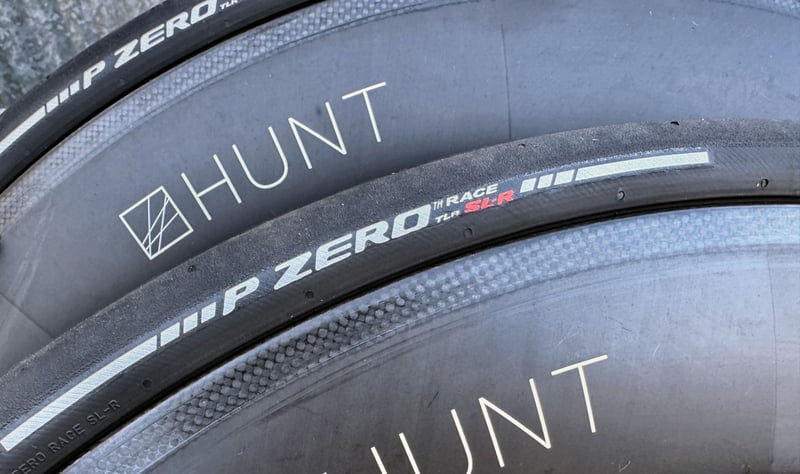
PAAS and LiteCore
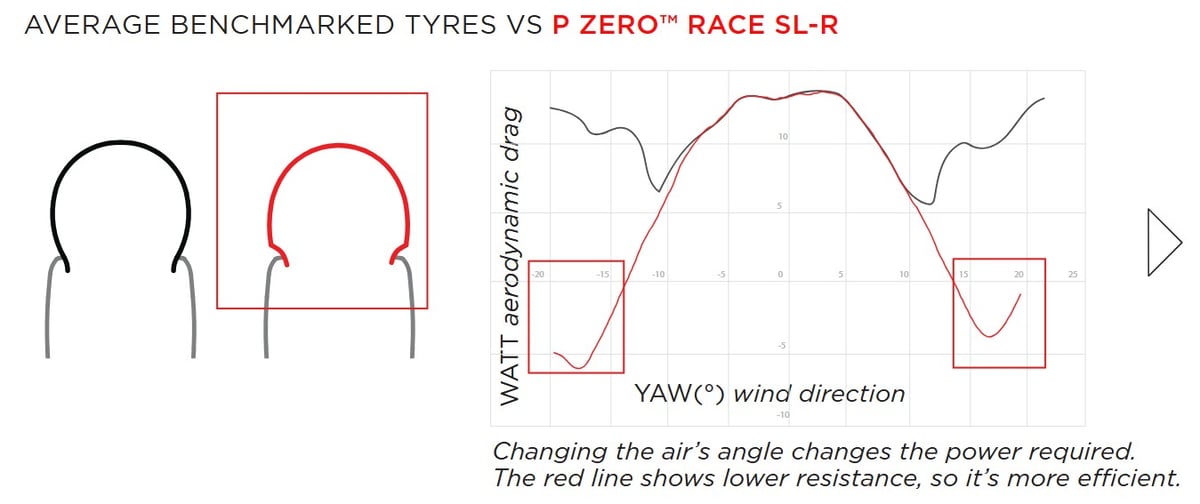
The SL-R introduces a profile geometry Pirelli calls PAAS — the Pirelli Advanced Aerodynamic System. The tyre-to-rim interface is a key point at which airflow separates from the wheel, creating drag; the PAAS profile (cross section) is shaped to keep that flow attached across the full range of yaw angles a rider encounters in competition. Pirelli’s wind-tunnel data show savings of 5 to 10 watts at high yaw angles compared with the benchmark alternatives.
This complex chart highlights the novel tyre cross-section on the left and shows on the right that yaw angles from +/- 13 to 20 degrees create propulsion (i.e., negative drag). From wind angles of yaw from +/- 7 to 13 degrees, drag is the same or slightly reduced compared to the average of other tested tyres.
The SL-R swaps the RS’s SpeedCORE casing for a new construction that Pirelli calls LiteCore. Both are 120 TPI tubeless-ready casings running the same SmartEVO2 compound, but LiteCore is the more supple of the two — and that suppleness is immediately noticeable, giving a nicely compliant road feel, and that is where the 10 per cent rolling resistance improvement over the RS comes from.
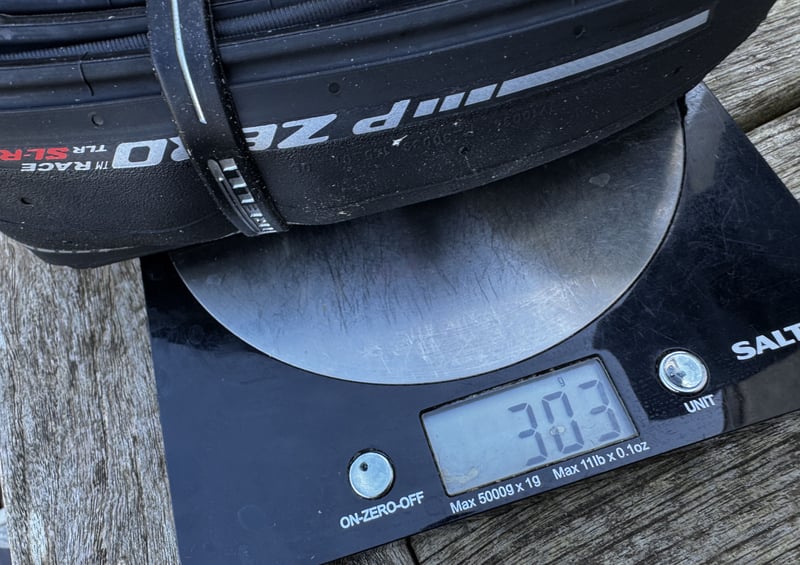
My Reservations: It’s easy for anyone to say that they like the Conti GP5000 (which I do). But my favourite tyre is the P-Zero TT Race (non-TLR). It weighs virtually nothing (170g) and just feels fast. Admittedly, I only ever used it on my TT when actually going fast (for me). But my reservation is that more recent generations of tyres have gotten heavier; they have to be structurally sound at higher widths and able to support tubless puncture protection. Then you have to add in the weight of the sealant and valve, or, in my case, the TPU race tube. Now, like other brands, Pirelli’s TLR SL-R weighs in at 303g on my scales (more than the claimed weight). I can even feel a difference between 170g on two tyres compared to 303g when accelerating.
Check the tyre-to-rim boundary. X marks the spot where the tyre hasn’t quite seated properly yet, which isn’t an issue. However, the other two highlighted areas show quite a bit of space. This WILL create turbulence and hence drag. The point being that the tyre needs to be designed for specific rims – the Conti was designed for a specific SWISS SIDE wheel, Pirelli hasn’t made any claims in that area. Clearly, neither tyre is perfect on these wheels (note that Pirelli recommends a wider internal rim than I used).
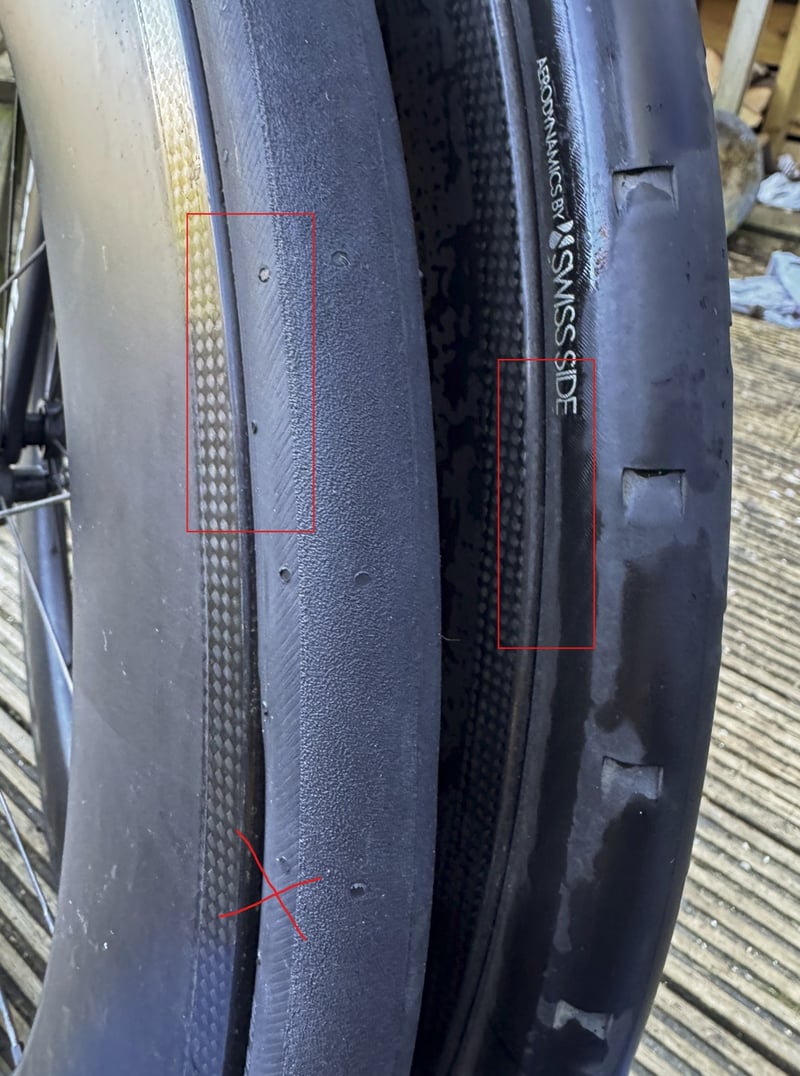
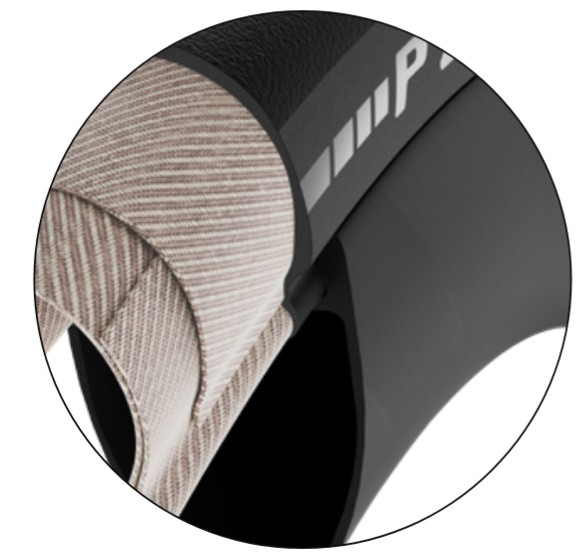
Contrast that image of mine with one from Pirelli. Your wheel rims might fit the tyre better and look as perfect as this diagram shows.
The weight comparison within the range is worth noting. At 275g (303 actual) for the 28mm, the SL-R is 15g lighter than the RS at the same size, and the gap widens against the standard P Zero Race. The 30mm variant weighs 295g (claim). Neither figure will satisfy the ultra-light contingent, but for a tubeless-ready tyre optimised for aerodynamics and road feel rather than minimum mass, the numbers are competitive. A 32mm version is scheduled for the fourth quarter of 2026.
Mounting was straightforward. The tyre seated without drama on a hooked rim, and I just managed to get it on without levers (Ok, there was some drama, I wore yellow rubber kitchen gloves to get some grip with only my fingers and hence avoid any chance of pinching a very expensive TPU inner!).
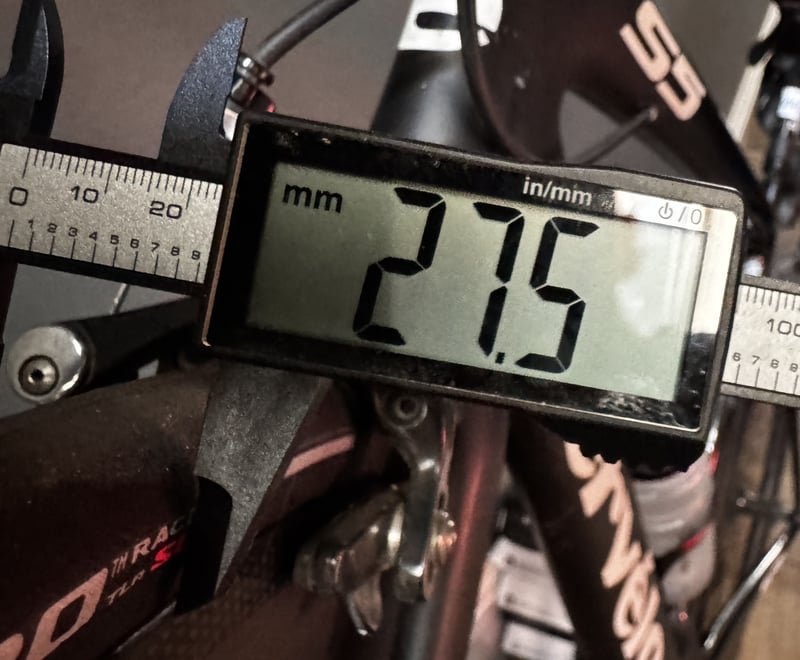
Pirelli specifies compatibility with hookless rims subject to pressure limits, and the box confirms ETRTO-standard development for modern wide rims. The aerodynamic profile is optimised for internal rim widths of 22-25mm, so my 19mm are suboptimal.
Recommended Tyre Pressure
Pirelli and Silca have excellent tyre pressure guides. You’ll need to know your weight, your bike’s weight, your internal rim width, and, ideally, the actual tyre width. For me, at 72 kg on a very good performance road bike, it came out at 83 psi (5.7 bar) on regular UK roads, but 88 psi (6.1 bar) on super-smooth roads. I tried both, and 88psi felt too hard.
When To Use
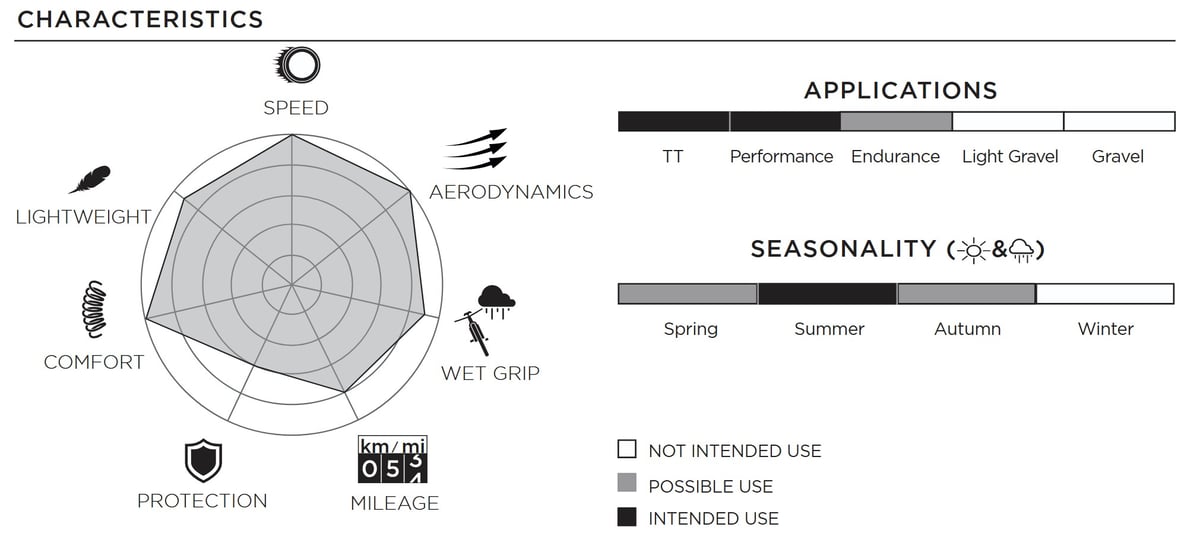
Pirelli’s chart shows when to use the tyre. Basically its a summer performance tyre that grips decently and is comfortable. Expect limited longevity and puncture protection.
Test Results
They felt fast, grippy and comfortable.
Grip, in the conditions available during my first tests — dry roads with one brief damp section — was entirely in keeping with what the SmartEVO2 compound has delivered on the RS. Nothing to report. The compound is not new to the SL-R; it appears on both tyres.
My confidence with them on fast corners was high, but I’m not Tom Pidcock.
A couple of speedy aero laps of Richmond Park sufficed for a timed test, and the times were what I would expect for my current level of fitness – I’m training for endurance, not speed, so no PBs today.
Specifications
| Casing | LiteCore TLR, 120 TPI |
| Compound | SmartEVO2 (launched 2024 on P Zero Race RS) |
| Aerodynamic system | PAAS (patent-pending) |
| Optimised rim width | 22–25mm internal (works on 19mm) |
| Hookless compatible | Yes, subject to max pressure limits |
| Manufacturing | Made in Italy |
| Natural rubber | FSC-certified, 21% of total tyre weight |
| Colourways | Black-Silver, Black Team Edition |
| Sizes | Weight |
| 28mm (28-622) | 275g — available now |
| 30mm (30-622) | 295g — available now |
| 32mm (32-622) | TBC — Q4 2026 |
Should you get one? (or a pair!)
I said last year with the Conti 111 that rubber compounds and tyre constructions can only improve so much from now on. For road performance, the latest generation of bike tyres is hard to improve on.
That said, reduced drag from the tyre shape and its interaction with rim shapes is probably an area where more gains can still be eked out from multiple effects and tricks. Similarly with the foil effect.
Any of these claimed new benefits has to be taken on trust. Sure, you can see the rolling resistance figures plainly on the excellent bicyclerollingresistance.com, but the aero data comes from non-real-world wind-tunnel tests. Slightly gusty winds, cars and fellow riders will all affect the aerodynamic performance of your wheels, and maybe the 2-watt gain you hoped for will never materialise.
Next, Pirelli advises that the tyre also offers rear-wheel performance benefits, albeit to a lesser extent. I’m not at all convinced about that. Continental didn’t claim that with the 111 model and indeed advised them to be used only on the front wheel.
Bottom line. They are undoubtedly nice, fast and grippy tyres. I’ve no way to quantify whether they’re the fastest or give me extra watts.
Last Updated on 13 June 2026 by the5krunner
My favourite kit and nutrition
- Garmin Fenix 9 Pro — I’ve just bought one.
- Injinji – Runners protect your toes. Avoid discomfort and minor injury. Run more. Run faster. I use them.
- Garmin 90-degree charging adapter — A small keyring adapter you can use anywhere. Essential when away. I use one.
- Garmin charging puck — the fastest and most reliable way to top up your Garmin before a session. I use one.
- Ravemen FR300 — Front light that mounts directly under your Garmin or Wahoo head unit. Keeps your bars clean and your beam pointed where it matters. I use one.
- Body Glide – The blue anti-chafe stick that all swimmers and many runners use. I use it.
- Maurten — The race nutrition trusted by elite athletes. Gels and drink mixes engineered to be easy on the stomach. I use them.
- Garmin Varia RTL515 — A radar rear light that alerts you to vehicles approaching from behind. Pairs with your Edge or Wahoo. I use this model.
- Favero Assioma Pro RS2 — The power-meter pedals most serious cyclists choose. Accurate, easy to move between bikes. I use this model.
- Garmin Forerunner 970 — A serious choice for a pro-grade triathlon watch. I use this.
- Polar H10 — My daily driver for accurate, waking HRV readings.
- Wahoo ELEMNT Roam 3 — The bike computer that has the feature Garmin lacks: usability. I use mine on most rides.
Reader-Powered Content

This content is not sponsored. It’s mostly me behind the labour of love, which is this site, and I appreciate everyone who supports it.
Support the site: Follow (free, fewer ads) · Subscribe (paid, ad-free) · Buy Me A Coffee ❤️
All articles are written by real people, fact-checked, and verified for originality. See the Editorial Policy. FTC: Affiliate Disclosure — some links pay commission. As an Amazon Associate, I earn from qualifying purchases.
tfk is the founder and author of the5krunner, an independent endurance sports technology publication. With 20 years of hands-on testing of GPS watches and wearables, and competing in triathlons at an international age-group level, tfk provides in-depth expert analysis of fitness technology for serious athletes and endurance sport competitors. ID

Is there a rotation arrow on these tyres. I’m having no luck finding one.
from memory i dont think there was. I do look for arrows every time.
there is no tread pattern for direction to matter.
Is there any data for the recommended internal/external rim widths for the 28mm tyre? Thanks
Do yourself a favour and get some modern wheels. I am also using 28mm tyre (Gp 5000 TT) and they measure 31mm on my wheel with 22mm internal width. Silca recommend me pressure between 63-73 depending on road conditions and speed parameters. For my riding style and UK road conditions I run 68 back 66 front and this configuration is super smooth and fast. Oh I run tubeless too and I am 82 kg. I can not imagine the discomfort using a 28mm tyre around 85 psi.
I got a pair in 28.
Fitting them on roval Rapide CLX I (21mm internal width, and something like 35 external width) has been quite….challenging, to say the least. Heavy use of tyre levers, tyre tensed like hell in the middle of the rim, and it even was quite difficult to sit in the bead, using an inner tube (latex). It was a bit easier on the rear Roval 321 wheel (19mm internal width).
As a comparison I can get along with bare hands for mounting GP5k (tubetype) on those wheels.
I’m still debating on returning them and go with something easier to fit, considering they’re mounted on the race bike…and the race is in 1 week…and I’m not sure I want to fiddle with them in case of a puncture 😀
interesting.
i got these on with my bare hands if i recall (just..I hate to use levers for fear of damaging the tubes i still use