Stride Length
Cadence input is accurate; errors mirror GPS distance measurement, typically 1–5% outdoors
Tracking running economy improvements over training blocks
Derived from GPS distance and cadence, not direct measurement; carries unknown error on an uncalibrated treadmill
In plain English: stride length is how far a runner travels from one footfall to the next, measured in metres. A longer value at the same pace generally means a more powerful or efficient gait; a shorter value at the same pace usually means a higher cadence. By default, Garmin calculates it from GPS distance and cadence rather than a foot sensor, so values can drift during intervals and carry unknown error on an uncalibrated treadmill.
Quick answers
Does Garmin measure stride length per step or per full gait cycle?
Garmin defines stride length as the distance from one footfall to the next — one step. Typical values range from around 0.75 m at easy jogging paces to approximately 1.5 m at race speed for most recreational runners.
Why is my stride length so low on Garmin?
The metric is calculated from GPS distance and cadence, so a slow pace produces a low value regardless of height or fitness. Values increase with speed — the same runner at an easy pace will always show a lower figure than at threshold pace. Compare values only against previous runs at a similar speed.
Why does stride length not work on a treadmill?
On older devices and some activity profiles, the metric is absent on a treadmill because the GPS position does not change, and no speed input is available. On current devices such as the FR970, it is recorded using accelerometer-estimated pace instead, but without treadmill calibration, the values carry unknown error. Calibrating the treadmill distance corrects the estimate and makes the values usable.
What is a good stride length on Garmin?
There is no universal target. The metric is governed by running speed, leg length, and running economy — a faster runner will naturally show a higher value than a slower runner at the same cadence. The most useful benchmark is the runner’s own historical data at comparable paces; a gradual increase at a fixed easy pace over weeks indicates improving running economy.
Stride Length — A Deep Dive
When Stride Length Is Actually Useful
- A warning sign of fatigue for me is a lower cadence and longer stride at a given speed. Rather than monitoring this via stride length, I would target cadence, which is a more accurate, real-time metric.
- I find that naturally allowing my step distance to increase when I tire is counterproductive. The longer reach requires more leg strength, which is my relative weakness, so I am loading that weakness rather than maintaining a high cadence, which relies on metabolic efficiency.
- Looking over months of hard training, I do see increases in stride length that follow increases in fitness. The observation is not especially useful, but it is reassuring.
Introduction
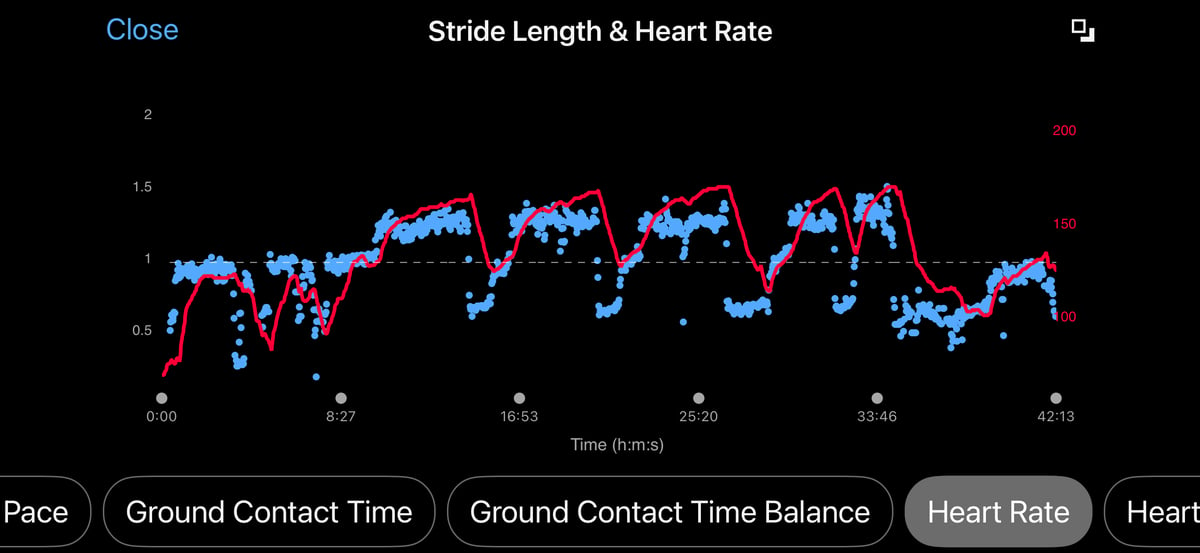
Stride length is the distance from one footfall to the next, measured in metres. It is one of six metrics in the Garmin Running Dynamics suite, introduced as part of the expanded suite on the Forerunner 630 with the HRM-Run strap in 2015.
Unlike most other running dynamics metrics, stride length carries no independent population benchmark. Its value is determined almost entirely by running speed and individual physiology, making within-runner trend analysis more informative than any comparison against published norms. The principal limitation is that Garmin derives the value from GPS distance and cadence rather than from direct measurement of foot position, which makes the metric sensitive to GPS quality and unreliable on a treadmill without calibration.
What Stride Length Actually Means
Values typically range from approximately 0.75 m at slow jogging paces to around 1.5 m at race speed for most recreational runners. No age or sex norms are published because the metric is governed primarily by running speed and individual leg length rather than fitness category. At any given pace, a higher value indicates a lower cadence, a taller runner, or a more powerful push-off; a lower value at the same pace reflects a higher cadence. Because pace is the product of cadence and stride length, any change in one variable at constant pace produces an equal and opposite change in the other.
How Garmin Calculates Stride Length
Garmin does not publish the calculation method. The most plausible derivation from the available sensor inputs is GPS-measured running speed divided by cadence rate. Since cadence counts steps from both feet, at 180 steps per minute (3.0 steps per second) and 5:00 min/km (3.33 m/s), the calculated value would be 1.11 m. The accelerometer in a running dynamics accessory or the watch’s own wrist sensor supplies the cadence figure; GPS supplies the speed figure. Neither sensor directly observes where each foot lands.
GPS smoothing directly affects the metric’s responsiveness. During acceleration, deceleration, or sharp turns, GPS pace lags behind the runner’s actual speed and values in these moments should be read as approximate. When GPS signal is lost briefly — in a tunnel, for example — the device falls back to accelerometer-estimated pace and the metric continues to record; values remain plausible but carry higher uncertainty than GPS-derived figures. On a treadmill, current devices such as the FR970 use accelerometer-estimated pace; without calibration the values carry unknown error, but with treadmill calibration completed they are usable.
What Affects the Reading
Pace is the dominant variable. Values increase predictably with running speed, and comparisons between sessions are only meaningful when pace is comparable. GPS signal degradation — under dense tree canopy, between tall buildings, or near a tunnel entrance — introduces noise into the pace input that flows directly into the output. Cadence accuracy also varies between sensor positions: wrist-based cadence degrades during hard acceleration and off-road running, both of which also stress GPS accuracy, compounding the effect.
How Accurate Is Garmin Stride Length
No published peer-reviewed study has assessed Garmin’s calculation against a laboratory gold standard for a wide population sample. Accuracy is bounded by the two inputs. Cadence from a chest strap is generally within 1–2 steps per minute at steady state, contributing less than 1.3% error at 160 spm. GPS distance is the larger source of uncertainty, typically 1–5% in normal outdoor conditions, rising in areas of poor satellite coverage, under tree canopy, or near tall buildings. Since the metric is derived directly from GPS distance and cadence, its error range mirrors the GPS distance error. A single session value may carry meaningful error; the same calculation applied consistently at comparable paces across sessions will reliably track genuine changes in running economy over time, as the GPS and cadence errors are broadly stable between sessions.
Competitor Equivalents
- Polar Vantage V3 and Vantage M3 provide no native measurement; the metric is available only via a paired Stryd foot pod, with no colour-coded percentile display.
- Apple Watch (Series 6 and later, watchOS 9 and later) provides the metric natively in metres in real-time workout views and in the Health app post-activity summary; no calculation method is published.
- Coros PACE 3, PACE Pro, APEX 2, APEX 2 Pro, VERTIX 2, and VERTIX 2S added native wrist-based measurement in a September 2025 firmware update, available in Road Run and Track Run modes, without a colour-coded percentile gauge system.
- Suunto Race and 9 series provide native cadence only; the metric requires a paired Stryd foot pod.
- Stryd foot pod measures the distance directly from inertial sensors at the foot rather than deriving it from GPS pace, making it compatible with any ANT+ or Bluetooth device and valid on treadmills without calibration; absolute values are not directly comparable to Garmin’s GPS-derived figures for the same runner at the same pace.
Which Garmin Devices Support Stride Length
The metric is available on any Garmin watch that accepts ANT+ running dynamics accessories — via the HRM-Run, HRM-Pro Plus, HRM-600, HRM-Fit, or Running Dynamics Pod — and was first introduced as part of the six-metric suite on the Forerunner 630 in 2015. Native wrist-based measurement was introduced in March 2023 and is now standard on all current Garmin OS devices with the required accelerometer. The Forerunner 165, Venu 3, Venu 3S, and Vívoactive 6 provide wrist-based measurement but cannot pair an external running dynamics accessory, which means Ground Contact Time Balance is unavailable on those models.
Where to Find Stride Length on Garmin
- Activity data field — add to any custom data screen within the activity profile; also appears in the dedicated Running Dynamics screen mid-activity alongside the other five core metrics.
- Garmin Connect app — Running Dynamics section within the activity detail view; session-level data only, no multi-week standalone trend graph.
- Garmin Connect web — activity-level data available; more limited presentation than the mobile app.
- Morning Report — not available.
- Watch face complication — not available.
- Garmin Connect Plus — not required; data is available to all Garmin Connect account holders with a compatible device and activity file.
Common Problems and Misreadings
Values during interval sessions commonly appear erratic, particularly at the start and end of each rep. GPS pace smoothing introduces lag during rapid acceleration and deceleration, and instantaneous values at those transitions do not represent steady-state mechanics. The per-rep average in the lap summary is a more reliable figure for post-session analysis.
On a treadmill, behaviour depends on the device generation. On older devices the metric may be absent; on current devices it is recorded via accelerometer-estimated pace and carries unknown error without calibration. See FAQ above for detail.
A persistent fall at the same pace often follows a deliberate cadence increase. Cadence and this metric are mathematically inverse at constant pace — raising step rate by 5% reduces it by approximately 5%. This is the expected mechanical consequence, not a sign of deteriorating form.
How to Improve Stride Length
The metric improves through training that builds propulsive force and elastic energy return, not through conscious effort to extend each step. Strength and plyometric work targeting the hip extensors, calf complex, and Achilles tendon develop the elastic storage capacity that underpins efficient gait at race pace. Short hill sprints develop posterior chain power directly relevant to push-off force. Attempting to lengthen each step by reaching further with the foot typically increases braking forces rather than improving economy.
Monitoring the metric at a consistent effort level across a training block provides a useful adaptation signal. A gradual increase at a fixed easy pace while cadence remains stable indicates improving running economy. A decline alongside a rising cadence reflects a cadence adaptation taking hold — the expected mechanical consequence rather than a problem requiring intervention.
Scientific Basis
Heiderscheit BC, Chumanov ES, Michalski MP, Wille CM, Ryan MB. Medicine and Science in Sports and Exercise. 2011. PMID: 20581720. Increasing step rate 5–10% above preferred cadence reduced stride length proportionally and simultaneously lowered energy absorption at the knee and hip, establishing the mechanical basis for the inverse relationship between cadence and this metric at constant pace.
Moore IS. Sports Medicine. 2016;46(6):793–807. This review found that preferred stride length approximates the metabolically optimal value for trained runners at submaximal speeds and that forced lengthening or shortening from the self-selected value typically increases oxygen cost, supporting within-runner trend analysis over prescriptive targets.
How Stride Length Connects to Other Garmin Features
The metric has a direct inverse mathematical relationship with Cadence — at constant pace, any rise in cadence produces a proportional fall in this figure — and serves as the denominator in the Vertical Ratio calculation, meaning that gains at a given effort level improve Vertical Ratio simultaneously. Changes also track closely with Ground Contact Time: as Ground Contact Time decreases through improved elastic energy return, this metric at a given pace typically rises because more of the gait cycle is spent in flight. Over longer training blocks, a gradual increase at a fixed aerobic effort is an informal indicator of improving running economy, the same underlying adaptation that contributes to VO2 Max gains, though the metric does not feed directly into the VO2 Max algorithm.
Small things I always use
- Garmin 90-degree charging adapter: Charges your Garmin from any USB-C cable. Essential when travelling. I use one.
- Body Glide: The blue anti-chafe stick swimmers and runners carry. I use it.
- Speedo earplugs: Fewer ear infections and no cold-water dizziness. I use them.
- Dryrobe Advance: My winter changing robe for open-water swims. I use one. A cheaper option is the AONYIYI changing robe.
- Maurten: Race fuel that stays easy on the stomach. I use them.
- Beet It Sport nitrate shots: Beetroot shots I take in the days before a race. I use them.
- Garmin charging puck: The quickest way to top up before a session. I use one.
- Injinji: Toe socks that stop rubbing, so you run more. I use them.
- Ultimate toe protectors: Stop black toenails on long runs. They work. I use them.
- Compressport R2 v2 calf sleeves: My calf sleeves of choice. I use them.
- Cellucor C4: My pre-workout before hard sessions.
- TPU tubes: Schwalbe Aerothan, Tubolito and Pirelli SmarTube. Light, tiny spares. I use all three.
- G8 insoles: Adjustable insoles that are good. I use them.
- Cycplus Cube: A 97g electric pump that gets a road tyre rideable in two minutes. I carry one. 5% off with code THE5KRUNNER.
Watches and sensors
- Polar H10: My daily driver for waking HRV.
- Polar Verity Sense: My backup arm-worn HR sensor.
- Nomad bedside charger: Charges my iPhone and Apple Watch overnight. I use it, and many of their bands.
- Train.Red: The best muscle oxygen sensor I’ve used.
- Tymewear: Accurate heart rate and reliable ventilatory zones. I use it to pace endurance rides over an hour.
- Garmin Forerunner 970: A pro-grade triathlon watch. I use this.
- Apple Watch Ultra 4: My daily smartwatch. No phone needed on rides.
- Garmin Fenix 9 Pro: I’ve just bought one.
On the bike
- Continental GP5000 for everyday riding, and Aero 111 on the front for special occasions.
- Helmets: Specialized S-Works Evade 3 for road riding, and Rudy Project Wing for TT-style races. I use both.
- Ravemen FR300: A front light that mounts under your Garmin or Wahoo. I use one.
- Wahoo TRACKR Radar: I use it on one bike and Varia on the other. They perform the same.
- Garmin Varia RTL515: Radar that warns you of cars from behind. I use this model.
- Wahoo ELEMNT Roam 3: The bike computer that’s easy to use. I use mine on most rides.
- Favero Assioma Pro RS2: Accurate power pedals that swap easily between bikes. I use this model.
Home and indoor training
- NPE Runn: Makes my basic treadmill smart, sending more accurate speed and distance to my watch and Zwift. I use it.
- Google Wifi: Keeps Zwift connected in my pain cave. I use it.
- Apple TV 4K: Zwift on the big screen. I use two.
- Google Nest Doorbell (wired, 2nd gen): My video doorbell, running in both Google Home and Apple Home. I use it.
Health, recovery and sleep
- FreeStyle Libre 3 Plus: Shows how my blood sugar responds to diet.
- hDrop: Measures my sweat loss in summer and indoors.
- Fourth Frontier Zone: Checks my heart under load in hard sessions.
- Oura Ring 5: My partner’s recovery tracker of choice.
- Eight Sleep: A cooling mattress cover my partner and I use nightly.
Reader-Powered Content

This content is not sponsored. It’s mostly me behind the labour of love, which is this site, and I appreciate everyone who supports it.
Support the site: Follow (free, fewer ads) · Subscribe (paid, ad-free) · Buy Me A Coffee
Written by real people, with AI assistance. Fact-checked and verified for originality. See the Editorial Policy. FTC: Affiliate Disclosure — some links pay commission. As an Amazon Associate, I earn from qualifying purchases.
