Garmin Fenix Range
The fēnix is Garmin’s flagship multisport GPS watch, built on the legacy of its 2012 debut, designed for athletes who train off-road. Where the Forerunner serves the road runner, the Fenix serves the adventurers who need navigation, durability, and battery life measured in days: the mountaineer, the ultramarathon runner, the diver, the hiker with three days of trail ahead. It carries a full topographic map on the wrist, supports more than 60 activity profiles, and is built to MIL-STD-810 standard with a 100-metre water rating.
The Fenix 9 Series
The Fenix 9 and Fenix 9 Pro launched on 25 August 2026 and are the current generation. The Fenix 9 is AMOLED; the Fenix 9 Pro adds a full titanium case, a brighter display, a 43mm size and an optional inReach satellite variant, with MIP Solar options on selected Pro models. See the Fenix 9 specifications and Fenix 9 Pro specifications, the Fenix 9 vs Fenix 8: which to buy guide, the Fenix 9 vs Fenix 9 Pro hardware comparison, and the Fenix 9 vs Apple Watch Ultra 4 comparison. Owners have reported 123 bugs in the first six weeks; the Fenix 9 bug list tracks each one and what’s fixed. For current prices and retailers, see where to buy the Garmin Fenix 9.
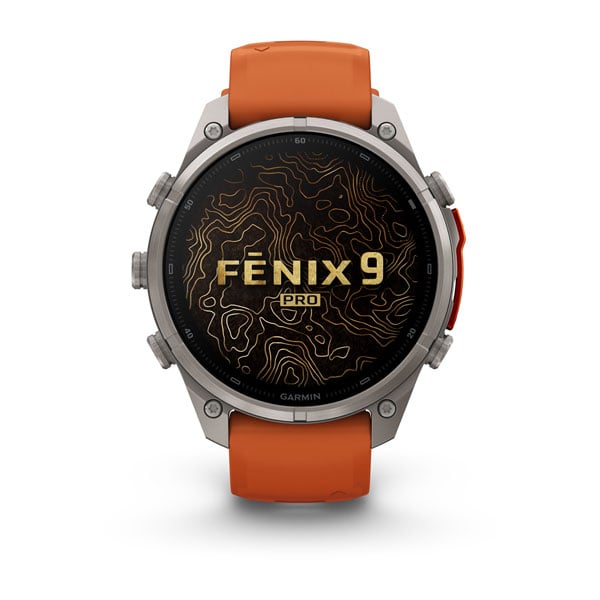
Garmin Fenix 9 range
Every Fenix 9 and Fenix 9 Pro model, including AMOLED, Solar, and inReach variants across all sizes. One link to the full range.

The Fenix 8 Series (previous generation)
The Fenix E (from $799.99 / £529.99) variant is the entry option, launched alongside the Fenix 8 in August 2024. It carries only an AMOLED display; no Solar variant, speaker or microphone, LED flashlight, or multi-band GNSS. The software stack is identical to the main Fenix 8 line. In terms of hardware, it sits close to the Epix Gen 2, and Garmin’s own comparison tool acknowledges this proximity. For buyers who want the Fenix software platform at a lower entry price and do not require the full hardware specification, it is a reasonable choice.
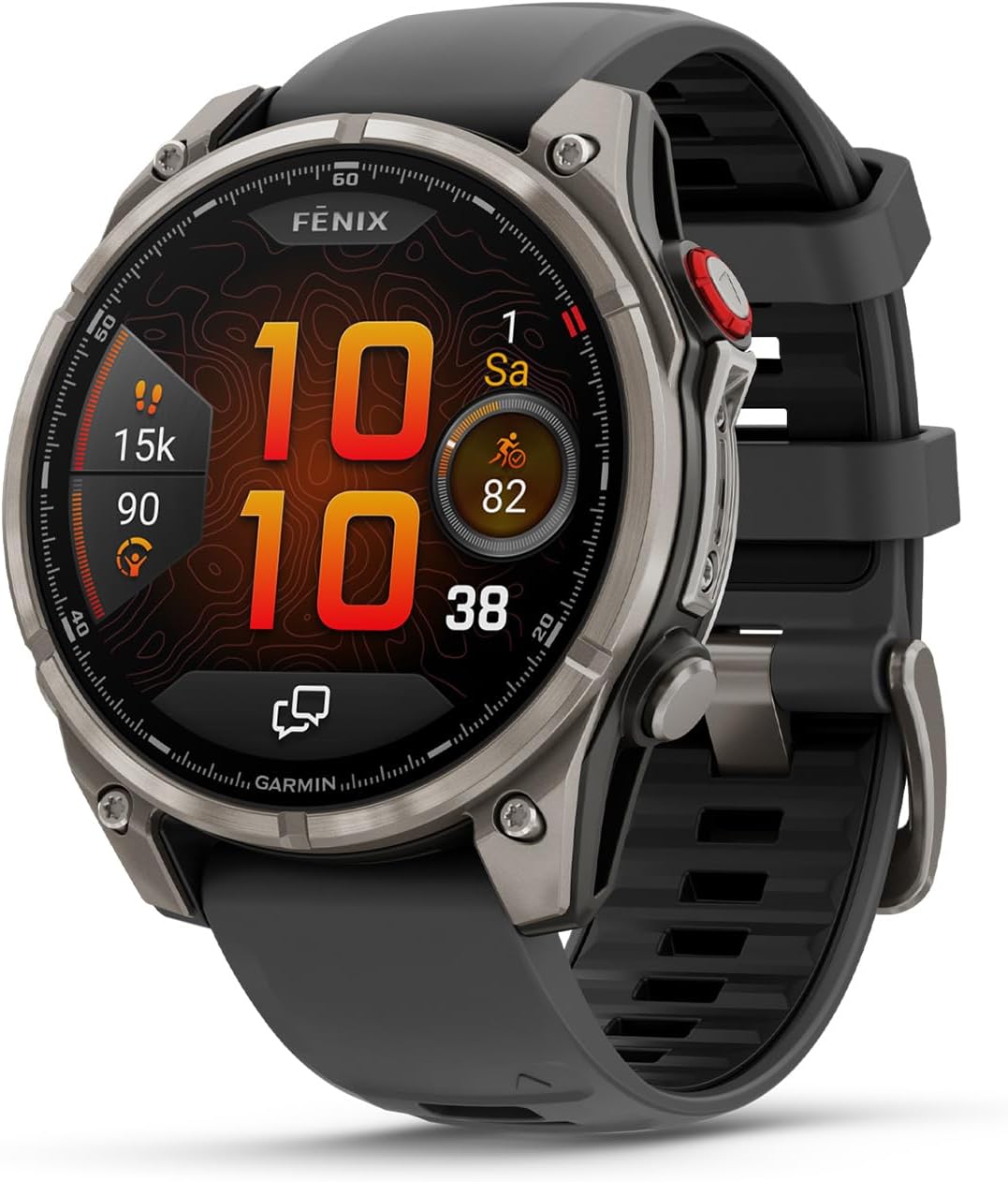

The Fenix 8 AMOLED (from $999.99 / £879.99, 43mm, 47mm and 51mm) is the core of the current range. The 43mm is the only sub-47mm model in the Fenix 8 Series. Base models use stainless steel with Gorilla Glass; premium, more durable variants at 47mm and 51mm upgrade to titanium with a sapphire crystal. Battery life reaches 29 days in smartwatch mode on the 51mm and 47 hours in GPS activity mode on the 47mm under full multi-band satellite load. Solar and AMOLED run identical software. The new UI platform introduced with the Fenix 8 has not been made available on the older Fenix 7 series, which is worth noting for anyone considering an upgrade from that generation.
The Fenix 8 Solar (from $1,099.99 / £869.99, 47mm and 51mm) is the battery-first choice. Titanium with sapphire crystal throughout — no steel option. The redesigned solar ring sits outside the display rather than over it, improving both screen brightness and charging efficiency over the Fenix 6 and 7 Series. Battery life in GPS activity mode lasts up to 52 hours on the 47mm and 68 hours on the 51mm, extending further in sustained sunlight. For multi-day expeditions, ultras, and anyone without reliable access to charging, the Solar is the right choice.
The Fenix 8 Pro (from $1,199.99 / £1,119.99, 47mm and 51mm) adds inReach satellite and LTE-M connectivity to the AMOLED platform. DLC titanium with sapphire crystal throughout. The headline capability — two-way messaging and SOS from the wrist without a paired phone — requires a mandatory inReach subscription from $7.99 per month. Voice call capability is handled exclusively through the Garmin Messenger app, which both parties to the call must use. Satellite coverage via Skylo varies by region; check Garmin’s coverage map for your area.
The Fenix 8 Pro MicroLED ($1,699.99 / £1,499.99, 51mm only) features a 4,500-nit MicroLED display — substantially brighter than the AMOLED models and among the highest-nit ratings fitted to a consumer smartwatch. The trade-off is battery life: according to Garmin’s published specifications, GPS activity with always-on display drops from 49 hours on the AMOLED Pro to 15 hours on the MicroLED equivalent. Garmin reduced the US price by $300 and the UK price to £1,499.99 from £1,730 in early 2026.
For the full model comparison and our reviews of each variant, see the Garmin Fenix 8 complete guide. Read the Garmin Fenix 8 review or see where to buy the Garmin Fenix 8.
How Garmin differentiates the Fenix range
Display technology. MIP Solar, AMOLED, and MicroLED are three different answers to the same question: how to balance screen quality against battery life.
- MIP Solar maximises battery at the cost of display resolution and colour depth.
- AMOLED offers the best daily-wear screen experience with battery life still measured in weeks.
- MicroLED offers the brightest display in the range, but at a battery penalty severe enough to alter the watch’s character. Solar and AMOLED run identical software. The display choice does not affect features.
Satellite connectivity. Base Fenix 8 models can pair with a standalone inReach device for satellite SOS and two-way messaging, preserving battery life and avoiding a subscription. Pro models integrate that system into the watch itself, but add a mandatory ongoing subscription and a weight and thickness penalty. The practical question is whether integration justifies those costs for the buyer’s actual use case.
Size. The 43mm AMOLED is the smallest Fenix ever produced and the only sub-47mm option in the current generation. The 47mm covers the widest range of wrist sizes and use cases. The 51mm maximises display area and battery life at the cost of weight and wearability on smaller wrists.
Case materials. All Solar models and all Pro models come exclusively in titanium with a sapphire crystal. AMOLED base models offer a choice: stainless steel with Gorilla Glass at entry price, or titanium with sapphire crystal at a premium. The grade of materials used is the primary driver of price variation within the AMOLED range.
Thirteen years: generations, variants and naming
The original Fenix launched in July 2012 as an outdoor navigation tool. The Fenix 2 (2014) added multisport profiles. The Fenix 3 (2015) introduced Connect IQ. The Fenix 3 HR (2016) brought optical wrist heart rate for the first time. There was no Fenix 4. The Fenix 5 (2017) launched in three case sizes. The Fenix 5 Plus (2018) added routable topographic maps. Solar charging arrived with the Fenix 6 (2019). The Fenix 7 (2022) added a touchscreen and multi-band GNSS. The Fenix 7 Pro (2023) added an LED flashlight and SatIQ.
The Fenix 7 generation produced the epix fork: Garmin launched the epix Gen 2 on identical hardware, with one difference: the Fenix retained MIP for battery life, while the epix adopted AMOLED for display quality. The Fenix 8 (August 2024) ended that split by bringing AMOLED to the Fenix line alongside Solar MIP and retiring the epix name. The Fenix 8 Pro followed in September 2025 — not a simultaneous release, but consistent with Garmin’s mid-cycle pattern of a Pro iteration arriving approximately 12 months after the base generation, adding headline features not ready at launch.
Within the current range, suffixes carry specific meaning.
- The E denotes the entry model: lower price, reduced hardware, identical software.
- The Pro denotes the mid-cycle satellite iteration.
- MicroLED refers to the display variant in the Pro.
- The generation number — 8, and the 9 launched in August 2026 — denotes the full platform refresh.
There was no Fenix 4.
The Fenix as Garmin’s Outdoor anchor
Garmin’s Fitness segment posted 42 per cent revenue growth in Q1 2026. The Outdoor division, where the Fenix sits, recorded its second consecutive soft quarter. The Forerunner range has grown independently from the Fenix among sport-focused buyers who typically do not need mapping or satellite capability, and the Fenix 8 Pro’s original pricing proved difficult to sustain. The $300 price reduction for the MicroLED in February 2026 reflected that market position.
The Fenix 9 and Fenix 9 Pro launched on 25 August 2026. Patent filings from early 2026 described a new antenna architecture using the watch case itself, with implications for GPS accuracy, battery life, and global cellular connectivity; see the Fenix 9 vs Fenix 9 Pro hardware comparison for what actually shipped.
What the accuracy data shows
GPS performance on the Fenix 8 is reliable across normal training and outdoor use. Testing the 47mm AMOLED during a 3.5-hour hike on the North Downs, alongside calibrated reference sensors, showed strong positional accuracy in open terrain. Multi-band GPS with SatIQ produces meaningfully better results in technically difficult environments — dense woodland, urban canyons, valley floors — compared with single-frequency alternatives. Multi-band GPS with SatIQ is standard across the entire Fenix 8 range, except for the Fenix E.
Optical heart rate performance follows the same pattern as the broader Garmin range. Elevate 5 on the Fenix 8 is adequate for passive wear, overnight HRV, and resting metrics. For interval training and racing, a chest strap produces more reliable instantaneous data. The physiology metrics the Fenix generates are useful relative guides to training stress, not clinical measurements.
Software, UI and Connect+
The Fenix 8 introduced a new UI platform that has not been made available on the older Fenix 7 series. The interface reorganises the menu structure, revises notification handling, and introduces a temporary touchscreen unlock that enables on-screen input during activities without permanently enabling the touchscreen. For those upgrading from a Fenix 7, the interface difference is positive and notable. For new buyers, it means the Fenix 8 carries a longer software support runway than a Fenix 7 purchased today.
Garmin typically issues two major firmware updates per year to current devices, with feature additions continuing for around two years post-launch. The Q1 2026 update brought Course Planner, Sleep Alignment, and expanded gear tracking. Firmware 21.25 added a battery manager glance and mixed-sport activity mode.
Garmin Connect+ is an optional paid subscription. For Fenix buyers, the more pressing subscription question is inReach: mandatory for Pro satellite features at $7.99 per month and above, representing a running cost that materially affects the total ownership calculation on the Pro models.
The Fenix for hiking, racing and outdoor navigation
The Fenix has carried preloaded routable topographic maps since the Fenix 5 Plus in 2018. Navigation runs from those maps without a phone, covering trail routing, waypoints, and breadcrumb tracking. ClimbPro, introduced with the Fenix 6 Pro series and present on all subsequent models, displays remaining ascent and gradient on a mapped course ahead, which changes how a hiker or trail runner manages effort on long climbs.
The inReach ecosystem extends that capability into safety. Garmin confirmed more than 3,000 inReach SOS activations in 2025, the majority involving hikers and backcountry users. The Fenix 8 Pro integrates that system directly at the wrist. Earlier Fenix models can pair with a standalone inReach Mini 3 to provide the same SOS and two-way messaging capabilities at a lower cost. A December 2025 firmware change made trail paths nearly invisible on the Fenix 8 Pro and Enduro 3 during navigation; Garmin subsequently resolved the issue in a later firmware update.
For ultramarathon and trail racing, the Solar models are the practical choice: events exceeding 30 hours rule out AMOLED on a single charge, and multi-day stage races require a watch that can go days between charging. The Fenix’s course navigation, ClimbPro gradient data, cutoff-time alerts, and rest-break tracking make it one of the most complete tools available for long-course racing. Road and track runners training at high volume benefit from the full Garmin physiology stack — Training Readiness, HRV Status, Training Load — alongside PacePro for race-day pacing on mapped courses.
The Garmin ecosystem
Connect IQ, Garmin’s third-party app platform introduced with the Fenix 3 in 2015, supports thousands of watch faces, data fields, widgets, and apps. The depth of that catalogue — covering everything from specialist sports metrics to navigation overlays to productivity tools — is unmatched by any competitor platform in this price tier. Third-party sensor support spans ANT+ and Bluetooth: power meters, chest-strap heart rate monitors, foot pods, radar units, and cycling dynamics sensors all connect natively without workarounds.
Garmin’s software support track record is a strong argument for the platform over alternatives, although the pace of meaningful updates has drawn more scrutiny in 2025 and 2026. Watches three and four generations old continue to receive firmware updates. The Fenix 8’s new UI platform is explicitly forward-looking: Garmin has positioned it as the foundation for future devices, which means software investments made in this generation will carry over. For buyers who keep a watch for four or five years, that longevity is a material factor that does not appear in any spec comparison.
Garmin Connect integrates with the major training platforms — Strava, TrainingPeaks, Today’s Plan, Final Surge — and pushes data to Apple Health and Google Health. The breadth of those integrations, maintained and expanded over more than a decade, means the data the Fenix generates is usable across virtually any coaching or analysis workflow a serious athlete is likely to run.
Fenix coverage on this site
Fenix 8: reviews and buyer guides
- Garmin Fenix 8 Review
- Garmin Fenix 8 Pro: Buyer’s Guide and MicroLED
- The Fenix 8 Pro is Not Your Adventure Watch: 4 Critical Failures
- Fenix 8 Pro and Bounce 2: CEO Confirms You Pay Twice for LTE
- Garmin Confirms Touch MicroLED Displays Are Coming
- Fenix 8 Pro: 14 New Features
- Best Garmin Watch for You in 2026: Buyer Types Explained
Software and firmware updates
- Garmin Q1 2026 Features: Every Update Detailed
- Official Garmin Q1 2026 Feature Update: All Watches and Edge
- Every New Garmin November 2025 Feature
Fenix 9
- Garmin Fenix 9 vs Fenix 8: Which to Buy, and Base vs Pro, Solar or inReach
- Fenix 9 vs Fenix 9 Pro: Hardware Comparison
- Fenix 9 Pro Map Lag Test
- Garmin Fenix 9: All 123 Bugs So Far
- Garmin MARQ Gen 3 Launches from $2,500 with LTE and SOS, built on the Fenix 9 Pro inReach with worldwide maps and address search
- Five MARQ Gen 3 Features Fenix 9 Doesn’t Have Yet, and which could come to Fenix 9 Pro
- Fenix 9 Features Will Pass to Existing Garmin Watches
- Garmin Fenix 9: 18 Product Listings Surface Ahead of Livestream
- Garmin’s August 25 Livestream: What We Expect
- Garmin’s Filings Confirm Satellite Split: Fenix 9, Fenix E 2 and Fenix 9 Pro Dated
- Garmin Fenix 9: Expected Features and Release Date (pre-filing speculation, superseded by the filing analysis above)
- Fenix 9 in 2026, Not 2027: Garmin’s Own Words
- Tri-band GPS: Will the Fenix 9 Get It?
- Garmin Catalyst 2’s 25 Hz GNSS: Could Fenix 9 Get It?
- Garmin Patents: 50cm GPS Accuracy and Improved Battery Life
Hiking, navigation and safety
- Garmin Fenix 8 Satellite SOS, Hiking Rescues and inReach 2025
- Fenix 8 Pro Owners Can’t See Trails
- Garmin Turn-by-Turn Navigation Failure: Fenix 7 and epix Fix
- Garmin inReach SOS: Complete Guide to Activation, Rescue and Costs
- Garmin inReach Mini 3: All You Need to Know
- Garmin inReach Multi-Device Support
Battery, solar and display technology
- Garmin Watch Battery Life 2025: Every Model Compared
- Garmin Battery Life: Seeking Infinity
- Garmin Solar Technology: Power Glass, MIP and the Unlimited Battery
- MicroLED Watch Displays: Growth or Boutique Niche?
- Kunlun Glass vs Sapphire vs Gorilla Glass: What’s Best for Your Watch?
The Fenix in the market
- Garmin Q1 2026 Earnings: Fenix, We’ve Got a Problem
- Garmin Scraps Fenix Growth Target After Q3 Miss
- Garmin Q3 2025 Earnings: Fitness Explodes, Fenix 8 Pro Underwhelms
- Garmin Fitness Overtakes Outdoor: How the Forerunner Beat the Fenix
- Garmin Admits Fenix 8 Pricing Error: Permanent Changes Made
- Suunto Core 2: A Garmin Fenix With a 2-Year Battery?
- Amazfit T-Rex Ultra 2: Out-Maps Instinct 3, Under-Prices Garmin Fenix
- Garmin Fenix 9 vs Apple Watch Ultra 4: Which to Buy?
Using your Fenix
- Top 100 Garmin Connect IQ Apps
- WhatsApp on Your Garmin: Setup, Problems and What Actually Works
- Crystal Reborn Watch Face: 1 Million Downloads, Rebuilt
- How to Remove Scratches from Sapphire and Gorilla Glass Screens
Explore the full resource library
This site covers endurance sport technology across a range of dedicated reference sections. Each one collects the most relevant articles, tests, and analysis on its topic in one place.
Buyer guides
- Best sports watch: tested recommendations by sport and athlete type (triathlon, running, marathon, cycling, hiking, and women)
- Best Garmin watch: Forerunner versus Fenix by series, sport, and budget
- Best wearables: fitness trackers, recovery trackers, heart rate monitors, running power meters, and female athlete tech
- Best cycling products: computers, smart trainers, power meters, and cycling heart rate monitors
- Gear I use: the watches, bikes, sensors, fuel and sleep kit tfk actually trains and races with, and what his partner uses
Brand and product guides
- Amazfit: the full Amazfit range from Balance to Cheetah to T-Rex, accuracy tests, HYROX partnership, and Zepp Health analysis
- Apple Watch: athlete-first coverage of Apple Watch across running, cycling, and triathlon
- COROS: watches, features, and firmware across the full COROS range
- Garmin: the company, the platform and the full range, and the starting point for choosing across every Garmin product line
- Garmin Edge: bike computers from entry-level navigation to flagship endurance and mountain biking
- Garmin Fenix: every model, feature, and firmware development for Garmin's flagship outdoor watch
- Garmin Fenix 8 Series: which variant to buy, upgrade advice, accuracy data, and the full Fenix 8 review and firmware coverage
- Garmin Forerunner: the full Forerunner line covered from entry level to triathlon flagship
- Garmin Instinct: rugged GPS watches for endurance and adventure athletes
- Garmin Features Explained: how Garmin's metrics work, from Training Load and Body Battery to Race Predictor and HRV Status
- Google Fitbit: Fitbit Edge, Fitbit Air, Google Health, Pixel Watch and the Wear OS platform
- Polar: watches, sensors, Polar Flow and training science across the full Polar range
- Runna: coach-written running plans that adapt as you train
- Suunto: Race, Vertical, Run and the SuuntoPlus ecosystem
- Strava: features, privacy, segments, and how Strava fits into a serious training setup
- Ride with GPS: route planning, navigation and how it works alongside Strava
- Wahoo: KICKR trainers, ELEMNT bike computers, and the Wahoo ecosystem
- WHOOP: strain, recovery, sleep and the full WHOOP ecosystem
Specifications database
- Full Specifications Database: detailed spec sheets, battery life, sensor lists and generation-on-generation comparisons for current Garmin, COROS, Amazfit, Samsung, Google Fitbit, Huawei, Polar, Suunto, Wahoo and Apple Watch models
Glossary
- Sports Technology Glossary: non-branded terminology across running, cycling, swimming, triathlon, hiking, strength training, HYROX, sensors, ecosystems, and brands
Sport and topic guides
- Running Watches: how to choose by discipline (road racing, trail, track, beginner, and multisport)
- Triathlon and Multisport Technology: watches, sensors, and race-day tools for swimmers, cyclists, and runners
- HYROX: training science, race analysis, and technology for the functional fitness race format
- parkrun: technology, training, and performance for the weekly 5K
- Hiking Technology: navigation, safety, and trail tech for walkers and hikers
- Heart Rate Monitoring: optical sensors, chest straps, accuracy comparisons, and how to set training zones
- Optical Sensors (PPG): the 40 things a wrist optical sensor could measure, from heart rate to glucose, ranked by evidence
- GPS Accuracy: how satellite systems perform across brands, terrains, and conditions
- Sports Watch Battery Life: battery claims, real-world tests, and how to manage battery life across Garmin, Apple, Amazfit and COROS
- Recovery Trackers: WHOOP, Oura, and the science of readiness scoring
- Muscle Oxygen Sensors: SmO2 and NIRS explained, Train Red and Moxy compared, and the category from BSX and Humon to Garmin and WHOOP
- Female Athlete Tech: wearables, physiology, and performance for female endurance athletes, covering cycle-synced training, RED-S, HR accuracy, and VO2max
- Sports Science: peer-reviewed research on HRV, VO2max, lactate threshold, running power, wearable accuracy, and supplementation
- Testing Methodology: how this site tests GPS accuracy, heart rate, battery life, and other performance claims
Content series
- Release Radar: confirmed launches, leaks, and rumours across Garmin, Apple, COROS, Polar, Suunto, and Wahoo
- Deep Dive Feature Files: weekly firmware feature updates across all brands (bug fixes excluded)
- Fix Files: weekly firmware bug fix tracking across all brands
Small things I always use
- Garmin 90-degree charging adapter: Charges your Garmin from any USB-C cable. Essential when travelling. I use one.
- Body Glide: The blue anti-chafe stick swimmers and runners carry. I use it.
- Speedo earplugs: Fewer ear infections and no cold-water dizziness. I use them.
- Dryrobe Advance: My winter changing robe for open-water swims. I use one. A cheaper option is the AONYIYI changing robe.
- Maurten: Race fuel that stays easy on the stomach. I use them.
- Beet It Sport nitrate shots: Beetroot shots I take in the days before a race. I use them.
- Garmin charging puck: The quickest way to top up before a session. I use one.
- Injinji: Toe socks that stop rubbing, so you run more. I use them.
- Ultimate toe protectors: Stop black toenails on long runs. They work. I use them.
- Compressport R2 v2 calf sleeves: My calf sleeves of choice. I use them.
- Cellucor C4: My pre-workout before hard sessions.
- TPU tubes: Schwalbe Aerothan, Tubolito and Pirelli SmarTube. Light, tiny spares. I use all three.
- G8 insoles: Adjustable insoles that are good. I use them.
- Cycplus Cube: A 97g electric pump that gets a road tyre rideable in two minutes. I carry one. 5% off with code THE5KRUNNER.
Watches and sensors
- Polar H10: My daily driver for waking HRV.
- Polar Verity Sense: My backup arm-worn HR sensor.
- Nomad bedside charger: Charges my iPhone and Apple Watch overnight. I use it, and many of their bands.
- Train.Red: The best muscle oxygen sensor I’ve used.
- Tymewear: Accurate heart rate and reliable ventilatory zones. I use it to pace endurance rides over an hour.
- Garmin Forerunner 970: A pro-grade triathlon watch. I use this.
- Apple Watch Ultra 4: My daily smartwatch. No phone needed on rides.
- Garmin Fenix 9 Pro: I’ve just bought one.
On the bike
- Continental GP5000 for everyday riding, and Aero 111 on the front for special occasions.
- Helmets: Specialized S-Works Evade 3 for road riding, and Rudy Project Wing for TT-style races. I use both.
- Ravemen FR300: A front light that mounts under your Garmin or Wahoo. I use one.
- Wahoo TRACKR Radar: I use it on one bike and Varia on the other. They perform the same.
- Garmin Varia RTL515: Radar that warns you of cars from behind. I use this model.
- Wahoo ELEMNT Roam 3: The bike computer that’s easy to use. I use mine on most rides.
- Favero Assioma Pro RS2: Accurate power pedals that swap easily between bikes. I use this model.
Home and indoor training
- NPE Runn: Makes my basic treadmill smart, sending more accurate speed and distance to my watch and Zwift. I use it.
- Google Wifi: Keeps Zwift connected in my pain cave. I use it.
- Apple TV 4K: Zwift on the big screen. I use two.
- Google Nest Doorbell (wired, 2nd gen): My video doorbell, running in both Google Home and Apple Home. I use it.
Health, recovery and sleep
- FreeStyle Libre 3 Plus: Shows how my blood sugar responds to diet.
- hDrop: Measures my sweat loss in summer and indoors.
- Fourth Frontier Zone: Checks my heart under load in hard sessions.
- Oura Ring 5: My partner’s recovery tracker of choice.
- Eight Sleep: A cooling mattress cover my partner and I use nightly.
Reader-Powered Content

This content is not sponsored. It’s mostly me behind the labour of love, which is this site, and I appreciate everyone who supports it.
Support the site: Follow (free, fewer ads) · Subscribe (paid, ad-free) · Buy Me A Coffee
Written by real people, with AI assistance. Fact-checked and verified for originality. See the Editorial Policy. FTC: Affiliate Disclosure — some links pay commission. As an Amazon Associate, I earn from qualifying purchases.
