Garmin Forerunner Range
The Garmin Forerunner is a line of GPS running and multisport watches that has been in continuous production since 2003, when the Forerunner 201 created the GPS running watch category. The FR310XT in 2009 established the triathlon watch as a product class; wrist-based optical heart rate arrived in 2015; AMOLED displays in 2023. Five models are currently active, all on AMOLED, following MIP’s departure from the consumer Forerunner range in May 2026.
The 2026 Forerunner Lineup
The Forerunner 70 (£219/$249) is the entry model. It carries the older-generation Elevate 4 optical HR, single-frequency GPS, and Garmin’s full physiology stack: HRV Status, Body Battery, Training Readiness, Training Load, and Trail VO2 Max. This is the first time Garmin has placed that sensor and software package at this price. Power meter support, Garmin Pay, open water swimming, a barometric altimeter, and triathlon profiles are absent.
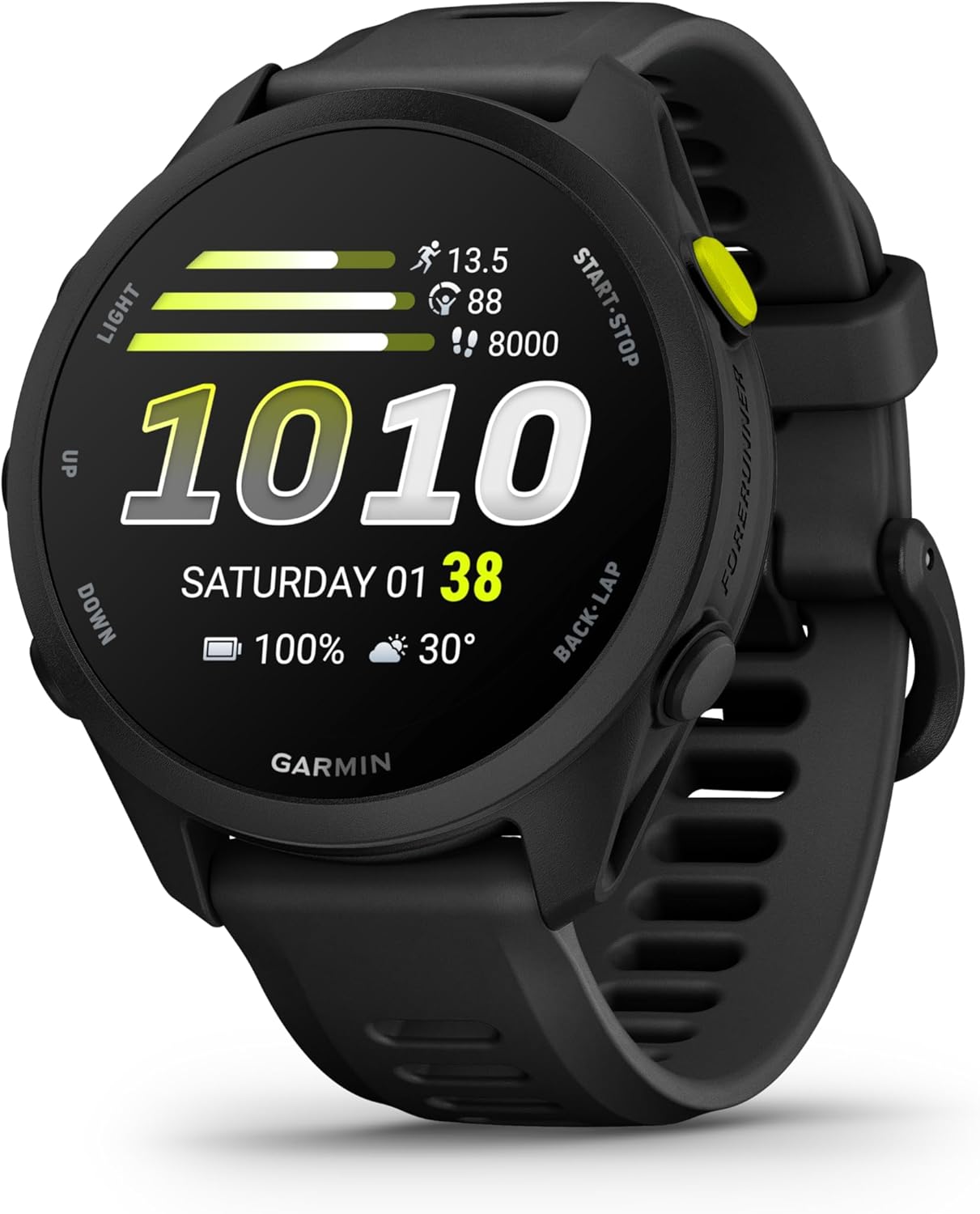
The Forerunner 170 (£259/$299, or £299/$349 with music) adds a barometric altimeter, Garmin Pay, open-water swim profiles, power-meter compatibility, and the adaptive Garmin Cycling Coach. The Music edition adds Wi-Fi sync, onboard storage and Spotify, Amazon Music and Deezer. Optical HR remains Elevate 4. GPS remains single-frequency. No maps, no triathlon.
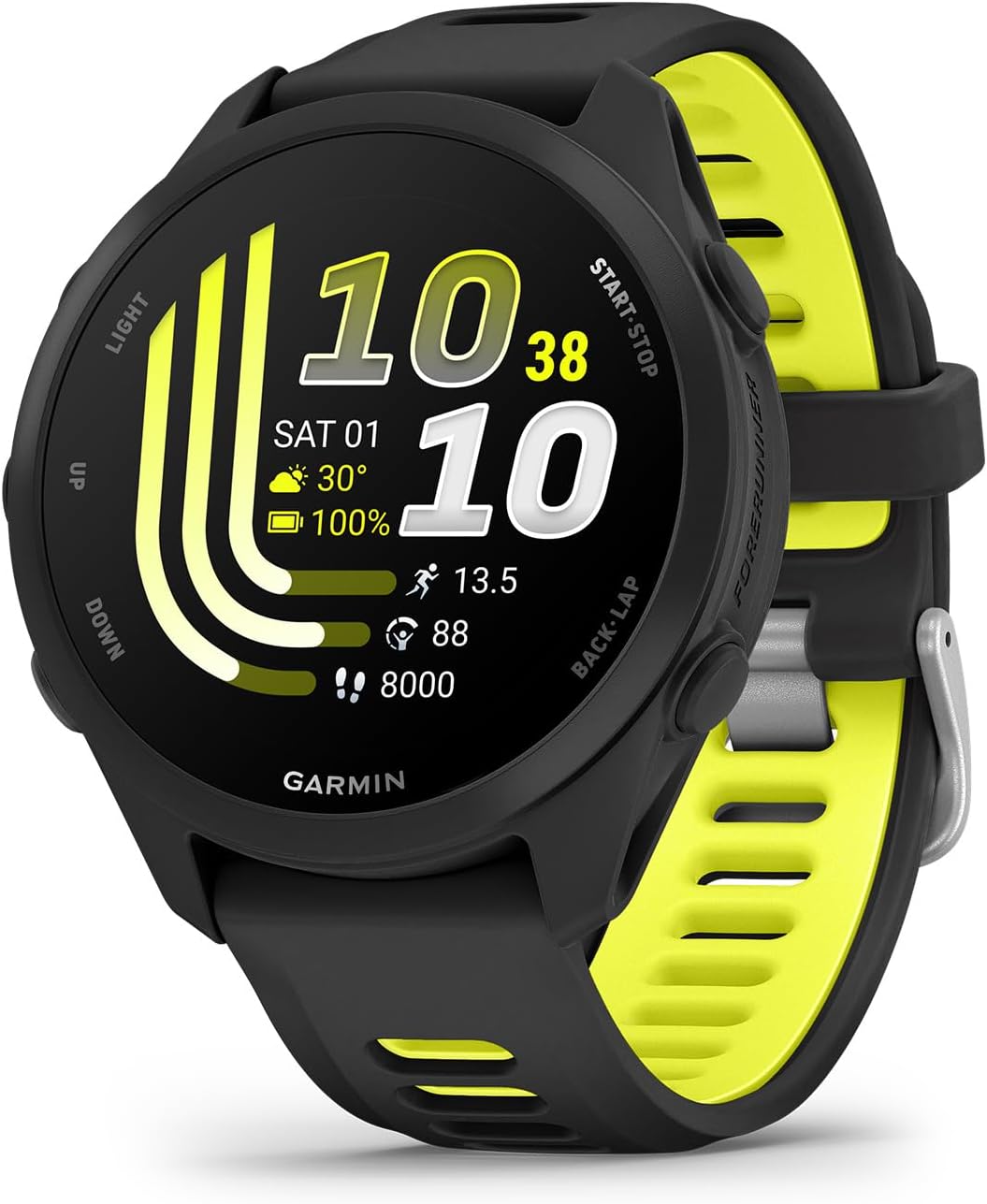
The Forerunner 265 (around $449/£430) is the established mid-level running watch. It steps up to dual-frequency GPS with SatIQ, Gorilla Glass 3, full training-load metrics, real-time stamina, PacePro, and triathlon profiles. Music is standard. There are no onboard maps.
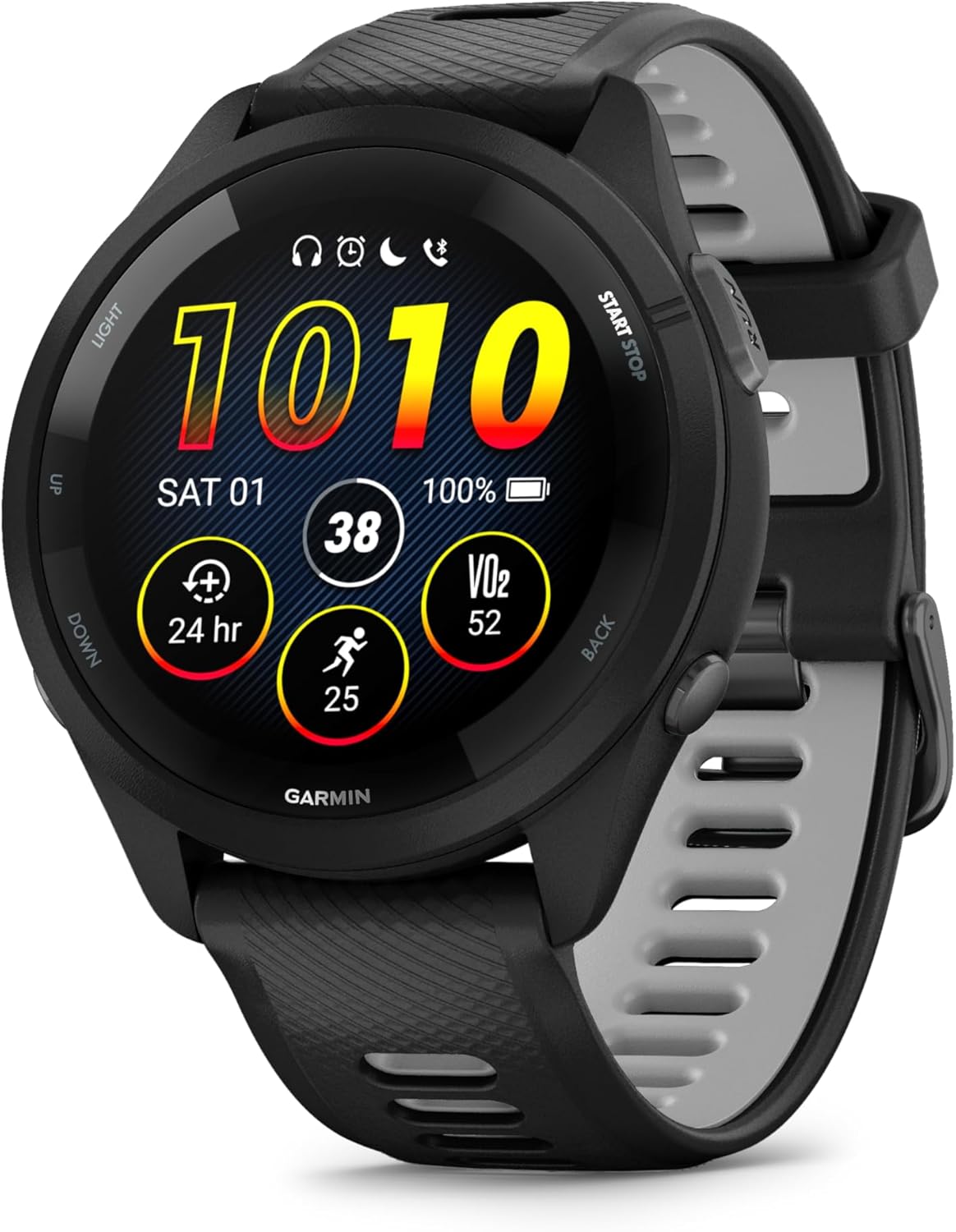
The Forerunner 570 ($549) upgrades the optical sensor to Elevate 5, adds a 1.4-inch display, an aluminium bezel, a speaker and microphone for voice commands and connected calls, skin temperature tracking, heat and altitude acclimation, and expanded multisport profiles, including Garmin Triathlon Coach. ECG hardware is present but disabled in the firmware. GPS is dual-frequency. There are no onboard maps.
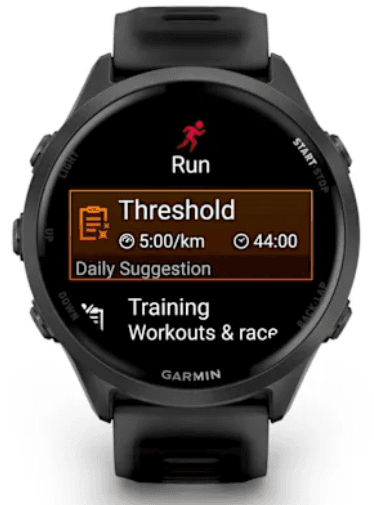
The Forerunner 970 is the only model in the current range with full topographic maps. It carries Elevate 5, dual-frequency GPS, ClimbPro, PacePro, race predictor, Garmin Coach and the complete triathlon feature set, including automatic transitions. In one sense, it is the watch Garmin positions against the Apple Watch Ultra at the premium end, in another sense, it is in a sporting class of its own.
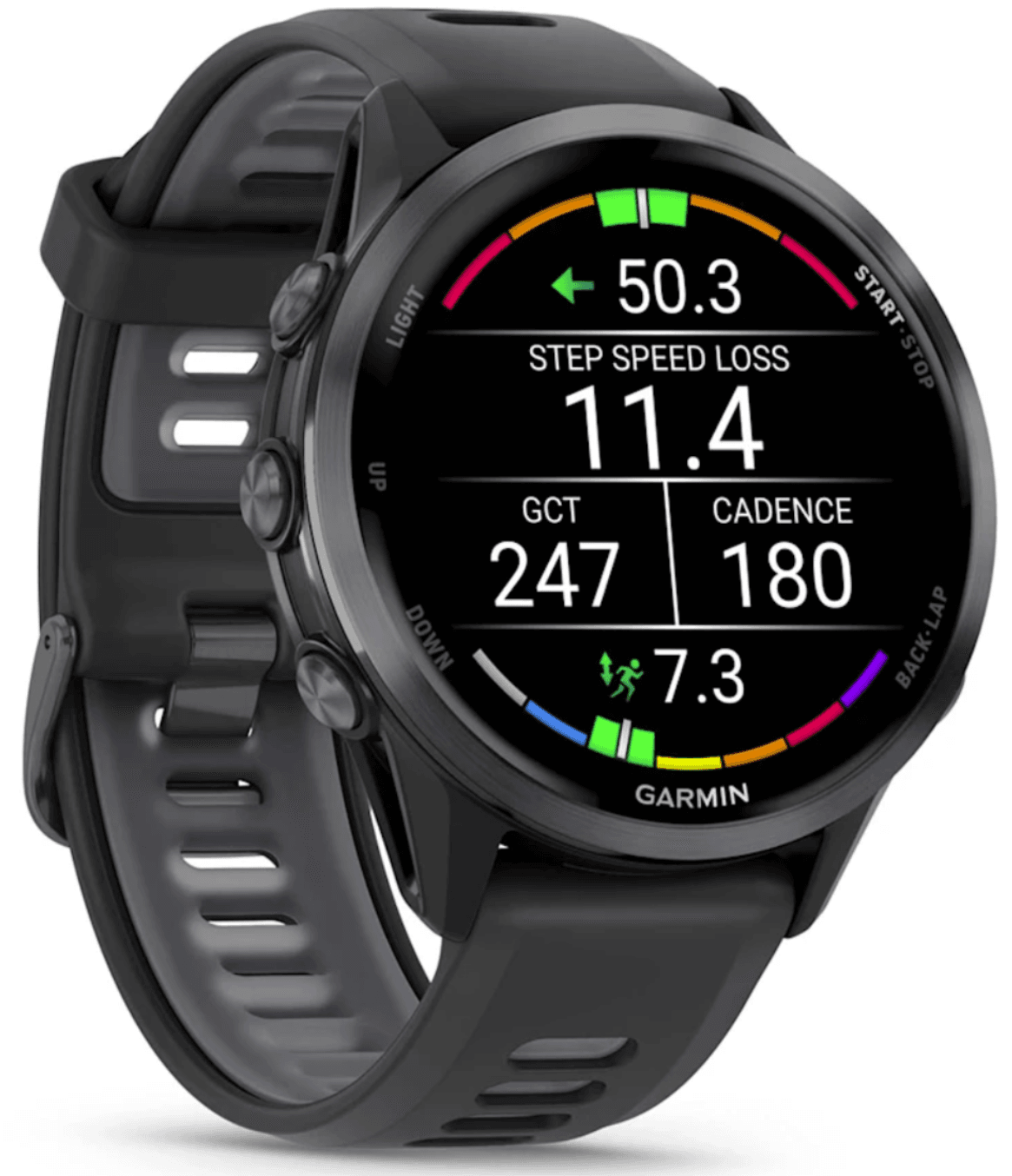
Garmin Forerunner 970
Premium GPS triathlon smartwatch. Features a bright AMOLED touch screen and a built-in LED flashlight.

How Garmin Differentiates the Range
Garmin structures the Forerunner line around four principal axes of hardware and software.
Optical HR sensor generation. The FR70 and FR170 carry Elevate 4, the same generation used in the Forerunner 165 that the FR170 replaces. The FR70 steps up two generations from the Elevate 3 in the Forerunner 55. No ECG, no skin temperature. The FR570, FR970 and Venu 4 carry Elevate 5, which adds ECG capability and skin temperature sensing. On the FR570, ECG is present in hardware but disabled in firmware, a deliberate commercial decision that preserves a step to the FR970.
GPS accuracy tier. All current Forerunners use a late-generation Synaptics chipset. Only the FR265, FR570 and FR970 include dual-frequency GPS with SatIQ. The FR70 and FR170 use single-frequency positioning. In normal conditions, the gap is marginal; in dense urban environments or under heavy tree cover, dual-frequency produces measurably better distance and pace data. Coros and Amazfit offer dual-frequency GPS at prices below the FR70, a point Garmin acknowledges in its own market commentary.
Onboard maps. No Forerunner below the FR970 carries topographic maps. The FR570 omits maps despite its $549 price. This preserves the FR970’s most visible single differentiator.
Triathlon and multisport. The FR70 and FR170 have no triathlon profile. The FR265 and FR570 include triathlon, duathlon, brick workouts and swimrun. The FR970 adds automatic transitions and race-specific navigation. The physiology stack, by contrast, is no longer a differentiator: Training Readiness, HRV Status, and the adaptive running coach now appear on the cheapest model in the range.
The Naming Conventions
The Forerunner numbering is confusing by design as much as by accident. The xx5 suffix in earlier models (FR235, FR265, FR965) denoted optical heart rate: the FR235 had it; its sibling, the FR230, did not. Since every Forerunner now includes optical HR, the suffix lost its meaning, and Garmin reset to FR570 and FR970 for the 2025 generation. Garmin’s Lead Product Manager confirmed the FR570 was named 570, not 270, because the step up in capability and materials from the FR265 felt too large for a simple incremental number. The future naming direction points toward four tiers: 1xx at entry, 3xx at mid-entry, 5xx at mid-high and 9xx at the flagship. An xx5 suffix may return to indicate a new differentiating feature, LTE being the most discussed candidate.
Forerunner as Garmin’s Commercial Engine
The Forerunner is the primary revenue driver of Garmin’s Fitness division, which also includes Edge cycling computers. That division grew 42 per cent in Q4 2025 and drove a 20 per cent single-day rise in Garmin’s share price when the results were published in February 2026. The Forerunner 970 was cited by management as a direct contributor to Q3 2025 earnings. Garmin’s own earnings commentary confirms it is taking share from Apple at the premium end and from lower-priced competitors at the lower end. The strategy is visible in the product line: the FR70 targets the entry segment where Coros and Amazfit compete, while the FR970 takes on the Apple Watch Ultra directly.
What the Accuracy Data Shows
GPS performance across the range is reliable for normal training use. Track testing of the Forerunner 970 alongside the Apple Watch Ultra 3 shows a positional accuracy advantage for the Garmin in most conditions. The step to dual-frequency matters primarily in technically difficult environments.
Optical heart rate tells a different story from the GPS. Elevate 4 and 5 are adequate for passive wear, resting metrics and overnight HRV. For interval training and racing, a chest strap provides more reliable data across all models. An academic study of the Forerunner 265 found resting heart rate accurate but HRV data unsuitable for clinical or research use. A separate study of 62 Garmin devices reached the same conclusion when compared with an ECG reference. The finding is consistent across generations: the physiology metrics the Forerunner produces are useful relative guides to training stress, not clinical measurements.
Software and Connect+
Garmin issues two substantive firmware updates per year to current devices, with major feature additions typically continuing for approximately two years post-launch. The Q1 2026 update brought Course Planner, Sleep Alignment, expanded gear tracking, and Varia voice alerts to the FR970 and FR570. Firmware 16.28 added battery manager insights and expanded multisport profiles to the same models.
Garmin Connect+ is an optional paid subscription. After 12 months of additions, it remains hard to justify for most Forerunner owners, with AI coaching and food logging the strongest current arguments in its favour. The food logging has documented shortcomings. The calculation shifts if Garmin delivers its planned native strength analytics later in 2026.
The Forerunner for Running, Racing and Triathlon
Road Racing
Road racing from 5K to marathon is the Forerunner’s primary use case. PacePro, which calculates real-time pace targets adjusted for gradient along a preloaded course, is available on the FR265 and above. The race predictor, based on current VO2max and recent training load, runs on all five models; on the FR970, it incorporates the actual course elevation profile when a course is loaded. Turn-by-turn cue alerts for pre-built courses are available on the FR265 and above. The FR70 and FR170 offer breadcrumb guidance without underlying map tiles. The FR570 and FR970 add a Suggested Finish Line feature that trims the recorded activity to the finish position of a loaded course rather than to the point where the timer is stopped.
Track
Track mode, which corrects GPS distance using the known geometry of a standard 400m loop, is present on the FR570 and FR970. A controlled GPS distance test published on this site compared the Forerunner 970 against the Apple Watch Ultra 3, Huawei Runner 2 and Amazfit Balance 2 across four laps in Lane 2. The FR970 recorded a 0.92 per cent error in pure GPS mode and improved to 0.72 per cent with track mode active, the best track-mode result in the test. Standard track recording as a sport profile is available on all five models; the distance corrections require the FR570 or FR970.
Triathlon and Multisport
The FR70 and FR170 do not have triathlon profiles. The FR265, FR570 and FR970 support triathlon, duathlon, brick, pool triathlon and swimrun as linked multisport modes. On the FR265 and FR570, transitions between disciplines require a manual button press. The FR970 adds automatic transition detection: the watch recognises when the athlete leaves the water or dismounts the bike and switches discipline profiles without input. Garmin Triathlon Coach, which generates an adaptive training plan based on a target race date and available weekly training hours, is available on the FR570 and FR970. On the FR970, it runs alongside full topographic navigation for the bike and run legs, as well as discipline-specific data screens for each segment.
The Garmin Ecosystem
The case for a Forerunner is not only a hardware decision. Garmin’s platform depth operates independently of which model is on the wrist.
Connect IQ and third-party app depth. Connect IQ is Garmin’s open application platform. Third-party developers publish data fields, apps, watch faces and widgets through an open developer programme. Data fields add computed metrics to sport screens and run natively on the watch, recording sensor data without a paired phone. The catalogue includes running power via Stryd, body temperature via CORE, and navigation via Komoot, along with a comprehensive set of training-specific data fields. The FR570 and FR970 support the full Connect IQ capability set. The FR70 and FR170 run apps, watch faces and data fields, and handle up to four Connect IQ data fields concurrently, double the previous entry-level limit.
Software update longevity. Garmin issues two substantive firmware updates per year to current devices. Major feature additions continue for approximately two years post-launch; bug corrections run beyond that. For buyers who plan to hold a watch for three years or more, the two-year major-feature window is a concrete factor in the ownership calculation.
Data portability. Garmin Connect exports activities in GPX, FIT and TCX formats. The FIT format is the endurance sports standard; Garmin created the specification and remains its primary steward. Activity sync to Strava, TrainingPeaks and other platforms runs automatically via Connected Apps. Any device or analysis tool that reads FIT files interprets Garmin-recorded activities directly, without conversion.
Training platform integrations. TrainingPeaks structured workouts sync bidirectionally to the watch via Garmin Connect. Workouts written in TrainingPeaks appear on the watch as step-by-step intervals with target power, pace, or heart rate ranges, and alert the athlete when they drift outside the prescribed window. Today’s Plan and Xert integrate on the same basis. Athletes on coached programmes receive sessions directly to the watch without manual entry.
Third-party sensor support. All current Forerunners support ANT+ and Bluetooth simultaneously. Supported devices include cycling power meters, heart rate chest straps, speed and cadence sensors, running footpods (including Stryd), and the Garmin Varia radar. Power meter support begins with the FR170; the FR70 does not support it. The HRM-Pro and HRM-600 chest straps add running dynamics data, including vertical oscillation, ground contact time, and cadence, to sport screens when paired with the FR265 and above.
Forerunner Reviews and Guides
Current Models
Garmin Forerunner 970: Review
Garmin Forerunner 570: All You Need to Know
Garmin Forerunner 265: Review
Garmin Forerunner 170: Review
Garmin Forerunner 70: Review
Garmin Forerunner 965: Review (previous generation)
Garmin Forerunner 955 Solar: Review (previous generation, solar option)
Garmin Forerunner 165: Comparison with FR55 and FR265 (superseded)
Accuracy
Forerunner 970 vs Apple Watch Ultra 3: GPS Track Test
Forerunner 265 HRV: Academic Study Results
62 Garmin Devices Tested Against a Clinical ECG
Garmin and Apple: Accuracy Across 39 Studies
Software and Setup
Forerunner 970 and 570: Firmware 16.28 Feature Guide
Q1 2026 Garmin Feature Update: All Watches
How to Set Up a New Garmin: Essential Settings
Garmin Race Day Masterclass
Garmin Battery Life: A Deep Dive
Garmin Battery Life 2025: Complete Model Comparison
Garmin Connect+: One-Year Review
Buyer Guides
Best Garmin Forerunner 2026
Best Garmin for Running 2026
Best Triathlon Watch 2026
Best Running Watch 2026
Context and Analysis
Garmin Forerunner Naming Conventions Explained
Five Wearable Watersheds: Where the Forerunner Fits
Garmin Q4 2025 Earnings: The Forerunner’s Role
Garmin Draws Level With Samsung in Global Smartwatch Share
Explore the full resource library
This site covers endurance sport technology across a range of dedicated reference sections. Each one collects the most relevant articles, tests, and analysis on its topic in one place.
Buyer guides
- Best sports watch: tested recommendations by sport and athlete type (triathlon, running, marathon, cycling, hiking, and women)
- Best Garmin watch: Forerunner versus Fenix by series, sport, and budget
- Best wearables: recovery trackers, heart rate monitors, running power meters, and female athlete tech
- Best cycling products: computers, smart trainers, power meters, and cycling heart rate monitors
Brand and product guides
- Amazfit: the full Amazfit range from Balance to Cheetah to T-Rex, accuracy tests, HYROX partnership, and Zepp Health analysis
- Apple Watch: athlete-first coverage of Apple Watch across running, cycling, and triathlon
- COROS: watches, features, and firmware across the full COROS range
- Garmin: the company, the platform and the full range, and the starting point for choosing across every Garmin product line
- Garmin Edge: bike computers from entry-level navigation to flagship endurance and mountain biking
- Garmin Fenix: every model, feature, and firmware development for Garmin's flagship outdoor watch
- Garmin Fenix 8 Series: which variant to buy, upgrade advice, accuracy data, and the full Fenix 8 review and firmware coverage
- Garmin Forerunner: the full Forerunner line covered from entry level to triathlon flagship
- Garmin Instinct: rugged GPS watches for endurance and adventure athletes
- Garmin Features Explained: how Garmin's metrics work, from Training Load and Body Battery to Race Predictor and HRV Status
- Google Fitbit: Fitbit Air, Google Health, Pixel Watch and the Wear OS platform
- Polar: watches, sensors, Polar Flow and training science across the full Polar range
- Runna: coach-written running plans that adapt as you train
- Suunto: Race, Vertical, Run and the SuuntoPlus ecosystem
- Strava: features, privacy, segments, and how Strava fits into a serious training setup
- Ride with GPS: route planning, navigation and how it works alongside Strava
- Wahoo: KICKR trainers, ELEMNT bike computers, and the Wahoo ecosystem
- WHOOP: strain, recovery, sleep and the full WHOOP ecosystem
Specifications database
- Full Specifications Database: detailed spec sheets, battery life, sensor lists and generation-on-generation comparisons for current Garmin, COROS, Amazfit, Samsung, Google Fitbit, Huawei, Polar, Suunto, Wahoo and Apple Watch models
Glossary
- Sports Technology Glossary: non-branded terminology across running, cycling, swimming, triathlon, hiking, strength training, HYROX, sensors, ecosystems, and brands
Sport and topic guides
- Running Watches: how to choose by discipline (road racing, trail, track, beginner, and multisport)
- Triathlon and Multisport Technology: watches, sensors, and race-day tools for swimmers, cyclists, and runners
- HYROX: training science, race analysis, and technology for the functional fitness race format
- parkrun: technology, training, and performance for the weekly 5K
- Hiking Technology: navigation, safety, and trail tech for walkers and hikers
- Heart Rate Monitoring: optical sensors, chest straps, accuracy comparisons, and how to set training zones
- Optical Sensors (PPG): the 40 things a wrist optical sensor could measure, from heart rate to glucose, ranked by evidence
- GPS Accuracy: how satellite systems perform across brands, terrains, and conditions
- Sports Watch Battery Life: battery claims, real-world tests, and how to manage battery life across Garmin, Apple, Amazfit and COROS
- Recovery Trackers: WHOOP, Oura, and the science of readiness scoring
- Muscle Oxygen Sensors: SmO2 and NIRS explained, Train Red and Moxy compared, and the category from BSX and Humon to Garmin and WHOOP
- Female Athlete Tech: wearables, physiology, and performance for female endurance athletes, covering cycle-synced training, RED-S, HR accuracy, and VO2max
- Sports Science: peer-reviewed research on HRV, VO2max, lactate threshold, running power, wearable accuracy, and supplementation
- Testing Methodology: how this site tests GPS accuracy, heart rate, battery life, and other performance claims
Content series
- Release Radar: confirmed launches, leaks, and rumours across Garmin, Apple, COROS, Polar, Suunto, and Wahoo
- Deep Dive Feature Files: weekly firmware feature updates across all brands (bug fixes excluded)
- Fix Files: weekly firmware bug fix tracking across all brands
