Garmin Instinct Series
The Instinct is Garmin’s rugged outdoor watch. It runs on five physical buttons, lacks onboard maps, and sells for well under half the price of the Fenix. Since 2018, it has offered Garmin’s outdoor navigation, sensors, and battery life at a price most Fenix buyers will not pay. Today’s line runs from a £220 entry model to a £520 hybrid with mechanical hands.
The Current Instinct range
The prices below are the current global list prices for each model. The launch RRP is shown, where Garmin has since cut it.
The Instinct E ($199.99 / £219.99 / €219.99) is the entry model and the only current Instinct sold in 40mm. Garmin cut its US price from $299.99 after criticism that it offered less than the older Instinct 2 at a similar price. The E omits:
- Solar charging
- Multi-band GNSS
- The LED flashlight
- Garmin Pay
- The newer training metrics
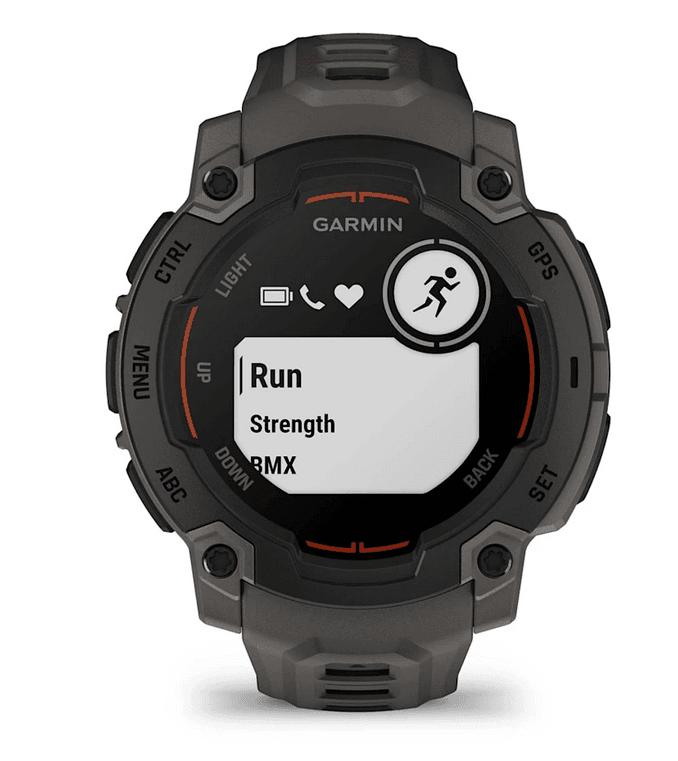

The Instinct 3 Solar ($299.99 to $349.99 / £299.99 to £349.99 / €319.99 to €349.99, in 45mm and 50mm) retains the monochrome memory-in-pixel display and the dual-window layout, with a Power Glass solar lens. Battery life in smartwatch mode is unlimited under sufficient daylight.
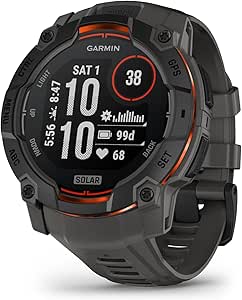
The Instinct 3 AMOLED ($299.99 to $349.99 / £349.99 to £399.99 / €399.99 to €449.99, in 45mm and 50mm) introduces a 390x390px colour display to the line. Smartwatch battery life is 18 to 24 days. No Instinct has a touchscreen, the AMOLED included.
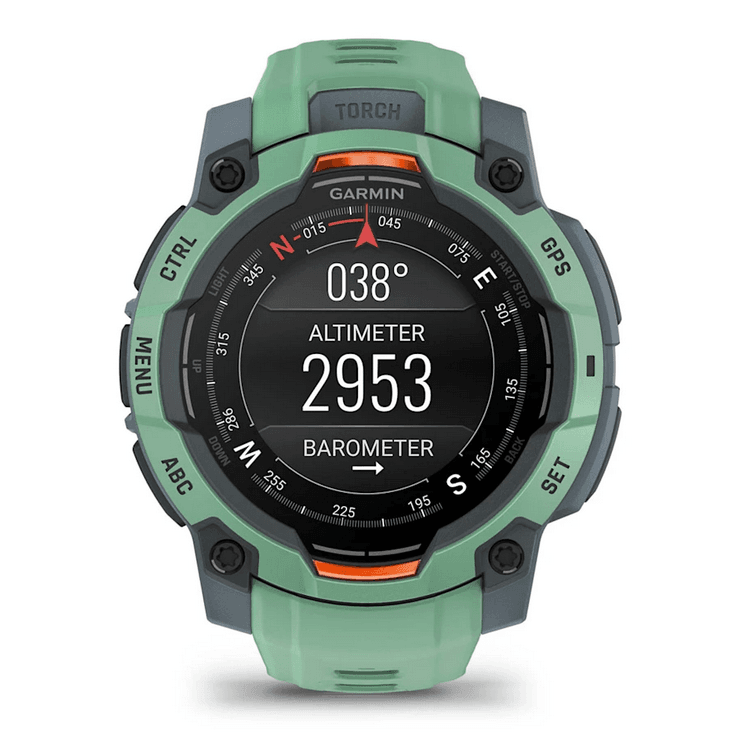
The Instinct 3 Tactical (from $499.99 in the US; UK and Eurozone pricing varies) adds the military layer:
- Stealth Mode
- A Kill Switch
- Jumpmaster
- A green flashlight for night-vision use
- Dual-format coordinates
- A rucking profile
- Applied Ballistics solver compatibility, behind an unlock fee

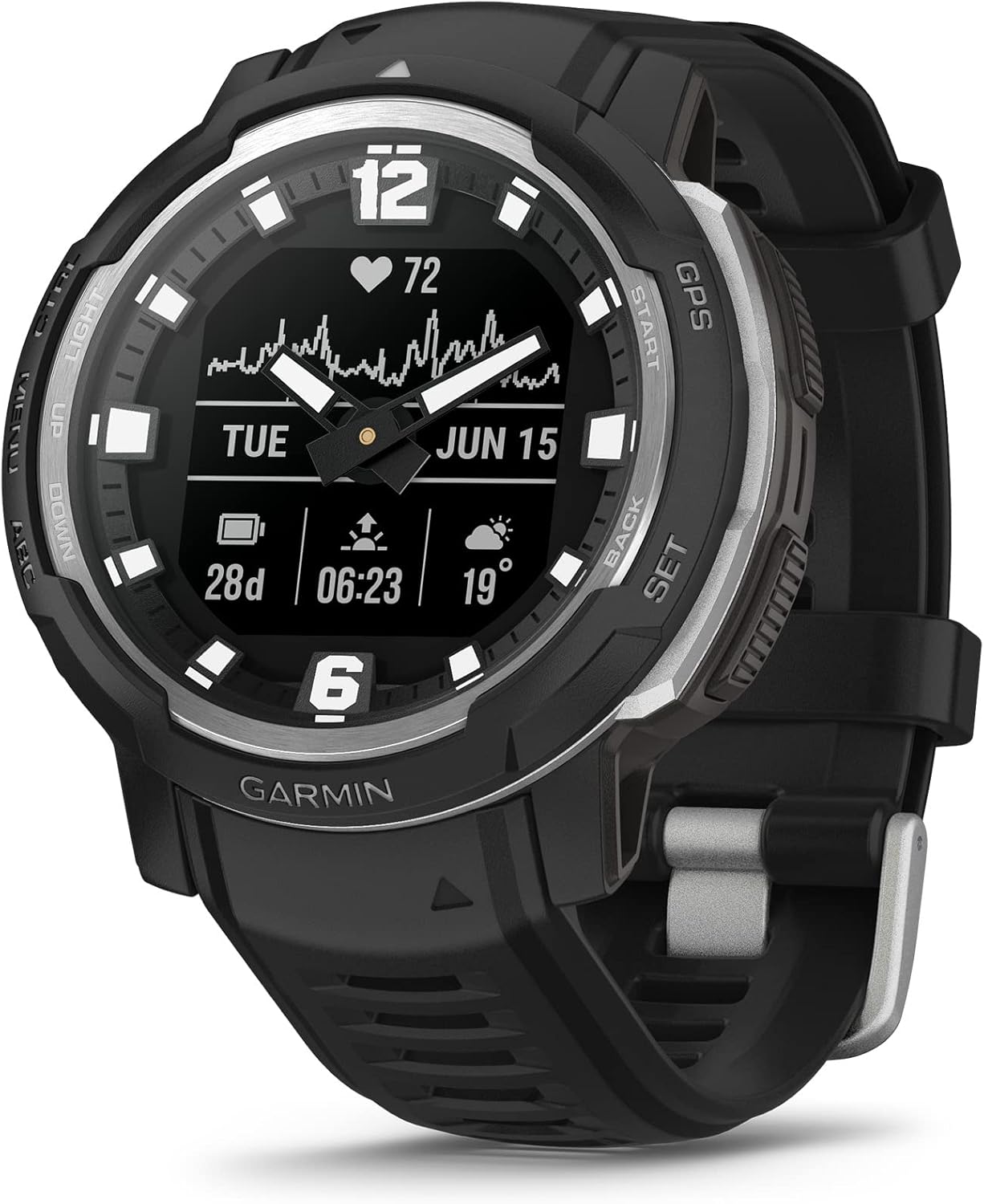
The Instinct Crossover SOLAR ($549.99 / £519.99 / €599.99) combines physical analogue hands with an MIP display. It carries the full Instinct 3 feature set.
How Garmin differentiates the Instinct range
The Instinct line is structured around three internal choices, with a fourth choice that distinguishes it from the Fenix Series.
Display and charging. Solar uses a monochrome memory-in-pixel screen and a Power Glass solar lens, with battery life measured in weeks and no limit under daylight. AMOLED uses a colour screen and runs for 18 to 24 days. The two are mutually exclusive within a generation.
Size. The 40mm option is available only on the Instinct E. The Instinct 3 sizes are 45mm and 50mm. A small wrist and the full Instinct 3 feature set are incompatible.
Feature tier. The Instinct E removes the flashlight, multi-band GNSS, Garmin Pay and the newer training metrics. Instinct 3 includes them all. Tactical adds the military layer.
Against the Fenix. The Instinct is a Fenix, re-packaged with the costly parts removed:
- No onboard maps; the Fenix has full TopoActive mapping
- Older Elevate Gen 4 optical heart-rate sensor, not the Fenix 8’s Gen 5
- Fibre-reinforced polymer case with a metal-reinforced bezel; the Fenix offers steel and titanium bezels and a sapphire-crystal option
- No touchscreen, speaker, microphone, Wi-Fi or onboard music
- No top-tier endurance metrics (Real-Time Stamina, Endurance Score, Hill Score), these are reserved for the Fenix and Enduro
GPS is the exception. Multi-band GNSS with SatIQ is standard across the Instinct range, the same satellite capability as the Fenix.
The two watches target similar buyers. Some prefer the Instinct’s utilitarian look, the longer runtime and the memory-in-pixel screen that stays readable in direct sun and rarely needs charging.
The Instinct for outdoor use and sport
Navigation is breadcrumb-only. The Instinct follows a course loaded from Garmin Connect or a GPX file, draws the track and supports TracBack, but it has no topographic map. The lack of that crucial outdoor feature – the Map – is the most common reason to consider a Fenix or a Forerunner 970 instead.
The barometric altimeter, three-axis compass and storm-alert barometer are standard, as is multi-band GNSS with SatIQ on every Instinct 3.
Training features include:
- VO2 max
- Training Status
- Training Readiness
- Training Load with Focus and Ratio
- HRV Status
- Recovery Time
Triathlon and most multisport profiles are supported. Power-based training tools are thinner than those in the higher end of the Garmin range.
Hiking and backcountry
The Instinct is built for multi-day hiking. The ABC sensor suite provides the environmental data a hiker needs without a phone: barometric altitude for elevation tracking, a compass for bearing, and storm alerts from pressure changes. TracBack navigates back to the start of any route. Courses loaded from Garmin Connect or third-party GPX files display as a breadcrumb track. The flashlight, standard on every Instinct 3, is a practical safety feature after dark.
The limitation that defines the watch is that there is no topographic map. Route planning must happen before the hike, on a phone or computer. Rerouting on the move is not possible. For day hikes on marked trails with a pre-loaded track, this is workable. For off-trail navigation in unfamiliar terrain, it is not. Third-party workarounds exist: dwMap caches route maps to the Instinct via Connect IQ, partially closing the gap on models with sufficient storage.
Trail and ultra running.
The Instinct carries enough of Garmin’s training stack to support structured trail and ultra training: VO2 max, Training Readiness, Training Load with the Focus and Ratio breakdowns, and HRV Status. Course navigation with an elevation profile is supported. ClimbPro, which displays remaining ascent and gradient on a mapped course, is absent; that requires a Fenix or Enduro.
Battery life is the Instinct’s strongest argument for ultra-distance events. The Solar 50mm runs indefinitely in smartwatch mode and reaches 60 hours in standard GPS mode, extending further with solar input. For events lasting over 24 hours, it outlasts every other AMOLED watch in the Garmin range without a charge. The trade-off is the screen: reading pace data on a monochrome MIP display at mile 80 is less comfortable than on an AMOLED, but the watch will still be running.
Rucking and tactical training
The Instinct 3 Tactical introduced a dedicated rucking profile that tracks pack weight alongside pace, distance, and elevation. Rucking has grown rapidly as a training discipline, and the Instinct is the cheapest Garmin to support it natively. The Tactical edition adds Stealth Mode, a Kill Switch, Jumpmaster, and night-vision-compatible lighting for military and law-enforcement users. For civilian ruckers who do not need the tactical features, the standard Instinct 3 supports weighted hiking tracking through the basic hiking profile, though it lacks the dedicated rucking data fields.
Thirteen years: history, naming and variants
The original Instinct launched in October 2018 at $299.99, half the price of the Fenix 5. It introduced the dual-window memory-in-pixel display, MIL-STD-810G durability, the ABC sensors and TracBack. Connect IQ, Garmin Pay and advanced training metrics were absent. A Tactical Edition followed in 2019.
In 2020, Instinct Solar brought Power Glass solar charging down from the Fenix 6X Pro Solar, adding Pulse Ox and Body Battery. It was the first Garmin watch with no theoretical battery limit in smartwatch mode when exposed to sufficient sunlight. The Surf and Tactical editions, launched together, differed in software and finish rather than in hardware. In 2022, the Instinct 2 added Connect IQ, VO2 max, Training Status, and a 40mm size, and the Instinct Crossover launched that same year as an analogue-hands hybrid. A year later, the 2X Solar introduced a 50mm case, the LED flashlight and multi-band GNSS.
Instinct 3, the current generation, launched in 2025 with AMOLED for the first time, the flashlight and multi-band GNSS standard, a metal-reinforced bezel and new Training Load metrics. The Instinct E and the Crossover AMOLED followed.
Naming follows a pattern:
- A plain number: the generation
- Solar and AMOLED: the display and charging combination
- E: the entry model
- 2X: the 50mm case in the second generation, retired now that 50mm is an Instinct 3 size option (effectively 3X)
- Tactical: the military feature layer
- Crossover: the analogue-hybrid body
Like the Fenix and Forerunner, the Instinct is a platform: Garmin has used the body for the Descent dive computers and, in 2020, a short-lived eSports edition that differed only in software.
The Instinct is Garmin’s entry-level outdoor anchor
The Instinct anchors the bottom of Garmin’s Outdoor range. An Instinct 3 AMOLED at $299.99 sits against a Fenix 8 AMOLED at $849.99, itself already reduced from $1,099.99 at launch. The Forerunner targets road and track runners; the Instinct targets outdoor users who want durability and are willing to forgo mapping to save money.
Every Instinct 3 model has fallen below its launch price on Garmin.com. US cuts are about a third of those in standard models. UK and Eurozone pricing have held closer to launch. The pattern is consistent with weaker recent results in Garmin’s Outdoor division and growth in Fitness.
What the accuracy data shows
Multi-band GNSS with SatIQ is standard on every Instinct 3, the largest accuracy upgrade the series has had. Dual-frequency reception across GPS, GLONASS, Galileo, BeiDou and QZSS produces measurably cleaner tracks than earlier single-frequency Instincts. This site’s ten-mile comparison test put Instinct 3 results on a par with hardware several times its price.
Heart rate is weaker. The Instinct 3 uses the older Elevate Gen 4 sensor, which is adequate for resting heart rate, overnight HRV and Body Battery. Intervals and racing benefit from a chest strap, paired over ANT+ or Bluetooth.
Software and Connect+
The Instinct 3 runs Garmin’s current software platform from a five-button interface. No model has a touchscreen, the AMOLED included. The CTRL button controls the flashlight; the ABC button accesses the altimeter, barometer, and compass.
Firmware updates arrive at a roughly quarterly cadence, matching the Fenix’s schedule. LiveTrack, Incident Detection, Garmin Messenger and Garmin Share are supported.
Connect+ is optional. The metrics the Instinct buyer relies on (Training Status, Body Battery, sleep, HRV) remain free in the base Garmin Connect app. Garmin does not require a subscription for the Instinct because it lacks inReach satellite hardware.
The Garmin ecosystem
Connect IQ, Garmin’s third-party app platform, runs on every Instinct 3 and Instinct E. It supports watch faces, data fields, widgets, and apps. The catalogue is narrower on the Instinct than on the Fenix or Forerunner because the monochrome MIP display on Solar models limits what developers can render, but the core third-party data fields, Stryd running power, CORE body temperature, and Komoot navigation, among them, all work.
Third-party sensor support spans ANT+ and Bluetooth. The Instinct 3 pairs with chest-strap heart rate monitors, cycling speed and cadence sensors, foot pods (including Stryd), and the Garmin Varia radar. Power meter pairing is present on the Instinct 3 but absent on the Instinct E.
Garmin Connect automatically syncs activities to Strava, TrainingPeaks, Today’s Plan, and other training platforms. Activities export in FIT, GPX, and TCX formats. For athletes on coached programmes, structured workouts sync from TrainingPeaks or Garmin Coach to the watch and execute as step-by-step intervals with target alerts.
Garmin’s firmware support typically continues for two years post-launch with major feature additions, and longer for bug corrections. The Instinct 3 sits in the same quarterly update cadence as the Fenix and Forerunner, which means it benefits from the large-device update group rather than being left on a slower track.
Instinct coverage on this site
Instinct 3: reviews and buyer guides
- Garmin Instinct 3 Review and How To Add Maps: AMOLED, Solar, E compared
- Garmin Instinct 3 Series Overview: Instinct E, Solar, AMOLED
- Garmin Instinct 3 Series: New Features To Be Added
- Garmin Instinct 3: Another Buggy and Under-Specified Product?
- Instinct 3: How Does It Look on Different-Sized Wrists?
The maps and navigation question
Accuracy, sensors and features
- Garmin Instinct 3 Accuracy Test: 10-Mile Comparison
- Garmin Instinct 3 Will Get Music Added by Garmin: Here’s Why
The Instinct E
Tactical
- Garmin Instinct 3 Tactical Compared to Tactix and Instinct 3 AMOLED
- Garmin Instinct 3 Tactical: Leaked by Garmin
- Garmin Instinct 3: You Rucked, They Answered
Solar, battery and display
The history of the line
- Garmin Instinct Specifications and Fenix 5 Comparison (2018)
- Garmin Instinct Review (2019)
- Garmin Instinct Specs and Fenix 5 Comparison (2019)
- Garmin Instinct Solar, Surf Solar, Tactical Solar
- Garmin Instinct 2 Solar, 2S Review
- New Garmin, 8 November 2022: Instinct Crossover
- Garmin EMS Instinct 2 Series and 2X
- Garmin Instinct 2X Revealed in Images
- Garmin Instinct 2X: What’s Different
- Garmin Instinct 2 Gets New Feature Announcement
The Instinct in the market
Explore the full resource library
This site covers endurance sport technology across a range of dedicated reference sections. Each one collects the most relevant articles, tests, and analysis on its topic in one place.
Buyer guides
- Best sports watch: tested recommendations by sport and athlete type (triathlon, running, marathon, cycling, hiking, and women)
- Best Garmin watch: Forerunner versus Fenix by series, sport, and budget
- Best wearables: fitness trackers, recovery trackers, heart rate monitors, running power meters, and female athlete tech
- Best cycling products: computers, smart trainers, power meters, and cycling heart rate monitors
- Gear I use: the watches, bikes, sensors, fuel and sleep kit tfk actually trains and races with, and what his partner uses
Brand and product guides
- Amazfit: the full Amazfit range from Balance to Cheetah to T-Rex, accuracy tests, HYROX partnership, and Zepp Health analysis
- Apple Watch: athlete-first coverage of Apple Watch across running, cycling, and triathlon
- COROS: watches, features, and firmware across the full COROS range
- Garmin: the company, the platform and the full range, and the starting point for choosing across every Garmin product line
- Garmin Edge: bike computers from entry-level navigation to flagship endurance and mountain biking
- Garmin Fenix: every model, feature, and firmware development for Garmin's flagship outdoor watch
- Garmin Fenix 8 Series: which variant to buy, upgrade advice, accuracy data, and the full Fenix 8 review and firmware coverage
- Garmin Forerunner: the full Forerunner line covered from entry level to triathlon flagship
- Garmin Instinct: rugged GPS watches for endurance and adventure athletes
- Garmin Features Explained: how Garmin's metrics work, from Training Load and Body Battery to Race Predictor and HRV Status
- Google Fitbit: Fitbit Edge, Fitbit Air, Google Health, Pixel Watch and the Wear OS platform
- Polar: watches, sensors, Polar Flow and training science across the full Polar range
- Runna: coach-written running plans that adapt as you train
- Suunto: Race, Vertical, Run and the SuuntoPlus ecosystem
- Strava: features, privacy, segments, and how Strava fits into a serious training setup
- Ride with GPS: route planning, navigation and how it works alongside Strava
- Wahoo: KICKR trainers, ELEMNT bike computers, and the Wahoo ecosystem
- WHOOP: strain, recovery, sleep and the full WHOOP ecosystem
Specifications database
- Full Specifications Database: detailed spec sheets, battery life, sensor lists and generation-on-generation comparisons for current Garmin, COROS, Amazfit, Samsung, Google Fitbit, Huawei, Polar, Suunto, Wahoo and Apple Watch models
Glossary
- Sports Technology Glossary: non-branded terminology across running, cycling, swimming, triathlon, hiking, strength training, HYROX, sensors, ecosystems, and brands
Sport and topic guides
- Running Watches: how to choose by discipline (road racing, trail, track, beginner, and multisport)
- Triathlon and Multisport Technology: watches, sensors, and race-day tools for swimmers, cyclists, and runners
- HYROX: training science, race analysis, and technology for the functional fitness race format
- parkrun: technology, training, and performance for the weekly 5K
- Hiking Technology: navigation, safety, and trail tech for walkers and hikers
- Heart Rate Monitoring: optical sensors, chest straps, accuracy comparisons, and how to set training zones
- Optical Sensors (PPG): the 40 things a wrist optical sensor could measure, from heart rate to glucose, ranked by evidence
- GPS Accuracy: how satellite systems perform across brands, terrains, and conditions
- Sports Watch Battery Life: battery claims, real-world tests, and how to manage battery life across Garmin, Apple, Amazfit and COROS
- Recovery Trackers: WHOOP, Oura, and the science of readiness scoring
- Muscle Oxygen Sensors: SmO2 and NIRS explained, Train Red and Moxy compared, and the category from BSX and Humon to Garmin and WHOOP
- Female Athlete Tech: wearables, physiology, and performance for female endurance athletes, covering cycle-synced training, RED-S, HR accuracy, and VO2max
- Sports Science: peer-reviewed research on HRV, VO2max, lactate threshold, running power, wearable accuracy, and supplementation
- Testing Methodology: how this site tests GPS accuracy, heart rate, battery life, and other performance claims
Content series
- Release Radar: confirmed launches, leaks, and rumours across Garmin, Apple, COROS, Polar, Suunto, and Wahoo
- Deep Dive Feature Files: weekly firmware feature updates across all brands (bug fixes excluded)
- Fix Files: weekly firmware bug fix tracking across all brands
Small things I always use
- Garmin 90-degree charging adapter: Charges your Garmin from any USB-C cable. Essential when travelling. I use one.
- Body Glide: The blue anti-chafe stick swimmers and runners carry. I use it.
- Speedo earplugs: Fewer ear infections and no cold-water dizziness. I use them.
- Dryrobe Advance: My winter changing robe for open-water swims. I use one. A cheaper option is the AONYIYI changing robe.
- Maurten: Race fuel that stays easy on the stomach. I use them.
- Beet It Sport nitrate shots: Beetroot shots I take in the days before a race. I use them.
- Garmin charging puck: The quickest way to top up before a session. I use one.
- Injinji: Toe socks that stop rubbing, so you run more. I use them.
- Ultimate toe protectors: Stop black toenails on long runs. They work. I use them.
- Compressport R2 v2 calf sleeves: My calf sleeves of choice. I use them.
- Cellucor C4: My pre-workout before hard sessions.
- TPU tubes: Schwalbe Aerothan, Tubolito and Pirelli SmarTube. Light, tiny spares. I use all three.
- G8 insoles: Adjustable insoles that are good. I use them.
- Cycplus Cube: A 97g electric pump that gets a road tyre rideable in two minutes. I carry one. 5% off with code THE5KRUNNER.
Watches and sensors
- Polar H10: My daily driver for waking HRV.
- Polar Verity Sense: My backup arm-worn HR sensor.
- Nomad bedside charger: Charges my iPhone and Apple Watch overnight. I use it, and many of their bands.
- Train.Red: The best muscle oxygen sensor I’ve used.
- Tymewear: Accurate heart rate and reliable ventilatory zones. I use it to pace endurance rides over an hour.
- Garmin Forerunner 970: A pro-grade triathlon watch. I use this.
- Apple Watch Ultra 4: My daily smartwatch. No phone needed on rides.
- Garmin Fenix 9 Pro: I’ve just bought one.
On the bike
- Continental GP5000 for everyday riding, and Aero 111 on the front for special occasions.
- Helmets: Specialized S-Works Evade 3 for road riding, and Rudy Project Wing for TT-style races. I use both.
- Ravemen FR300: A front light that mounts under your Garmin or Wahoo. I use one.
- Wahoo TRACKR Radar: I use it on one bike and Varia on the other. They perform the same.
- Garmin Varia RTL515: Radar that warns you of cars from behind. I use this model.
- Wahoo ELEMNT Roam 3: The bike computer that’s easy to use. I use mine on most rides.
- Favero Assioma Pro RS2: Accurate power pedals that swap easily between bikes. I use this model.
Home and indoor training
- NPE Runn: Makes my basic treadmill smart, sending more accurate speed and distance to my watch and Zwift. I use it.
- Google Wifi: Keeps Zwift connected in my pain cave. I use it.
- Apple TV 4K: Zwift on the big screen. I use two.
- Google Nest Doorbell (wired, 2nd gen): My video doorbell, running in both Google Home and Apple Home. I use it.
Health, recovery and sleep
- FreeStyle Libre 3 Plus: Shows how my blood sugar responds to diet.
- hDrop: Measures my sweat loss in summer and indoors.
- Fourth Frontier Zone: Checks my heart under load in hard sessions.
- Oura Ring 5: My partner’s recovery tracker of choice.
- Eight Sleep: A cooling mattress cover my partner and I use nightly.
Reader-Powered Content

This content is not sponsored. It’s mostly me behind the labour of love, which is this site, and I appreciate everyone who supports it.
Support the site: Follow (free, fewer ads) · Subscribe (paid, ad-free) · Buy Me A Coffee
Written by real people, with AI assistance. Fact-checked and verified for originality. See the Editorial Policy. FTC: Affiliate Disclosure — some links pay commission. As an Amazon Associate, I earn from qualifying purchases.
