Body Battery
Useful as a broad indicator; less reliable as an absolute reading at any given time of day
Tracks energy flows and recoveries during the day
Measures nervous system state, not how you actually feel
Quick answers
Why is my Body Battery not charging overnight?
The three most common causes are a loose watch fit, degrading the HRV signal during sleep, a disruptor such as alcohol or late exercise elevating heart rate through the night, or the algorithm still calibrating during the first one to two weeks of wear. During that initial period, morning scores of 50–70 are normal and do not indicate a problem with sleep quality.
Does alcohol affect Body Battery?
Yes — alcohol is the most consistent disruptor. Metabolising it elevates resting heart rate and suppresses HRV during sleep, which the algorithm reads as physiological stress rather than recovery, regardless of how long the athlete sleeps. Even moderate evening alcohol consumption typically produces a measurably lower morning score.
How accurate is Body Battery?
No formal accuracy specification exists for Body Battery as a composite score. As a trend indicator, it is more useful than as an absolute reading: three consecutive low morning scores reliably signal accumulated fatigue even if any single figure is imprecise. Accuracy is poor within the first ten days of wear and when the overnight wrist HR signal is degraded.
Is Body Battery the same as Training Readiness?
No. Body Battery tracks available energy continuously throughout the day on a 5–100 scale, and is not one of Training Readiness’s inputs. Training Readiness is a separate morning-only composite score built from sleep score, HRV status, recovery time, acute training load, sleep history, and stress history.
Body Battery — A Deep Dive
When Body Battery Is Actually Useful
- I glance at Body Battery throughout the day, and sometimes investigate unexplained drops — illness, overreaching, or unusual stress often show up before I feel them consciously. Alcohol has a predictable and visible effect: my score turns negative within a few hours of drinking.
- I take a waking score below 25 as a specific warning signal and will pause to reconsider hard training that day. HRV Status is a better indicator here — it measures resting physiology across multiple nights rather than a single overnight — but Body Battery gives an immediate number the moment I wake up.
- After hard exercise, my score eventually falls, sometimes significantly. The delay between finishing the workout and that drop occurring tells me something useful — a longer delay suggests my body is coping better with the training load.
Body Battery is a Garmin energy-reserve score, originally developed by Firstbeat Analytics, that estimates how much physiological capacity an athlete has available at any given moment. On a scale of 5 to 100, it rises during sleep and rest and falls during exercise, stress, and illness. It is a modelled estimate derived from continuous heart rate variability analysis, not a direct physiological measurement, and Garmin positions it as a readiness guide rather than a diagnostic instrument. The feature has been available across Garmin’s wearable range since 2018. The model requires one to two weeks of consistent wear before it stabilises to an individual’s physiology.
What the Number Actually Means
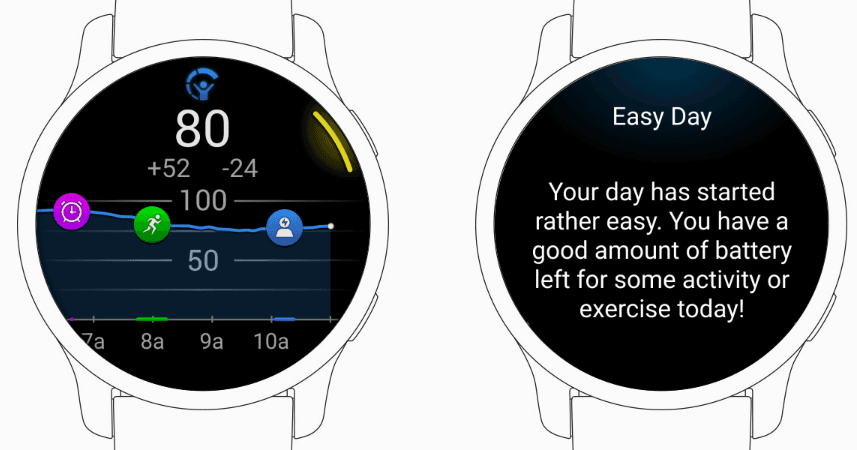
On current devices, Garmin uses four zones documented in the Fenix 8 owner’s manual (November 2025). Highly trained athletes tend to recover more quickly overnight because their bodies shift into a recovery state more readily during sleep.
| Score | Zone | What it means |
|---|---|---|
| 76–100 | High reserve energy | Ready for intense training |
| 51–75 | Medium reserve energy | Suitable for moderate activity |
| 26–50 | Low reserve energy | Consider lighter activities |
| 5–25 | Very low reserve energy | Prioritise rest and recovery |
Zone labels from the Fenix 8 owner’s manual (November 2025). The displayed minimum is 5. Older device manuals used different zone names.
How Garmin Calculates It
Body Battery is computed by the Firstbeat Analytics engine, which Garmin acquired in June 2020. The primary inputs are RMSSD (the beat-to-beat HRV parameter most sensitive to stress and recovery state), daytime stress derived from HRV patterns, and overnight sleep quality and duration. When the body is under stress — during exercise, emotional stress, or illness — the score drains. When the body shifts into a recovery state during rest or sleep, it rises. The athlete’s VO2 max estimate affects drain rate during exercise: fitter athletes drain more slowly at equivalent absolute intensities. Sleep is the only period in which substantial score recovery occurs; a full, high-quality night can add 40–60 points. The calculation requires continuous optical HR data — gaps in wear produce gaps in the model. Garmin does not publish the full mathematical specification.
What Affects the Reading
Alcohol is the most consistent disruptor: metabolising it elevates resting heart rate and suppresses HRV during sleep, which the algorithm reads as stress rather than recovery. Illness and fever produce identical effects through the immune response. Late-night hard exercise — within two to three hours of sleep — leaves the body in an elevated state of stress that suppresses overnight recovery, even when sleep duration is adequate.
On the hardware side, loose watch fit, tattoos over the sensor, cold peripheral circulation, and very dark skin tones all degrade the HRV signal. During a recorded activity, the displayed score is held at its pre-activity value; the calculated drain is applied when the session is saved.
How Accurate Is It
No formal accuracy specification exists for Body Battery as a combined score. As a trend indicator, it is more useful than as an absolute reading: three consecutive low morning scores reliably signal accumulated fatigue even if any single figure is imprecise. Accuracy is poor within the first ten days of wear and when the overnight wrist HR signal is degraded.
Competitor Equivalents
- Polar’s Nightly Recharge is an overnight-only HRV recovery score combining a nervous system recovery component and a sleep component, with no daytime energy tracking.
- Apple’s Vitals app monitors five overnight biometrics and alerts when they deviate from personal norms, but produces no combined energy or readiness score.
- COROS Daily Stress is a 1–100 stress accumulation score where higher means more stressed — the inverse of Body Battery’s framing — with no recoverable-energy model.
- Suunto’s Body Resources is a 0–100% energy reserve indicator updated over a 16-hour daytime window; originally built on the same Firstbeat engine as Body Battery, it now runs Suunto’s own algorithms on Race-series devices.
- Wahoo produces cycling head units only and has no equivalent feature.
Which Garmin Devices Support It
Body Battery was introduced in 2018 on the Vivosmart 4 and is supported on all current Garmin watches with a continuous optical heart rate sensor. The only exceptions are the Vivofit line, which has no optical HR sensor, and the Swim 2, which does not collect continuous HR outside the water. Body Battery TrueUp (Q1 2025) synchronises the score across multiple watches on the same account; the Fenix 7 series and Epix Gen 2 are excluded from TrueUp.
Where to Find It
- Watch widget: Widget loop > Body Battery — current score and charge/drain timeline.
- Glance: current score without opening the full widget.
- Morning Report: surfaces alongside HRV Status and Sleep Summary on wake on supported devices.
- During activity: score display is frozen at the pre-activity value; drain is applied on save. Not available as a live data field.
- Garmin Connect app: Health Stats > Body Battery — 24-hour colour-coded timeline (green = charging, orange/red = drain), 7-day trend view, and from November 2025 average daily charge/drain and monthly peak data. Core data is free; AI narrative summaries require Connect Plus ($6.99/month).
- Garmin Connect web: Health > Body Battery — daily timeline viewable; trend analysis is more limited than the app.
Common Problems and Misreadings
A score that fails to fully recover overnight has three main causes: loose watch fit degrading the HRV signal during sleep; a disruptor such as alcohol, late exercise, or illness elevating heart rate through the night; or the algorithm still calibrating during the first one to two weeks of wear, when morning scores of 50–70 are normal. See FAQ above for detail.
Unexpected drain during easy exercise is expected behaviour. All aerobic activity puts the body under physical stress, which the algorithm records as a drain regardless of perceived effort. The magnitude varies with background stress: a run on a high-stress day drains more than the same run on a low-stress day at the same pace, because the body’s stress level entering the session is already elevated.
Persistently low scores across multiple days signal accumulated fatigue rather than a calculation error. The score cannot reset and can only rise through genuine physiological recovery. The dotted-line projection Garmin Connect displays during non-wear periods is an estimate based on recent patterns, not a real measurement.
How to Improve It
Sleep is the primary lever. Consistent sleep timing, avoiding alcohol, avoiding eating within three hours of bedtime, and limiting strenuous exercise to the early evening or earlier all support greater overnight recovery. No waking activity restores the score as efficiently as high-quality sleep.
Daytime stress management is the second lever: physiological stress actively drains the score even without exercise. Scheduling deliberate recovery — easy days, rest weeks, short midday rest periods — prevents the score from remaining persistently low during heavy training blocks.
Scientific Basis
Firstbeat Technologies (2014). Stress and Recovery Analysis Method Based on 24-Hour Heart Rate Variability. Firstbeat white paper. Describes the HRV-based stress and recovery classification method — the core engine of Body Battery.
Firstbeat Technologies (2012). Recovery Analysis Method Based on Heart Rate Variability. Firstbeat white paper. Provides the scientific basis for the algorithm’s ability to distinguish genuine physiological recovery from inactive wakefulness.
Firstbeat Technologies (2014). Sleep Analysis Method Based on Heart Rate Variability. Firstbeat white paper. Details the wrist-HRV method for classifying sleep onset, stages, and quality — the primary source for the overnight charging mechanism.
Pietilä, J. et al. (2018). Acute effect of alcohol intake on cardiovascular autonomic regulation during the first hours of sleep. JMIR Mental Health. Provides peer-reviewed evidence that alcohol elevates heart rate and suppresses HRV during early sleep, directly explaining the reduction in overnight Body Battery recovery.
How It Connects to Other Features
Body Battery draws its continuous HRV data from [LINK: hrv-status] and its overnight charging from [LINK: sleep-tracking], with Sleep Score feeding into the same calculation. Daytime [LINK: all-day-stress] shares the same HRV stream and actively drains the score during waking hours. Body Battery is not an input to Training Readiness, which instead draws on sleep score, HRV status, Recovery Time, acute training load, sleep history, and stress history. VO2 max indirectly affects drain rate during exercise: a higher estimate causes the algorithm to model a lower physiological cost per unit of intensity.
