Garmin Training Readiness
Accuracy
Trend-reliable; no published error figure for the composite score
Best for
Athletes managing training load across a structured weekly cycle
Weakness
Cannot detect muscular fatigue or mental fatigue — both invisible to a wrist sensor
Quick answers
What does Training Readiness mean on Garmin?
Training Readiness is a composite score from 0 to 100 that indicates how prepared the body is to handle a training load on a given day. It combines six factors — sleep score, HRV status, remaining recovery time, acute training load, sleep history, and stress history — into a single morning figure. A score of 95 to 100 is labelled Prime; 75 to 94 is High; 50 to 74 is Moderate; 25 to 49 is Low; and 1 to 24 is Poor.
Why is my Garmin Training Readiness low?
A low score most commonly reflects HRV suppression from the previous night — caused by poor sleep, alcohol, late eating, elevated stress, or the tail end of a high training load. The HRV component responds to physiological state rather than subjective sleep quality, so the score and perceived feel frequently diverge. A sharp drop after a race or long run is expected behaviour: the acute load and recovery time components maintain a suppressive cost for 24 to 72 hours regardless of how well the athlete slept that night.
How accurate is Garmin Training Readiness?
Garmin has published no independent validation study for the composite score against a reference standard such as laboratory recovery markers. Practical utility lies in trend reliability rather than absolute precision — an athlete who consistently sees low scores after poor sleep and high scores after structured recovery is receiving accurate directional information. The score cannot detect muscular soreness or mental fatigue, both of which fall outside what a wrist optical sensor can measure.
Does Training Readiness work without wearing the watch to sleep?
The score degrades significantly without overnight data. Sleep score and HRV status require continuous overnight monitoring; without them, only recovery time, acute load, and stress history contribute to the result. The watch flags the missing sleep data, and the reduced output carries less weight than a full overnight reading. Allow three to four weeks of consistent overnight wear before treating any score as fully calibrated.
Garmin Training Readiness — A Deep Dive
When Training Readiness Is Actually Useful
- The extremes are where it earns its place. A Prime score before a hard session, and I stop second-guessing myself. A Poor reading the morning of a planned long run, and I move it without much thought.
- I trust it less when poor sleep is the likely culprit behind a bad score. The weighting is hidden, so when the score sits in amber after a rough night, I genuinely cannot tell how much of that is the sleep versus something else. I can often perform very well, regardless of a one-off bad night’s sleep.
- DOMS catches it out. My legs are usually worst two days after a hard session, but by then the score has often bounced back. I have gone into sessions feeling confident on paper, only to pay for it with DOMS-induced sluggishness.
Garmin Training Readiness is a composite score from 0 to 100 that indicates how prepared an athlete’s body is to handle a training load on a given day. It consolidates several physiological signals into a single figure each morning, reflecting the preceding night and day rather than a long-term fitness trajectory. Three weeks of consistent overnight wear are required before the score stabilises.
What the Number Actually Means
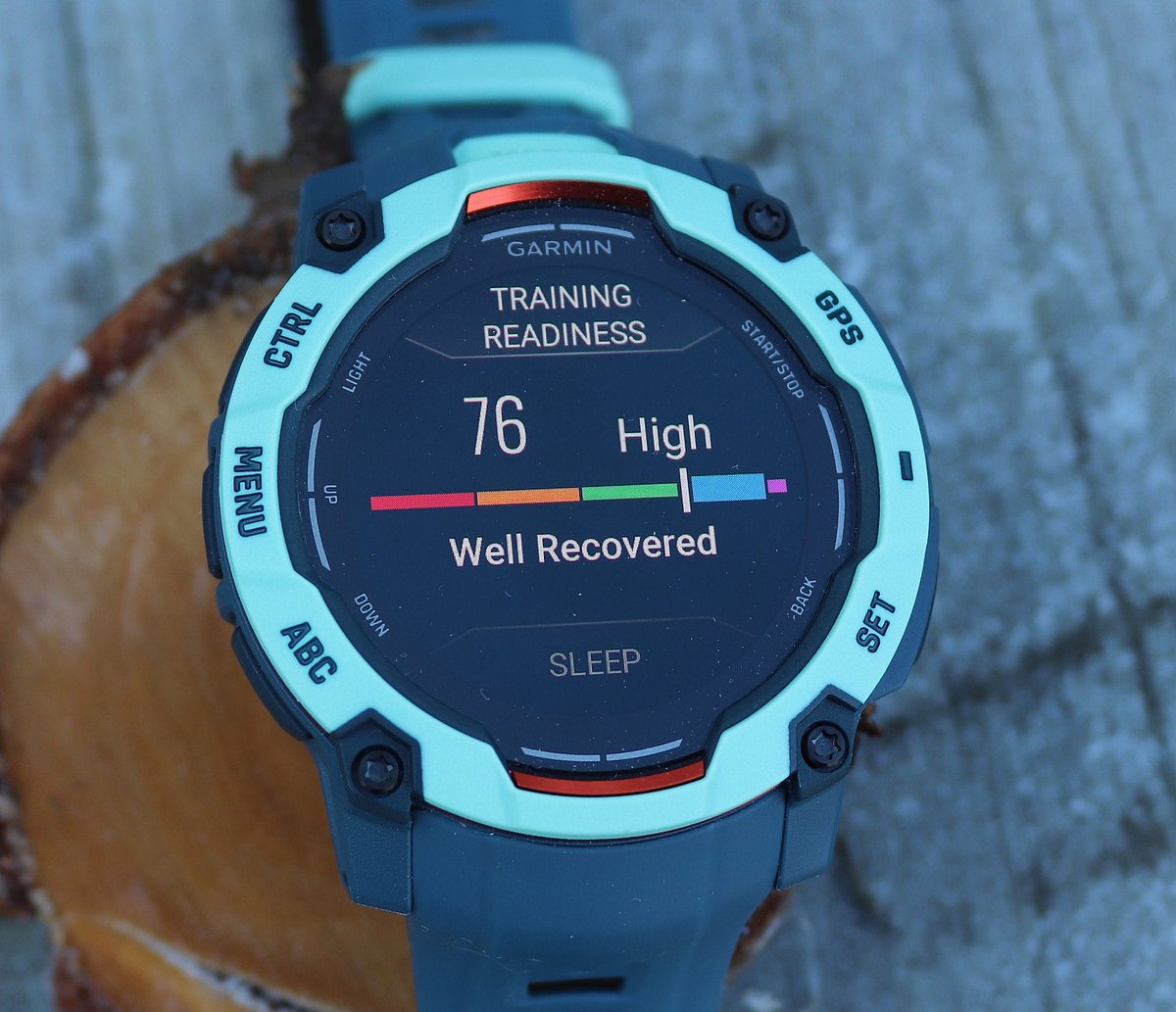
A score of 95 to 100, labelled Prime, indicates the body is at its best possible readiness. A score of 75 to 94, labelled High, means the body is ready for challenges. A score of 50 to 74, labelled Moderate, means good to go. A score of 25 to 49, labelled Low, means it’s time to slow down. A score of 1 to 24, labelled Poor, means the body needs to recover. The score sets context for the day’s decision; it does not prescribe exact effort.
How Garmin Calculates It
The score combines six contributing factors: sleep score, HRV status, remaining recovery time, acute training load, sleep history, and stress history. Each factor carries an undisclosed weighting; the combined result is normalised to the 0–100 scale. Garmin processes data from the optical heart rate sensor and, where available, a chest strap.
The HRV baseline takes at least 19 nights to establish, which is why Garmin recommends three weeks of consistent overnight wear before treating the score as reliable. Partial scores or no score may appear during this initialisation period.
| Score Range | Status | Colour | Recommendation |
|---|---|---|---|
| 95–100 | Prime | Purple | Best possible |
| 75–94 | High | Blue | Ready for challenges |
| 50–74 | Moderate | Green | Good to go |
| 25–49 | Low | Orange | Time to slow down |
| 1–24 | Poor | Red | Let your body recover |
What Affects the Reading
Poor sleep quality disproportionately lowers the score. A night with fragmented sleep stages produces a low HRV reading and a reduced sleep score simultaneously; a single disrupted night can drop the score by 20 or more points. Alcohol depresses HRV during sleep and compounds across both the HRV Status and sleep score components. Wrist-based measurement introduces variability because the optical sensor captures the pulse interval rather than the true R-R interval, and motion artefacts during sleep corrupt short segments of the overnight recording.
Heat and humidity suppress HRV independently of training load, potentially underestimating functional readiness during a heat acclimatisation block. A high acute training load applies a suppressive penalty that persists for several days, regardless of sleep quality — accumulated fatigue takes time to clear. Illness elevates resting heart rate and disrupts HRV, often lowering the score before the athlete consciously registers fatigue.
How Accurate Is It
Garmin has published no independent validation study for the composite score against a reference standard such as laboratory recovery markers. Firstbeat white papers cover the individual components — HRV-based recovery and sleep staging — but no error figure exists for the combined output as of March 2026.
Practical utility lies in trend reliability rather than absolute precision. An athlete who consistently sees low scores after poor sleep and high scores after structured recovery is receiving accurate directional information. Kiviniemi et al. (2007) demonstrated that HRV-guided training produces greater VO2 max gains than fixed-schedule training, providing indirect support for the approach.
Competitor Equivalents
- Polar’s Nightly Recharge and Readiness Score weights nightly ANS recharge as a distinct component rather than integrating it into a multi-factor composite.
- Coros derives its Recovery Indicator from HRV, resting heart rate, and training load, expressed as a percentage with heavier weighting on recent load than Garmin’s six-factor model.
- Suunto’s Body Resources uses overnight HRV and sleep data via Firstbeat algorithms licensed before Garmin’s June 2020 acquisition.
- Apple Watch aggregates sleep stages and HRV into a Vitals summary in the Health app rather than a single daily readiness score; no direct equivalent exists as of March 2026.
- Whoop combines HRV, resting heart rate, respiratory rate, and sleep into a daily Recovery Score percentage via a dedicated band worn continuously, removing the charging compromise inherent in a watch.
Which Garmin Devices Support It
Training Readiness is part of the Training Status suite introduced in January 2017, with the current six-factor composite established on the Fenix 6 generation. The Fenix 8 series — including the Fenix E, Enduro 3, Tactix 8, and Quatix 8 — carries full support, as do the Forerunner 970, Forerunner 570, Venu 4, Venu X1, and vivoactive 6. Prior-generation devices — Forerunner 965, Forerunner 265, Epix Pro Gen 2, and Fenix 7 Pro — carry the feature but will not receive the updated weighting introduced with the Forerunner 970 in May 2025. Training Readiness is absent from Edge computers, the Forerunner 165, the Forerunner 55, and the Instinct 3 line.
Where to Find It
- Watch widget: swipe from the watch face on AMOLED models or press the up/down buttons on MIP models; shows the score, a breakdown of contributing factors, and a colour-coded readiness band.
- Morning Report: surfaces automatically when the watch is first raised after waking on compatible devices.
- Garmin Connect app: Performance Stats section; current score, 30-day trend graph, and six contributing factor scores for the current day.
- Garmin Connect web: the metric is visible, but the breakdown of contributing factors and the trend graph are less detailed than in the mobile app.
A Garmin Connect Plus subscription is not required to access Training Readiness.
Common Problems and Misreadings
A score lower than expected after a subjectively good night’s sleep usually reflects HRV suppression from late eating, alcohol earlier in the evening, elevated stress, or the tail end of a high training load. The HRV component responds to physiological state rather than subjective sleep quality, and the two frequently diverge. See FAQ above for details.
A high score when the athlete feels exhausted reflects the composite’s inability to detect muscular soreness or cumulative mental fatigue, both of which are beyond what a wrist sensor can measure. See FAQ above for detail.
Wide day-to-day fluctuation in the first weeks of use is expected while the algorithm builds its baseline. A sharp drop after a race or long run, despite good sleep, is also expected behaviour: the load and recovery time components maintain a cost for 24 to 72 hours regardless of sleep quality. See FAQ above for details.
How to Improve It
Sleep is the primary lever. Consistent duration of seven to nine hours at regular times raises both the sleep score and overnight HRV components simultaneously. Irregular bedtimes suppress HRV even when the total duration is adequate. Building structured easy days into the training week allows the acute load component to clear between hard sessions, preventing the score from remaining chronically suppressed.
Reducing evening stimulation of the body’s stress response — late caffeine, screen exposure, emotionally activating content — improves the stress history component. An athlete who consistently sees low scores despite adequate sleep and managed training load should examine evening habits before attributing the pattern to another cause.
Other Points
Heart rate variability, the primary signal underlying Training Readiness, has been linked to all-cause mortality risk independently of traditional cardiovascular risk factors. Tsuji et al. (1994), publishing in Circulation, found reduced HRV was associated with significantly elevated risk of cardiac death in a large community cohort, establishing clinical significance beyond athletic recovery.
HRV declines measurably during detraining. Pober et al. (2004), publishing in Medicine and Science in Sports and Exercise, reported HRV deterioration beginning within two to four weeks of cessation of training, with a steeper decline in older athletes. An athlete returning from injury may therefore see persistently suppressed Training Readiness scores reflecting genuine deconditioning rather than inadequate recovery from recent sessions.
Scientific Basis
Kiviniemi, A.M., Hautala, A.J., Kinnunen, H., Tulppo, M.P. (2007). Endurance training is guided individually by daily heart rate variability measurements. European Journal of Applied Physiology, 101(6), 743–751. Demonstrated that HRV-guided training produced greater VO2 max gains than fixed-schedule training, establishing the empirical basis for using daily HRV as a readiness marker.
Plews, D.J., Laursen, P.B., Stanley, J., Buchheit, M., Kilding, A.E. (2013). Training adaptation and heart rate variability in elite endurance athletes. Sports Medicine, 43(9), 773–791. Identified conditions under which HRV-based readiness assessment is most reliable, including consistent measurement timing and baseline stabilisation.
Firstbeat Technologies (2014). Sleep Detection and Analysis with Accelerometer and Heart Rate Data. Firstbeat Technologies white paper. Describes the sleep staging algorithm underpinning the sleep score component of Training Readiness.
Firstbeat Technologies (2019). Stress and Recovery Analysis Method Based on 24-Hour Heart Rate Variability. Firstbeat Technologies white paper. Describes the HRV-based stress and recovery methodology underpinning the HRV Status and Body Battery components.
How It Connects to Other Features
Training Readiness draws its HRV component from [LINK: hrv-status], which tracks overnight HRV relative to a personal 60-day baseline; a deteriorating HRV Status directly suppresses the readiness score.
The sleep quality input comes from Sleep Score and [LINK: sleep-stages]; poor deep sleep staging lowers the input even when total duration is adequate.
Recovery Time suppresses the score in proportion to the number of hours remaining after the most recent hard session.
Body Battery contributes energy reserve data across the full 24-hour period, so daytime stress lowers the following morning’s score even when overnight sleep is good.
Training Readiness feeds into Daily Suggested Workouts, shifting recommendations toward recovery when the score is low.
Training Load provides the acute load input; a spike from a race or hard session suppresses readiness for one to three days.
Small things I always use
- Garmin 90-degree charging adapter: Charges your Garmin from any USB-C cable. Essential when travelling. I use one.
- Body Glide: The blue anti-chafe stick swimmers and runners carry. I use it.
- Speedo earplugs: Fewer ear infections and no cold-water dizziness. I use them.
- Dryrobe Advance: My winter changing robe for open-water swims. I use one. A cheaper option is the AONYIYI changing robe.
- Maurten: Race fuel that stays easy on the stomach. I use them.
- Beet It Sport nitrate shots: Beetroot shots I take in the days before a race. I use them.
- Garmin charging puck: The quickest way to top up before a session. I use one.
- Injinji: Toe socks that stop rubbing, so you run more. I use them.
- Ultimate toe protectors: Stop black toenails on long runs. They work. I use them.
- Compressport R2 v2 calf sleeves: My calf sleeves of choice. I use them.
- Cellucor C4: My pre-workout before hard sessions.
- TPU tubes: Schwalbe Aerothan, Tubolito and Pirelli SmarTube. Light, tiny spares. I use all three.
- G8 insoles: Adjustable insoles that are good. I use them.
- Cycplus Cube: A 97g electric pump that gets a road tyre rideable in two minutes. I carry one. 5% off with code THE5KRUNNER.
Watches and sensors
- Polar H10: My daily driver for waking HRV.
- Polar Verity Sense: My backup arm-worn HR sensor.
- Nomad bedside charger: Charges my iPhone and Apple Watch overnight. I use it, and many of their bands.
- Train.Red: The best muscle oxygen sensor I’ve used.
- Tymewear: Accurate heart rate and reliable ventilatory zones. I use it to pace endurance rides over an hour.
- Garmin Forerunner 970: A pro-grade triathlon watch. I use this.
- Apple Watch Ultra 4: My daily smartwatch. No phone needed on rides.
- Garmin Fenix 9 Pro: I’ve just bought one.
On the bike
- Continental GP5000 for everyday riding, and Aero 111 on the front for special occasions.
- Helmets: Specialized S-Works Evade 3 for road riding, and Rudy Project Wing for TT-style races. I use both.
- Ravemen FR300: A front light that mounts under your Garmin or Wahoo. I use one.
- Wahoo TRACKR Radar: I use it on one bike and Varia on the other. They perform the same.
- Garmin Varia RTL515: Radar that warns you of cars from behind. I use this model.
- Wahoo ELEMNT Roam 3: The bike computer that’s easy to use. I use mine on most rides.
- Favero Assioma Pro RS2: Accurate power pedals that swap easily between bikes. I use this model.
Home and indoor training
- NPE Runn: Makes my basic treadmill smart, sending more accurate speed and distance to my watch and Zwift. I use it.
- Google Wifi: Keeps Zwift connected in my pain cave. I use it.
- Apple TV 4K: Zwift on the big screen. I use two.
- Google Nest Doorbell (wired, 2nd gen): My video doorbell, running in both Google Home and Apple Home. I use it.
Health, recovery and sleep
- FreeStyle Libre 3 Plus: Shows how my blood sugar responds to diet.
- hDrop: Measures my sweat loss in summer and indoors.
- Fourth Frontier Zone: Checks my heart under load in hard sessions.
- Oura Ring 5: My partner’s recovery tracker of choice.
- Eight Sleep: A cooling mattress cover my partner and I use nightly.
Reader-Powered Content

This content is not sponsored. It’s mostly me behind the labour of love, which is this site, and I appreciate everyone who supports it.
Support the site: Follow (free, fewer ads) · Subscribe (paid, ad-free) · Buy Me A Coffee
Written by real people, with AI assistance. Fact-checked and verified for originality. See the Editorial Policy. FTC: Affiliate Disclosure — some links pay commission. As an Amazon Associate, I earn from qualifying purchases.
