Garmin Sleep Stages
~70% in Garmin’s own study; 40–50% in independent testing
Spotting multi-week trends in deep sleep during hard training
REM and awake detection — the two stages misclassified most often
Quick answers
Why does my Garmin show almost no deep sleep?
The most frequent causes are a loose watch band, frequent movement during sleep, or lying still while awake at the start or end of the night. Ensure the watch fits snugly, one to two finger-widths above the wrist bone. If the figure remains consistently low across many nights and shows no correlation with feeling unrefreshed, the reading likely reflects a classification limitation rather than a genuine deficit in deep sleep.
How accurate is Garmin sleep stage tracking?
Garmin’s own 2019 validation study found roughly 70% overall stage accuracy. Independent testing by the Quantified Scientist — a postdoctoral researcher — places real-world agreement closer to 40–50% across all four stages. Sleep duration figures are substantially more reliable than the stage breakdown across all consumer wearables.
How much deep sleep and REM should I be getting each night?
In healthy adults, deep sleep typically accounts for 15 to 20 per cent of total sleep time and REM for 20 to 25 per cent — roughly 70 to 100 minutes of deep and 90 to 120 minutes of REM on eight hours of sleep. Both proportions decline with age, so compare against age-appropriate norms, not population averages.
Does alcohol affect Garmin sleep stage readings?
Yes, in two ways. Alcohol suppresses REM in the first half of the night and disrupts normal stage cycling, so the physiological data the algorithm reads is genuinely altered. It can also inflate apparent deep sleep early in the night by mimicking the stillness and slowing heart rate that the algorithm associates with N3. Do not treat sleep stage data from nights involving alcohol as representative of normal recovery.
Garmin Sleep Stages — A Deep Dive
When Sleep Stages Are Actually Useful
- From time to time, I review my sleep stage data over the last week or month, or when I’m feeling more tired than expected. If my Deep Sleep is less than an hour on several days, I will usually tweak my sleep schedule with easy wins of eating earlier and avoiding alcohol.
- I can tell when I’ve had a bad night’s sleep, and the Garmin data invariably agrees. However, if the bad component of my sleep was later in the night, it could leave my Deep Sleep intact, and on those occasions, I would train as normal.
Garmin Sleep Stages is the four-category overnight classification system built into compatible Garmin watches that divides a night’s sleep into Light, Deep, REM, and Awake periods, producing a nightly hypnogram that feeds directly into the sleep score and broader recovery metrics. The feature is part of Garmin’s Advanced Sleep Monitoring (ASM) capability, introduced in June 2018, when heart rate variability analysis was added to existing accelerometer data, enabling the four-stage classification used by current devices. The feature is passive: it requires no manual activation beyond wearing the watch during sleep with the optical heart rate sensor active.
The principal limitation is accuracy. Garmin’s own validation study reports an overall stage classification accuracy of approximately 70% across four stages, and independent testing has found real-world performance lower still, particularly for REM and awake detection. Sleep duration figures — when the wearer fell asleep and when they woke up — are more reliable than the stage breakdown.
What the Number Actually Means
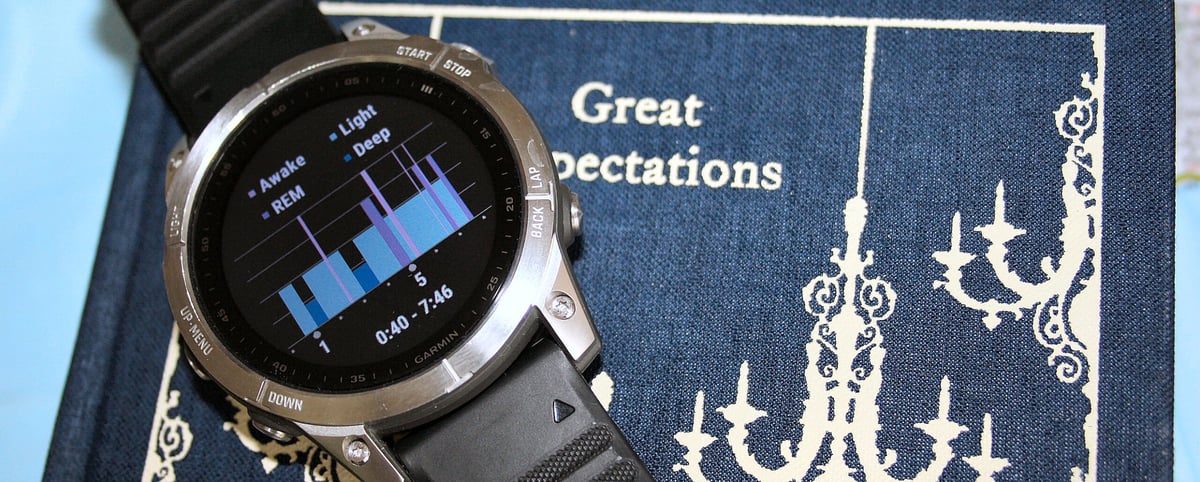
A full night of healthy adult sleep typically comprises four to six 90-minute cycles, each progressing from light sleep through deep sleep and into REM before returning toward lighter sleep.
Deep sleep is the physically restorative stage — the body repairs muscle tissue, synthesises proteins, and supports immune function — typically accounting for 15 to 20 per cent of total sleep time in younger adults. REM is the cognitively restorative stage during which memory consolidation and emotional processing occur, typically accounting for 20 to 25 per cent of total sleep time. Light sleep is the largest category, at around 50-55 per cent. Brief awake periods totalling 20 to 30 minutes across a night are normal and rarely recalled.
Both deep sleep and REM decline with age, while light sleep and awake time increase. Athletes interpreting stage data should account for age and sex when comparing their data against published norms before concluding their sleep quality.
How Garmin Calculates It
Sleep stage classification uses an algorithm trained on data collected by Garmin Health in collaboration with the University of Kansas Medical Center, validated in 2019 against a Sleep Profiler EEG (electroencephalogram) reference device across 55 participants sleeping at home. On current devices, classification runs entirely on the watch.
The inputs are accelerometer movement data and optical photoplethysmography (PPG)-derived heart rate and HRV. HRV — the beat-to-beat variation in the heart’s rhythm — is the primary differentiator between stages: heart rate is low and stable in deep sleep, rises and becomes more variable during REM, and movement signals confirm awake periods. Clinical stages N1 and N2 are combined into Light Sleep; N3 is reported as Deep Sleep; REM and Awake are reported as named.
For the feature to function, the optical heart rate sensor must be active, and the watch must be worn for at least two hours before bedtime. Correct sleep and wake window times must be set in Garmin Connect; if those conditions are unmet, stage data may be absent or incomplete for that night. Respiration rate and Pulse Ox are available as chart overlays in Garmin Connect on supported devices, but are not direct inputs into stage classification. HRV can show overnight gaps even when the heart rate is continuous, because HRV has stricter signal quality thresholds; a loose band, a restrictive sleeping position, or excessive movement can trigger these gaps without affecting the heart rate trace.
What Affects the Reading
Watch fit is the single most consequential hardware factor. A loosely worn watch introduces movement artefacts into the PPG signal, causing the algorithm to misidentify sleep stages or fail HRV quality checks. Skin tone, tattoos, and wrist hair density can similarly degrade the PPG signal, thereby causing it to fall below the HRV-based stage-differentiation threshold. Alcohol disrupts normal stage cycling — suppressing REM in the first half of the night and potentially inflating apparent deep sleep — affecting both the underlying physiology and the algorithm’s ability to classify it accurately.
High training load alters overnight HRV in ways the algorithm cannot distinguish from stress or illness; both suppress the autonomic signals used to separate deep sleep from REM.
How Accurate Is It
Garmin’s 2019 validation study found an overall stage classification accuracy of 69.7% and a Cohen’s kappa of 0.54 (a measure of agreement beyond chance) among 55 real-world participants. The most common misclassifications were true deep sleep recorded as light sleep (29.1% of true deep periods), and true REM recorded as light sleep (26.4% of true REM periods). Sensitivity for detecting sleep periods was 95.8%; specificity for detecting wake was 73.4%.
For comparison, inter-scorer agreement between two trained PSG technicians is approximately 83% with a kappa of 0.78 — a ceiling that no consumer wearable has reached. A 2025 study in Sleep Advances comparing six consumer wearables against polysomnography found low wake detection specificity for the Garmin Vivosmart 4 — among the lowest in the comparison — suggesting that brief nocturnal awakenings are the feature’s most consistent weakness across consumer wearables.
An independent evaluation reported on the5krunner by postdoctoral researcher Rob (the Quantified Scientist) placed Garmin’s average stage agreement at 40 to 50 per cent across all four categories in more recent testing, comparable to Polar and worse than Oura, Apple, Fitbit/Google, and Whoop. These findings come from personal testing by a single researcher rather than a peer-reviewed publication, but are consistent with the published multi-device PSG literature. Individual nightly figures carry significant uncertainty; sustained trends across multiple nights are more likely to reflect genuine physiological shifts than any single reading. Sleep duration figures are substantially more reliable than stage breakdowns across all consumer wearables.
Competitor Equivalents
- Polar — Sleep Plus Stages: uses the same actigraphy plus optical PPG inputs as Garmin, mapping to identical Light (N1+N2), Deep (N3), REM, and Awake categories; requires Continuous HR tracking to be manually enabled; a Polar white paper reports a kappa of approximately 0.39 against PSG; independent testing has placed Polar at a comparable accuracy level to Garmin.
- Apple Watch — Sleep Stages: classifies into REM, Core (equivalent to Garmin’s Light, covering N1+N2), Deep, and Awake; relies primarily on accelerometer signals, including respiration-induced motion patterns rather than optical HR for stage differentiation; has performed consistently better than Garmin in independent accuracy testing and is supported by a published Apple white paper with PSG validation.
- Coros — Sleep Quality with REM Tracking: uses four categories identical to Garmin’s (Deep, REM, Light, Awake) with HRV sampled in ten-minute intervals; REM tracking was added in a May 2022 firmware update; requires a minimum of three hours of sleep for full stage data to generate; no formal accuracy validation study has been published.
- Suunto — Sleep Tracking: records sleep duration, deep sleep, REM, and awake time on current Race and Vertical series hardware; HRV-derived sleep quality is available when optical HR is enabled; current implementation is proprietary following Garmin’s acquisition of Firstbeat in June 2020.
Which Garmin Devices Support It
Advanced Sleep Monitoring is supported on all current Garmin watches with an optical heart rate sensor. The four-stage classification using HRV was introduced in June 2018, initially on the vívoactive 3, Forerunner 645, Forerunner 935, vívosmart 3, vívosport, vívomove HR, and their Music variants, with the Fenix 5 series following shortly after.
The only exceptions are nine legacy devices that predate the 2018 update and did not receive it via firmware: D2 Bravo, Fenix 3 HR, Fenix Chronos, Forerunner 225, Forerunner 235, Forerunner 735XT, Vivoactive HR, Vivosmart HR, and Vivosmart HR+.
The Garmin Index Sleep Monitor, launched 18 June 2025, is a dedicated upper-arm band that syncs full four-stage data to Garmin Connect without needing to be set as the primary wearable. The sleep score derived from stage data is supported on most current ASM-capable devices, including the Fenix 6, 7 and 8 series, Forerunner 255, 265, 955 and 965, and Venu 2 and 3 series.
Where to Find It
- Watch widget: scroll to the sleep widget from the watch face; shows previous night’s total sleep time, sleep score (where supported), and per-stage summary; pressing into the widget on most current devices reveals a simplified stage chart.
- Widget glance: condensed sleep summary showing total sleep time and score in the glance loop; the full hypnogram is not shown at glance level.
- Activity data field: not available — sleep stage data is captured passively overnight and is not a real-time exercise metric.
- Morning Report: on supported current-generation devices, including the Forerunner 965 and Forerunner 165, a sleep summary including stage overview appears alongside recovery time and Body Battery.
- Garmin Connect Mobile — Health Stats > Sleep: full hypnogram with colour-coded stage bands; overlays for movement, respiration rate, and Pulse Ox where supported; historical trend data is accessible for free within the Garmin Connect app.
- Garmin Connect web — Health Stats > Sleep: nightly hypnogram and stage breakdown at comparable detail to the mobile app; stage-overlay options may render differently by browser and screen size.
Common Problems and Misreadings
Very low or zero deep sleep is the most frequently reported issue. Watch fit is the primary cause: a loosely worn watch interrupts the stillness-plus-slow-HRV signature the algorithm uses to identify N3, systematically underestimating deep sleep time. The reverse failure — lying completely still while awake — can inflate deep sleep for the same reason. Neither outcome reflects a genuine physiological problem; both are classification artefacts of the wrist-based method. See FAQ above for detail.
REM figures that appear implausibly low reflect the stage Garmin misclassifies most often. Approximately 26 per cent of true REM periods are recorded as light sleep in Garmin’s own validation data, so a consistently low REM figure may be accurate but may equally be a partial classification failure. See FAQ above for detail.
Discrepancies between Garmin and another device worn simultaneously are expected. Different algorithms applied to the same wrist produce materially different stage totals, and neither device has access to the EEG to arbitrate.
Stage data occasionally changes after the first morning sync. On older devices where classification ran in Garmin’s cloud, the output could be revised in the hours after waking; on current watch-based processing, this is less pronounced but can still occur when Garmin Connect recalculates the sleep score post-sync. A session that starts before the wearer has fallen asleep — because the wearer lies still, reading in bed — can produce an inflated total sleep time and incorrect early-night stage assignments; manually adjusting the sleep start time in Garmin Connect corrects the record.
How to Improve It
Consistent sleep scheduling is the most reliable lever for deep sleep. Going to bed and waking at the same time every day — including rest days — reinforces the circadian rhythm that governs when deep sleep occurs. Because deep sleep concentrates in the first half of the night, earlier bedtimes protect the stages the body prioritises first when sleep pressure is high.
REM is particularly sensitive to alcohol and late high-intensity training. Abstaining from alcohol for several hours before sleep and completing hard sessions at least four to six hours before bedtime gives the autonomic nervous system time to shift toward parasympathetic dominance (the rest-and-recovery state). Total sleep duration remains the variable with the clearest evidence base for recovery benefit; prioritising duration through earlier bedtimes is more effective than attempting to engineer specific stage proportions directly.
Other Points
Ohayon and colleagues’ 2004 meta-analysis of 65 polysomnography studies covering 3,577 participants aged 5 to 102 years established that deep sleep declines markedly with age in healthy adults, while light sleep and wake-after-sleep-onset time increase, and REM decreases more gradually. An older athlete whose Garmin consistently shows low deep sleep and elevated light sleep may be experiencing a normal age-related distribution rather than impaired recovery.
Scientific Basis
Burgett S, Blair R, Lightfoot D, Siengsukon C, Reetz A, Stevens S. “Commercially Available Wearable Provides Valid Estimate of Sleep Stages.” Poster, Annual Meeting of the American Academy of Neurology, May 2019; published as Garmin Health Announces Sleep Study Results, garmin.com, June 2019. Garmin’s primary internal validation of the ASM neural network reporting 69.7% overall accuracy and a Cohen’s kappa of 0.54 in 55 real-world participants against an EEG reference device. This study was Garmin-funded and presented as a conference poster rather than in a peer-reviewed journal.
Ohayon MM, Carskadon MA, Guilleminault C, Vitiello MV. “Meta-Analysis of Quantitative Sleep Parameters From Childhood to Old Age in Healthy Individuals.” Sleep, Vol. 27, No. 7, October 2004, pp. 1255–1273. DOI: 10.1093/sleep/27.7.1255. Meta-analysis of 65 PSG studies covering 3,577 subjects establishing normative deep sleep decline and REM reduction across the adult lifespan — the reference framework for interpreting age-related stage distributions in Garmin’s output.
Chinoy ED, Cuellar JA, Huwa KE, Jameson JT, Watson CH, Bessman SC, Hirsch DA, Cooper AD, Drummond SPA, Markwald RR. “Performance of Seven Consumer Sleep-Tracking Devices Compared with Polysomnography.” Sleep, Vol. 44, Issue 5, 2021. DOI: 10.1093/sleep/zsaa291. Multi-device PSG validation study — including the Garmin Vivosmart 3 and Fenix 5S — establishing that consumer wrist wearables achieve high sensitivity for sleep detection but substantially lower specificity for wake detection, with stage accuracy well below EEG-based methods.
de Souza L, Benedito-Silva AA, Pires ML, Poyares D, Tufik S, Calil HM. “Further Validation of Actigraphy for Sleep Studies.” Sleep, 2003, 26(1):81–5. PMID: 12627737. Primary validation of actigraphy as a method to estimate sleep and wake periods, underpinning the movement component of Garmin’s stage classification algorithm.
How It Connects to Other Features
Sleep stage data is a primary input to the Garmin Sleep Score, which aggregates stage proportions, sleep duration, HRV-derived overnight stress, and restlessness into a single nightly score ranging from 0 to 100.
The sleep score feeds directly into Training Readiness, where it is one of six contributing factors; a night with a poor stage distribution reduces the training readiness score the following morning.
Body Battery recharges during sleep at a rate governed by overnight HRV quality, so nights with sustained autonomic recovery produce higher morning values than fragmented nights of equivalent duration. [LINK: hrv-status] draws on the same overnight HRV signal that distinguishes REM from deep sleep; gaps in the HRV record caused by poor watch fit affect both the stage classification and the HRV Status baseline.
The Respiration Rate feature captures breathing rate at each stage and displays it as an overlay on the sleep hypnogram in Garmin Connect Mobile. [LINK: sleep-coaching] uses stage data alongside sleep timing and duration when generating personalised bedtime and wake time recommendations.
