Garmin Index S3 Leaked? The Likely Truth Behind DC Rainmaker’s Shattered Scale
Is Garmin finally ready to address a key weakness in its health tracking? A surprising image from Garmin’s biggest reviewer suggests that an Index S3 smart scale could be close.
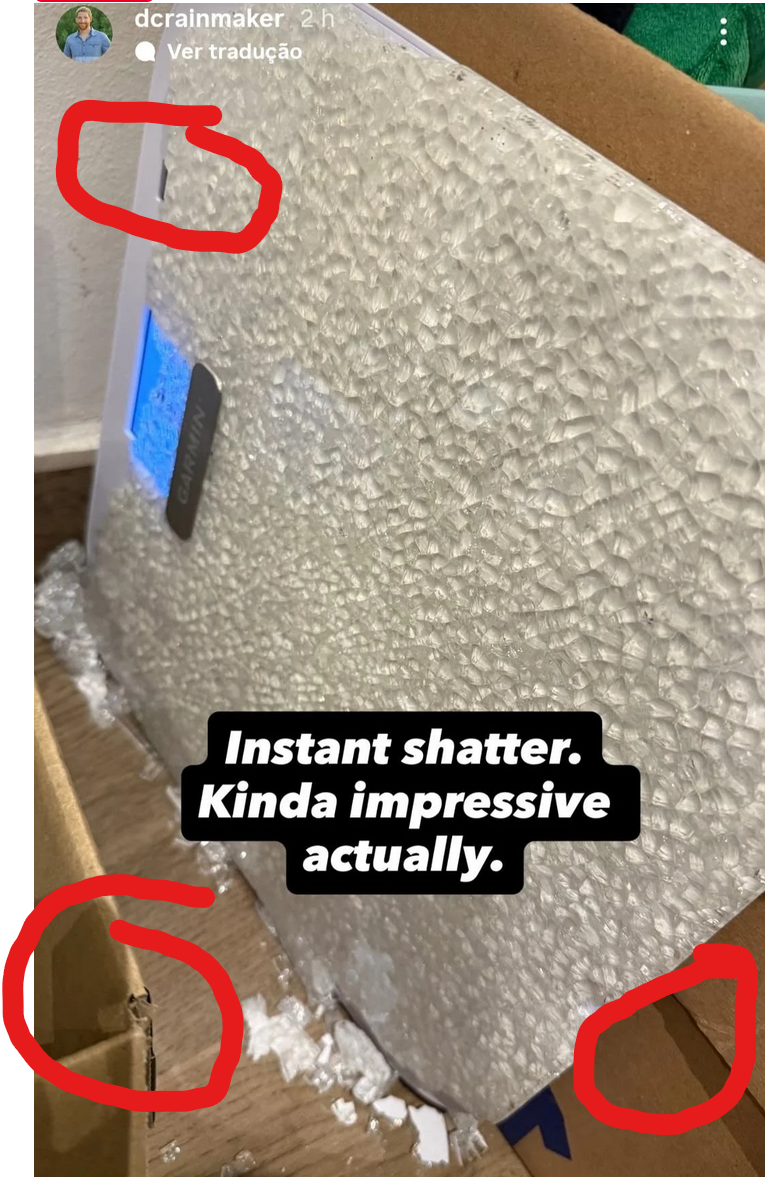
Reddit user FSantos_1993 spotted a curious post on DC Rainmaker’s Instagram page showing a shattered Garmin scale near some boxes. It’s odd that Garmin would send an old Index S2 scale in 2025, or even want one returned, for that matter. It’s a strangely timed image, given that the current Index S2 has been on the market for years – other than the broken glass, there is nothing else newsworthy.
Timing: Why the “Leak” is Turning Heads, but There’s More
The Index S2 launched in 2020, and an Index S3 replacement is overdue, especially with CES around the corner. Fact. A five-year refresh window for this product is typical, so this could be one case where two plus two really does make four.
I have an Index S2 myself, and the image looks subtly different from my S2 scale, with a section at the top not on my model, suggesting it could be a new design. I’ve highlighted the dark section on image above and the boxes near the scale, indicating an unboxing or return.
Against that, dcrainmaker, to my knowledge, has never inadvertently shown a picture of an unreleased Garmin device. Similarly, dcrainmaker would not have posted somebody else’s image without attribution (which could have been in the now-deleted reel).
The Problem: Why the Index S2 is Falling Behind
If you own a Garmin watch, you know the ecosystem is comprehensive. However, the Index S2 is not one of its highlights (1, 2, 3):
- BIA Accuracy Issues: The scientific basis of foot-to-foot Bioelectrical Impedance Analysis (BIA) is flawed. The signal likely only estimates body composition along its path (legs and lower torso). Alternatives use handles to give BIA pathways over the upper half of the body.
- Data Sensitivity: Highly sensitive to hydration levels, recent exercise, food/drink intake, and time of day—causing fluctuations and inaccuracies.
- Demographic Limits: Population-specific equations reduce precision across ethnicities, ages, and genders.
- UX Flaws: Even after release, Index S2 was underfeatured and a pain to link to Wi-Fi and shared accounts.
What a Garmin Index S3 Must Deliver to Win
For a new Index S3 to be a useful addition to an athlete’s or biohacker’s gadget arsenal, it needs to bridge the gap between a simple scale and a medical-grade body analyser. Here is what it needs:
- Segmental Composition: To offer a modern BIA scale and compete with Withings, Garmin needs tech that measures arms, legs, and torso separately—likely achieved via retractable hand-held sensors
- Improved Accuracy: Moving beyond basic BIA to use multi-frequency technology and to publish science showing correlation with DEXA scans is needed.
- Improved Setup: an easier way to more permanently link to Garmin conenct and share with others
Caution: To achieve segmental composition, it requires handles, and the picture does not appear to show them. The author strongly suspects we are seeing a broken S2 rather than a new S3.
Last Updated on 30 January 2026 by the5krunner
Reader-Powered Content

This content is not sponsored. It’s mostly me behind the labour of love, which is this site, and I appreciate everyone who supports it.
Support the site: Follow (free, fewer ads) · Subscribe (paid, ad-free) · Buy Me A Coffee ❤️
All articles are written by real people, fact-checked, and verified for originality. See the Editorial Policy. FTC: Affiliate Disclosure — some links pay commission. As an Amazon Associate, I earn from qualifying purchases.
tfk is the founder and author of the5krunner, an independent endurance sports technology publication. With 20 years of hands-on testing of GPS watches and wearables, and competing in triathlons at an international age-group level, tfk provides in-depth expert analysis of fitness technology for serious athletes and endurance sport competitors.

I think he’s just ‘unboxing’ old stuff he has shipped from The Netherlands to his new place…
Yeah, I agree.
I have a (White) Index S2 too, and if a shine a bright torch into the right hand side of the glass, near the top, I can see some refraction suggesting there’s something around the same spot highlighted in the post photo, in my own scales, so I think its incredibly unlikely that the image is any new device.
That said, I really, really want to see a new, more accurate Index S3, so I’m secretly hoping the Ray accidentally broke it when he was pulling it out of storage to do some side-by-side comparisons with an Index S3? 😀
The company that owns the original BIA scale technology and manufactures the most reliable and accurate scales is Korea’s INBODY.
To be honest, unless you measure your weight on a large INBODY machine installed in a gym or hospital, you can’t trust it.
The smart scale Garmin could make a fortune with:
Measuring only weight, marketing it a lot. Tell people that it integrates Data into their Vivosmart/Vivoactive/Venu etc day to day watches. Tell people that it integrates weight into Apple health and so on.
Sell it for not more than 30€. Compete directly with the cheaper Asian scales, but throw your name into the ring.
I know a lot of people which don’t trust all that BS data all of the watches measure but want to track weight on a reliable and connected scale.
not so sure about that
probably an opportunity is as you describe but not for garmin.
garmin needs >>50% margins which is harder at the budget end (30€). to justify the higher prices it needs ‘unique’ features and integration. the S2 was quite light on both those counts.
Garmin doesn’t “need” margins of 50%. It has chosen to chase the numbers because that’s what impresses the numbskulls on Wall St. That’s usually a recipe for short term success and being a brief stockmarket darling, then a crash.
For comparison, Apple’s gross margin’s under Jobs averaged around 30% and he built a pretty successful company. Higher margins are can often be a sign of effectively stealing from the future. It’s easy to improve margins by cutting back on R&D, substituting quality products for cheap replacements and hoping the consumer doesn’t notice (they do eventually) or outsourcing everything so you eventually become just a marketing shell company for somebody else’s product (as Cook has done with Apple, following in the footsteps of HP and many others).
ha. true!
garmin invests well in R&D
Kind of agree: I have some noname scale (well, some non-international “brand”) that only does Bluetooth sync to its crappy app, and if that wasn’t bad enough, it only syncs when the body fat guesser has a signal. Which works in some months, and reliably fails in others. So the routine of getting the app ready to sync fades away, making it effectively a dumb scale no better than a 10€ one. Sync to Garmin cloud, and don’t bother me with questionable skin conductivity metrics, that would be something worth hard-earned cash to me (not as much as the full Index, obviously)
You forgot one downside of the s2: overpriced.
I use a website smartscalesync $18 a year to get my data into Garmin, Was using a Withings scale and now using a Wyze ultra I imported from America. It populates all the fields in the connect app.
If Garmin ever do a full body scale I will give it serious consideration. Unless I give in and buy the Wyze Ultra Full body scale in the meantime.
Hmm, they just have added new Weight tracking widget in beta for FR970. Is is a sign?
It’s a sign there’s a weight tracking widet about to be publically released for sure 😉
being serious. idk. maybe
Thought the same 🤓