Polar Street X: A New Market, Not a New Rival
Polar launched Street X today at £219 / €249.90. Before the inevitable comparison pieces land, it is worth being precise about what this watch is actually competing with — because the answer is less obvious than the rugged aesthetic suggests.
The Garmin Instinct 3 AMOLED will be the first comparison most writers reach for. It shouldn’t be. The Instinct 3 AMOLED starts at £349.99, has no maps, no touchscreen, and sits well below the Fenix 8/Fenix E in Garmin’s own hierarchy. It is a watch that looks built for the outdoors, but cannot navigate them without pre-loaded routes. Garmin has papered over that limitation with a range of vertically focused variants — camo editions, surf-specific models, a Tactical Edition with military-grade features — which suggests the brand understands it is selling identity as much as capability.
The Instinct 3 finds buyers among first-time smartwatch upgraders and niche-sport enthusiasts alike. Those who want that rugged aesthetic at a sub-Fenix price. It is not a benchmark. It’s more a competitor in the category it originally created.
That category is now getting crowded.
The COROS Nomad, at $349, is a more serious outdoor proposition than the Instinct 3 in several respects: it has offline maps, a built-in microphone, 22 days of battery life in smartwatch mode, and 50 hours of GPS time. It also has a dedicated skateboard-tracking mode — GPS and motion-sensor data combined — making it the only watch in this space to explicitly reach urban action sports. Whether skaters and devotees of urban chic will buy a $349 GPS watch is a different question. But COROS has at least named the audience.
Amazfit’s Active Edge sits at the other end of the ambition scale — rugged styling, GPS, gym and outdoor tracking, and a dual-tone design that also leans toward street culture without the serious outdoor credentials. It is cheaper than Street X and more style than substance.
Update: The hands-on review is now live: Polar Street X Review.
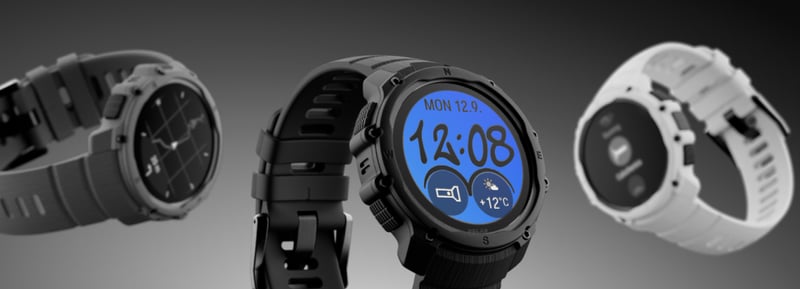
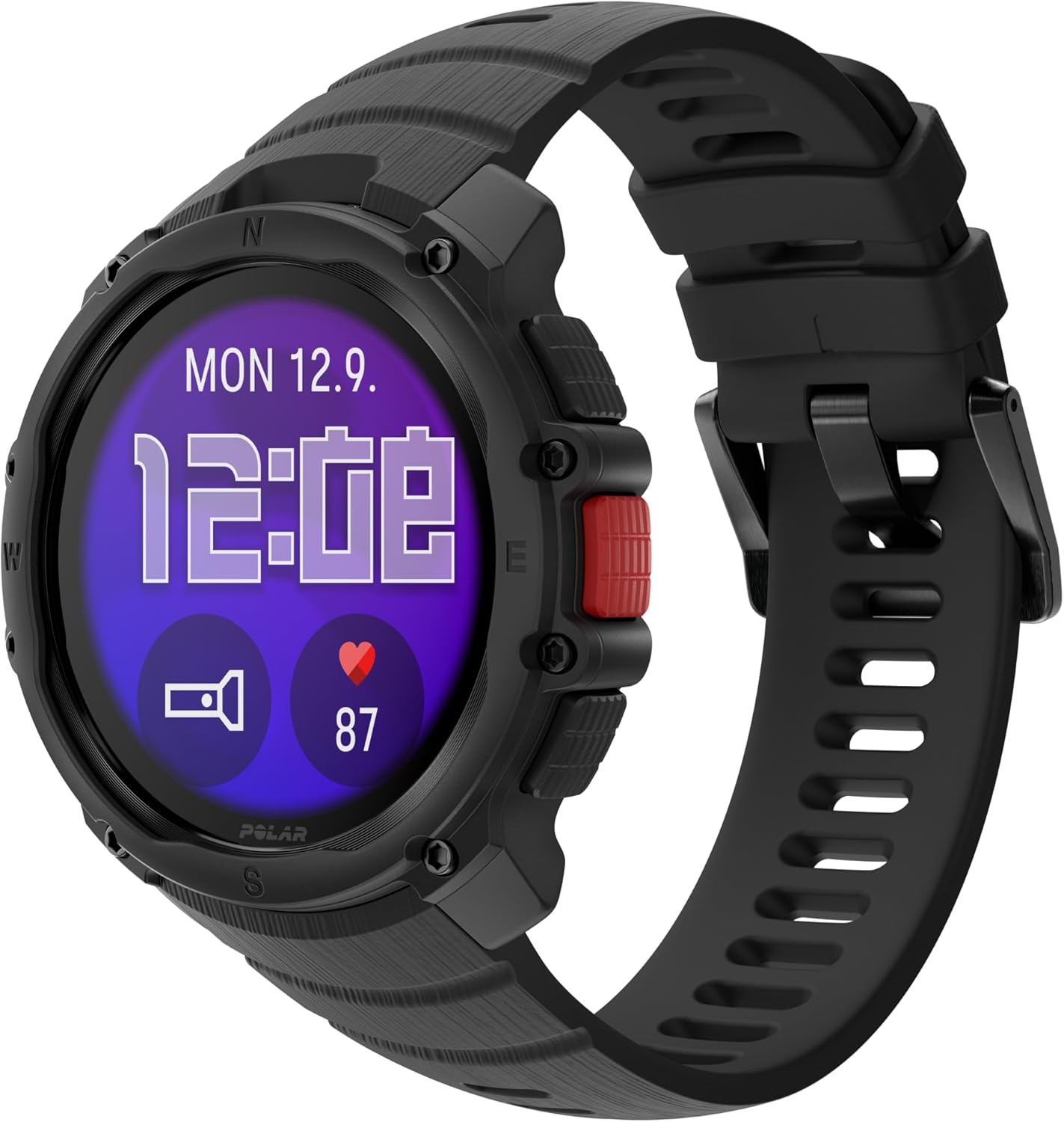
Street X sits between these two and belongs to neither group. At 48 grams, with a reinforced polymer chassis, an eight-screw case, and a MIL-STD-810H rating, the durability is genuine. The 1.28-inch AMOLED is a touchscreen — a usability advantage over the Instinct 3 at any price. Battery lasts up to 10 days in smartwatch mode and up to 43 hours with GPS active. There are no offline maps, which is consistent with the price but worth stating plainly.
What Street X does carry is Polar’s complete recovery suite: Training Load Pro, Nightly Recharge, Sleep Plus Stages, HRV monitoring, and nightly skin temperature. That is not a trimmed-down package. For a buyer who wants serious recovery analytics, that’s a decent offer. For payments, Polar does not have contactless built into the watch itself, but it does sell a payment-enabled strap as an accessory, albeit in a different style.
Polar’s language is deliberate: urban athletes, hybrid training, city movement, spontaneous activity. Polar is not writing for the trail runner or the triathlete. It is writing for a younger, health-conscious buyer whose activity profiles resist categorisation — gym, run, commute, weekend ride — and who wants a watch that reflects how they actually live rather than the outdoor pursuit they aspire to.
This is a real audience. It is also one that no major watch brand has addressed with any clarity. Garmin’s urban offerings feel like outdoor watches in town. Apple Watch requires an iPhone and prioritises the sleek, clean smartwatch tech experience over real urban lifestyles.
Fitbit has (temporarily) retreated from serious athletes. Whoop and the Polar SENSE strap found buyers in this gap by offering recovery science at accessible prices without the complexity of a full GPS watch. Street X is the next logical step from that playbook.
The risk is positioning. A rugged-looking watch at a lower price can read as a budget version of something more expensive rather than a confident choice in its own right. If Street X is framed as a cheaper Instinct, it will lose that feature comparison. If Polar can define it as the right watch for a younger generation who play, train, and recover everywhere — and market it in the spaces where that audience actually lives — it may be staking out territory none of its current rivals has claimed.
The market Polar appears to be targeting lacks clarity, let alone a clear leader. That is the opportunity. Whether Polar has the marketing conviction to own it is the question this launch leaves open.
For the complete guide to Polar watches, sensors and training science, see the Polar hub on this site.
More: Street X on Polar.com. £219 / €249.90.

Product Details
For full specifications and test results, see the Polar Street X Review. Initial Battery test results show it almost lives up to the claimed specs of 43 hours of GPS recording. The test condition probably accounted for the slightly lower figure in this one test. See also: Komoot Apple Watch App Review: Standalone Navigation Tested.
Last Updated on 14 June 2026 by the5krunner
My favourite kit and nutrition
- Garmin Fenix 9 Pro — I’ve just bought one.
- Injinji – Runners protect your toes. Avoid discomfort and minor injury. Run more. Run faster. I use them.
- Garmin 90-degree charging adapter — A small keyring adapter you can use anywhere. Essential when away. I use one.
- Garmin charging puck — the fastest and most reliable way to top up your Garmin before a session. I use one.
- Ravemen FR300 — Front light that mounts directly under your Garmin or Wahoo head unit. Keeps your bars clean and your beam pointed where it matters. I use one.
- Body Glide – The blue anti-chafe stick that all swimmers and many runners use. I use it.
- Maurten — The race nutrition trusted by elite athletes. Gels and drink mixes engineered to be easy on the stomach. I use them.
- Garmin Varia RTL515 — A radar rear light that alerts you to vehicles approaching from behind. Pairs with your Edge or Wahoo. I use this model.
- Favero Assioma Pro RS2 — The power-meter pedals most serious cyclists choose. Accurate, easy to move between bikes. I use this model.
- Garmin Forerunner 970 — A serious choice for a pro-grade triathlon watch. I use this.
- Polar H10 — My daily driver for accurate, waking HRV readings.
- Wahoo ELEMNT Roam 3 — The bike computer that has the feature Garmin lacks: usability. I use mine on most rides.
Reader-Powered Content

This content is not sponsored. It’s mostly me behind the labour of love, which is this site, and I appreciate everyone who supports it.
Support the site: Follow (free, fewer ads) · Subscribe (paid, ad-free) · Buy Me A Coffee ❤️
All articles are written by real people, fact-checked, and verified for originality. See the Editorial Policy. FTC: Affiliate Disclosure — some links pay commission. As an Amazon Associate, I earn from qualifying purchases.
tfk is the founder and author of the5krunner, an independent endurance sports technology publication. With 20 years of hands-on testing of GPS watches and wearables, and competing in triathlons at an international age-group level, tfk provides in-depth expert analysis of fitness technology for serious athletes and endurance sport competitors. ID

Looks really nice with good value. Due to the demise of the iSmoothrun app for Apple Watch and the geopolitical situation I recently switched from Apple Watches (I use 2, due to the inferior battery life) to a Polar Vantage M3. I am so pleased with the switch and really enjoy the Polar ecosystem. Really hope they release a bike computer.
My initial impression is that this is a well thought out product for this segment. We will see how it will pan out.
indeed.
coros were good at snigffing out new opportunities. Classic marketing. Hopefully Polar has done the same here.
Bike computer no is polar plains, is true?
Polar used to make bike computers but left the market some time ago. it is a hard market to break info.
until very recently polar lacked the necessary mapping/routing competencies required for the modern age. but now they have them
it is feasible now that polar tries to enter the bike market again.
however i suspect they will not do this in the near future for other reasons eg distractin and differnet sales chnnels being required