Polar Street X Review 2026: Battery, HR, GPS and Sport Testing
This is a hands-on test, review and opinions of the Polar Street X across battery life, heart rate accuracy, GPS, sleep staging, durability, and the integrated flashlight. It started out as a short review, but I got carried away – check out the summary section and quick references at the top before diving into the details.
The data and experiences come from over 200 miles of cycling, multiple running sessions, and five-device sleep comparison testing. For the full positioning analysis, including where Street X sits against the Garmin Instinct 3 AMOLED (£$£$£$) and COROS Nomad, check out this separate, first thoughts article: Polar Street X: A New Market, Not a New Rival.
| Specs Price: £219 / €249.90 / $249.90 RRP. Currently £186 on Amazon UK. Weight: 48 g (with strap) Case: 45 mm, bio-based polymer, eight-screw chassis, MIL-STD-810H Display: 1.28-inch AMOLED touchscreen, 416 x 416, Gorilla Glass 3 Battery: 10 days smartwatch, 43 hours GPS training, 170 hours eco mode GPS: Multi-constellation single-frequency (GPS, GLONASS, Galileo, BeiDou, QZSS) HR sensor: Precision Prime Gen 3.5 optical Water rating: WR50 Flashlight: Integrated LED, four white levels, one red Spec Take Out: Solid spec. Slightly outdated but excellent value. |
| Features Recovery suite: Training Load Pro, Nightly Recharge, Sleep Plus Stages, HRV, nightly skin temperature Training tools: FitSpark daily workouts, FuelWise nutrition guidance, wrist-based running power, Work-Rest Guide Running programmes: Structured plans from 5K to marathon, Season Planner Navigation: Route guidance, turn-by-turn via Komoot, back-to-start, compass, barometer. No offline maps. Sport profiles: 170+, including skateboarding, inline skating, callisthenics, indoor climbing Connectivity: Bluetooth LE, Polar Flow app, Strava (60-day trial), Komoot Missing: No music storage, no contactless payment on watch, no TrainingPeaks sync Feature Take Out: Quality features that are widely underrated. Expect an app overhaul in 2026. |
Heads Up: This is a media loaner. If you buy from the links, I get commission, which supports the work here. I’m a high-level, age-group multisport athlete who has tested devices like these for well over a decade. I was once known to have skated a bit before the lure of the snow took me away.
Listen to the discussion
Polar Street X: Recovery Science at a Street Price
Polar Street X Review Summary
Polar Street X is a lifestyle-first watch with genuine training credentials, aimed at a younger buyer whose activities span the gym, running, commuting, weekend rides, and, of course, street sports. There is no direct comparison, and Street X sits somewhere between a WHOOP recovery band and a full GPS sport watch. Street X owns that gap at £219 RRP (currently £186 on Amazon UK), with no subscription.
The hardware uses older components than Polar’s Vantage M3: a prior-generation optical HR sensor (Precision Prime Gen 3.5 vs Elixir Gen 4), and a single-frequency GPS. All reasonable at the price, though buyers expecting flagship Polar accuracy from this new watch should take note.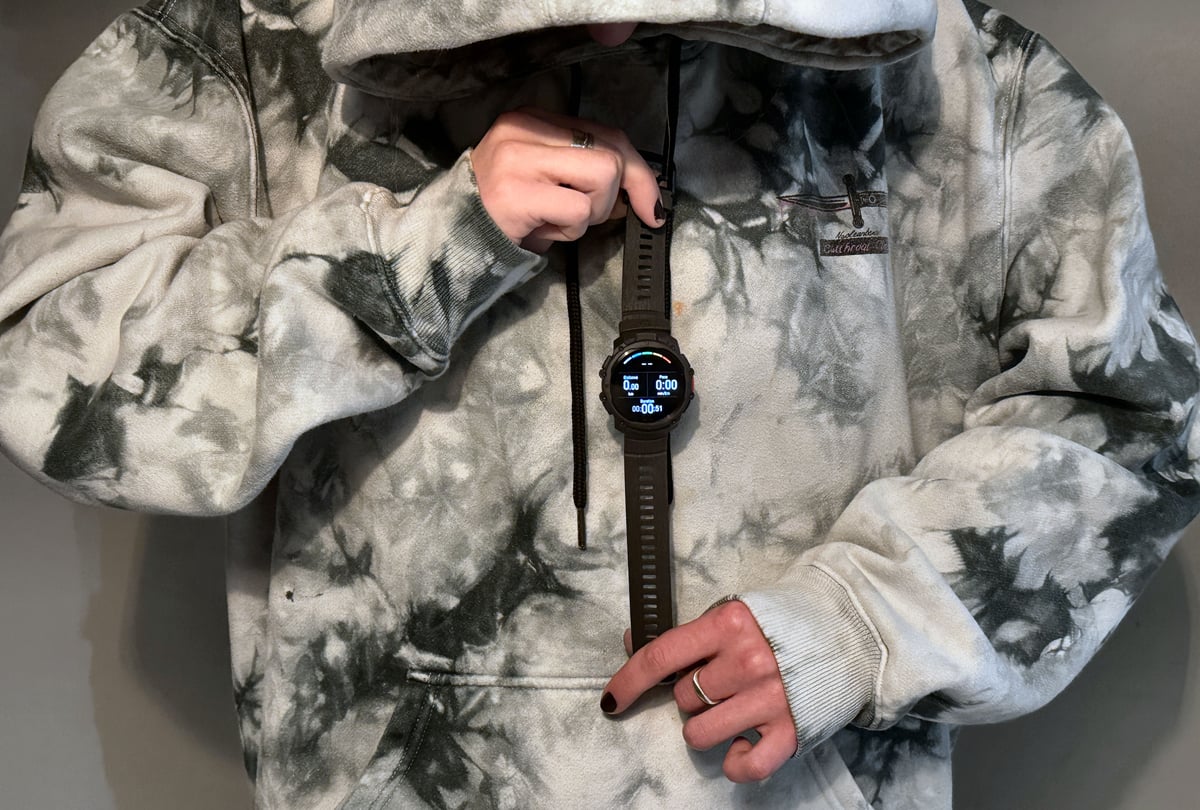
In tests, battery life broadly supports the 43-hour GPS claim. GPS accuracy is adequate in open and suburban conditions but falls short of dual-frequency devices in dense urban environments. Heart rate is approximately correct during sport, but is periodically off by up to 10 bpm when measured against a chest strap. The sleep stage classification raised a concern about detecting deep sleep after heavy exertion.
At 48 g, the watch is exceptionally comfortable for all-day and overnight wear.
Build quality is solid: MIL-STD-810H durability, Gorilla Glass 3, and unmarked after a week of testing. The integrated LED flashlight is a useful addition. Polar’s complete recovery suite (Training Load Pro, Nightly Recharge, Sleep Plus Stages, HRV, skin temperature) is included without a paywall, a genuine differentiator against WHOOP and a strong reason to consider this watch for recovery-focused buyers who want a screen and GPS.
The question Street X leaves open is whether Polar has the marketing conviction to define this as a new category rather than allowing it to be framed as a cheaper alternative to something else. The product is good enough to deserve that chance.
Pros
- Full Polar recovery and training suite at £219, no subscription – Good
- Factory replaceable battery broadly matches the 43-hour GPS claim – Very Good
- Exceptionally light (48 g) and comfortable for all-day and overnight wear – Very Good
- MIL-STD-810H durability, unmarked after weeks of use – Very Good
- AMOLED touchscreen at a price point where competitors lack one – Very Good
- Integrated LED flashlight with white and red modes – Very Good
- Data Privacy – location or your daughter’s health info is stored in Europe – Excellent
- Already discounted to £186 on Amazon UK – Wow!
Cons
- Single-frequency GPS, less accurate in urban environments than dual-frequency devices – Disappointing
- Older optical HR sensor, frequently 10 bpm off during cycling and intervals – Par for the course
- Sleep stage classification questionable: deep sleep may be misclassified as light – Unexpected, deeper testing needed
- Offline maps absent – Expected and OK for the price. City directions would be nice, though.
- Contactless payment requires a separate strap accessory
- Button guards slightly too prominent for gloved use
- Limited watchface selection for an all-day wear proposition – Notable omission
User Review
( votes)Urban / Street Sport Profiles
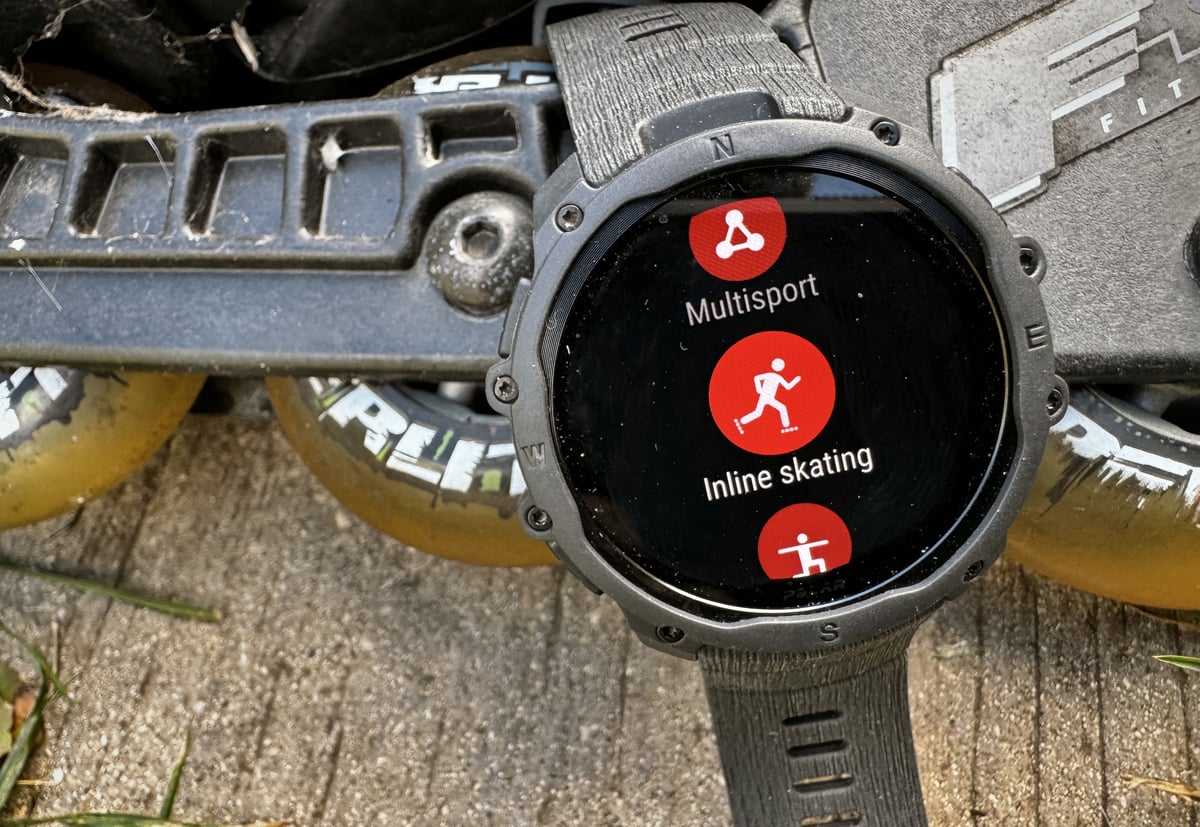
Polar claims 170+ sport profiles. The full list includes skateboarding, inline skating, roller skating, callisthenics, street dancing (which covers breaking, though not labelled as such), rope skipping, kickbiking, obstacle course racing, and indoor climbing. The breadth is genuine, and the core urban sports that most buyers will actually use are present.
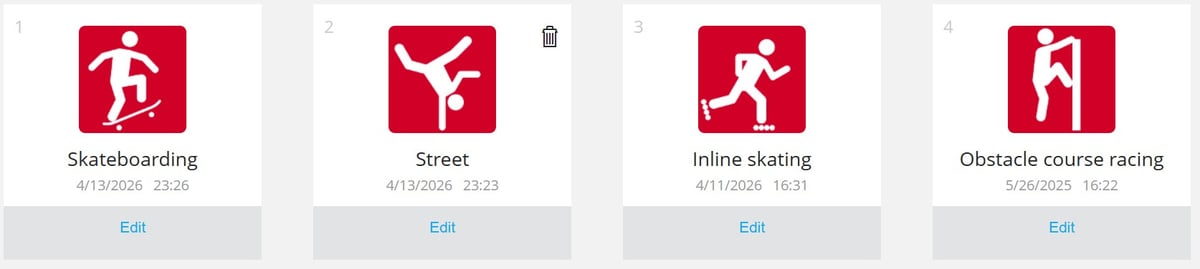
Each sport profile sets default values for GPS usage, heart rate broadcast, and training load weighting. Callisthenics uses the Work-Rest Guide for rest timing between sets, which is a useful touch. Skateboarding and inline skating record heart rate, GPS track, duration, and training load. These are functional profiles that will do the job for most buyers tracking time, effort, and recovery across varied urban sessions.
There is room to grow, and given how clearly Polar has identified this audience, the foundations are in place for future updates. A few additions would strengthen the positioning:
- Parkour/freerunning, which featured prominently in Polar’s own Street X launch marketing and the Polar Journal Street X edition, deserves a dedicated profile
- BMX freestyle and BMX flatland are both World Urban Games disciplines and Olympic sports since Tokyo 2020
- Bouldering, the indoor climbing variant most associated with urban gyms, would complement the existing indoor climbing profile
- Slacklining, a recognised World Urban Games discipline
- Breaking/breakdancing as a named profile rather than only available under the generic “Street” subcategory within Dancing
Sport-specific metrics for street activities (trick counts for skateboarding, session structure for bouldering) are largely unexplored across the industry. COROS has made a first attempt with skateboard tracking on the Nomad. If Polar builds on its urban positioning by tailoring profiles and metrics to these audiences, Street X could own a space that currently has no clear leader.
Battery Test
Including refreshment stops and forgetting to stop the workout, I recorded over 20 hours of GPS cycling time on Street X. The AOD was disabled, but the wake time during wrist movement was almost instant, and the AOD’s absence was unnoticeable.
I finished those 20 hours with 43% battery life remaining. Polar has a performance training mode claim of 43 hours. So 57% of 43 = 24 hours of expected use (vs 20 actual + use out of exercise). On that rough-and-ready basis, it seems to consume a bit more than would be expected given the Polar claim, but it is in the right ballpark.
Battery performance will vary considerably depending on your brightness setting and AOD setting. Further, sunny days may make the watch compensate with extra brightness, reducing battery life more than you might expect.
For multi-day battery life with AOD, it was in the 3-5-day ballpark.
This battery testing forms part of the watch battery life hub.
Polar Street X Heart Rate Accuracy
Heart rate accuracy is mixed but broadly serviceable during sport. On balance, you will get usable data for most training purposes.
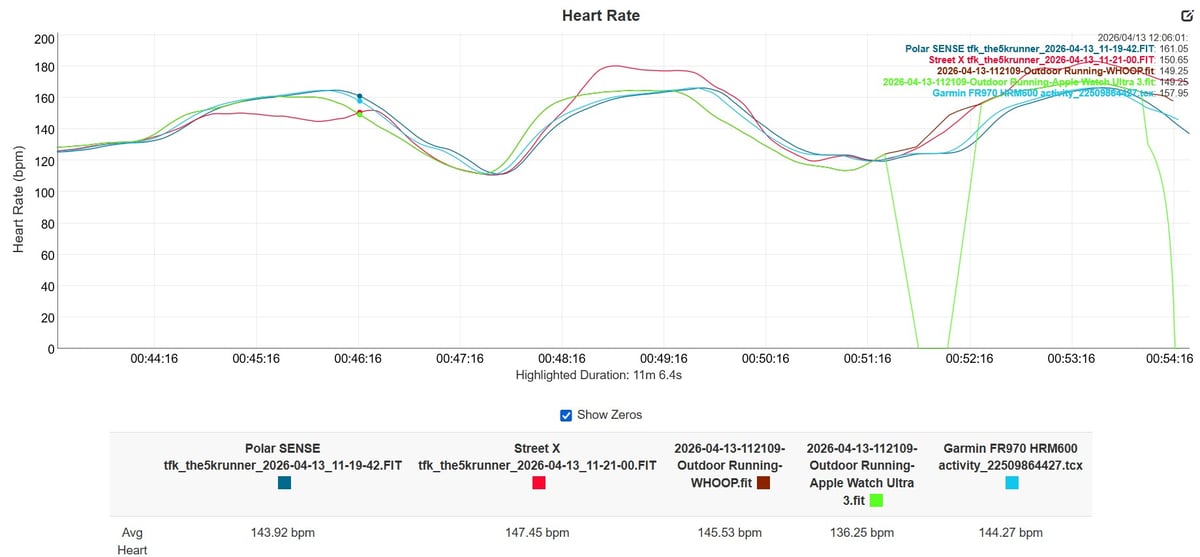
This test started with steady-state running, and the Polar HR track took a little while to settle down, initially reading up to 20 bpm too high, then becoming accurate for the remainder of the session.
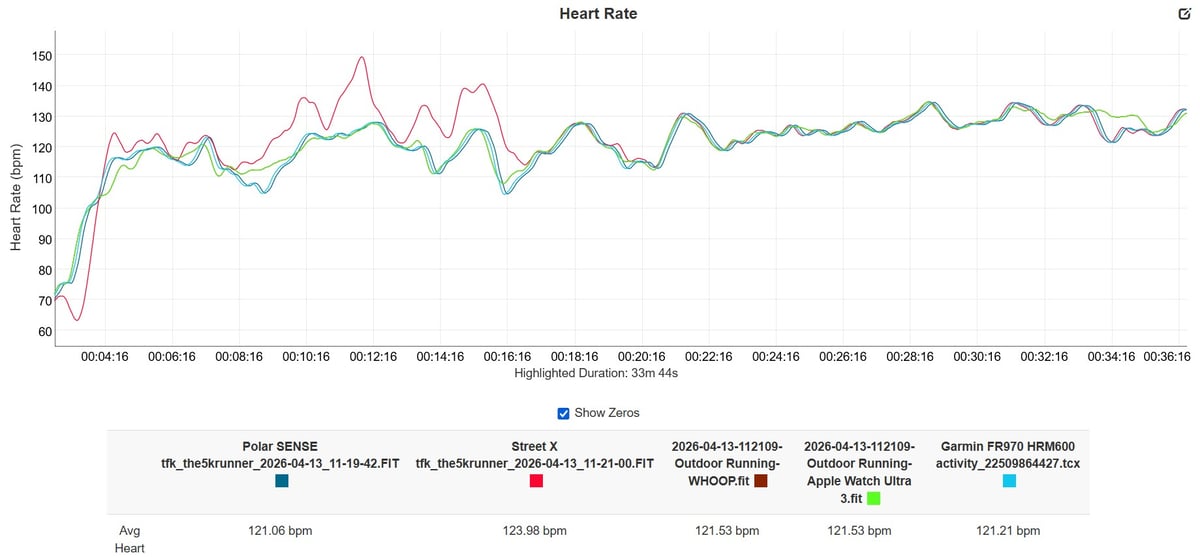
This part of the test had some faster intervals. The Apple Watch deliberately drops HR data when it has low confidence, causing the visible dropouts on the chart. Polar stayed in the right ballpark throughout but was off by up to 10 bpm at peak efforts. The average heart rate was about right, whereas the Apple Watch was significantly lower than the mean, owing to the dropouts. A fair question: would you rather have approximate data or no data?
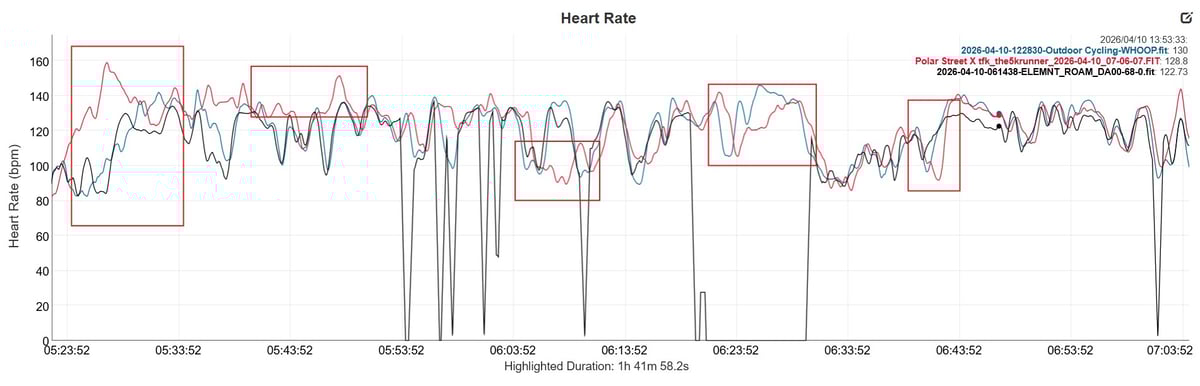
I also cycled on poor roads for 200 miles, where a pattern emerges, but the quality of the comparators (Garmin HRM-600, Whoop MG) was also highly mixed, making a true comparison difficult. The section in the following chart seems representative and shows some agreement between Whoop and Garmin HRM-600. Polar invariably differs from one or both, albeit remaining roughly in the right zone and avoiding dropouts.
Polar’s data would appear correct to the wearer with only one device. However, it is frequently off by around 10 bpm.
Overall: Inconclusive.
GPS Accuracy
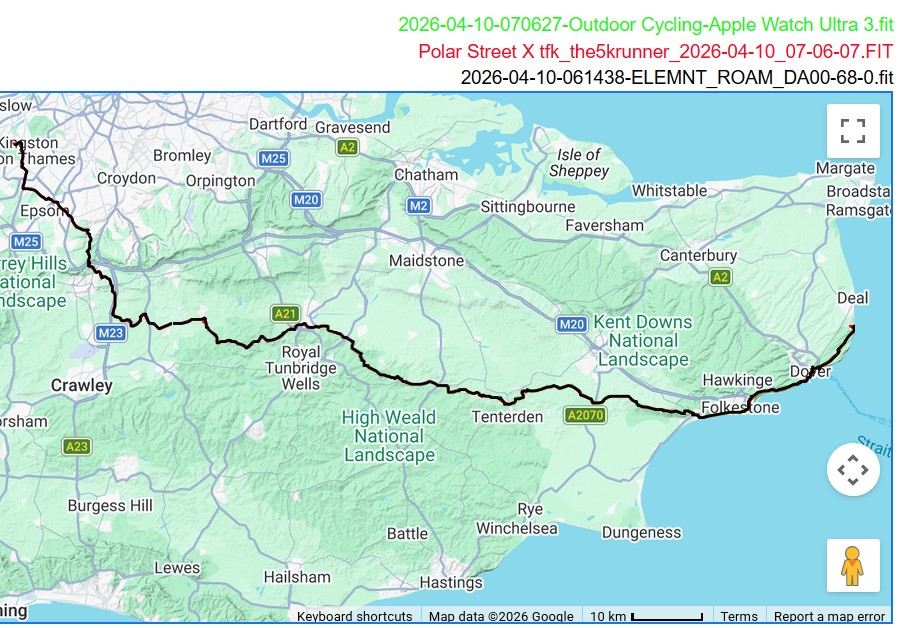
Overall, the track looks excellent for the long ride.
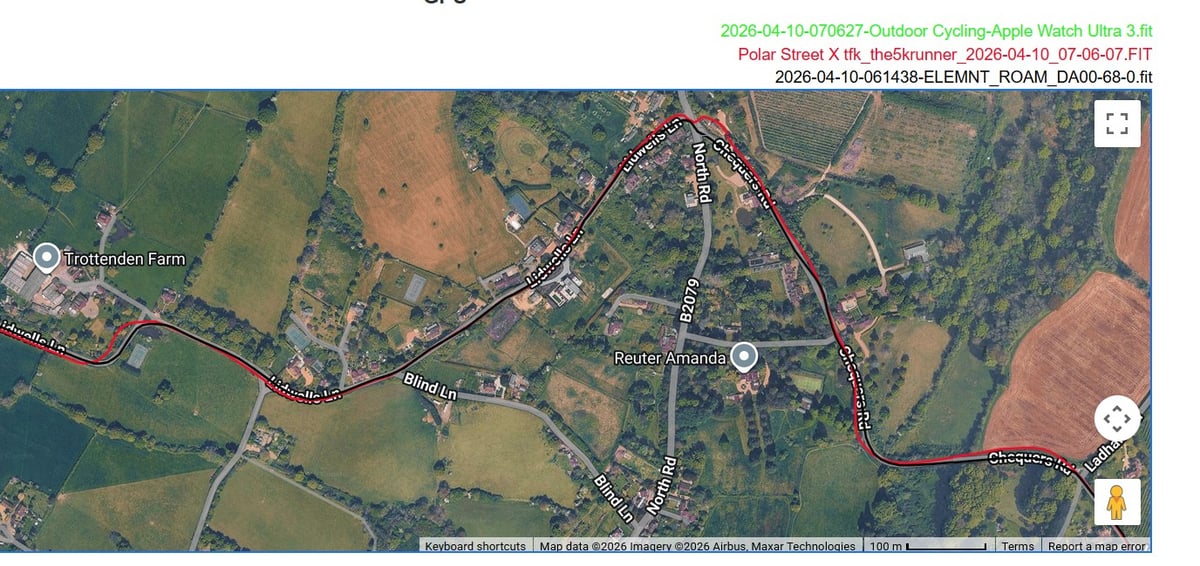
In open-road cycling conditions, the performance was strong, with the worst section showing a divergence of roughly 5 m after a coffee stop that temporarily unsettled the GPS lock.
 In a large town environment with tall buildings, accuracy fell short of the reference devices (Garmin Forerunner 970, Apple Watch Ultra 3), with errors up to 10 m.
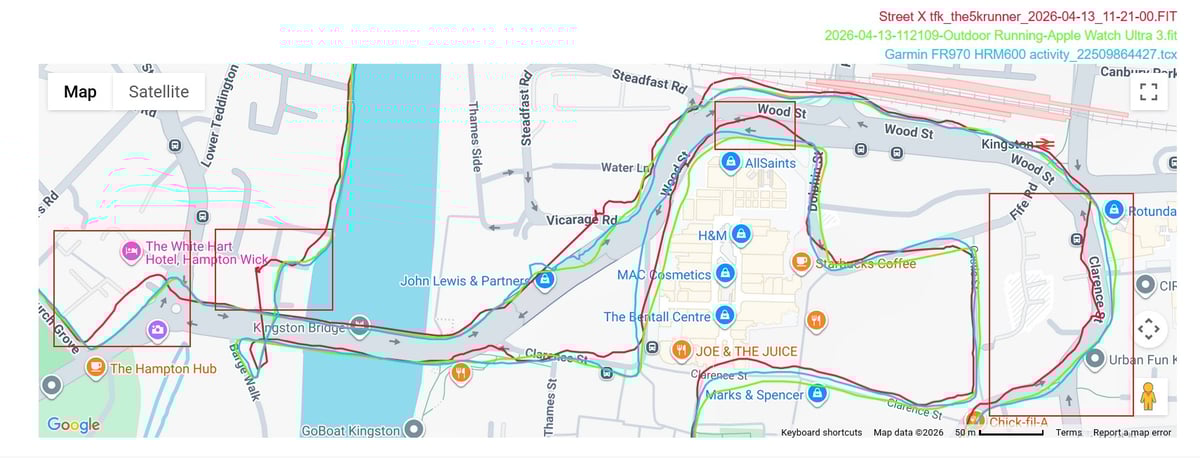 In easier suburban conditions, Street X frequently matched the reference tracks precisely.
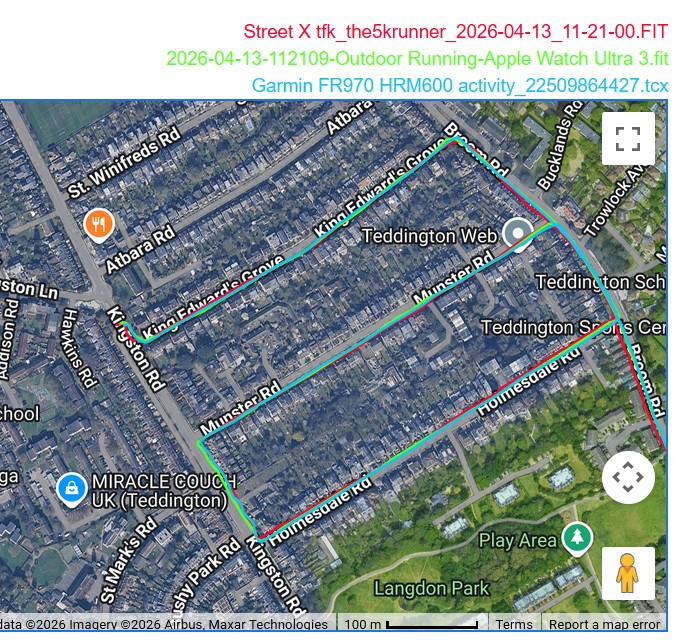
Overall, GPS performance is typical of a prior-generation multi-constellation GNSS device. It lacks the precision of newer dual-frequency chipsets. Street X matches the average accuracy performance of GPS watches from five years ago, which is adequate for some activities.
Comfort, Buttons, and Wearability
At 48 g with a strap, Street X is one of the lightest watches in its class and genuinely comfortable for all-day and overnight wear. I wore it continuously across two 100+-mile cycling days, during sleep testing, and on many other occasions – all with no irritation.
The chunky, eight-screw design borrows from the Garmin Instinct aesthetic. It looks larger than it feels. The strap is colour-matched and blends into the case, which looks good out of the box but limits aftermarket replacement options. A generic 22 mm strap will fit, but may not sit flush against the lugs.
The buttons work well and have a pleasant, soft action, then finish just before you would expect a physical click. The button guards are effective at preventing accidental presses but slightly too prominent for gloved use. Bare-fingered operation is fine.
Polar’s on-watch menus are largely unchanged from the rest of the range. A new watch face ships with Street X. As with most brands, Polar could do with a stronger selection of dedicated faces to encourage all-day wear on a lifestyle-positioned product.
Durability
Street X has held up without a scratch during my week of testing, which is expected given its MIL-STD-810H rating. The bio-based polymer case is unremarkable but solid. The Gorilla Glass 3.0 lens will eventually scratch, but it is a sound, durable choice for this price point and the intended urban use cases.
Sleep Test
The sleep metrics that matter most for health are total duration, consistency of bedtime, and how quickly you fall asleep. Individual-stage breakdowns are less reliable and less important, despite what the wearable industry tells you. In total duration, Polar Street X performed well, recording 412 minutes, the median of five devices worn simultaneously.
The concern is narrower than being the median device: how did Polar classify that sleep?
I recorded this night after cycling over 100 miles per day for the previous two days. I was extremely tired. My usual baseline is roughly 60 minutes of deep sleep, and after that level of exertion, the body prioritises deep sleep for muscular recovery. Deep sleep should have been elevated. It felt elevated.
| light | deep | rem | interruption | total | |
| Polar Street X | 304 | 35 | 73 | 15 | 412 |
| Eight Sleep | 193 | 73 | 129 | 395 | |
| Apple Watch Ultra 3 | 203 | 50 | 116 | 369 | |
| Amazfit Helio Strap | 276 | 76 | 72 | 424 | |
| Whoop MG | 159 | 153 | 118 | 5 | 430 |
Three devices reported elevated deep sleep consistent with heavy recovery demand: Whoop (153 min), Amazfit (76 min), and Eight Sleep (73 min). Polar recorded 35 minutes of deep sleep, below my normal baseline. Its total sleep time is right in the middle of the group, so the issue is classification rather than detection. Polar appears to have shifted the time that should have been spent in deep sleep into the light category. One night with no clinical reference proves nothing, and Polar may well perform differently on a more typical night. It is worth watching this in further testing.
Flashlight Test
The onboard LED (a proper 1,000 nit LED, not a display torch) has four levels of white brightness and one level of red, easily toggled with the right-side buttons. By default, the top-left button turns the flashlight on, and the bottom-left button keeps the light on and returns you to wherever you were. Here is a very short video where I scroll through the colours and brightness modes.
There is enough light to easily illuminate objects at 5 m at night. It is not as bright as the Forerunner 970, which illuminates perhaps twice the distance. Brightness comes at a battery cost, of course.
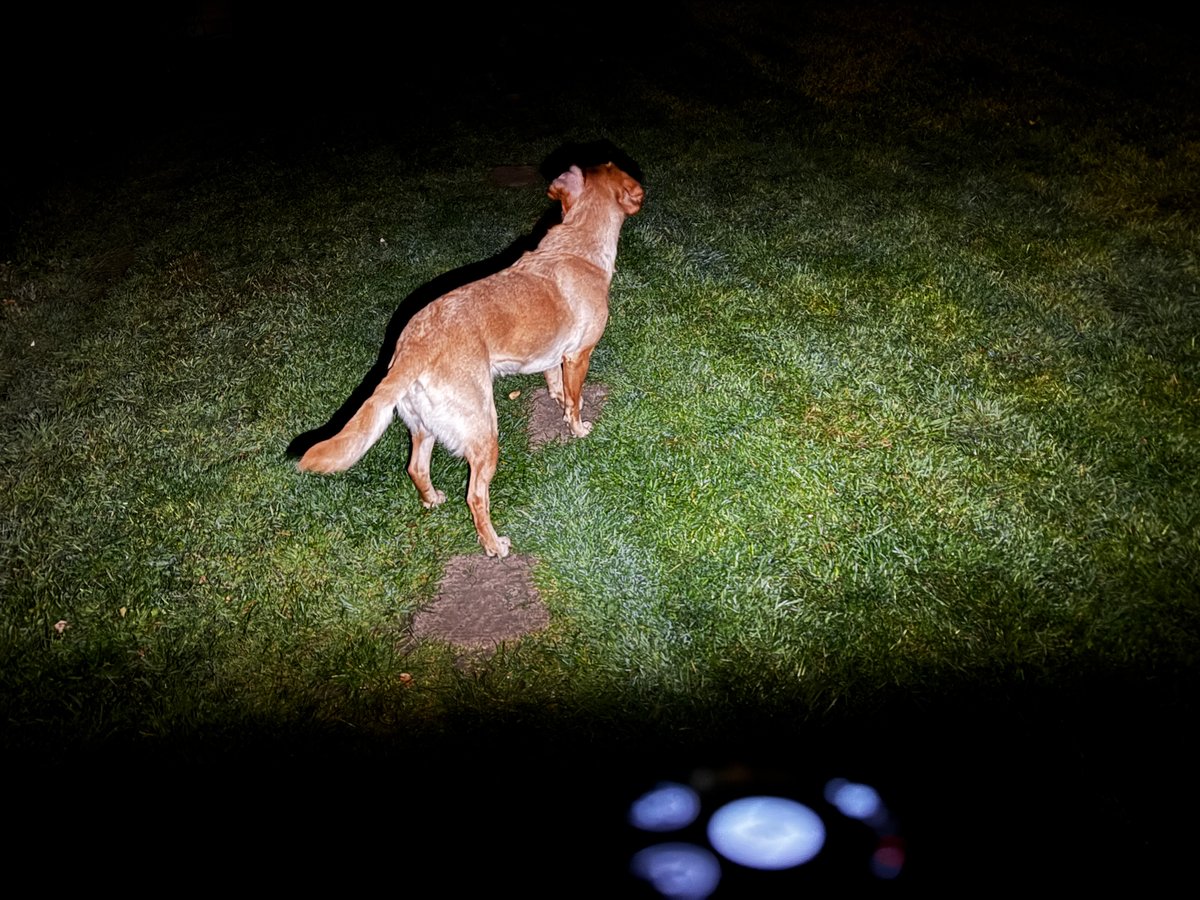
There is nothing on offer with more exotic colours, flash patterns or beam focusing. At this price, what you get is good.
The following image shows the brighter FR970 on the left.
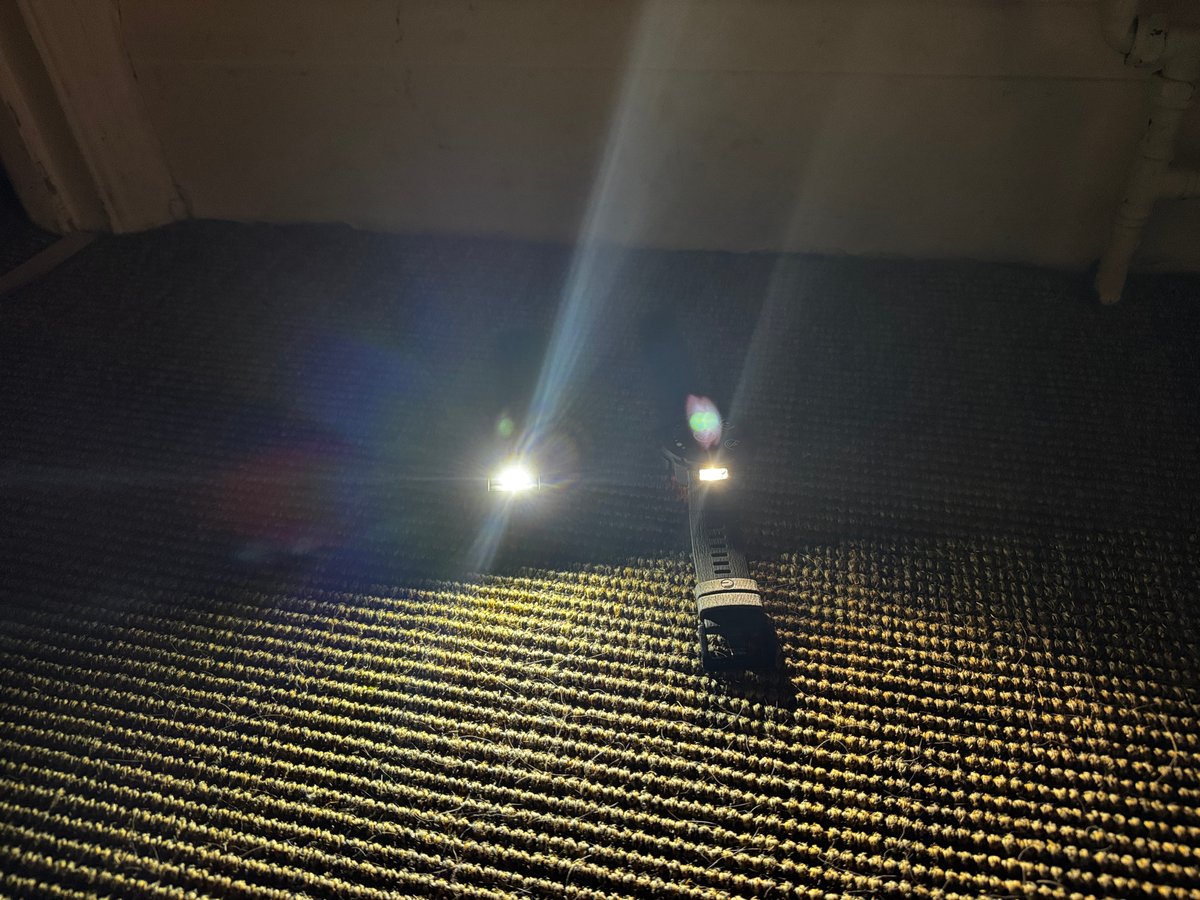
The flashlight is fairly basic but functional, offering no flash, strobe, SOS, metronome or auto-on modes.
Who Should Buy the Polar Street X
Street X is best suited to a buyer who wants recovery and training analytics on the wrist without paying for a flagship watch or a monthly subscription. If your training is varied (gym, running, cycling, skating, commuting) rather than focused on a single endurance discipline, and you care more about understanding how your body recovers than about mapping a backcountry route, this watch delivers well above its price.
It also suits anyone stepping up from a Whoop or the Polar SENSE band who wants a screen and GPS without the complexity or cost of a full multisport platform. The 48 g weight and all-day comfort make it a genuine wear-it-everywhere proposition. If you are a parent buying a first serious sports watch for a teenager who trains across multiple activities, or a young urbanite, Street X offers genuine tools at a price that makes sense.
Street X is less suited to buyers who need accurate GPS in dense urban environments, offline maps, or precise heart rate data during high-intensity intervals. Serious endurance athletes training in heart rate zones should pair it with a chest strap or look at the excellent Polar Vantage M3.
Polar Street X vs Garmin Instinct 3 AMOLED
The Instinct 3 AMOLED is the comparison most people will reach for, but the two watches serve different audiences at very different prices. The Instinct 3 AMOLED 45mm starts at £349.99, roughly £130 more than the Street X at RRP and £164 more than the current Amazon UK price of £186. That gap buys you a newer dual-frequency GNSS chipset, a more recent optical HR sensor (Elevate Gen 4), Garmin Pay, the Garmin ecosystem and Connect app, and the probability of longer software support. It also buys you a watch with no touchscreen, no maps (the same limitation as Street X), and a significantly more complex menu structure and ecosystem.
Street X counters with a touchscreen AMOLED display, Polar’s complete recovery suite with no paywall, a lower weight, and a price that undercuts even the cheapest Garmin Instinct E. The Instinct 3 is a rugged outdoor watch that also appeals to urban buyers. Street X is an urban watch that happens to be rugged. The overlap is more aesthetic than functional. If you want the Garmin ecosystem, expedition-grade battery life, and the broadest third-party app support, the Instinct 3 remains the stronger platform. If you want recovery science, a touchscreen, and the best value per pound at this end of the market, Street X is the more interesting proposition.
A note on the contactless payment strap: Polar sells a payment-enabled strap as a separate accessory, but it was designed for a different model and will look slightly mismatched.
No firmware updates have been issued since launch.
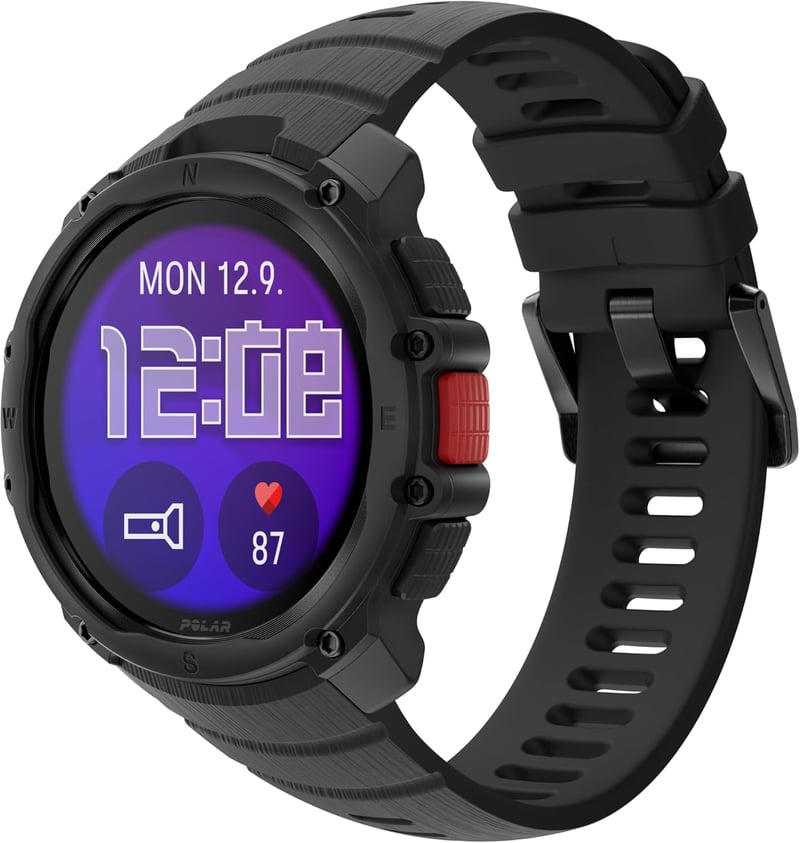
Polar Street X Specifications
This table compares Street X against Polar’s entry-level triathlon watch, the Vantage M3. The feature set is strong for the price, but the hardware is a generation older.
| Feature | Polar Street X | Polar Vantage M3 |
|---|---|---|
| Price | ||
| RRP (UK) | £219.00 | £349.00 |
| Display | ||
| Type | AMOLED | AMOLED |
| Size | 1.28 inch | 1.28 inch |
| Resolution | 416 × 416 | 416 × 416 |
| Touchscreen | Yes | Yes |
| Always-on display | Yes | Yes |
| Ambient light sensor | Yes | Yes |
| Screen protection | Gorilla Glass 3.0 | Gorilla Glass |
| Dimensions and build | ||
| Size (W × H × D) | 45 × 45 × 13.8 mm | 44.7 × 44.7 × 12.2 mm |
| Weight with a strap | 48 g | 53 g |
| Weight without strap | 28 g | 35 g |
| Case material | Bio-based plastic | Plastic |
| Bezel material | Bio-based plastic | Stainless steel |
| Military standard | MIL-STD-810H | — |
| Water resistance | WR50 | WR50 |
| Operating temperature | −20 °C to +50 °C | −20 °C to +50 °C |
| Battery | ||
| Capacity | 385 mAh | 310 mAh |
| Smartwatch mode | 10 days | 7 days |
| Performance training mode | 43 hours | 30 hours |
| Eco training mode | 170 hours | 70 hours |
| Satellite and navigation | ||
| GPS / GLONASS / Galileo | Yes | Yes |
| BeiDou / QZSS | Yes | Yes |
| Dual-frequency GPS | — | Yes |
| Assisted GNSS | Yes | Yes |
| Full-colour topographic maps | — | Yes |
| Route guidance | Yes | Yes |
| Barometer | Yes | Yes |
| Compass | Yes | Yes |
| Sensors | ||
| Optical heart rate (OHR) | Gen 3.5 | Gen 4 |
| Precision Prime biosensing | Yes | — |
| Polar Elixir biosensing | — | Yes |
| ECG | — | Gen 1 |
| SpO2 (blood oxygen) | — | Gen 1 |
| Skin temperature | Gen 1 | Gen 1 |
| Accelerometer | Yes | Yes |
| Gyroscope | Yes | Yes |
| Hardware | ||
| CPU | 275 MHz | 275 MHz |
| Memory | 37 MB | 37 MB |
| Storage | 32 MB | 32 GB |
| LED flashlight (white and red) | Yes | — |
| Connectivity | Bluetooth LE / USB-C | Bluetooth LE / USB-C |
| Training and coaching | ||
| Sports profiles | 170+ | 150+ |
| Training Load Pro | Yes | Yes |
| Recovery Pro | Yes | Yes |
| FitSpark guided workouts | Yes | Yes |
| FuelWise nutrition guidance | Yes | Yes |
| Wrist-based running power | Yes | Yes |
| Energy sources tracking | Yes | Yes |
| Voice guidance | Yes | Yes |
| Running programme | Yes | Yes |
| Season planner | Yes | Yes |
| Vertical speed and VAM | Yes | Yes |
| Swimming metrics | Yes | Yes |
| Work-Rest Guide | Yes | Yes |
| Sleep and wellness | ||
| Sleep tracking | Yes | Yes |
| Recovery tracking | Yes | Yes |
| Daily readiness | Yes | Yes |
| App and integrations | ||
| Polar Flow | Yes | Yes |
| Strava (60-day trial) | Yes | Yes |
| Komoot | Yes | Yes |
| TrainingPeaks | — | Yes |
| Clue | — | Yes |
| Colours available | ||
| Options | Night Black, Snow White, Forest Green | Night Black, Greige Sand |
Pricing: £219 / €249.90 / $249.90 RRP. Currently £186 on Amazon UK.
Quick answers
How long does the Polar Street X battery last with GPS?
Polar claims 43 hours in performance training mode with GPS and optical heart rate active. In a real-world cycling test recording over 20 hours with AOD disabled, the watch finished with 43% battery remaining. That suggests roughly 35 hours of total GPS time, slightly below the claim but within a reasonable margin once general smartwatch use between sessions is factored in.
Is the Polar Street X heart rate sensor accurate?
The Street X uses Polar’s Precision Prime Gen 3.5 optical sensor, a generation behind the Elixir sensor in the Vantage M3. During steady-state running, it settles into reasonable accuracy after an initial lag, but it is frequently off by up to 10 bpm during cycling and high-intensity intervals. Sleep heart rate tracking is broadly correct. For training that depends on precise heart rate zones, pair with a chest strap.
Does the Polar Street X have GPS maps?
Street X does not have offline maps. It supports route guidance with turn-by-turn directions from imported routes via Komoot or Polar Flow, and includes a compass, barometer, and back-to-start navigation. For full map support within the Polar range, the Vantage M3 or Grit X2 are the options.
Is the Polar Street X waterproof?
Street X carries a WR50 rating (water resistant to 50 metres) and supports pool swimming with stroke detection. It is suitable for rain, showers, and swimming, but is not rated for diving.
Does the Polar Street X have contactless payment?
Contactless payment is not built into the watch. Polar sells a payment-enabled strap, though it was designed for a different model, and the visual match is imperfect.
How does the Polar Street X compare to the Garmin Instinct 3?
The Instinct 3 AMOLED starts at £349.99 and offers a newer dual-frequency GPS chipset, a more recent optical HR sensor, Garmin Pay, and the Garmin ecosystem. Street X counters with a touchscreen, Polar’s full recovery suite without a subscription, lower weight (48 g), and a significantly lower price. Neither watch has offline maps. The Instinct 3 suits buyers who want the Garmin platform and expedition-grade battery. Street X suits buyers who prioritise recovery analytics and value.
Is the Polar Street X good for running?
Street X supports structured running programmes from 5K to marathon distances, wrist-based running power, and daily workout suggestions from FitSpark. Heart rate accuracy during steady running is adequate after an initial settling period, though it can lag during sharp intensity changes. GPS accuracy is good in open and suburban conditions, but less precise than that of dual-frequency devices in built-up areas. For casual to moderate runners, it is a capable option. Competitive runners training in precise zones should use a chest strap.
Does the Polar Street X track parkour or BMX?
There is no dedicated parkour, freerunning, or BMX profile. Parkour featured in Polar’s own Street X launch marketing but has not yet been added to the sport profile list. These activities can be tracked under generic profiles such as Other outdoor or Functional training, which will record heart rate, GPS, duration, and training load. Sport-specific metrics such as trick detection or movement classification are not available on any current Polar device.
Is the Polar Street X worth it for a teenager?
At £186 on Amazon UK, Street X is one of the strongest options for a younger buyer who trains across multiple activities. It includes Polar’s full recovery and training suite with no subscription, 170+ sport profiles covering skateboarding, inline skating, callisthenics, and more, plus a built-in flashlight and MIL-STD-810H durability. The AMOLED touchscreen is intuitive for anyone familiar with a smartphone. Key youth limitations include the absence of music storage and contactless payment on the watch itself.
Does the Polar Street X work without a phone?
Street X records workouts, tracks heart rate, and logs GPS independently. You do not need a phone during the activity. The Polar Flow app on a smartphone is needed to sync data, configure sport profiles, and receive firmware updates. The watch functions fully as a standalone training device during exercise.
Is the Polar Street X good for skateboarding?
Street X includes a dedicated skateboarding sport profile that records heart rate, GPS track, duration, calories, and training load. It does not offer skateboard-specific metrics such as trick detection or session structure. For tracking time, effort, and recovery from skating sessions, it does the job. COROS Nomad is currently the only watch attempting sport-specific skateboard tracking.
Polar Street X price: where to buy
The Polar Street X has a recommended price of £219 / €249.90 / $249.90.
Buy Polar Street X direct from Polar or one of my partners.
For the complete guide to Polar watches, sensors and training science, see the Polar hub on this site.

Last Updated on 3 October 2026 by tfk the5krunner
Small things I always use
- Garmin 90-degree charging adapter: Charges your Garmin from any USB-C cable. Essential when travelling. I use one.
- Body Glide: The blue anti-chafe stick swimmers and runners carry. I use it.
- Speedo earplugs: Fewer ear infections and no cold-water dizziness. I use them.
- Dryrobe Advance: My winter changing robe for open-water swims. I use one. A cheaper option is the AONYIYI changing robe.
- Maurten: Race fuel that stays easy on the stomach. I use them.
- Garmin charging puck: The quickest way to top up before a session. I use one.
- Injinji: Toe socks that stop rubbing, so you run more. I use them.
- Ultimate toe protectors: Stop black toenails on long runs. They work. I use them.
- Compressport R2 v2 calf sleeves: My calf sleeves of choice. I use them.
- Cellucor C4: My pre-workout before hard sessions.
- TPU tubes: Schwalbe Aerothan, Tubolito and Pirelli SmarTube. Light, tiny spares. I use all three.
- G8 insoles: Adjustable insoles that are good. I use them.
- Cycplus Cube: A 97g electric pump that gets a road tyre rideable in two minutes. I carry one. 5% off with code THE5KRUNNER.
Watches and sensors
- Polar H10: My daily driver for waking HRV.
- Polar Verity Sense: My backup arm-worn HR sensor.
- Nomad bedside charger: Charges my iPhone and Apple Watch overnight. I use it, and many of their bands.
- Train.Red: The best muscle oxygen sensor I’ve used.
- Tymewear: Accurate heart rate and reliable ventilatory zones. I use it to pace endurance rides over an hour.
- Garmin Forerunner 970: A pro-grade triathlon watch. I use this.
- Apple Watch Ultra 4: My daily smartwatch. No phone needed on rides.
- Garmin Fenix 9 Pro: I’ve just bought one.
On the bike
- Continental GP5000 for everyday riding, and Aero 111 on the front for special occasions.
- Helmets: Specialized S-Works Evade 3 for road riding, and Rudy Project Wing for TT-style races. I use both.
- Ravemen FR300: A front light that mounts under your Garmin or Wahoo. I use one.
- Wahoo TRACKR Radar: I use it on one bike and Varia on the other. They perform the same.
- Garmin Varia RTL515: Radar that warns you of cars from behind. I use this model.
- Wahoo ELEMNT Roam 3: The bike computer that’s easy to use. I use mine on most rides.
- Favero Assioma Pro RS2: Accurate power pedals that swap easily between bikes. I use this model.
Home and indoor training
- NPE Runn: Makes my basic treadmill smart, sending more accurate speed and distance to my watch and Zwift. I use it.
- Google Wifi: Keeps Zwift connected in my pain cave. I use it.
- Apple TV 4K: Zwift on the big screen. I use two.
- Google Nest Doorbell (wired, 2nd gen): My video doorbell, running in both Google Home and Apple Home. I use it.
Health, recovery and sleep
- FreeStyle Libre 3 Plus: Shows how my blood sugar responds to diet.
- hDrop: Measures my sweat loss in summer and indoors.
- Fourth Frontier Zone: Checks my heart under load in hard sessions.
- Oura Ring 5: My partner’s recovery tracker of choice.
- Kineon MOVE+: Red light therapy for niggles. It works.
- Eight Sleep: A cooling mattress cover my partner and I use nightly.
Reader-Powered Content

This content is not sponsored. It’s mostly me behind the labour of love, which is this site, and I appreciate everyone who supports it.
Support the site: Follow (free, fewer ads) · Subscribe (paid, ad-free) · Buy Me A Coffee ❤️
Written by real people, with AI assistance. Fact-checked and verified for originality. See the Editorial Policy. FTC: Affiliate Disclosure — some links pay commission. As an Amazon Associate, I earn from qualifying purchases.

tfk is the founder and author of the5krunner, an independent endurance sports technology publication. With 20 years of hands-on testing of GPS watches and wearables, and competing in triathlons at an international age-group level, tfk provides in-depth expert analysis of fitness technology for serious athletes and endurance sport competitors. ID

Any news regarding the 2025 announced Polar Flow App Update?
strangely quiet. I saw images of it last year but only beta.
How the turns have tabled….Polar seems to be pretty dead. Their HRMs are still great but their watches are not interesting anymore….Suunto seems to come back with a vengance but Polar…well I hope there are still enough people who have a different view and hate Gramin and the Chinese (Suunto) enough to spend their money on Polar. Competition is always good
It’s really a shame about Polar!
For years, they’ve been slacking off on two extremely important areas:
– Watch OS
– Polar App
Meanwhile, Suunto has made a comeback, and Amazfit is becoming increasingly successful.
Google has also placed a strong focus on sports with its Pixel 4 Watch.
On top of that, a Google Fitbit AI Health Coach is on the horizon, most likely accompanied by new Fitbit hardware.
What has always bothered me:
Polar had Apple’s arrogance, but without its success.
For years, users on Reddit have repeatedly criticized Polar for the same issues, yet Polar has just kept going.
I hope they’ll soon come out with a new app and a new watch that also has a new, modern OS!
It would be a shame if they disappeared from the market.
I echo what you say and Poalr is coming out with a new app, i saw part sof it last year but no news on the latest relase. I woudln’t describe them as arrogant, rather instead making use of the reousrces they have as a private company.
Good review, and I liked your comment on single vs dual band gps. I have a Suunto Run and Pacer Pro, where I live distances are similar.
Battery life 20/.57…no?
I switched to Polar in February when I bought a Vantage M3. I must say that I am really happy with my choice, although there are some minor glitches. But Garmin and Direct Connect are not without issues and quirks either. The Polar Flow eco system is really powerful and provides me with all data I need (coming from TrainingPeaks).
The Street X seems to be a very good to be a budget watch (the best?), and provides far more value than the Garmins at the same price points. But it is a shame that Polar doesn’t fully nail it, they are so close on both the Watches and the app side.
From a geopolitical viewpoint they are also the only option if you want to avoid US or Chinese companies, so I really hope they can fix the glitches they have.
yup.
all the brands have issues, it’s only annoying when they affect you!!
You’re probably right about that.
And I guess a second problem is that the whole fitness watch industry has changed:
These days, you probably need more programmers than engineers.
The whole AI thing, algorithms, and so on.
yep it’s changing tho.
60% of Claude (AI) is written by claude…and increasing.
Point beign tht AI takes the place of human coders, currently to the point of turning the humans into agents managing multiple ai coding streams and bug fixing. great for productivity. introduces some bugs but that will always happen
when ai gets better (very soon) it becomes the agent. programmers will soon be out of a job.
not sure on the effect on engineers i would imagine it has similar productiviy benefits but will take longer for ai to be as good as the humans overall.