Garmin CIRQA has nothing to do with the leaked Muscle Battery.
If you delve into sports zones science, as I have on occasion, you will soon come to realise that the zones we routinely use (power, HR, pace) are merely approximations for an ever-changing state. A state that changes from day to day and within your workout. Truly dynamically adapting training zones would be a wonderfully prescriptive tool.
A few years ago, an HRV-based technique called dfa a1 appeared to offer exactly that. Suunto later introduced a variant called DDFA. I got very excited about both methods at the time, but when I tried to use them, I found the insights were quite elusive and required continuously reliable data to be meaningful.
I should have read a 2023 paper by renowned sports scientist Bruce Rogers (pubmed), which showed that an algorithmic technique combining muscle oxygen metrics (specifically the HHb breakpoint) and HRV (dfa a1) could perhaps give the stability and accuracy I was missing. That combination of SmO2 and HRV for real-time threshold detection is relevant to what follows.
However, that mix of metrics never quite seemed to progress beyond the lab.
Roll forward to 2026.
Listen to the discussion
Garmin Trademarks a SmO2 Sensor
I covered the Muscle Battery trademark in detail yesterday. The short version: it is a direct muscle oxygen measurement via NIRS, fundamentally different from anything Garmin currently offers, and it requires dedicated hardware that cannot work from the wrist.
The trademark application states that Muscle Battery relates to software for “capturing, processing and analysing muscle oxygen saturation“. NIRS sensors measure oxyhaemoglobin (O2Hb) and deoxyhaemoglobin (HHb). From those two raw signals, SmO2 is derived as a percentage (O2Hb divided by total haemoglobin), and THb (the sum of both) serves as a proxy for local blood volume. Existing Garmin optical sensors cannot detect O2Hb and HHb.
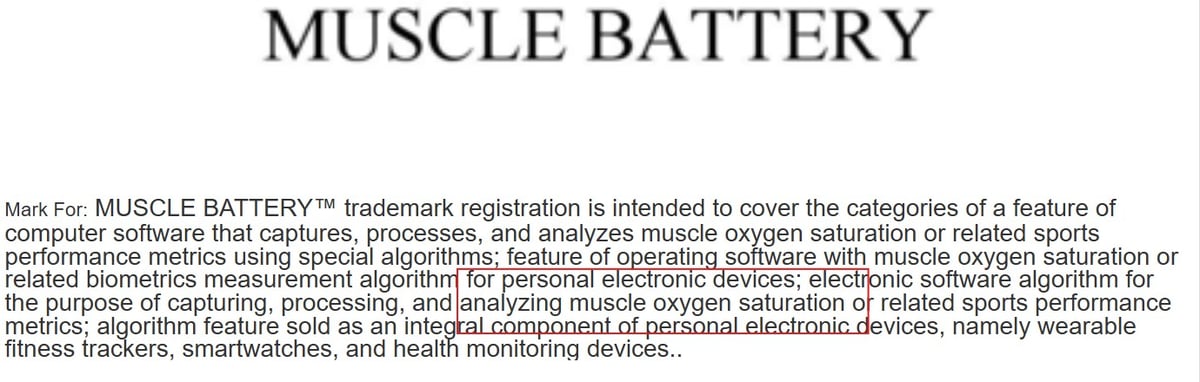
This might never become a real product, but if it does, it is very clearly a new piece of hardware. The applications range from race pacing to hypertrophy confirmation, benefiting both endurance and strength athletes.
Could Garmin actually sell this?
Muscle oxygen data is niche and quite hard to understand. I have used it on and off for years. All regular readers here would get to grips with it, but it is not as intuitively obvious as the likes of power zones, where a higher number simply means it is harder. SmO2 does not work like that (check out NNOXX’s guide to see what I mean).
Garmin has the scale and reach to take SmO2 to the masses where the likes of Humon Hex failed. And there is a high-margin play here: athletes training with two or four sensors could spend hundreds of dollars on hardware alone.
But even with Garmin’s might behind it, Muscle Battery might still be relegated to specialist pro niches. Remember, Garmin leaked its cycling aero sensor a few years ago (Vector AIR). It was definitely a real product, but Garmin presumably determined it was not commercially viable at scale. Probably a fair assessment.
What if CIRQA and Muscle Battery are the same product?
The three sets of leaks, CIRQA, Muscle Oxygen, and the Strength Training feature, are all strangely coincidental, all coming in the same quarter. This got me thinking.
This is always a bit dangerous. Me. Thinking.
What if all of Garmin’s recent leaks are very closely interconnected? Perhaps even algorithms and trademarks centred on the same physical product, CIRQA?
The media has assumed that CIRQA is Garmin’s Whoop competitor. What if it is not? Or, in a more nuanced way, what if it is a Whoop competitor with an entire additional raft of advanced features built around Muscle Battery and SmO2?
The argument does not hold
Sadly, the argument almost certainly does not hold. CIRQA and the Muscle Battery sensor are almost certainly separate products.
The most obvious reason is physical. As I detailed in the trademark analysis, a muscle oxygen sensor must be placed directly on the target muscle, shielded from ambient light, in a consistent position from one session to the next. CIRQA appears to be predominantly a wrist or arm band. It cannot be repositioned across quads, hamstrings, and calves from set to set, nor support the multiple simultaneous sensor placements that meaningful SmO2 monitoring requires.
Then there is the data quality problem, and this is where Bruce Rogers’ work becomes directly relevant. His method of determining the three-zone critical thresholds requires accurate HRV from a high-quality electrical chest strap. The published study used a Polar H10 with meticulous belt placement to eliminate artifact. A light-based PPG sensor on a wristband, even one that also incorporates NIRS wavelengths for SmO2, is extremely unlikely to deliver the HRV fidelity that the method demands.
The reason is fundamental, not incremental. PPG on the wrist measures pulse waves through skin, fat, and variable blood flow. The signal is prone to motion artifact and lacks the R-peak precision of an electrical ECG. Rogers’ combined threshold method averages the HRV-derived threshold (HRVT2) with the NIRS-derived deoxyhaemoglobin breakpoint (HHb BP). If the HRV half of that equation is unreliable, the combined estimate is no better than NIRS alone. Put another way, it is impossible in 2026 for a single wrist-worn device to deliver both high-fidelity HRV and localised muscle oxygen.
CIRQA fits a wrist-based, Whoop-style recovery platform built around HRV. Muscle Battery points clearly toward a dedicated SmO2 sensing ecosystem. The hardware, placement requirements, and data fidelity constraints make meaningful overlap between the two physical sensors highly unlikely.
That said, Garmin may still unify them at a software or platform level. The strength-training features from the recent survey, food logging, and recovery analytics all work with HRV alone and fit a wristband naturally. SmO2 data from a separate Muscle Battery sensor could be integrated into the same Garmin Connect ecosystem alongside CIRQA data, without the two devices needing to be the same product.
Two separate products. One platform. That is probably where this is heading.
Last Updated on 12 April 2026 by the5krunner
Reader-Powered Content

This content is not sponsored. It’s mostly me behind the labour of love, which is this site, and I appreciate everyone who supports it.
Support the site: Follow (free, fewer ads) · Subscribe (paid, ad-free) · Buy Me A Coffee ❤️
All articles are written by real people, fact-checked, and verified for originality. See the Editorial Policy. FTC: Affiliate Disclosure — some links pay commission. As an Amazon Associate, I earn from qualifying purchases.
tfk is the founder and author of the5krunner, an independent endurance sports technology publication. With 20 years of hands-on testing of GPS watches and wearables, and competing in triathlons at an international age-group level, tfk provides in-depth expert analysis of fitness technology for serious athletes and endurance sport competitors.
