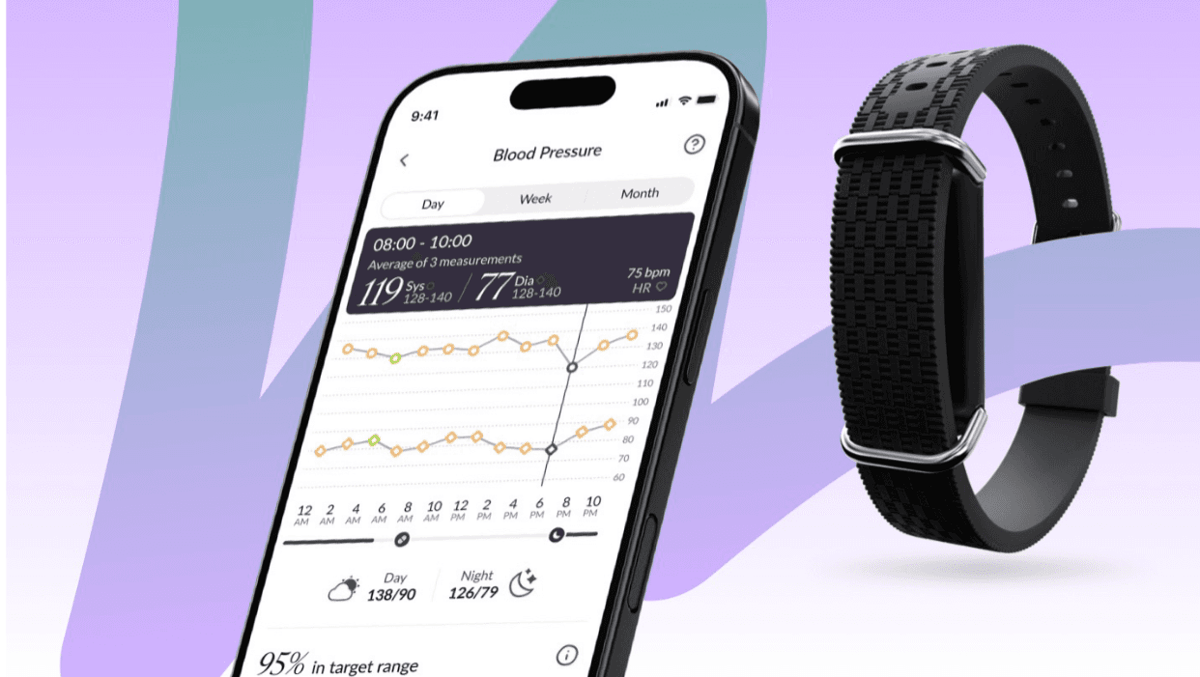
 Breakthrough – First cuffless and FDA-approved continuous blood pressure monitor
The Hilo Band, formerly Aktiia, has become the first cuffless blood pressure monitor to gain over-the-counter clearance from the U.S. Food and Drug Administration. Set to hit the U.S. market in 2026, this wrist-worn device, with over 130,000 users worldwide and CE-marked as a Class IIa medical device, promises to transform how wearables manage hypertension. Backed by two decades of research and rigorous clinical trials (some links below), the Hilo Band offers continuous, non-invasive blood pressure tracking, overcoming the limitations of traditional cuff-based monitors.
For decades, blood pressure monitoring has relied on sphygmomanometers, which use inflatable cuffs to take snapshot readings. While reliable in clinical settings, these devices often fail to capture the full picture of blood pressure fluctuations, especially during sleep, a critical period for assessing heart risk. The discomfort of cuff inflation discourages regular use, and improper positioning or activity can lead to inaccurate home readings.
Recent innovations on the wrist include the trend estimation of blood pressure from photoplethysmography (PPG) sensors, heart rate, heart rate variability (HRV), and blood flow patterns during sleep, as exemplified recently by Whoop MG. Whilst giving valuable nightly readings, this method only supports broad trends.
The Hilo Band sidesteps the clinical issues and adds one further step to accuracy than Whoop, delivering more frequent monitoring to help better understand the intra-daily picture.
What is HILO? How does it work?
The Hilo system comprises a lightweight, waterproof wristband that uses photoplethysmography, an optical technology that measures blood volume pulsatility by analysing arterial movements beneath the skin. Worn like a smartwatch, the band takes up to 50 readings (averages) daily, even during sleep, without disturbing the user. A companion smartphone app visualises systolic and diastolic data, offering insights such as day-versus-night averages and Time in Target Range, a metric showing how often blood pressure stays within healthy limits. Users can track the impact of lifestyle choices, compare weekday and weekend trends, and share detailed reports with their doctors. A monthly calibration with a validated oscillometric cuff, included with the system, ensures accuracy and meets stringent ANSI/AAMI/ISO standards.
Is HILO Accurate?
The Hilo Band’s precision has been proven across diverse clinical settings. In one study, the calibration cuff showed readings within 1.3 mmHg for systolic and 0.2 mmHg for diastolic pressure compared to a mercury sphygmomanometer, with 86% and 95% of measurements within 10 mmHg, respectively. A month-long trial confirmed the band’s accuracy in the sitting position, with mean differences of less than 0.5 mmHg for both systolic and diastolic readings. In intensive care, the device matched invasive arterial catheter measurements, while tests in elderly users aged 65 to 85 showed consistent performance across sitting, standing, and lying positions. A comparison with ambulatory blood pressure monitoring found no significant differences in daytime readings, with the Hilo Band accurately identifying 79% of nocturnal blood pressure dippers, a key indicator of cardiovascular health.
So What?
This technology promises a significant shift in hypertension management. By providing frequent, unobtrusive measurements, the Hilo Band enables early detection of blood pressure changes, empowering its owners to make timely lifestyle adjustments or seek medical advice. Its ease of use is claimed to boost adherence, addressing the compliance issues that plague traditional monitors. The app’s detailed insights and data-sharing capabilities equip clinicians with comprehensive data, paving the way for personalised care. While not a diagnostic tool, the Hilo Band offers unparalleled visibility into heart health when used with medical guidance.
The FDA’s approval marks a key point in time for accessible, clinically validated blood pressure monitoring. As e-health continues to rise, the Hilo Band stands poised to lead a transformation in cardiovascular care, making hypertension management less intrusive and more integrated into everyday life. For millions worldwide, this device could mean a new level of control over their heart health, bringing precision and peace of mind to a critical aspect of wellness.
Take Out
Years in the making, this is a big step forward for the wrist! At £210, it’s not unreasonably priced compared to the benefits many will get from using it. Although Aktiia claim this to be the first, there is also a similar product from Corsano, which, admittedly, takes less frequent readings.
Hopefully, this indicates that significant premium wearables companies like Samsung, Apple, Huawei, and Garmin will license this technology or bring it close to the market.
Sources and resources:
- Company website: Hilo
- Similar competitive product: Corsano
- Press release: here
- Blood Pressure Monitoring 28(2):p 109-112, April 2023. | DOI: 10.1097/MBP.0000000000000639
- Blood Pressure Monitoring 26(4):p 305-311, August 2021. | DOI: 10.1097/MBP.0000000000000531
- Blood Pressure Monitoring 25(2):p 105-109, April 2020. | DOI: 10.1097/MBP.0000000000000421
- Journal of Hypertension 43(4):p 690-697, April 2025. | DOI: 10.1097/HJH.0000000000003960
-
Theiler, K., Sola, J., Damianaki, A., Pfister, A., Almeida, T. P., Alexandre, J., … Wuerzner, G. (2023). Performance of the Aktiia optical blood pressure measurement device in the elderly: a comparison with double-blinded auscultation in different body positions. Blood Pressure, 32(1). https://doi.org/10.1080/08037051.2023.2281320
-
American Journal of Hypertension, Volume 38, Issue 5, May 2025, Pages 295–302, https://doi.org/10.1093/ajh/hpaf003
Last Updated on 29 January 2026 by the5krunner
Reader-Powered Content

This content is not sponsored. It’s mostly me behind the labour of love, which is this site, and I appreciate everyone who supports it.
Support the site: Follow (free, fewer ads) · Subscribe (paid, ad-free) · Buy Me A Coffee ❤️
All articles are written by real people, fact-checked, and verified for originality. See the Editorial Policy. FTC: Affiliate Disclosure — some links pay commission. As an Amazon Associate, I earn from qualifying purchases.

tfk is the founder and author of the5krunner, an independent endurance sports technology publication. With 20 years of hands-on testing of GPS watches and wearables, and competing in triathlons at an international age-group level, tfk provides in-depth expert analysis of fitness technology for serious athletes and endurance sport competitors.

Any idea if this requires special LEDs, or is it just a smart algorithm that existing wearable arrays could take advantage of? I can’t imagine any wearable manufacturers incorporating the tech into current gen devices/arrays even if it is just a firmware update, but it would certainly reduce the lead time for the next generation of devices to use the tech.
For EU citizens:
Aktiia is only legally able to sell and ship products to countries where we have received regulatory clearance. Currently, those countries include:
Australia
Austria
Canada
France
Germany
Italy
Liechtenstein
Luxembourg
Switzerland
Spain
The Republic of Ireland
The United Kingdom
You just copy paste the company’s marketing story, didn’t you?
here’s the press release: https://www.prnewswire.com/news-releases/aktiias-hilo-band-becomes-first-cuffless-blood-pressure-monitor-cleared-by-fda-for-over-the-counter-use-302501123.html
I’ve had one of these bands for years! Would really prefer it be integrated into my Garmin so I don’t need to wear two items at once. But I will wear this occasionally when I have concerns about high blood pressure. Nice device.
Would be interesting to see a comparison directly with WHOOP day by day
I think this one actually measure it all the time or at least on demand while Whoop just throw a morning so not really a usefull or easy way to compare at all
Whoop don’t even say much besides a guessing range (in my case that i have low blood pressure values it fails EVERY SINGLE DAY lol)
I spent a full week put the exact values of my withings and it was every single morning 61/93 range and every single day that i let Whoop guess it gives me 62/115 range lol then i fix it and add manually but i was hoping at least after 2 weeks of doing this already it would at least put it in 100 or lower but never did it 😛
Even a 6 year old kid would guess what my blood pressure would be after 14 straight days barely change 1 or 2 points and always on 61/93
At least they could just create an AI algorithm that would adjust but guess it’s too “beta” yet, hope they will fix it and not just a gimmick as i thought it would be when they launched
Samsung watch did it way better after calibrate it
whoop takes continuous readings at high frequency
so it must come down to the fidelity of the algorithm or what has been proven for the claims it mames which manifests itself as a nightly average)