PF-Sweat Patch (beta) — Continuous Lactate Monitoring: First Non-Invasive Wearable
For decades, accessing lactate — the gold standard biomarker of endurance performance — required drawing blood. PointFit Technology, a Hong Kong-based start-up, is proposing to end that invasive inconvenience. Its PF-Sweat Patch continuously reads lactate and other biomarkers from sweat in real time, without breaking the skin. Currently in beta and available by waitlist, it is the first device of its kind to reach this stage in a consumer wearable form.
The Technology
The PF-Sweat Patch is an ultra-thin conformable patch built on a proprietary nanomembrane (PF-ACE) of Ultra-High Molecular Weight Polyethylene (UHMWPE), approximately 100 nanometres thick, developed at the Hong Kong University of Science and Technology (HKUST) and documented in a peer-reviewed paper in the IEEE Sensors Journal in 2021. PointFit licenses the material from HKUST and has developed the sensor architecture, circuitry, and signal processing on top of it under international patent WO2019123019A2.
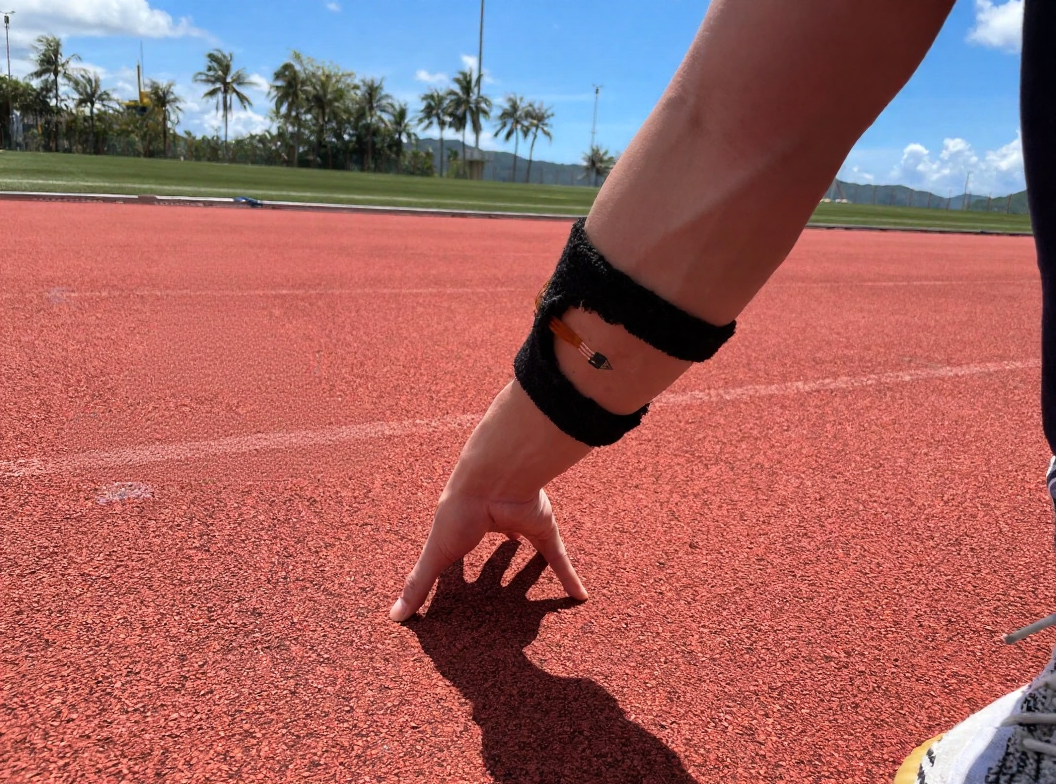
The sensing method captures biochemical signals as sweat passes through the membrane’s porous structure rather than pooling it in microfluidic channels, as most adjacent (semi-competing) devices do. The company argues this eliminates delays of up to 25 minutes from channel-based collection. Signals are transmitted via Bluetooth Low Energy to a companion iOS and Apple Watch application; an NFC variant is available for intermittent monitoring. The patch stays on the skin without adhesive.
The product has been validated for accuracy against blood tests at 92 per cent for lactate, albeit in controlled indoor environments; outdoor validation across variable temperatures and altitudes remains ongoing.
What It Measures and Where It Is Headed
The current beta measures three biomarkers: lactate for exercise intensity and mitochondrial health, electrolytes for fluid balance, and sweat rate for hydration management. Future goals for the technology cover Cortisol monitoring, Glucose, creatinine, and C-reactive protein (post-surgical inflammation monitoring).
Timeline and Investment
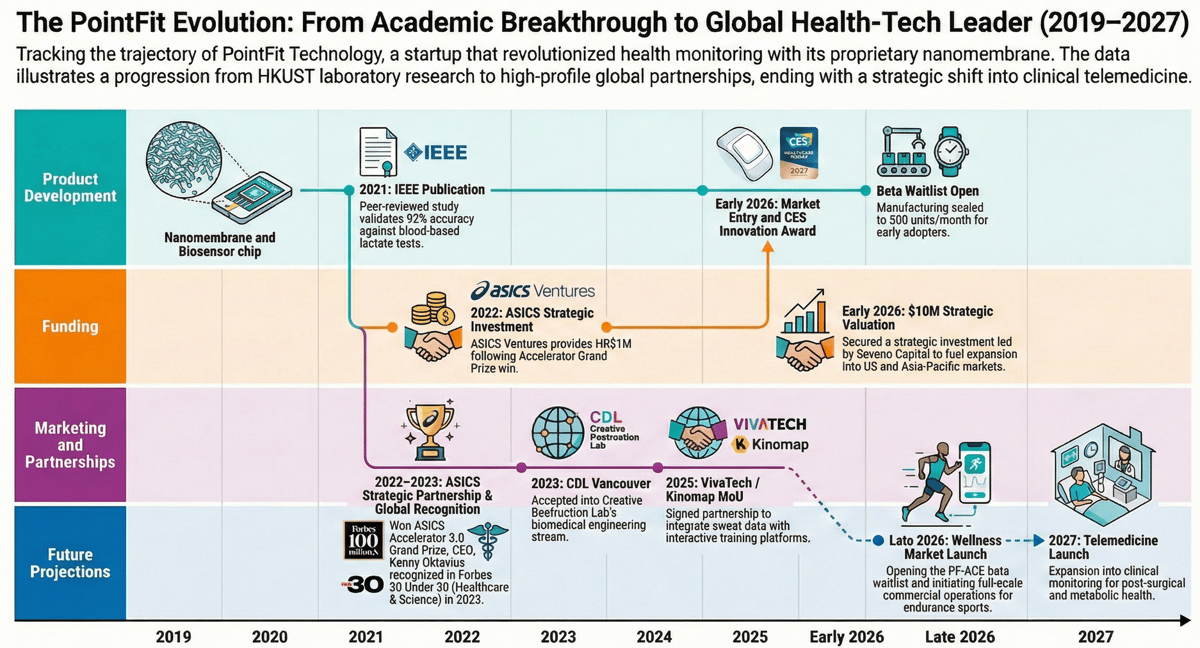
- 2019–2020: Technology originated as a master’s thesis in chemical engineering at HKUST. Company incorporated as Point Fit Technology Limited, Hong Kong.
- 2021: Peer-reviewed paper published in IEEE Sensors Journal. HKSTP Elevator Pitch Competition won.
- 2022: Grand Prize at ASICS Accelerator Program 3.0; approximately HK$1 million investment from ASICS Ventures Corporation. Listed in Forbes Asia 100 to Watch.
- 2023: Forbes 30 Under 30. Startup World Cup China Regional Championship won. Accepted into Creative Destruction Lab biomedical engineering stream, CDL-Vancouver cohort.
- January 2025: Exhibited at CES Las Vegas within the HKSTP pavilion. Coverage in TechCrunch.
- June 2025: VivaTech Paris — Memorandum of Understanding signed with Kinomap, the French indoor cycling training platform. Approach confirmed from a major European football club.
- January 2026: CES Innovation Award in Digital Health for the PF-Sweat Patch.
- February 2026: Seveno Capital leads a strategic investment valuing PointFit at $10 million. Targets Asia-Pacific, mainland China, and the Middle East. Total backers: HKUST Entrepreneurship Fund, ASICS Ventures, Hong Kong Trade Development Council, Creative Destruction Lab, Hong Kong Social Enterprise Challenge.
- 2026 (projected): Commercial wellness market launch. Beta production at 500 units per month.
- 2027 (projected): Telemedicine and clinical applications launch.
Competitive Position
The wearable sweat sensor market comprises tens of companies, most of which focus on hydration and electrolytes rather than lactate. No commercially available wearable currently offers continuous, non-invasive lactate monitoring. The nearest products are Nix Biosensors (US), measuring fluid and electrolyte loss via single-use patches at approximately $132, and Flow Bio (UK), a fully reusable device measuring sweat rate and sodium loss at £295 with Garmin and Wahoo integration — both independently validated, neither tracking lactate. Epicore Biosystems (US) measures lactate alongside hydration markers with its ECHO Smart Patch, but primarily operates in professional sport and occupational health. European start-up IDRO targets continuous sweat lactate monitoring for endurance sports, but has not reached commercial availability. Standard fitness wearables — Apple Watch, Garmin and equivalents — rely on optical and electrical sensors and are categorically unable to directly access biochemical data.
Take Out, Limitations and Outlook
This site has periodically written about the imminence of these next-gen sensors, which have seemed fairly close to market for several years. Other than hydration sensors, the hopes have so far failed to materialise. That now seems poised to change. However, the product prototype images, above, appear ‘fragile’, so scaling the practicalities and aesthetics of the design might take over a year, possibly two.
Next, we need to ask whether there is demand for lactate sensing. I’ll answer my own question and say that there is, but it is probably limited to high-level amateur endurance athletes, pro teams and sports labs. That limitation will inevitably lead the company toward medical-grade uses, which is where the money eventually leads.
If you’re waiting for anything like this to come from Garmin or Apple, I strongly suspect you’ll be infor a long wait.
The PF-Sweat Patch is currently in beta. Waitlist at pointfittech.com. Not evaluated by the FDA. Some capability details are drawn from company materials not independently verified.
This article is part of the site’s sports science reference for endurance athletes.
Last Updated on 3 October 2026 by tfk the5krunner
Small things I always use
- Garmin 90-degree charging adapter: Charges your Garmin from any USB-C cable. Essential when travelling. I use one.
- Body Glide: The blue anti-chafe stick swimmers and runners carry. I use it.
- Speedo earplugs: Fewer ear infections and no cold-water dizziness. I use them.
- Dryrobe Advance: My winter changing robe for open-water swims. I use one. A cheaper option is the AONYIYI changing robe.
- Maurten: Race fuel that stays easy on the stomach. I use them.
- Garmin charging puck: The quickest way to top up before a session. I use one.
- Injinji: Toe socks that stop rubbing, so you run more. I use them.
- Ultimate toe protectors: Stop black toenails on long runs. They work. I use them.
- Compressport R2 v2 calf sleeves: My calf sleeves of choice. I use them.
- Cellucor C4: My pre-workout before hard sessions.
- TPU tubes: Schwalbe Aerothan, Tubolito and Pirelli SmarTube. Light, tiny spares. I use all three.
- G8 insoles: Adjustable insoles that are good. I use them.
- Cycplus Cube: A 97g electric pump that gets a road tyre rideable in two minutes. I carry one. 5% off with code THE5KRUNNER.
Watches and sensors
- Polar H10: My daily driver for waking HRV.
- Polar Verity Sense: My backup arm-worn HR sensor.
- Nomad bedside charger: Charges my iPhone and Apple Watch overnight. I use it, and many of their bands.
- Train.Red: The best muscle oxygen sensor I’ve used.
- Tymewear: Accurate heart rate and reliable ventilatory zones. I use it to pace endurance rides over an hour.
- Garmin Forerunner 970: A pro-grade triathlon watch. I use this.
- Apple Watch Ultra 4: My daily smartwatch. No phone needed on rides.
- Garmin Fenix 9 Pro: I’ve just bought one.
On the bike
- Continental GP5000 for everyday riding, and Aero 111 on the front for special occasions.
- Helmets: Specialized S-Works Evade 3 for road riding, and Rudy Project Wing for TT-style races. I use both.
- Ravemen FR300: A front light that mounts under your Garmin or Wahoo. I use one.
- Wahoo TRACKR Radar: I use it on one bike and Varia on the other. They perform the same.
- Garmin Varia RTL515: Radar that warns you of cars from behind. I use this model.
- Wahoo ELEMNT Roam 3: The bike computer that’s easy to use. I use mine on most rides.
- Favero Assioma Pro RS2: Accurate power pedals that swap easily between bikes. I use this model.
Home and indoor training
- NPE Runn: Makes my basic treadmill smart, sending more accurate speed and distance to my watch and Zwift. I use it.
- Google Wifi: Keeps Zwift connected in my pain cave. I use it.
- Apple TV 4K: Zwift on the big screen. I use two.
- Google Nest Doorbell (wired, 2nd gen): My video doorbell, running in both Google Home and Apple Home. I use it.
Health, recovery and sleep
- FreeStyle Libre 3 Plus: Shows how my blood sugar responds to diet.
- hDrop: Measures my sweat loss in summer and indoors.
- Fourth Frontier Zone: Checks my heart under load in hard sessions.
- Oura Ring 5: My partner’s recovery tracker of choice.
- Kineon MOVE+: Red light therapy for niggles. It works.
- Eight Sleep: A cooling mattress cover my partner and I use nightly.
Reader-Powered Content

This content is not sponsored. It’s mostly me behind the labour of love, which is this site, and I appreciate everyone who supports it.
Support the site: Follow (free, fewer ads) · Subscribe (paid, ad-free) · Buy Me A Coffee ❤️
Written by real people, with AI assistance. Fact-checked and verified for originality. See the Editorial Policy. FTC: Affiliate Disclosure — some links pay commission. As an Amazon Associate, I earn from qualifying purchases.
tfk is the founder and author of the5krunner, an independent endurance sports technology publication. With 20 years of hands-on testing of GPS watches and wearables, and competing in triathlons at an international age-group level, tfk provides in-depth expert analysis of fitness technology for serious athletes and endurance sport competitors. ID

If we’re talking about non‑invasive lactate detection, there is (probably) a more advanced device available in Poland. The difference is that the sensor is worn inserted into special shorts. The company is called “Q‑Lac. Sport Science”, and what’s particularly important is that it already works in real time and is compatible with Garmin watches – live results, during traing. I’ve never tested it myself because it costs $400–500, but look interesing. Regards
I think sweat lactate testing will truthfully not revolutionize us in the way other people may hope. Lactate testing is already difficult logistically and hard to get a good sample without contamination. I think lactate testing has a role of course, but continuous monitoring is probably not the way. I hope I’m wrong. But we need to remember that lactate is just one surrogate marker of anaerobic metabolism. it’s not the holy grail people want it to be. If anything, for real time data, muscle oxygen via NIRS is probably a much more reliable model to show actual metabolism in real time. Lactate lags, which is something I think people often forget. It’s always been better as a spot check for that reason. In medicine, as a doctor, I absolutely see a huge use case here. We use lactate as a surrogate marker for septic shock. Same idea, different application. If the cells are in a perfusion or oxygenation deficit lactate will rise. We rely on spot checks here too. But seeing a rising lactate trend would allow early detection of shock. In sports medicine? I’m less confident it will be more useful than a spot check after a rep. The more you read about lactate threshold, the more you realize how many variations people use and how it’s not really a standardized measurement. And it has a large margin of error. Useful when you’re dialing in exact efforts, like Norwegian style training. Perhaps useful for trends during continuous runs. We shall see.
ty
i’m not sure sure about SmO2. it has its place but requires calibration and exact position for results from one usage to be applicable to the next. Also SmO2 (and even nitric oxide sensing https://the5krunner.com/2024/01/10/nnoxx-one-review-discount/) gives data that is harder to interpret for the average athelte than the simple zones of hr and power.
https://q-lac.pl/en/?wmc-currency=EUR that seems to be SmO2 not lactate. I’d not heard of it as Iuse train.red or moxy, ty for the heads up
I was just about to write about Q-LAC, but someone beat me to it. It’s clear that Poland has little clout and global notoriety. But the truth is, Q-LAC was the first to conduct large-scale scientific research. The company hired a research institute. However, they went a step further by linking muscle oxygen levels to lactic acid levels. Humon, before 2020, presented the results of analyses on the effectiveness of SMo2 sensors in determining LT2 relative to muscle oxygen levels and declines. And the results are consistent, with accuracy hovering above 99%. The situation is worse with LT1. Returning to Q-LAC, it’s an estimate, the same as VO2Max in the algorithms of Garmin, Coros, Suunto, Polar, and others. It’s based on estimation, because without a needle and a blood sample, there’s no other way to determine the concentration. However, I recommend speaking with the CEO of Q-LAC; he’ll tell you everything. Dariusz Nożyński, an eight-time Wings for Life winner and one of Poland’s best marathon runners, collaborates with the company. He demonstrates blood lactate measurements and compares them with the Q-LAC sensor. A Facebook group has also been created, but you need to speak some Polish to understand or use a translator. The CEO himself speaks perfect English, so you can easily communicate with him. The company isn’t huge, so asking to speak with him isn’t as difficult as asking for a Garmin CEO. He’s happy to answer questions. He’s also been interviewed. The sensor itself has a special leg or short that neutralizes artifacts, allowing for a better skin image than the competition. You can also watch an interview with the CEO on Bieganie.pl or YouTube. This topic has been ongoing for several years, and he’s undoubtedly the first and best candidate for perfecting non-invasive lactate measurement.
But it is still important to emphasize that this is an SMo2 sensor with the option of estimating the lactic acid level.
Hey,I have been using ONASPORT for almost 6 months now. It measures Real time lactate, sodium concentration, Dehydration and sweat rate. Honestly its an amazing product. The best thing is whenever I have any issues with the unit their Customer care is very quick to respond. i was able to generate Sweat report, Lactate thresholds and my day to day sweat profiling using their product. They seem to be working in Glucose as well and presenting their research in conferences etc.