My partner’s perfect bibtights and saddle combo for indoor training
Finding a kit that genuinely works for women on the turbo is harder than it looks.
After a mini bike fit (saddle fit!) plus some trial and error, my partner landed on a combination that solved it: the PRO Sirin Performance saddle paired with the Ale Clothing Winter Pragma Women’s Bib Tights. Here is why they work for her, and why the order in which you think about them matters.
The saddle myth is worth killing first.
Most women approach saddle shopping looking for something plush – padded, comfy, soft. It is an understandable instinct and almost always the wrong one. A saddle that is too soft compresses unevenly, shifts under load, and creates pressure in exactly the places it is trying to protect.
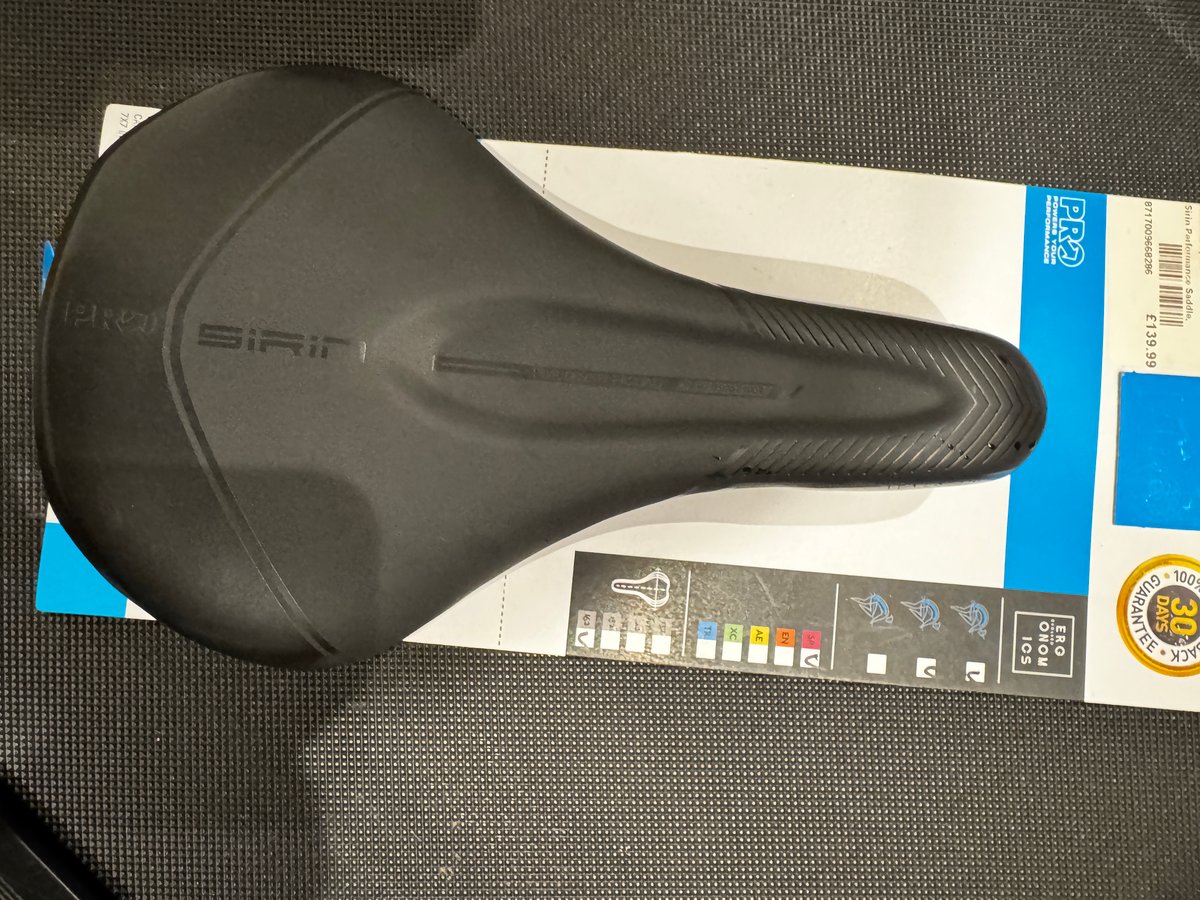
The correct approach is counterintuitive. A firmer saddle, correctly sized and positioned, should place load precisely on the sit bones — the two bony points at the base of the pelvis — and nowhere else. The sit bones are the only structures in the lower pelvis designed to bear weight. When the saddle is the wrong width, they cannot do their job. Load migrates inward onto the perineum or labia, and no amount of foam corrects that.
A well-designed cutout or central channel then removes any remaining soft-tissue contact. Get the width and cutout geometry right together, and the saddle becomes comfortable by eliminating the problem rather than padding over it. This applies equally to men and women.
One important distinction on discomfort: some sit-bone soreness when adapting to a new saddle is normal and temporary, particularly if you are moving from something plusher. Numbness, tingling, or burning is a different matter. Those are signs of soft-tissue compression and should prompt an immediate reassessment of saddle width, tilt, or fore-aft position — not patience.
Position matters as much as the saddle itself. A nose that tilts upward directs the load into the soft tissues and rotates the pelvis backwards, compounding the problem. Start level — zero degrees of tilt front to back — and make only micro-adjustments of one to two degrees nose-down if perineal pressure persists after that. Fore-aft position is equally important: a saddle set too far back causes the rider to slide toward the nose, loading soft tissue regardless of how well the saddle is designed. Most riders are not sitting where they think they are, and a professional fit often reveals the position was the problem all along.
The saddle: PRO Sirin Performance
The Sirin was developed in collaboration with a pelvic floor specialist, placing it in a different category from saddles that are simply narrowed or recoloured versions of men’s designs. The bridgeless cutout spans 32mm. The nose is 35mm wide — slim enough to avoid inner-thigh friction at higher cadences while still providing the anterior support a ‘proper’ road bike position demands. Dual-density EVA foam places firmer material under the sit bones and softer material at the margins. The carbon-reinforced base keeps the platform stable under load, and the stainless steel INOX rails resist corrosion and flex fatigue over years of use,e but probably no more or less different than any other rail.
Two widths are available: 152mm and 162mm. As a starting point, a sit-bone measurement of approximately 120 to 130mm typically corresponds to the 152mm saddle; 130mm and above tends toward the 162mm. The standard convention for a road or performance position seems to add 20-25mm to the raw sit-bone measurement. A forward pelvic rotation — which is what an aggressive riding position produces — brings the contact points slightly closer together than a static measurement suggests, which is why road saddles run narrower than you might expect. A proper sit-bone measurement, taken at a bike fit or using the cardboard-at-home method, is always a better starting point than guesswork.
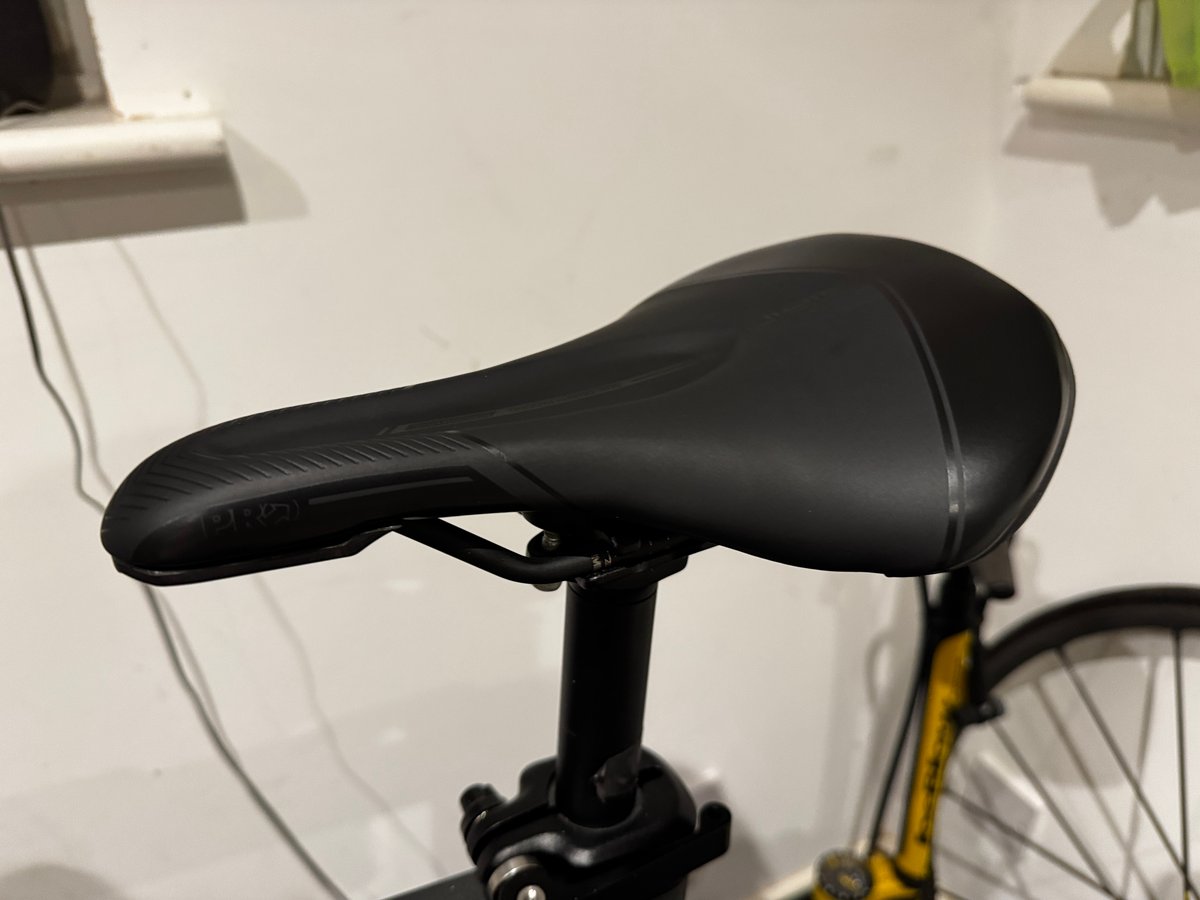
PRO Sirin Performance — specifications
- Width: 152mm or 162mm
- Weight: 205g (152mm) / 215g (162mm)
- Nose width: 35mm
- Cutout width: 32mm
- Base: Carbon-reinforced nylon
- Rails: INOX stainless steel
- Padding: Dual-density EVA
- Cover: Durable PU
- Shape: Anatomic Fit
- Price: £139.99
Available from Richmond Cycles.
The bibtights: Ale Clothing Winter Pragma Women’s Bibtights
The bib shorts or tight need to fit snugly — close enough that the pad maintains contact with the body through the full pedal stroke and does not shift or bunch. A moving pad is a chafing pad. That means sizing to the snug end of the range, not the comfortable-standing-up end. If you are between sizes, size up for length and reach; do not size up for the chamois.
More: Ironman Gregory Barnaby and Duathlon champion Giorgia Priarone sign with Ale
A new chamois feels better out of the box than it will at six months. The high-memory foam softens and compresses with use, and on the turbo — where sweat saturation and heat are constants, and your position never changes — that process accelerates. A quality pad lasts six months to two years, depending on frequency, duration, and how well it is cared for. Strictly follow the 30-degree machine-wash-and-line-dry guidance on the Pragma label, wash after every session, and the pad will perform well.
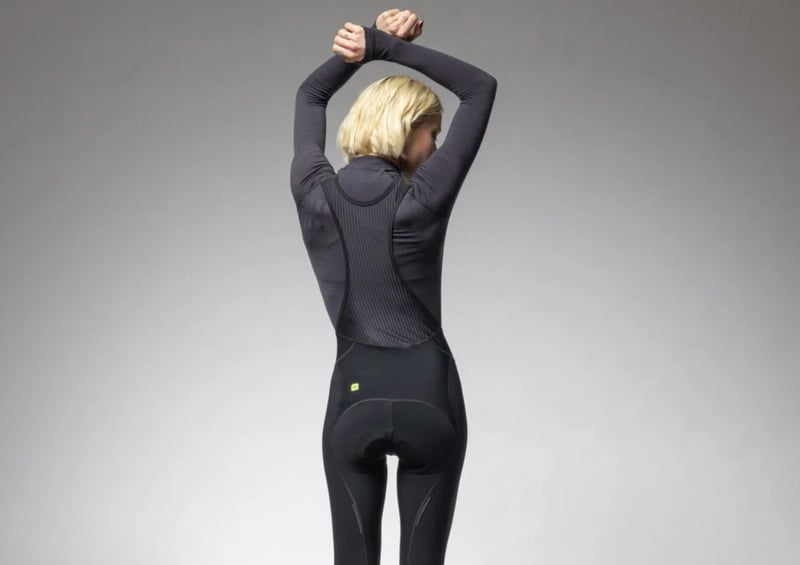
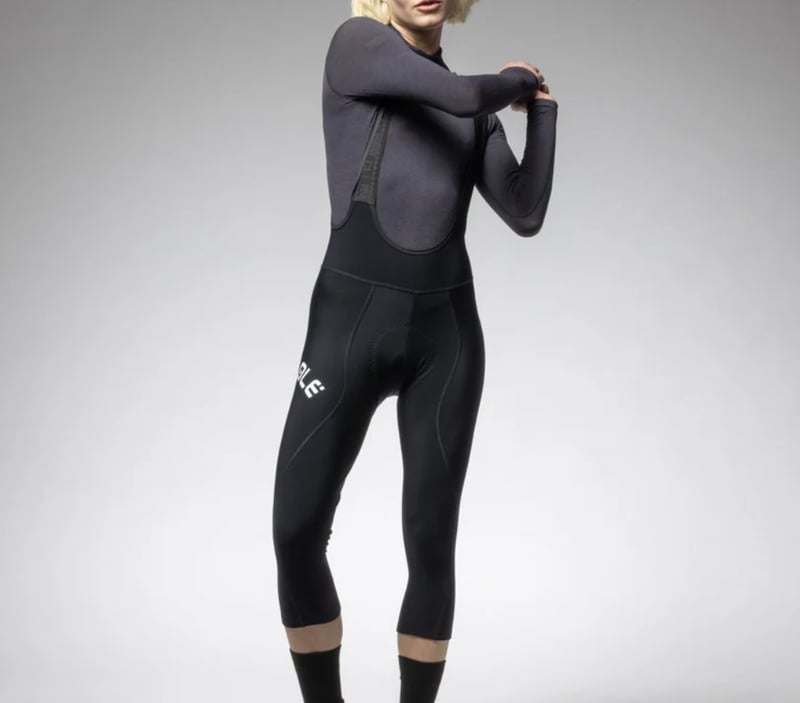
One more point on padding thickness: Thicker does not mean more comfortable. Foam that is too soft allows the sit bones to sink through it, which increases pressure on surrounding soft tissue — the same mechanism that makes a too-soft saddle counterproductive. The Pragma’s Comfort6W pad uses the correct approach: firmer support where the body’s structure can handle it, softer or absent elsewhere. The stretch microfibre fabric handles indoor heat reasonably well, and the structured crotch panel is cut to maintain saddle position through the pedal stroke rather than shifting with it. Rated for 5 to 12 degrees Celsius, it is well suited to a cool garage or pain cave, though once you get warmed up indoors,s those numbers become irrelevant.
Ale Clothing Winter Pragma Women’s Bib Tights — specifications
- Recommended temperature: 5 to 12 degrees Celsius
- Weight: 225g
- Main fabric: 86% polyamide, 14% elastane
- Pad: Comfort6W high-memory foam
- Care: Machine wash 30 degrees, line dry, no bleach, no tumble dry
- Sizes: XS to 2XL
- Price: £110 RRP
Latest bib tights available directly from ALE.
Why they work together
The saddle handles pressure relief at the source. The pad handles comfort at the interface. Between them, there should be nothing working against the rider. Indoors, the case for getting this right is stronger than outdoors: no road vibration, no position changes forced by terrain, and no distraction. Whatever is wrong becomes the only thing you notice.
Q: Did the combo work for my partner and me?
A: Yes.
- PRO Sirin Performance Verdict: My partner loves the saddle, finding it the comfiest ever. For me, it’s OK, and I can use it, but I prefer my Selle saddle tho. The PRO Sirin feels better to me than the Fiziik saddle that came with the KICKR BIKE Pro.
- ALE Pragma bibtights Verdict: My partner gives these a plush and comfy 9/10 for indoor use. Bibtights in general, for her score lowly on outdoor rides due to the inconvenience of undressing for loo stops.
It’s no guarantee that it will be right for you, of course, but the ALE tights and PRO SIRIN saddle are good places to start your research, and both are from trusted brands.
I also use the SIRIN saddle, as I can’t be bothered to swap it over to mine on the KICKR Bike PR, and it’s fine for a 2-hour indoor ride, though not optimal. My current favourite saddle is (I think it’s called) a Selle SLR or, as I call it, “The Harbinger of PBs“. For long outdoor rides over an hour, I only ever use quality cycling shorts, e.g. ASSOS, ALE and GORE WEAR, amongst others.
More: Ale
Last Updated on 27 March 2026 by the5krunner
Reader-Powered Content

This content is not sponsored. It’s mostly me behind the labour of love, which is this site, and I appreciate everyone who supports it.
Support the site: Follow (free, fewer ads) · Subscribe (paid, ad-free) · Buy Me A Coffee ❤️
All articles are written by real people, fact-checked, and verified for originality. See the Editorial Policy. FTC: Affiliate Disclosure — some links pay commission. As an Amazon Associate, I earn from qualifying purchases.
tfk is the founder and author of the5krunner, an independent endurance sports technology publication. With 20 years of hands-on testing of GPS watches and wearables, and competing in triathlons at an international age-group level, tfk provides in-depth expert analysis of fitness technology for serious athletes and endurance sport competitors.
