London Marathon 2027: Two Days, One Million Applicants
The London Marathon, already the world’s most popular road race, is planning its most ambitious transformation in 45 years. Organisers are in advanced talks to stage the 2027 edition across two days, doubling the field to 100,000 runners.
The numbers tell their own story. A record 1,133,813 people entered the public ballot for the 2026 race, a 36 per cent increase on the previous year and nearly treble the 410,000 who applied just three years earlier. With approximately 57,000 places available, the odds of securing a ballot entry have fallen to around 2 per cent. Against that backdrop, the case for expansion is straightforward. The challenge of delivering it is anything but.
More: TCS London Marathon 2026 – Race Day Guide
The Two-Day Plan
Referred to internally as the “Double London Marathon,” the proposal would split the mass participation field over the weekend of 24 and 25 April 2027, with 50,000 runners on Saturday and a further 50,000 on Sunday. The elite men’s and women’s races, currently staged on the same morning, would be separated across the two days, each retaining its own distinct identity and broadcast window.
The plans have not yet received formal approval. Organisers have confirmed, however, that stakeholder discussions are underway, whatever that means. A spokesperson for London Marathon Events said the organisation is “continually exploring innovative ways to enable more people to take part, while delivering positive benefits for London,” adding that the immediate focus remains on delivering the 2026 race on 26 April.
The Mayor of London’s office has also indicated support in principle. A spokesperson for Sadiq Khan said the Mayor “looks forward to working with London Marathon and partners to consider if it might be possible to host an event that will run across two days next year.”
Organisers currently view the two-day format as a one-off event rather than a permanent structural change, though the scale of demand makes it difficult to imagine the genie being put back in the bottle.
A Race in Numbers: Growth Since 2005
The table below illustrates the growth of the London Marathon from 2005 to 2025, including ballot applications, total finishers, and male and female breakdowns where data is publicly available. The organisers do not routinely publish a full gender breakdown in their official annual statistics; figures marked with an asterisk are drawn from third-party race data providers.
| Year | Ballot Applications | Total Finishers | Male Finishers | Female Finishers |
|---|---|---|---|---|
| 2005 | 132,000 | 35,300 | 24,690* | 10,571* |
| 2006 | 119,000 | 33,250 | 22,849* | 10,075* |
| 2007 | 128,000 | 35,729 | — | — |
| 2008 | 120,000 | 34,637 | — | — |
| 2009 | 155,000 | 35,404 | — | — |
| 2010 | 163,000 | 36,666 | — | — |
| 2011 | 163,926 | 34,872 | — | — |
| 2012 | 170,150 | 36,812 | — | — |
| 2013 | 167,449 | 34,381 | — | — |
| 2014 | 169,682 | 35,977 | — | — |
| 2015 | 172,888 | 37,793 | — | — |
| 2016 | 247,069 | 39,140 | — | — |
| 2017 | 253,930 | 39,487 | — | — |
| 2018 | 386,050 | 40,220 | 23,701* | 16,478* |
| 2019 | 414,168 | 42,549 | — | — |
| 2020† | 457,861 | 61 | — | — |
| 2021† | — | ~40,000 | — | — |
| 2022 | — | 40,000+ | — | — |
| 2023 | — | 43,965 | — | — |
| 2024 | 578,374 | ~53,000 | 31,018* | 22,829* |
| 2025 | 840,318 | 56,640 | ~31,350 | ~25,250 |
* Third-party race data from MarathonGuide and Race Insights. † The 2020 race was restricted to elite athletes only due to the COVID-19 pandemic. The 2021 and 2022 events were held in October due to the pandemic; applicant figures were not reported publicly for either year. The 2025 female figure is estimated from the reported proportion of approximately 49 per cent female finishers. London Marathon Events does not publish official gender breakdowns for all years.
The table illustrates the pace of change. Ballot applications barely moved between 2005 and 2015, hovering between 120,000 and 175,000. The surge began in 2016, when a new online entry system broadened access, and applications jumped to 247,000. By 2024, they had reached 578,000, and the 2025 figure of 840,318 shattered that record. The 2026 total of 1.13 million confirmed the trend as structural rather than cyclical.
The gender composition of the field has also shifted substantially. In 2005, women made up just 30 per cent of finishers. By 201,8 that proportion had risen to 41 per cent, and by 20,25 women accounted for approximately half the field, reflecting a broader transformation in mass participation running over two decades.
The Charitable and Financial Case
The financial argument for expansion is compelling. The 2025 event raised £87.3 million for charity across 56,640 finishers, making the London Marathon the world’s largest annual one-day fundraising event. Organisers believe a doubled field in 2027 could push that figure beyond £130 million, a sum that would represent a significant uplift for the hundreds of charities that depend on the race for a substantial portion of their annual income.
Hugh Brasher, chief executive of London Marathon Events, has framed the expansion in terms that go beyond the commercial. Invoking the race’s founding spirit, he pointed to the original aim of showing “happiness and a sense of achievement in a somewhat troubled world.” He suggested those words resonate as strongly today as they did when the first race was held in 1981.
The marathon is believed to generate £ 64 million in revenue for the capital; a 2-day event would likely exceed £100m. A number not to be sniffed at.
The Logistical Challenge
The operational complexity of a two-day event is considerable. Staging the marathon requires closing a 26.2-mile route through some of London’s most heavily trafficked areas, as well as coordination with Transport for London, the Metropolitan Police, multiple borough councils, and the emergency services. Extending that disruption across an entire weekend is a different proposition from a single Sunday closure.
The event’s registration and kit collection process presents its own difficulties. The ExCeL exhibition centre in East London, which already hosts a busy pre-race expo, would need to accommodate twice the number of runners over the course of the weekend. Several participants have noted that the expo is already stretched. As one regular runner commented: “There is no reason to force everyone to come to the expo. I had to spend hours travelling and hire extra childcare, all to pick up a bib that could have been posted to me.”
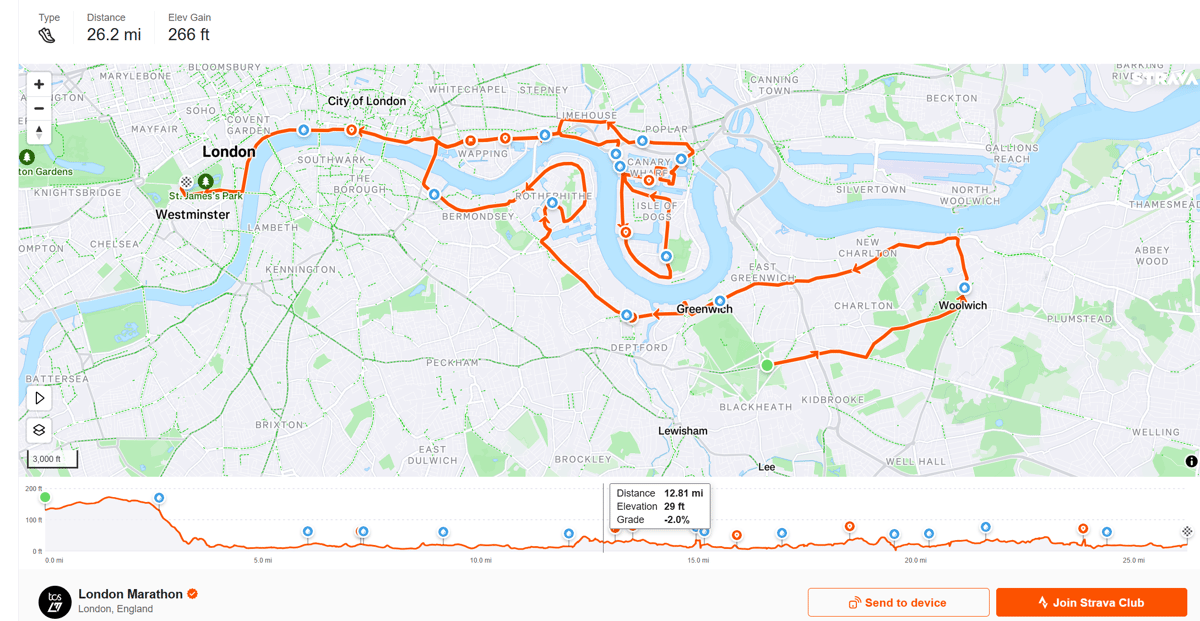
Residents along the route have raised concerns with particular force. Those living in Blackheath, Charlton, Limehouse and the Rotherhithe peninsula, where the course effectively encircles parts of the community, face road closures that restrict movement for significantly longer than the race itself, with barriers typically going up days before the start. The prospect of a two-day event has prompted sharp responses from some of those affected.
One Blackheath resident put the position plainly: “Closing off our SE London neighbourhood from the rest of the world for one day is acceptable, but keeping us effectively trapped in our houses for a whole weekend would most certainly not be.” A resident on the route in the Rotherhithe area echoed the concern, noting that the area’s main public transport road is closed for the duration and that the disruption extends well beyond race day itself, as barriers go up the week before. A Charlton resident noted that some streets leave people unable to leave the immediate area by any means of transport, and questioned whether extending that to a full weekend was reasonable.
The question of policing costs also surfaced. One observer noted that organisers might be less enthusiastic about a two-day event if they were required to meet the full cost of the police operation, rather than having that expense fall to the taxpayer.
The Case For
Supporters of the two-day format point to a simple equity argument: with more than a million people trying and only around 57,000 succeeding, the current system leaves the overwhelming majority of applicants empty-handed for reasons unrelated to their commitment or ability. Doubling the field is the most direct way of addressing that imbalance.
The charitable case reinforces the point. More runners means more fundraising, and the race has been the engine of charitable income for hundreds of organisations since it was founded. The prospect of raising more than £130 million in a single weekend carries significant weight at a time when many charities are under financial pressure.
Some readers proposed variants. One suggested staggered start times spread across the day as a less disruptive alternative to a full second day. Another called for priority to be given to first-time ballot entrants to reduce the advantage enjoyed by those who repeatedly enter through club or charity routes. A third argued that a one-off two-day event, framed as a celebration of the race’s 46th year, could serve as a statement of civic confidence without committing to a permanent structural change.
“I think this would be amazing. Unfortunately I haven’t been lucky enough to get a place yet, but fingers crossed! All those who say it’s just about the money — would you care to join me on a nice 18-mile training run to discuss this?” — BBC reader comment
The Case Against
Not everyone is persuaded that big financial incentives have distorted the event’s founding mission. Some feel the course is already overcrowded. One participant who ran last year on a charity place wrote that “the course felt too crowded at times compared to previous times I have run it,” and accused organisers of being too focused on records and numbers at the expense of the runner’s experience. Another, who described London as the least favourite of the six World Marathon Majors they had completed, pointed to the geographical spread of the start, finish, and expo as a structural weakness that a larger field would only intensify.
The commercial dimension has drawn criticism from multiple directions. Some pointed to the fees charged to charities for their race places as evidence that the event’s founding mission has been distorted by financial incentives. Others questioned the priority given to celebrity and influencer entries. A running club member noted that his club received just one place for the 2026 race, while entry remains straightforward for those willing to commit to large charity fundraising targets.
“It used to be a fun run, then the money stepped in and took the shine off it.”
The suggestion that the elite and mass participation fields might be split across different days has drawn mixed reactions. Some runners argue that a dedicated day for competitive entrants would restore something of the event’s original character. Others see any formal division as an uncomfortable signal about whose participation is considered more legitimate.
Does It Actually Improve Your Chances?
The honest answer is: a little. With 100,000 places set against more than 1.1 million applicants, ballot odds would improve from roughly 2 per cent to something approaching 9 per cent, assuming the applicant pool does not grow significantly in response to the expanded field. That is an improvement, but it still means the overwhelming majority of those who enter will be unsuccessful.
Other entry routes remain available. Good for Age entry is open to any runner, affiliated or otherwise, who can demonstrate a qualifying time from a recognised event. Club runners may secure places through affiliated athletics clubs, though allocations have been reduced in recent years. Charity places remain widely available, though participants typically commit to raising a minimum sum, and the fees involved can be considerable.
Several longstanding ballot applicants aired their frustration. One noted he had applied for 16 consecutive years without success. Another recalled that the old rule guaranteeing entry after five consecutive rejections was removed, leaving applicants with no clearer path in. A third offered a dryer verdict: “Does it mean I will receive two letters saying I wasn’t chosen in the ballot instead of just one, like the last 20 years?”
What Comes Next
Formal approval for the two-day format requires sign-off from the Mayor’s office, Transport for London, and the relevant borough councils. Organisers have said the focus for now is on the 2026 race, which takes place on 26 April. The ballot for the 2027 event is expected to open on race weekend.
What is clear is that the London Marathon’s success has created a problem of its own making. An event that set out to bring joy to the streets of the capital now struggles to accommodate the scale of its own ambition. Whether two days is the answer, or whether it simply doubles the spectacle while leaving the odds stubbornly long, may depend less on logistics than on what the race is ultimately for.
The 2026 TCS London Marathon takes place on Sunday, 26 April. The ballot for the 2027 event opens on race weekend.
Last Updated on 27 March 2026 by the5krunner
Reader-Powered Content

This content is not sponsored. It’s mostly me behind the labour of love, which is this site, and I appreciate everyone who supports it.
Support the site: Follow (free, fewer ads) · Subscribe (paid, ad-free) · Buy Me A Coffee ❤️
All articles are written by real people, fact-checked, and verified for originality. See the Editorial Policy. FTC: Affiliate Disclosure — some links pay commission. As an Amazon Associate, I earn from qualifying purchases.

tfk is the founder and author of the5krunner, an independent endurance sports technology publication. With 20 years of hands-on testing of GPS watches and wearables, and competing in triathlons at an international age-group level, tfk provides in-depth expert analysis of fitness technology for serious athletes and endurance sport competitors.
