Garmin patents seek 50cm GPS accuracy and improved battery life
In its ongoing quest to realise the 50cm accuracy potential of dual-band GNSS, Garmin has filed patents for a redesigned antenna that advances that goal while also freeing up internal space for a bigger battery and, for the first time, pointing toward genuinely global LTE compatibility. The underlying work dates to at least September 2024, and could realistically appear in the Fenix 9, expected later this year.
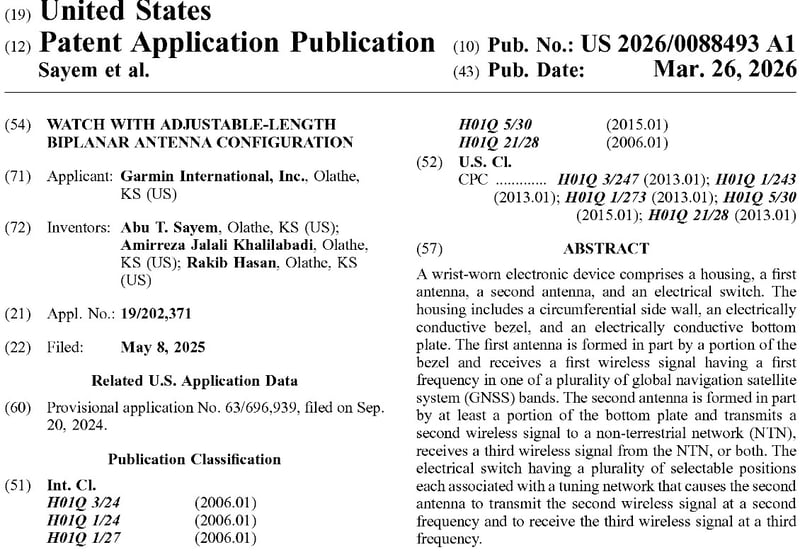
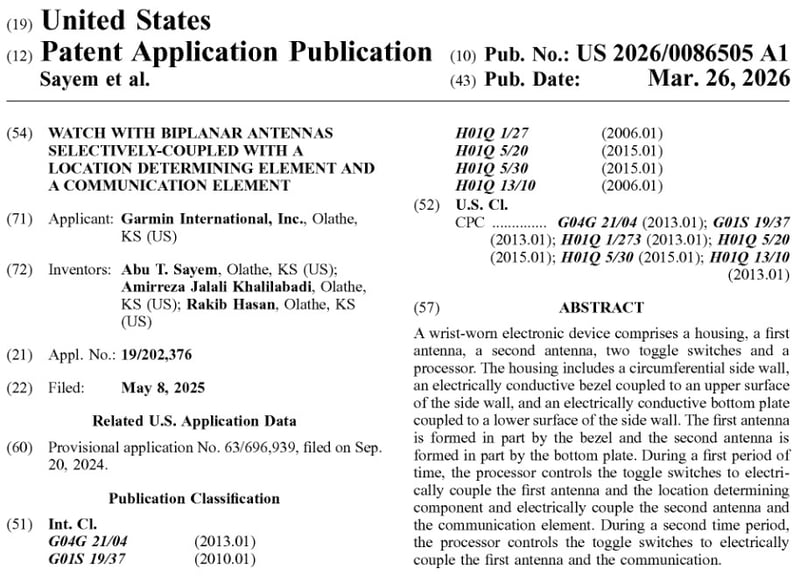
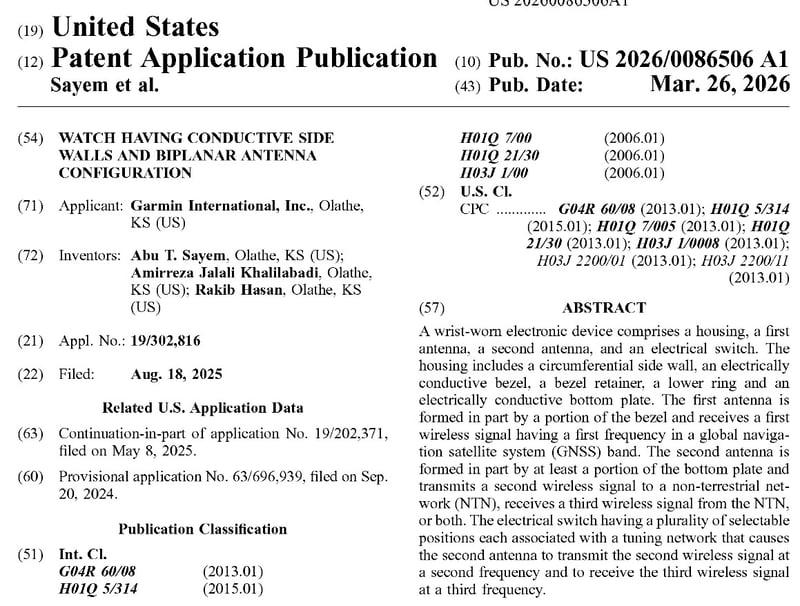
Garmin has filed patent applications for a new antenna architecture that promises to deliver more precise GPS positioning, a slimmer or longer-lasting watch, and cellular connectivity that works anywhere in the world, on both current networks and next-generation 5G networks. The three applications, US 20260086505, US 20260088493, and US 20260086506, were made public on 26 March 2026 and represent a radical rethink of how antennas are integrated into a smartwatch case, with implications that extend well beyond navigation accuracy.
Every smartwatch buyer faces the same four frustrations.
- Cellular connectivity stops working the moment you travel abroad, because your watch is tuned to the frequency bands used in the region where you bought it.
- Dual-band GPS watches deliver impressive accuracy, but genuine 50-centimetre precision is rarely, if ever, achieved by wearables.
- Smaller case formats in a manufacturer’s range cannot accommodate the antenna hardware required for the most capable connectivity features.
- And battery life, however much it improves with each new generation, is never quite enough.
Garmin’s new patent applications address all four directly.
Better GPS accuracy
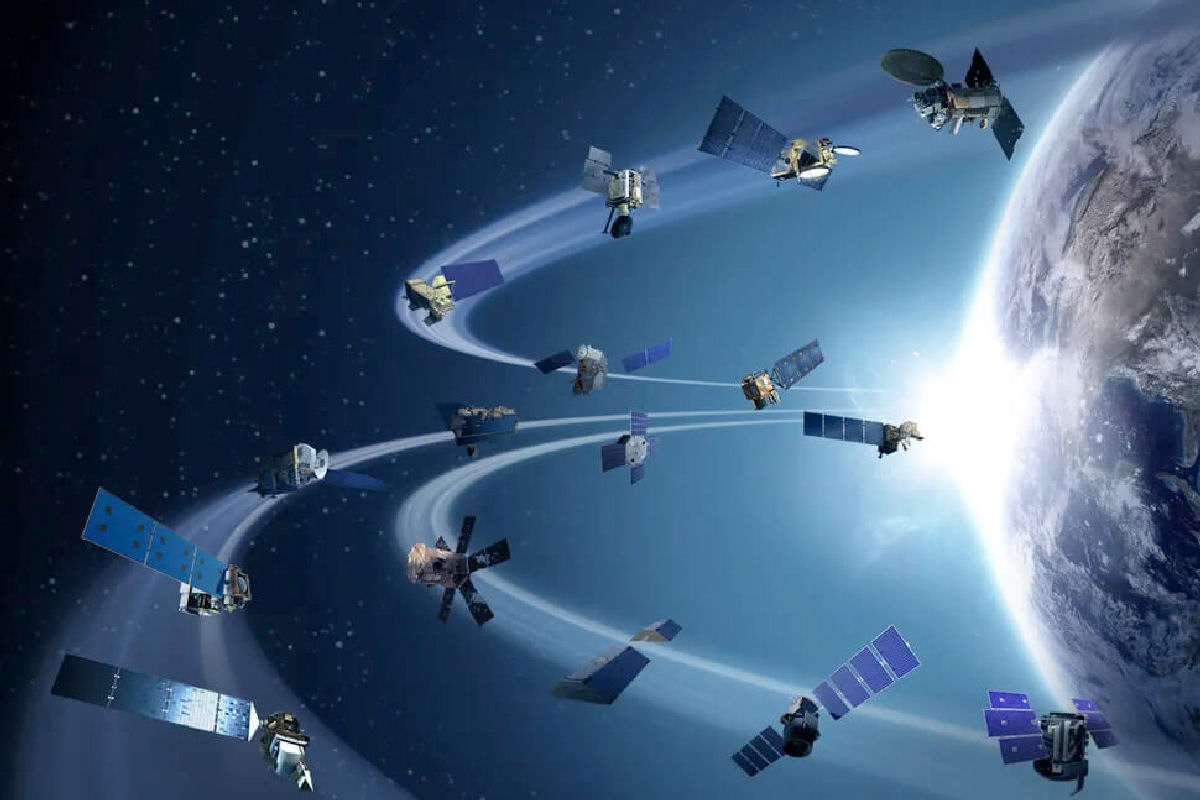
Garmin’s premium watches already receive GPS signals on both L1 and L5 bands, and dual-band (dual frequency) delivers significantly better real-world accuracy than single-band L1. But dual-band alone does not guarantee the sub-50 centimetre precision the industry is converging on. Antenna design is the variable that determines how much of the available signal quality a watch actually captures.
That distinction matters now. Our own testing of the Huawei Watch GT Runner 2, which uses a novel tri-frequency antenna architecture, found that GPS tracks, under many conditions, outperformed those from both Garmin and Apple on the same routes. DC Rainmaker found edge cases where the Huawei struggled, a useful reminder that no single test is definitive. Still, the broader point stands: better antenna engineering extracts better positioning from the same satellites. Garmin’s new architecture is its answer to that challenge.
Satellite connectivity, Garmin’s home turf
Satellite communication is where these patent applications do their most significant work, and where Garmin has most at stake with its inReach SOS service.
The antenna switching architecture described in the filings is designed as much for two-way satellite messaging as for terrestrial cellular. The bezel antenna, the same element that receives GPS signals on L1 and L5, can be redirected to handle NTN L-band satellite communications, the frequency range used by low-earth orbit satellite networks for two-way messaging. A switch determines in real time whether the antenna is serving GPS or satellite communication, toggling between the two based on a schedule, a signal-strength reading, or a manual override from the wearer.
This connectivity behaviour matters to Garmin more than to any other smartwatch maker. The company’s inReach satellite messaging platform, which enables two-way text messaging and SOS alerts from anywhere on Earth without cellular coverage, is its clearest point of differentiation in the adventure market.
The new patent applications suggest Garmin is working to deliver inReach-class satellite capability in a more compact and efficient form, potentially extending it further down its product range or to smaller case sizes that suit people with small wrists.
These capabilities promise consequential improvements for off-grid explorers.
A thinner case or a bigger battery
The central engineering insight in these patent applications is that the watch case itself becomes the antenna. The metal bezel on the front of the watch and the metal back plate form two separate antenna elements, stacked on different horizontal planes with the circuit board between them. No dedicated antenna components are required inside the case.
Every smartwatch today includes one or more discrete antenna structures alongside the battery, circuit board, sensors, and other components competing for space in a case designed to sit comfortably on a wrist. Removing that hardware frees up volume. That volume could be used to house a larger battery, extending the watch’s battery life. Alternatively, the changes could permit a thinner, lighter and more comfortable case.
The applications do not specify what Garmin intends, and no product dimensions have been announced. The savings may also help reduce manufacturing costs, which in turn leads to the next benefit.
Premium features beyond the Fenix range
Garmin’s product range runs from entry-level fitness trackers to the flagship Fenix series, with a significant price gap between them. Features that appear first on premium models, including satellite messaging, dual-band GPS, and now cellular connectivity, tend to take years to migrate down the range. If the new antenna architecture reduces the component cost of delivering these capabilities, that migration could happen more quickly. A buyer considering a mid-range Garmin watch in two or three years may find that it includes features currently available only on devices costing twice as much.
One important constraint: the architecture requires a metal bezel and back plate to function as an antenna. That limits how far down the range these benefits can travel. Plastic-cased entry-level watches cannot benefit, but mid-range metal-cased models are a realistic target.
One watch that works everywhere, now and in the future
Cellular networks use different frequency bands in different parts of the world. A watch built for North American networks will not connect to European ones, and vice versa. Garmin’s own Joe Heikes acknowledged this to DC Rainmaker, explaining that the physical constraints of fitting an LTE antenna into a watch case make it impossible to tune efficiently across all global frequency bands simultaneously. The result is that Garmin, like Apple, ships separate regional versions of its cellular watches. No single model works everywhere.
The new patent applications describe a switching system based on the detected GPS location. It identifies the regional frequency group corresponding to that location and automatically selects the correct antenna tuning. The wearer does nothing.
This matters more than it might appear, because the problem does not disappear as networks evolve. Apple moved its Apple Watch Ultra 3, Series 11, and SE 3 to 5G RedCap, the lightweight 5G standard designed specifically for wearables, in 2025. It is the first major smartwatch maker to do so. Yet Apple’s own carrier pages confirm that two regional SKUs are still required, because 5G RedCap inherits the same band fragmentation as LTE.
If Garmin brings a watch to market built on this architecture, it could point toward a future where a single device operates on cellular networks globally.
A note on what these patent applications are not
Provisionally filed in 2024, US 20260086505, US 20260088493, and US 20260086506 remain patent applications, not granted patents or product announcements. Garmin has not announced a watch built on this architecture, and there is no guarantee that any of the benefits described here will appear in a specific product on a specific timeline. The space savings inside the case have not been quantified, and the 50-centimetre accuracy figure, while the established industry benchmark for dual-band GNSS, does not appear in the applications themselves.
Readers considering a purchase should treat this as a signal of where Garmin’s engineering is heading, not as a specification for a watch they can buy today. That said, new components take about 3 years to make their way into real watches so work in early 2024 could materialise as soon as Fenix 9 this year.
What this means for your next watch
The lure of greater GPS accuracy and longer battery life in a Fenix 9 is compelling, as would be the same benefits in a 43mm or 47mm case. For Garmin’s core off-grid audience, thinner cases and global cellular roaming may matter less than those two fundamentals.
But perhaps the more interesting story is one we have only touched on. The Forerunner 970 is a mid-sized watch with a metal case. An antenna architecture like this one could, in principle, bring satellite messaging and dual-band accuracy to models like that, entirely outside the Fenix range. That would be a meaningful shift in what a running watch can do.
Last Updated on 28 March 2026 by the5krunner
Reader-Powered Content

This content is not sponsored. It’s mostly me behind the labour of love, which is this site, and I appreciate everyone who supports it.
Support the site: Follow (free, fewer ads) · Subscribe (paid, ad-free) · Buy Me A Coffee ❤️
All articles are written by real people, fact-checked, and verified for originality. See the Editorial Policy. FTC: Affiliate Disclosure — some links pay commission. As an Amazon Associate, I earn from qualifying purchases.
tfk is the founder and author of the5krunner, an independent endurance sports technology publication. With 20 years of hands-on testing of GPS watches and wearables, and competing in triathlons at an international age-group level, tfk provides in-depth expert analysis of fitness technology for serious athletes and endurance sport competitors.
