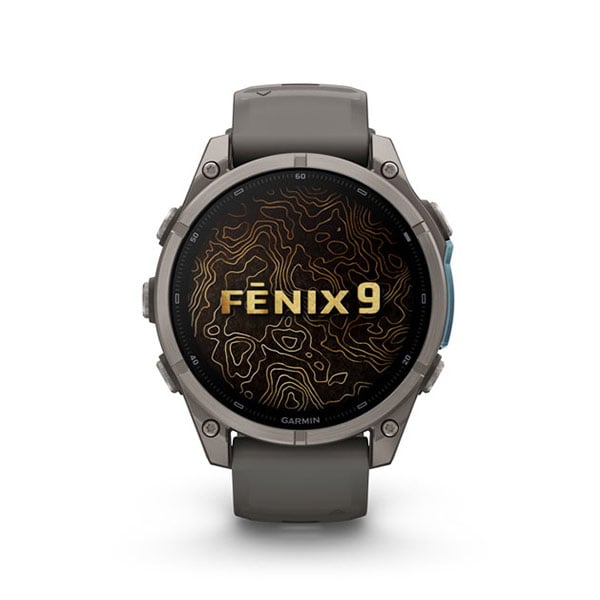
 Garmin Fenix 9: Everything We Know and Expect
The outdoor product tease for Garmin’s confirmed livestream for Tuesday, 25 August at 1:00 PM CET was followed by what looks to be a genuine retailer leak. Czech online store SkiAndBike listed 18 Fenix 9 configurations, first spotted by Fitness Tracker Test, but pulled soon after.
More: Huge Fenix 9 Image Leak (All Genuine, sourced here from garmin.com)
How our original predictions are holding up
Back in March 2026, before any regulatory filings existed, this site rated a set of likely Fenix 9 features by probability. The SKU leak confirms some of those calls, contradicts others, and leaves plenty still open:
| Topic | Current prediction |
|---|---|
| Display Tech | Expect a 1.5″ display on the 51mm case model (leaked)
Expect AMOLED screens with even better visibility in all light conditions and for lower power consumption. Don’t expect microLED. Chances: 90%. LTPO AMOLED, as used on AWU3, would cut always-on power draw, but LTPO needs an improved display driver and SoC. Garmin’s current NXP i.MX RT595 from Fenix 7 days won’t support that. |
| GNSS Connectivity | Tri-band GNSS is coming to Garmin. If not this year, then next year on the Fenix 10. Chances: 80% this year, 95% in 2027. |
| Processor Upgrade | Garmin’s current NXP i MX RT595 MCU-class chip is not powerful enough to drive the display smoothly. Competitors have far faster-rendering map screens that move more fluidly. As a map and navigation company, Garmin has to improve here. Chances: 80%. |
| Battery Upgrade | There is probably a slightly better battery available somewhere that Garmin can use. However, any boost to overall battery life will inevitably come from more efficient and smaller components that consume less power and free up space for a physically larger battery. These are what will drive better battery life, not any new magical battery chemistry. Chances: 90%. |
| AI Features | Fenix 9 will likely have no AI features on the watch itself. It may be able to connect to the rather limited AI features in any future expansion of Garmin Connect+ (subscription version). However, the latest NXP chip does have limited AI capabilities, and these may be included. Chances: 10% (not on the watch). |
| Solar AMOLED Option | Garmin has patents for this (2022), but I do not expect them to materialise any time soon. Chances: 10%. Expect a more solar-efficient MIP option instead. |
| Elevate Gen 5 | We might see a new Elevate Gen 6 optical HR array appear on another device before the Fenix. Expect improved accuracy claims, blood pressure trend capabilities, and deeper arrhythmia detection. Chances: 10%.
Resolved: images show the same LED configuration as Elevate Gen 5, no Elevate Gen 6. No blood pressure trend capability expected this generation. |
| LTE, 5G RedCap, WiFi and Bluetooth | Do not expect new strategic capabilities here like true cellular calling. Garmin has already made its call with improved 4G LTE-M and satellite connectivity on the Fenix 8 Pro. The need for both call parties to use the Garmin Messenger app for communication somewhat ties the company’s hands, so expect features to remain safety-focused rather than convenience-focused. Chances: 20%. |
| Wireless Charging | Wireless charging is not expected on the Fenix 9. Garmin might add it to other models, but not here. The charger stays. Chances: 10%. |
| New Sports Sensors | Products are now coming to market that can sense lactate and hydration via sweat in near real time. The technology is too immature to appear on a Fenix 9. Perhaps in the next Elevate generation. |
| Ventilatory Threshold | The Fenix 9 might be the first to support new ventilatory threshold (VT) features derived from the HRM 600, though this type of pro-sports feature would better suit a new Forerunner. Chances: 30%. |
| Will there be a Fenix 9 Pro? | Pro and Pro inReach tiers are catalogued alongside the standard Fenix 9 for 2026 |
| Pricing | I don’t expect too many changes to Fenix 9 pricing in the USA. Garmin has already tested out higher prices for Fenix 8 microLED and reversed them. Expect the base AMOLED model to open near $999 / £879 and the Pro variant to sit in the $1,199 range. |
Update: we’ve corrected the base model’s product numbers below. An earlier version of this post used 010-04671 through 010-04673, based on an inconsistency in a source article that has since been cleaned up. The correct numbers are 010-04761 through 010-04763.
The listings are split into four tiers by product number, consistent across sizes:
| Model | Size | Product no. |
|---|---|---|
| Fenix 9 AMOLED | 43mm | 010-04761 |
| Fenix 9 AMOLED | 47mm | 010-04762 |
| Fenix 9 AMOLED | 51mm | 010-04763 |
| Fenix 9 Pro AMOLED (no inReach) | 43mm | 010-04335 |
| Fenix 9 Pro AMOLED (no inReach) | 47mm | 010-04336 |
| Fenix 9 Pro AMOLED (no inReach) | 51mm | 010-04337 |
| Fenix 9 Pro AMOLED inReach | 43mm, 47mm, 51mm | 010-04335 / 010-04336 / 010-04337 (shared with the non-inReach Pro; inReach is a trim on the same SKU family) |
| Fenix 9 Pro MIP-Solar inReach | 47mm | 010-04338 |
| Fenix 9 Pro MIP-Solar inReach | 51mm | 010-04339 |
The retailer’s own labelling was inconsistent between Pro and Pro inReach at points, which is why the same product number families cover both; the inReach radio appears to be a trim level within the Pro tier rather than a separate product number.
![garmin-fenix-9-skiandbikecz[1]](https://the5krunner.com/wp-content/uploads/2026/08/garmin-fenix-9-skiandbikecz1.jpg)
Pricing, converted from Czech koruna at roughly 21 Kč to the dollar and including Czech VAT, ran from about $1,170 for the 43mm base AMOLED to about $1,570 for the 51mm Pro AMOLED inReach in carbon. These are not US MSRP figures, but if they hold any signal, they point to another price increase at the flagship tier.
Neither Enduro 4 nor Fenix E2 appear on the retailer. Fitness Tracker Test points out that SkiAndBike still lists the outgoing Enduro 3, which raises the possibility that Tuesday’s event covers the Fenix 9 range alone, with Enduro 4 and Fenix E2 following separately. The current Fenix 8, Fenix 8 Pro and Enduro 3 lineup is on sale at the time of writing, a typical sign of inventory clearance ahead of a flagship launch.
A follow-up piece matched colour and finish to each SKU: Bare Titanium Fog Gray and Gold Titanium at 43mm, Carbon DLC Black and Titanium Autumn Orange/Spark among the 47mm and 51mm options, plus a Titanium Pebble Gray/Silver Gray finish exclusive to both Pro Solar inReach sizes. Only some listings carried “Pro” in the title for the inReach AMOLED tier despite sharing the same product number family, which looks like inconsistent listing copy rather than a missing model.
None of the 18 SKUs say anything about new sensors or features, which is the bigger question for anyone deciding whether to upgrade rather than case size or colour. This site’s standing feature speculation has an Elevate Gen 6 sensor as the most likely differentiator, closing Garmin’s gap against Whoop, Apple and Samsung on blood pressure trends and better passive ECG. Garmin is also expected to follow Fenix 9 with a MARQ Gen 3 built on the same platform, but not on Tuesday, that launch typically comes weeks after the volume Fenix model.
Quick answers
How many Fenix 9 models are there?
At least four confirmed product-number tiers: a base Fenix 9 AMOLED, a Fenix 9 Pro AMOLED, a Fenix 9 Pro AMOLED inReach, and a Fenix 9 Pro MIP-Solar inReach.
Does the Fenix 9 come in a 43mm size?
Yes. The base AMOLED and the Pro/inReach AMOLED tiers both include a 43mm option. MIP-Solar stays exclusive to 47mm and 51mm.
Is the Fenix 9 Pro launching alongside the standard Fenix 9?
Yes, according to leaked retailer SKUs, contradicting an earlier filing-based estimate that placed the Pro on a separate 2027 timeline.
Last Updated on 25 August 2026 by the5krunner
My favourite kit and nutrition
- Garmin Fenix 9 Pro — I’ve just bought one.
- Injinji – Runners protect your toes. Avoid discomfort and minor injury. Run more. Run faster. I use them.
- Garmin 90-degree charging adapter — A small keyring adapter you can use anywhere. Essential when away. I use one.
- Garmin charging puck — the fastest and most reliable way to top up your Garmin before a session. I use one.
- Ravemen FR300 — Front light that mounts directly under your Garmin or Wahoo head unit. Keeps your bars clean and your beam pointed where it matters. I use one.
- Body Glide – The blue anti-chafe stick that all swimmers and many runners use. I use it.
- Maurten — The race nutrition trusted by elite athletes. Gels and drink mixes engineered to be easy on the stomach. I use them.
- Garmin Varia RTL515 — A radar rear light that alerts you to vehicles approaching from behind. Pairs with your Edge or Wahoo. I use this model.
- Favero Assioma Pro RS2 — The power-meter pedals most serious cyclists choose. Accurate, easy to move between bikes. I use this model.
- Garmin Forerunner 970 — A serious choice for a pro-grade triathlon watch. I use this.
- Polar H10 — My daily driver for accurate, waking HRV readings.
- Wahoo ELEMNT Roam 3 — The bike computer that has the feature Garmin lacks: usability. I use mine on most rides.
Reader-Powered Content

This content is not sponsored. It’s mostly me behind the labour of love, which is this site, and I appreciate everyone who supports it.
Support the site: Follow (free, fewer ads) · Subscribe (paid, ad-free) · Buy Me A Coffee ❤️
All articles are written by real people, fact-checked, and verified for originality. See the Editorial Policy. FTC: Affiliate Disclosure — some links pay commission. As an Amazon Associate, I earn from qualifying purchases.
tfk is the founder and author of the5krunner, an independent endurance sports technology publication. With 20 years of hands-on testing of GPS watches and wearables, and competing in triathlons at an international age-group level, tfk provides in-depth expert analysis of fitness technology for serious athletes and endurance sport competitors. ID

No 43mm MIP really really sucks. Those of us with smaller wrists were hoping they’d get it together for this release.
Wonder what the sell rate of MIP devices still is compared to AMOLED. I used to be a true believer in the MIP devices, but the AMOLED devices have gotten so good, I’d take AMOLED in pretty much any situation, even in the bright desert sun here in AZ. Unless battery life is critical for multi-day activities, I can’t imagine choosing MIP over AMOLED now.
Agree, AMOLED looks very good but I also like the always on MIP display being glance-able, no need for a wrist gesture unless in a darkened environment needing the back light.
I don’t care. Even if they sold in 10:1 proportions, Garmin shouldn’t leave their loyal fanbase without anything to choose from. And it seems they’re doing just that.
First time I’m considering a 43 mm version. Got a 47 mm for the last ten years. If they get a 1.4 inch screen and around 12 mm thick would be a no brainer for me. Don’t need the inreach tech, it’s not that good yet for coverage sadly. Good times for Fenix lovers are coming this week 🤟🏾
No enduro 4? :/
MIP only with pro version ? No need in-reach for me : I live in a country there is no coverage and no garmin messenger. Sad I have to pay for the useless upgrade of in-reach. Hope will see a no-pro version MIP of the F9.
Well this is exactly what I worried about, when the first amoled version got out…
Once they get it right, they just forget about anything else, because people like shiny things.
I get it, maps are more usable on amoled, you can display gradients, but let’s be real: was it necessary really to leave no options left for those who prefer a less in-the-face (and more eye and battery friendly) option, want to go high-end with maps and don’t want to wear a brick for a watch??
But I go further: with the instinct still being crippled by unnecessary restrictions (no music, no hill score, no endurance score, old HR sensor, don’t even talk about maps), you basically have no normal sized MIP option with even mid-level features…
I sure hope they will make a smaller Enduro, or at least an Instinct Pro, because even after all this I don’t want to change to other brand
(Coros nomad looks like a good option, but still lacking compared to Garmin and I don’t see them implement NFC payment any time soon)
I hope that the CPU speed will increase, wireless charging, smaller bezel on the 51mm for a bigger screen.
Is there a hint in the new picture here?
https://www.garmin.com/da-DK/
Seems likely they will use the newer version of the CPU they use now:
https://www.nxp.com/company/about-nxp/smarter-world-videos/IMXRT700-SMARTWATCH-DEMO-VID
If so they will have AI on the watch, mostly for marketing as the AI isn’t that powerful. LLM and other high power AI features will still need to run in the cloud which I’m guessing means Connect+ as Garmin will need to pay for higher server use that LLMs use.
Elevate 6- historically it seems like fenix isn’t on the bleeding edge of new sensors and was hoping the cirqa would collect more info then existing watches as a sign of what was coming but that didn’t happen. Garmin may have lots of pressure to update the sensor this time around to add more functionality
An NPU of the power on the RT700 can be used for voice to text, better “noise” cancellation from the OHR sensor and even things like real time real time form analysis and recommendations mid exercise.
So whilst it’s not running a LLM that can answer your spoken questions about the Venezuelan legal system on a run, it’ll still be able to do plenty of useful things.
The downside of cirqa not having Elevate 6 is that it’s going to already be outdated, only weeks after its release, as soon as something with Elevate 6 comes out.
But the upsode of Fenix 9 not having Elevate 6 is that now Cirqa will have the current generation sensor for at least a little bit longer.
Personally I suspect that Elevate 6 isn’t ready for the mainstream yet; if it was then we’d have probably seen it on Cirqa. And if it wasn’t ready for Cirqa then I doubt it’s ready for Fenix 9 either. I’d bet the first watch we see it on is the next Venu or Forerunner 9XX, and then eventually Fenix 9+.
official pictures and specifications: https://www.garmin.com.tw/products/intosports/fenix-9-pro-47-orange/
https://www.youtube.com/watch?v=6SJeJWzRRPY
ty!!!
taken down. i missed seeing that one unfortunately 🙁
The word “Enduro” seemed to be merged with/into the keyword “Pro Solar”.
So there will be no Enduro 4. Not know, not in 3 months.