Suunto Core 2: A Garmin Fenix With a 2-Year Battery? It might even be 5 years.
Suunto is bringing the Core back. Expect Garmin Fenix capability (ABC, weather, maps, durable materials) but this time on a single replaceable battery.
A new model, the Suunto Core 2, has now appeared in an FCC filing (model: OW245) with limited but enlightening details beyond the re-emergence of the old 2007 model’s name.
- Stainless steel case marking
- 100 m water resistance
- Bluetooth Low Energy
- CR3032 lithium battery
It’s no exaggeration to say that the battery choice has the potential to reframe the outdoor watch category.
A Two-Decade Hardware Template
For two decades, the modern outdoor watch has broadly converged towards a single hardware template. Rechargeable lithium-ion battery. Multi-band GNSS. Optical heart rate. AMOLED or transflective colour display. Bluetooth, WiFi, music, and payments. Garmin’s Fenix line is the reference design, and Suunto’s own Vertical, Race 2, and Run watches sit on the same template, distinguished only by materials, features, and price. Battery life across the category ranges from days to low weeks, and a proprietary charging cable is standard kit on every multi-day trip…just in case.
The Core 2 filing walks away from this. The watch carries a replaceable battery.
This appeared at the same time as a second Suunto product, the SHRM2 heart rate sensor. Full analysis of that filing: Suunto SHRM2 heart rate monitor, a new Whoop competitor?
Why a Replaceable Battery Works in 2026
The battery choice is realistic in 2026 because every aspect of the internal tech has changed. Low-power Bluetooth chipsets, OHR sensors and reflective displays have all moved to standby power requirements far below the 2007 baseline. Whether Suunto has built the Core 2 to take full advantage of that headroom will be confirmed when the watch ships, of course.
Nevertheless, based on some offline calculations I ran, the CR3032 has the energy budget for a runtime measured in years rather than weeks.
CR3032, Not CR2032
The battery warrants a close look.
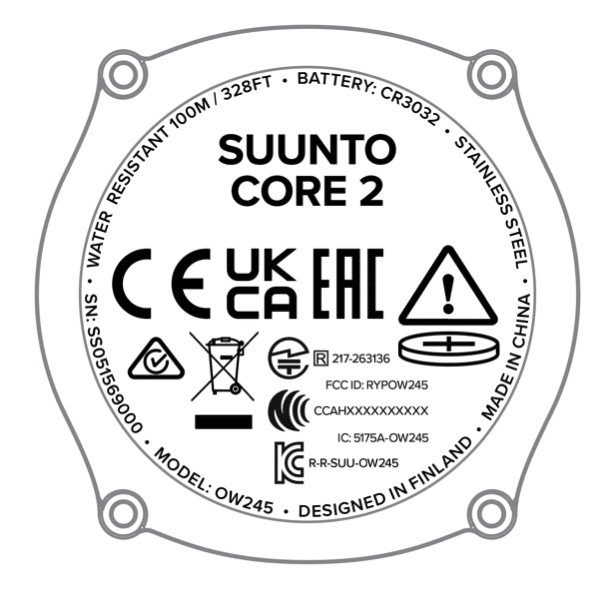
The label specifies a CR3032, not a CR2032. Look again, the two numbers are easy to visually confuse. A CR2032 holds roughly 220-240 mAh. A CR3032 shares the same 3 V lithium chemistry and the same 3.2 mm thickness, but is significantly larger in diameter, at 30 mm versus 20 mm. The resulting extra volume increases capacity from roughly 220 mAh in the CR2032 to 500 mAh in the CR3032, more than twice the energy.
CR3032 batteries are less common in consumer electronics these days, used in a small number of medical devices and industrial sensors, but rarely in watches.
Alternative approaches to long battery life are covered in the watch battery life hub.
What the FCC Filing Confirms
- Brand and product name on the label: Suunto Core 2
- Model number: OW245
- FCC ID: RYPOW245, filed under Suunto Oy, Finland
- IC: 5175A-OW245
- KC: R-R-SUU-OW245
- Japan MIC: R 217-263136
- Battery: CR3032 lithium, user-replaceable. Note: CR3032, not CR2032
- Water resistance: 100 m / 328 ft
- Material reference: stainless steel
- Wireless: Bluetooth Low Energy, 2402 to 2480 MHz
- Country of manufacture: China. Designed in Finland
- Conformity marks: FCC, IC, CE, UKCA, EAC, KC, RCM (Australia), Telec (Japan), WEEE
- Confidentiality on documents: runs to September 2026
Update, 10 June 2026: Second Certification Trail in Indonesia
A second certification database has now listed OW245. The Indonesian e-Sertifikasi system records a certificate dated 4 June 2026 under certificate number 122484/DJID/2026, listing Suunto as the brand, OW245 as the model, “SUUNTO OW245” as the marketing name, and Outdoor Watch as the device category. The applicant is PT Indo Arloji Perkasa, and the country of origin is listed as China.
No additional hardware details come with the listing. The value is procedural. A product with one certification can stall in development. A product moving through additional regional approvals is being readied for sale. The September 2026 confidentiality window for the FCC documents continues to align with the intended launch timing.
The Fenix Comparison
A Garmin Fenix sets the benchmark for what a modern outdoor watch delivers. Multi-band GNSS, mapping, training load, optical heart rate, music, payments and an AMOLED option, with battery life on the order of two to three weeks in smartwatch mode and a charging cable required at every multi-day stop. The Core 2 looks set to land in the same capability bracket as the Vertical and Race in the modern Suunto line, rather than below them.
The differentiator is the battery footing, i.e., a modern outdoor watch that runs for years on a single replaceable battery, versus rechargeables that need a cable every fortnight; this is a category move that nothing in the Fenix range can match.
A Full-Circle Decision
The full-circle nature of this battery decision elevates Core 2 beyond a simple new-product filing. Industry effort has gone into squeezing more days out of rechargeable batteries. Suunto appears to have solved the problem from the other end. Rather than charging the watch more often or fitting a bigger lithium-ion pack, the company has paired modern outdoor-watch electronics with a replaceable battery and let efficient silicon do the work. The judgment on whether that delivers in practice will have to wait until review units are available, but I can see no reason why Suunto will let us down.
Confidentiality on the FCC documents runs to September 2026, which typically aligns with a planned market release.
For the price and where to buy, see Suunto Core 2 price and where to buy.
Frequently Asked Questions
What is the Suunto Core 2?
The Suunto Core 2 is a new outdoor watch from Suunto that has appeared in an FCC filing under model number OW245. It is the successor to the original Suunto Core, which has been in continuous production since 2007, with the Core, Core Alpha, and Core Alpha Stealth variants. Suunto has not yet officially announced the watch.
When will the Suunto Core 2 be released?
Suunto has not confirmed a release date. The confidentiality period on the FCC documents runs to September 2026, which typically aligns with a planned market launch. An autumn 2026 release is the most likely window. A second certification trail on the Indonesian e-Sertifikasi system, dated 4 June 2026, suggests the device is progressing through regional approvals on schedule.
Is Suunto launching anything else alongside the Core 2?
A second Suunto product, the SHRM2, has surfaced in firmware references and regulatory filings. The most plausible interpretation is an arm-worn optical heart rate band, putting Suunto into the Whoop and Polar Verity Sense category for the first time. The SHRM2 and Core 2 timelines appear close enough to suggest a coordinated launch. Full analysis of the SHRM2 filing is here.
What battery does the Suunto Core 2 use?
The Suunto Core 2 uses a CR3032 lithium battery according to the FCC filing. The battery is user-replaceable. Note that this is a CR3032, not the more common CR2032. The CR3032 is significantly larger than a CR2032, sharing the same 3.2 mm thickness but with a 30 mm diameter, compared to the CR2032’s 20 mm. It holds roughly 500 mAh, more than twice the energy of a CR2032.
How long will the Suunto Core 2 battery last?
Suunto has not published a runtime figure. The CR3032 has the energy budget for a runtime measured in years rather than weeks. The actual figure will depend on how aggressively Suunto wakes the Bluetooth radio, sensor duty cycle and backlight use.
Will the Suunto Core 2 have GPS?
The FCC filing does not reference any GNSS or GPS receiver; it covers radio interfaces only and does not exhaust the watch’s feature set. Modern low-power GNSS chipsets are compatible with coin-cell power budgets when used in short bursts rather than continuous tracking. Suunto has not confirmed the GPS position either way.
Will the Suunto Core 2 have wrist heart rate?
The FCC filing does not address optical heart rate. Modern OHR sensors operate at duty cycles that are compatible with multi-year battery life on a CR3032. Suunto has not confirmed the position.
Is the Suunto Core 2 waterproof?
The Suunto Core 2 is rated to 100 m of water resistance according to the FCC label. This is a meaningful upgrade on the 30 m rating of the existing Core line. A 100 m rating is suitable for swimming and surface watersports.
Will the Suunto Core 2 work with the Suunto app?
The FCC filing confirms a Bluetooth Low Energy radio, which makes app pairing the most likely use case. Suunto has not detailed app functionality. Settings sync, firmware updates, and log export are the typical functions added when an outdoor watch first gains Bluetooth connectivity.
Where is the Suunto Core 2 made?
The FCC label states Made in China and Designed in Finland. The filing itself is held under Suunto Oy in Finland (FCC ID RYPOW245). The Indonesian certification, processed by PT Indo Arloji Perkasa, also lists China as the country of origin.
How does the Suunto Core 2 compare to a Garmin Fenix?
The Suunto Core 2 appears positioned in the same capability bracket as a Garmin Fenix in modern outdoor watch terms, alongside the Suunto Vertical and Race rather than below them. The differentiator is the battery. A modern feature set on a replaceable battery rated in years against the Fenix’s rechargeable cycle of two to three weeks. Final feature-by-feature comparisons will have to wait for the official specification.
Where can I buy a CR3032 battery?
CR3032 batteries are available from major electronics retailers, watch parts suppliers and online marketplaces. They are less common than CR2032 batteries because they are mainly used in medical devices and industrial sensors. Brands include Panasonic, Renata and Maxell.
For the complete Garmin Fenix series guide, covering all current models, history and buying advice: Garmin Fenix guide.
Last Updated on 3 October 2026 by tfk the5krunner
Small things I always use
- Garmin 90-degree charging adapter: Charges your Garmin from any USB-C cable. Essential when travelling. I use one.
- Body Glide: The blue anti-chafe stick swimmers and runners carry. I use it.
- Speedo earplugs: Fewer ear infections and no cold-water dizziness. I use them.
- Dryrobe Advance: My winter changing robe for open-water swims. I use one. A cheaper option is the AONYIYI changing robe.
- Maurten: Race fuel that stays easy on the stomach. I use them.
- Beet It Sport nitrate shots: Beetroot shots I take in the days before a race. I use them.
- Garmin charging puck: The quickest way to top up before a session. I use one.
- Injinji: Toe socks that stop rubbing, so you run more. I use them.
- Ultimate toe protectors: Stop black toenails on long runs. They work. I use them.
- Compressport R2 v2 calf sleeves: My calf sleeves of choice. I use them.
- Cellucor C4: My pre-workout before hard sessions.
- TPU tubes: Schwalbe Aerothan, Tubolito and Pirelli SmarTube. Light, tiny spares. I use all three.
- G8 insoles: Adjustable insoles that are good. I use them.
- Cycplus Cube: A 97g electric pump that gets a road tyre rideable in two minutes. I carry one. 5% off with code THE5KRUNNER.
Watches and sensors
- Polar H10: My daily driver for waking HRV.
- Polar Verity Sense: My backup arm-worn HR sensor.
- Nomad bedside charger: Charges my iPhone and Apple Watch overnight. I use it, and many of their bands.
- Train.Red: The best muscle oxygen sensor I’ve used.
- Tymewear: Accurate heart rate and reliable ventilatory zones. I use it to pace endurance rides over an hour.
- Garmin Forerunner 970: A pro-grade triathlon watch. I use this.
- Apple Watch Ultra 4: My daily smartwatch. No phone needed on rides.
- Garmin Fenix 9 Pro: I’ve just bought one.
On the bike
- Continental GP5000 for everyday riding, and Aero 111 on the front for special occasions.
- Helmets: Specialized S-Works Evade 3 for road riding, and Rudy Project Wing for TT-style races. I use both.
- Ravemen FR300: A front light that mounts under your Garmin or Wahoo. I use one.
- Wahoo TRACKR Radar: I use it on one bike and Varia on the other. They perform the same.
- Garmin Varia RTL515: Radar that warns you of cars from behind. I use this model.
- Wahoo ELEMNT Roam 3: The bike computer that’s easy to use. I use mine on most rides.
- Favero Assioma Pro RS2: Accurate power pedals that swap easily between bikes. I use this model.
Home and indoor training
- NPE Runn: Makes my basic treadmill smart, sending more accurate speed and distance to my watch and Zwift. I use it.
- Google Wifi: Keeps Zwift connected in my pain cave. I use it.
- Apple TV 4K: Zwift on the big screen. I use two.
- Google Nest Doorbell (wired, 2nd gen): My video doorbell, running in both Google Home and Apple Home. I use it.
Health, recovery and sleep
- FreeStyle Libre 3 Plus: Shows how my blood sugar responds to diet.
- hDrop: Measures my sweat loss in summer and indoors.
- Fourth Frontier Zone: Checks my heart under load in hard sessions.
- Oura Ring 5: My partner’s recovery tracker of choice.
- Eight Sleep: A cooling mattress cover my partner and I use nightly.
Reader-Powered Content

This content is not sponsored. It’s mostly me behind the labour of love, which is this site, and I appreciate everyone who supports it.
Support the site: Follow (free, fewer ads) · Subscribe (paid, ad-free) · Buy Me A Coffee
Written by real people, with AI assistance. Fact-checked and verified for originality. See the Editorial Policy. FTC: Affiliate Disclosure — some links pay commission. As an Amazon Associate, I earn from qualifying purchases.
tfk is the founder and author of the5krunner, an independent endurance sports technology publication. With 20 years of hands-on testing of GPS watches and wearables, and competing in triathlons at an international age-group level, tfk provides in-depth expert analysis of fitness technology for serious athletes and endurance sport competitors. See the gear tfk uses. ID

I still have my Core, I’ve had it since day one, back in 2007 or thereabouts: it’s never given me any trouble and it still works a treat. I’m pleased to see its successor… we’ll have to wait and see.
I would be happy if it is a normal core but maybe some added features like step tracking, or connected GPS (if that is possible with coin battery) that you could let the phone run GPS through the Suunto app but let the watch start/stop the workout. That would be awesome but not sure if that is a possibility. Funny thing is, a month or so ago I posted on Reddit asking for a Core update with some more modern features like some bluetooth connectivity.
G-Shock offers a couple of watches with a replacable battery and BT connectivity. So this wouldn’t be anything groundbreaking. I used to own several Vectors, the predecessor of the Core, and a few Cores back in the day. I remember they (Core) all had display issues and I had them shipped to Suunto to get them fixed, but that worked surprisingly well and Suunto paid for the shipping. But other then that, they were pretty affordable, cool and reliable 20 years ago. Good to see Suunto is doing more, good stuff.
Yes I went through some of the G-Shocks to check on battery life. Agreed it’s not super groundbreakingas this sort of thing was done decades ago!
I wouldn’t class the Casios as fully competitive. Whereas if Core 2 were something like a vertical with a different batter then that is groundbreaking (at least in my eyes!)
>Whereas if Core 2 were something like a vertical with a different batter then that is groundbreaking (at least in my eyes!)
Yep, that’s what I hope
The battery makes this a fail for me. Whilst it would be good to see some feature updates. The thing that made the core so good and indeed most traditional watches, is the easy user replaceable battery. I have devices with obscure batteries and after the first battery swap I’ve stopped using them. It’s just to hard and too annoying to have to try to source the battery. Especially in something like a watch you want it quickly replaceable the same day it dies.
This is the best news of the year for me! I asked Suunto last year to upgrade the Core Alpha watch—at least in terms of materials. It suits me almost 100 percent. But I’m not thrilled about the planned Bluetooth integration. In my opinion, it’s unnecessary in the real outdoor or military world. It’s just a waste of signal transmitter . But I’m really looking forward to it!