The two-hour barrier was broken twice today.
In record-legal conditions at the London Marathon, Sabastian Sawe of Kenya crossed the line in 1:59:30, 65 seconds inside Kelvin Kiptum’s world record.
Yomif Kejelcha of Ethiopia followed in 1:59:41 on his marathon debut. Jacob Kiplimo of Uganda took third in 2:00:28, also under the previous world record. Sawe and Kejelcha both wore the Adidas Adizero Adios Pro Evo 3, launched three days before the race. Kiplimo wore another supershoe, the Nike Alphafly 4 prototype.
So begins the new generation of endurance running tech.
What happens next
London 2026 was warm. Late April in central London delivered conditions several degrees above the optimum for marathon performance, which at elite pace costs roughly two to three seconds per kilometre. The 1:59:30 mark was set despite that. Berlin, in late September, on the flattest course in the major marathon calendar, is the next obvious target. Eight of the ten men’s marathon world records before Kelvin Kiptum’s Chicago run were set there. The same Adidas Adizero Adios Pro Evo 3, on the Berlin course in cool autumn air, invites a faster time.
Nike will respond. Kiplimo’s 2:00:28 in third place was set in a prototype Alphafly 4, and Nike effectively created the modern supershoe category with the Vaporfly 4% in 2017. Watching Adidas take the first race-legal sub-2 will not sit comfortably in Beaverton. A consumer Nike racer under 100 grams is the obvious counter, and the deadline is Berlin.
The technology will not stay in the marathon. The same supercritical foams and stiffening elements have already lowered the half-marathon, 10K, and the 5,000m and 10,000m track records. Ruth Chepngetich’s women’s marathon record of 2:09:56, set in Chicago in October 2024, is the next mark most exposed to the new generation of shoes.
How the tech gains accumulate
Three effects compound to produce the modern supershoe. To varying degrees, all are relevant to any distance runner.
- Mass. Lower shoe weight reduces the metabolic cost of swinging the foot through each stride. Published research suggests roughly a 1 per cent gain in running economy per 100 grams removed. This is NOT the same as you carrying a tiny amount less weight; the saving is linked to a swinging weight.
- Foam. Modern supercritical foams, including PEBA, TPEE and TPU compounds, return more elastic energy than the EVA midsoles they replaced. A thicker, softer stack returns more energy per footstrike. Adidas Lightstrike Pro Evo, the foam in the Pro Evo 3, is TPEE-based.
- Plate. A stiff carbon element, whether plate, rods or perimeter rim, restricts metatarsophalangeal joint flexion (now you know), lengthens the effective foot lever and smooths the rollover at toe-off.
The combination, capped at 40mm of stack, has shaved seconds off the world record in each generation. These culminated in today’s amazing times.
The complete sub-two-hour list
Only three people have ever gone under 2 hours for the marathon distance. Everyone was set in a carbon-plated supershoe.
- Eliud Kipchoge, 1:59:40.2. INEOS 1:59 Challenge, Vienna, 12 October 2019. Nike Alphafly prototype. Paced by 41 rotating elites and a lead vehicle, not eligible for ratification.
- Sabastian Sawe, 1:59:30. London Marathon, 26 April 2026. Adidas Adizero Adios Pro Evo 3. The first sub-two-hour mark was set in race conditions.
- Yomif Kejelcha, 1:59:41. London Marathon, 26 April 2026. Adidas Adizero Adios Pro Evo 3. Marathon debut.
No other runner has gone under two hours. Kipchoge’s Monza Breaking2 attempt in 2017 stopped at 2:00:25, and Kiptum’s Chicago world record of October 2023 stood at 2:00:35.
The Adidas Adizero Adios Pro Evo 3
Let’s dive into the tech details of the Evo 3.
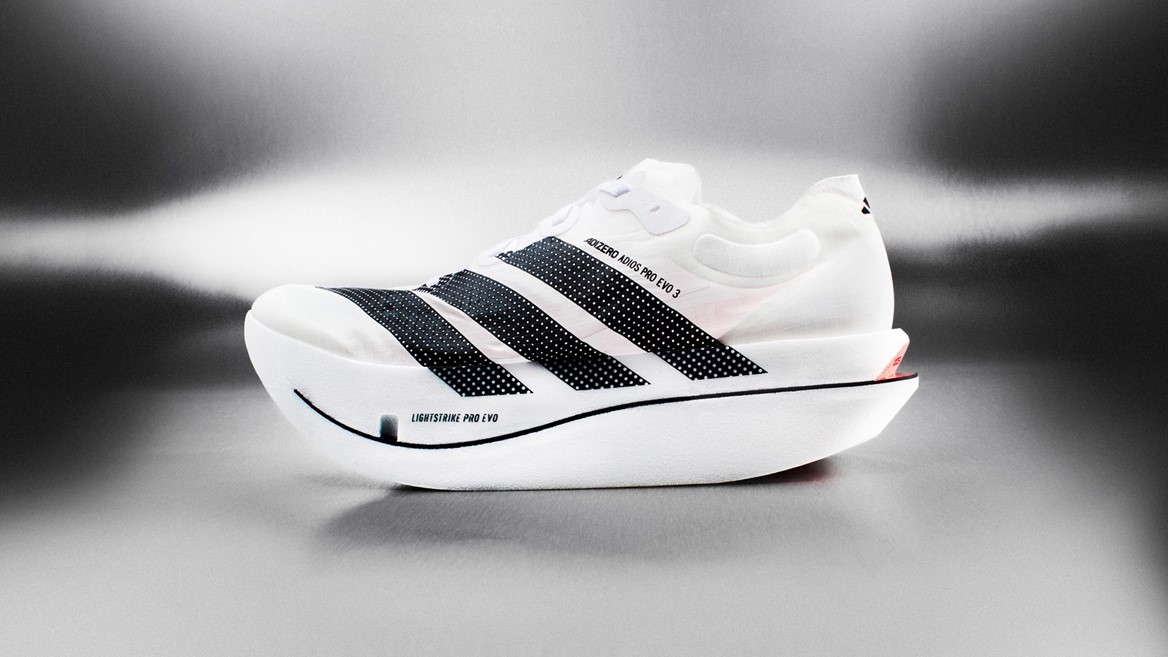
The shoe used by Sawe and Kejelcha is the first carbon-plated marathon racer to weigh under 100 grams.
- Weight: 97 grams in a men’s UK 8.5, around 30 per cent lighter than the Pro Evo 2 (I have a pair – they are fast!)
- Stack: 39mm at the heel, 36mm at the forefoot, 1mm under the World Athletics legal ceiling of 40mm.
- Foam: a new generation of Lightstrike Pro Evo, claimed to be 50 per cent lighter than the version used in the Pro Evo 2.
- Stiffening: ENERGYRIM, a carbon-fibre frame around the outer edge of the midsole rather than under the foot. Lighter than a full plate, allowing the foam to compress directly beneath the foot, while the perimeter rim provides propulsion.
- Outsole: Continental rubber on the forefoot.
- Adidas claims: 1.6 per cent better running economy than the Pro Evo 2, 11 per cent more forefoot energy return.
- Price: $500!
What this means for amateur runners
Normally, I would be cautious about new tech and say something like, “For mere mortals, there is no need to get excited.” However, there is no need to be cautious here; these shoes and similar supershoes will make any runner faster, at least faster than a regular GBP/USD 100 pair you might currently use. Almost anyone reading this article WILL knock off about 30 seconds from their 5K PB… maybe more if you are typically a slower runner.
That said, the carbon element delivers most of its benefit at an elite pace, where ground contact is brief and toe-off mechanics dominate the stride.
The foam delivers benefit at every pace. For a runner targeting a four-hour or five-hour marathon finish, much of the running-economy gain comes from the foam rather than the plate. Opinion: a shoe with a modern supercritical foam and no carbon may capture most of what matters at a fraction of the cost.
One caveat. High-stack soft-foam shoes without a stiffening plate can feel less stable, particularly for runners prone to ankle problems or on uneven surfaces. Take a cautious first outing before committing to one for race day.
Regular runners on a budget: look for a supercritical foam such as PEBA, TPEE or TPU. Brand language varies.
Quick answers
What shoes did the sub-2 marathon runners wear at London 2026?
Sabastian Sawe and Yomif Kejelcha both wore the Adidas Adizero Adios Pro Evo 3, the first carbon-plated marathon racer under 100 grams. Jacob Kiplimo, third in 2:00:28, wore a Nike Alphafly 4 prototype.
How many sub-2-hour marathons have ever been run?
Three. Eliud Kipchoge ran 1:59:40.2 at the INEOS 1:59 Challenge in Vienna in October 2019, but that was a paced exhibition and not eligible for ratification. Sabastian Sawe ran 1:59:30 at London 2026, and Yomif Kejelcha ran 1:59:41 in the same race. They are the only sub-two-hour performances on record.
Will the London 2026 marathon record fall again?
Probably yes, and possibly soon. London 2026 was run in warm conditions that cost roughly two to three seconds per kilometre at elite pace. Berlin in September, on the fastest course in the major marathon calendar, is the obvious next target for the same shoe in cooler air.
Will Nike release a sub-100-gram racer to match the Adidas Pro Evo 3?
Almost certainly. Nike created the supershoe category with the Vaporfly 4% in 2017 and is unlikely to let a competitor break the first race-legal sub-2 mark. The Alphafly 4 prototype worn by Jacob Kiplimo at London is the platform on which a consumer answer is most likely to be built. Berlin in September is the deadline that matters.
Do amateur runners need a carbon-plated supershoe to gain from this technology?
The carbon element delivers most of its benefits at an elite pace. For a runner targeting a four-hour or five-hour marathon, the bigger contribution comes from a modern supercritical foam (PEBA, TPEE or TPU), now available in shoes priced well below the $500 of the Pro Evo 3. A supercritical-foam shoe without a carbon plate may capture most of what matters at a fraction of the cost. High-stack soft-foam shoes without a plate can feel less stable, so a cautious first outing is sensible before race day.
Last Updated on 3 October 2026 by tfk the5krunner
Small things I always use
- Garmin 90-degree charging adapter: Charges your Garmin from any USB-C cable. Essential when travelling. I use one.
- Body Glide: The blue anti-chafe stick swimmers and runners carry. I use it.
- Speedo earplugs: Fewer ear infections and no cold-water dizziness. I use them.
- Dryrobe Advance: My winter changing robe for open-water swims. I use one. A cheaper option is the AONYIYI changing robe.
- Maurten: Race fuel that stays easy on the stomach. I use them.
- Beet It Sport nitrate shots: Beetroot shots I take in the days before a race. I use them.
- Garmin charging puck: The quickest way to top up before a session. I use one.
- Injinji: Toe socks that stop rubbing, so you run more. I use them.
- Ultimate toe protectors: Stop black toenails on long runs. They work. I use them.
- Compressport R2 v2 calf sleeves: My calf sleeves of choice. I use them.
- Cellucor C4: My pre-workout before hard sessions.
- TPU tubes: Schwalbe Aerothan, Tubolito and Pirelli SmarTube. Light, tiny spares. I use all three.
- G8 insoles: Adjustable insoles that are good. I use them.
- Cycplus Cube: A 97g electric pump that gets a road tyre rideable in two minutes. I carry one. 5% off with code THE5KRUNNER.
Watches and sensors
- Polar H10: My daily driver for waking HRV.
- Polar Verity Sense: My backup arm-worn HR sensor.
- Nomad bedside charger: Charges my iPhone and Apple Watch overnight. I use it, and many of their bands.
- Train.Red: The best muscle oxygen sensor I’ve used.
- Tymewear: Accurate heart rate and reliable ventilatory zones. I use it to pace endurance rides over an hour.
- Garmin Forerunner 970: A pro-grade triathlon watch. I use this.
- Apple Watch Ultra 4: My daily smartwatch. No phone needed on rides.
- Garmin Fenix 9 Pro: I’ve just bought one.
On the bike
- Continental GP5000 for everyday riding, and Aero 111 on the front for special occasions.
- Helmets: Specialized S-Works Evade 3 for road riding, and Rudy Project Wing for TT-style races. I use both.
- Ravemen FR300: A front light that mounts under your Garmin or Wahoo. I use one.
- Wahoo TRACKR Radar: I use it on one bike and Varia on the other. They perform the same.
- Garmin Varia RTL515: Radar that warns you of cars from behind. I use this model.
- Wahoo ELEMNT Roam 3: The bike computer that’s easy to use. I use mine on most rides.
- Favero Assioma Pro RS2: Accurate power pedals that swap easily between bikes. I use this model.
Home and indoor training
- NPE Runn: Makes my basic treadmill smart, sending more accurate speed and distance to my watch and Zwift. I use it.
- Google Wifi: Keeps Zwift connected in my pain cave. I use it.
- Apple TV 4K: Zwift on the big screen. I use two.
- Google Nest Doorbell (wired, 2nd gen): My video doorbell, running in both Google Home and Apple Home. I use it.
Health, recovery and sleep
- FreeStyle Libre 3 Plus: Shows how my blood sugar responds to diet.
- hDrop: Measures my sweat loss in summer and indoors.
- Fourth Frontier Zone: Checks my heart under load in hard sessions.
- Oura Ring 5: My partner’s recovery tracker of choice.
- Eight Sleep: A cooling mattress cover my partner and I use nightly.
Reader-Powered Content

This content is not sponsored. It’s mostly me behind the labour of love, which is this site, and I appreciate everyone who supports it.
Support the site: Follow (free, fewer ads) · Subscribe (paid, ad-free) · Buy Me A Coffee
Written by real people, with AI assistance. Fact-checked and verified for originality. See the Editorial Policy. FTC: Affiliate Disclosure — some links pay commission. As an Amazon Associate, I earn from qualifying purchases.
tfk is the founder and author of the5krunner, an independent endurance sports technology publication. With 20 years of hands-on testing of GPS watches and wearables, and competing in triathlons at an international age-group level, tfk provides in-depth expert analysis of fitness technology for serious athletes and endurance sport competitors. See the gear tfk uses. ID

I think you probably know this but while Nike ZoomX started the super shoe midsole race with supercritical Pebax (PEBA from Arkema), adidas uses TPEE as the basis for Lightstrike Pro and Lightstrike Pro Evo. Puma nitro was originally TPEE and has evolved to aTPU. All three of those chemistries are used in different supercritical foaming, molding and — in the case of Lightstrike pro evo — milling techniques to manufacture super shoe midsoles for various brands. I’m not 100% certain but I think adidas has stuck with TPEE chemistry and just different advanced processing techniques to develop Lightstrike Pro and pro evo foam across generations of shoes.
i vaguely knew soe of that and defer to your greater knowledge!!
I own a Nike Pegasus 41 (no carbon) and Adidas Adios Pro 4 (carbon) and have run the same course under same conditions at same HR and the difference is around 10/15 sec per km in a 4:50:km pace, which is massive (and nowhere near elite numbers). Unsure if it is the carbon plate, but the Adios Pro feel and prove to be a much faster shoe.
hi i’ve doen similar tests with similar super shoes and maybe at that speed the saving is around what you say. it’s almost certainly a saving of a few tens of seconds for alomst everyone doing a 5k.
I ran in the very first London marathon in 1981… If today’s runners were to use shoes from that period, the 2 hour barrier may not have been breached. It’s similar to cycling, F1, and any other sport that has advanced with tech aid. In order for a level playing field, all specs for tech should have a ceiling for true comparison. Basically the better the tech, the more performance is enhanced. But let’s not take away the brilliant jaw dropping runs of those guys who smashed the world record. Truly amazing.
ha ha yes! there is no way that shoes from 1981 would power a sub-2 hour marathon in 2026.
I suppose there are parallels with F1 but there are far fewer rules governing running tech that make a difference. Much less to tinker with when designing a shoe and surprising that it took show tech so long to find a better foam.
Had the great privilege of exhibiting at the Marathon. Record breaking all-round.
Thanks very much for sharing your quality insights.
This saddens me. If the question is “Who is using the best technology to augment the human body?”, then I can complete a marathon in around 45 seconds, and a trained fighter pilot would take about half that. If the question is “Who’s the best athlete?”, then augmenting people with go-fast technology makes that question impossible to answer. So exactly what question are we trying to answer?
I take the point and agree.
However the top atheltes proabbly all have similar tech after a ashort while, so the answer is still roughly the same. that said, even the ‘best’ athelte or best team might lose on the day from luck or bad preparation
Q: who is the best F1 driver?
is much harder to answer where tech plays a much more significant role in determining the result.