No published validation; as reliable as the wrist sensor’s resting pulse
A prompt to check in when the pulse is unusually high or low at rest
Checks a threshold, not the heart’s rhythm, so it cannot detect AFib
In practice: This is a straightforward feature that alerts you to something important happening within your body. It works well in my experience testing it against unusual limits.
Quick answers
How do I turn on abnormal heart rate alerts on a Garmin watch?
On most watches, open the settings menu and select Notifications & Alerts, then System Alerts or Health & Wellness, then Abnormal Heart Rate Alerts. Turn on the High Alert, the Low Alert or both, and set each threshold in beats per minute.
What should I set my Garmin heart rate alert thresholds to?
Garmin leaves the thresholds to the wearer and gives no recommended values. A high threshold should sit clearly above the pulse the wearer normally sees when sitting, and a fit athlete should set the low threshold below their resting heart rate to avoid false alarms. Anyone with a known heart condition should ask their doctor for both figures.
Why did my Garmin give me an abnormal heart rate alert?
The alert means only that the pulse crossed the chosen threshold after at least 10 minutes without steps. Garmin says it does not notify of any potential heart condition, so anyone with symptoms or repeated alerts should see a doctor.
Can a Garmin watch detect AFib?
Abnormal heart rate alerts cannot, because they check only how fast the heart is beating. Garmin’s ECG App records a 30-second trace on demand and checks it for signs of atrial fibrillation, on supported watches and in supported countries.
Abnormal heart rate alerts – a deep dive
When abnormal heart rate alerts are actually useful
Although this is a feature not aimed at medical-grade detection, it is a very useful and sufficiently accurate alert to prompt you to look closer at what is happening.
Introduction
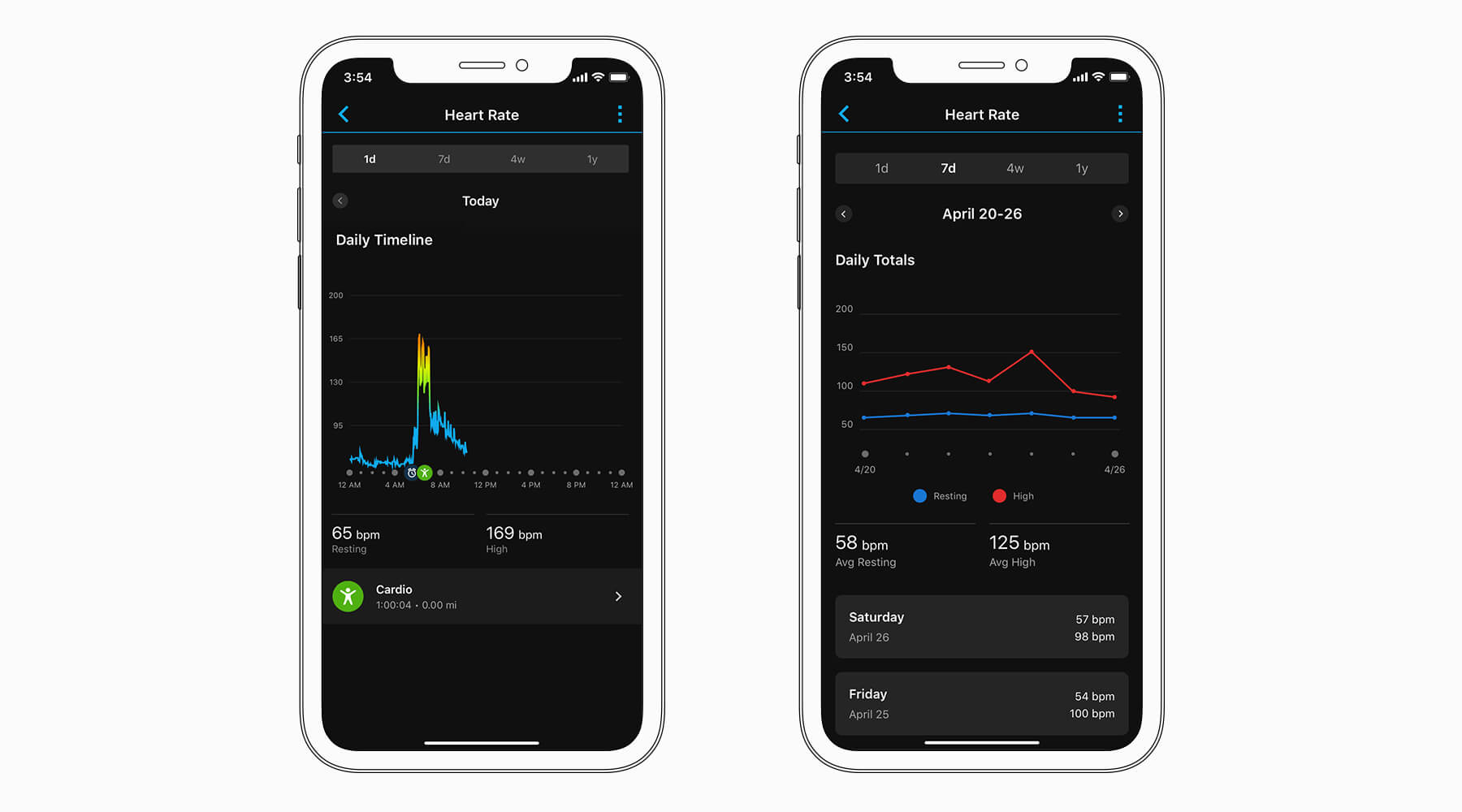
Garmin abnormal heart rate alerts warn the wearer when their pulse is unusually high or low at rest. Garmin’s support page describes it this way: “Select Garmin devices can alert you when your heart rate goes above or below a specified level when you are not active.” The wearer sets the high and low thresholds, and the watch shows a message and vibrates when one is crossed.
Garmin introduced the alerts in 2018, listing them as new in the launch of the vívosmart 4 on 30 August 2018. Their limitation is that they compare one number with another: they say nothing about the heart’s rhythm, and Garmin states that they do not notify of any potential heart condition.
What abnormal heart rate alerts actually mean
An alert means the wrist heart rate went above the high threshold or below the low threshold after the watch detected no movement, such as steps, for at least 10 minutes. Low alerts are not sent during the sleep window set in Garmin Connect, which stops the normal overnight drop in heart rate setting them off. Garmin gives no default or recommended thresholds, and no medical meaning is attached to an alert.
How Garmin calculates abnormal heart rate alerts
Garmin publishes the trigger but not the detail. It does not say how long the pulse must stay past the threshold before an alert fires, how it smooths short spikes, or how it treats movement without steps, such as cycling without a recorded activity. All three are unknown.
What affects the reading
The alert can only be as good as the wrist heart rate behind it. At rest the optical sensor reads well: a 2026 laboratory study put the Forerunner 955 within about half a beat per minute of an ECG on average, though individual seated readings were up to 6.4 bpm below and 5.3 bpm above the ECG.
The thresholds decide everything else. A high alert set close to normal daily heart rate fires often, and a low alert set above a fit athlete’s resting pulse can fire during ordinary rest.
How accurate are Garmin abnormal heart rate alerts
Garmin publishes no validation of the alerts. Whether an alert fires correctly depends on the wrist sensor, covered above. Whether it means anything medically is a separate question, and the only published evidence is for Apple Watch’s similar alerts. Wyatt and colleagues (2020) reviewed 264 Mayo Clinic patients evaluated for an abnormal pulse detected by Apple Watch. Only 30 of the 264 (11.4%) received a clinically actionable heart diagnosis, and of the 15 patients who came in after an alert without any symptoms, only one was diagnosed. The authors concluded that consumer pulse alerts produce many false positives.
Competitor equivalents
- Apple Watch sends high and low heart rate notifications when the heart rate stays above or below a chosen BPM, on Series 1 or later for ages 13 and up, and separately checks for irregular rhythms suggestive of atrial fibrillation.
- Suunto Run’s heart rate widget has a High HR alert that sounds when heart rate stays at or above a chosen value for five seconds, and Suunto’s guide mentions no low alert.
No equivalent was found in Polar, WHOOP or Oura documentation, and the heart rate alerts COROS documents are for workouts.
Which Garmin devices support abnormal heart rate alerts
Garmin introduced abnormal heart rate alerts in 2018 on the vívosmart 4. Garmin describes them as available on select devices and publishes no list. The setting appears in the owner’s manuals for current fēnix, Forerunner, Venu and vívoactive watches, and for vívosmart trackers and vívomove hybrid watches.
Where to find abnormal heart rate alerts on Garmin
- Current watches: Settings > Notifications & Alerts > Health & Wellness (or System Alerts) > Abnormal Heart Rate Alerts > High Alert or Low Alert.
- Older watches: from the heart rate widget, Heart Rate Options > Abnormal Heart Rate Alerts on Forerunner 945, or the Wrist Heart Rate settings on vívoactive 4.
- Sleep window: set in Garmin Connect, it stops low alerts during sleep.
Common problems and misreadings
An alert with no obvious cause is the most common worry. See Quick answers above.
Low alerts that never arrive at night are expected, because Garmin does not send them during the sleep window.
The lack of an alert is not reassurance about rhythm. The alerts ignore irregular heartbeats entirely, and Garmin’s ECG App is the feature that checks for atrial fibrillation.
How to improve abnormal heart rate alerts
The alerts cannot be trained, but they can be made more useful. The low threshold works best set below the daily resting heart rate and the high threshold clearly above the wearer’s normal sitting pulse, adjusted if alerts arrive too often.
Scientific basis
Wyatt KD, Poole LR, Mullan AF, Kopecky SL and Heaton HA. Journal of the American Medical Informatics Association, 2020. DOI 10.1093/jamia/ocaa137. Found a high false-positive rate when patients were evaluated after an Apple Watch abnormal pulse alert.
How abnormal heart rate alerts connect to other Garmin features
The alerts watch the same pulse that sets the daily resting heart rate, and knowing that figure is the best guide to a sensible low threshold. Low alerts stay silent during sleep, so overnight changes in heart rate are better followed in Health Status. Garmin’s ECG App checks the rhythm the alerts ignore.
2026 Seasonal Gifts
- Garmin CIRQA: Garmin’s screenless band, which uses your phone as the display. I tested it and sometimes use it as a backup on the site.
- HoloSwim 3 Pro: Swim goggles with GPS and your pace in the lens, so you can swim without a watch. Code THE5KRUNNER takes 10% off. I tested them.
- Kineon MOVE+: Red and infrared light for sore knees, Achilles and other joints after hard training. I use it.
- Fitbit Air: A screenless band for steps, sleep and heart rate, with no subscription needed. It was closest to a manual 9,000-step test. I use it as a backup sometimes.
Small things I always use
- Garmin 90-degree charging adapter: Charges your Garmin with any USB-C cable. Essential when travelling. I use one.
- Body Glide: The blue anti-chafing stick swimmers and runners carry. I use it.
- Speedo earplugs: Fewer ear infections and no cold-water dizziness. I use them.
- Dryrobe Advance: My winter changing robe for open-water swims. I use one. A cheaper option is the AONYIYI changing robe.
- Maurten: Race fuel that stays easy on the stomach. I use them.
- Beet It Sport nitrate shots: Beetroot shots I take in the days before a race. I use them.
- Garmin charging puck: The quickest way to top up before a session. I use one.
- Injinji: Toe socks that stop rubbing, so you run more. I use them.
- Ultimate toe protectors: Stop black toenails on long runs. They work. I use them.
- Compressport R2 v2 calf sleeves: My calf sleeves of choice. I use them.
- Cellucor C4: My pre-workout before hard sessions.
- TPU tubes: Schwalbe Aerothan, Tubolito and Pirelli SmarTube. Light, tiny spares. I use all three.
- G8 insoles: Adjustable arches, perfect position. I use them.
- Cycplus Cube: A 97g electric pump that gets a road tyre rideable in two minutes. I carry one. 5% off with code THE5KRUNNER.
Health, recovery and sleep
- FreeStyle Libre 3 Plus: Shows how my blood sugar responds to diet. Occasional use.
- hDrop: Measures my sweat loss in summer and indoors. I use it.
- Fourth Frontier Zone: Checks my heart under load in hard sessions.
- Oura Ring 5: My partner’s recovery tracker of choice.
- Eight Sleep: A cooling mattress cover my partner and I use nightly (see next).
- Chilipad 2.0: Cools or heats your side of the bed on a schedule, with no subscription. US only. I am testing it; it seems pretty good.
Watches and sensors
- Polar H10: My daily driver for waking HRV.
- Polar Verity Sense: My backup arm-worn HR sensor.
- Nomad bedside charger: Charges my iPhone and Apple Watch overnight. I use it, and many of their bands.
- Train.Red: The best muscle oxygen sensor I’ve used. Occasional use.
- Tymewear: Accurate heart rate and reliable ventilatory zones. I use it to pace endurance rides over an hour.
- Garmin Forerunner 970: A pro-grade triathlon watch. I use this.
- Apple Watch Ultra 4: My daily smartwatch. No phone needed on rides.
On the bike
- Continental GP5000 for everyday riding, and Aero 111 on the front for special occasions. I use both.
- Helmets: Specialized S-Works Evade 3 for road riding, and Rudy Project Wing for TT-style races. I use both.
- Ravemen FR300: A front light that mounts under your Garmin or Wahoo. I use one.
- Ravemen FR1000: The light and the computer mount in one unit, so nothing else goes on the bars. Better than mine.
- Ravemen FR1500SE: 1,500 lumens hanging under your Garmin, for proper night rides.
- Ravemen FR1100SE: 1,100 lumens under your Garmin, and up to 46 hours on slow flash.
- Ravemen FR500: A brighter FR300 with the same mount.
- Wahoo TRACKR Radar: I use it on one bike and Varia on the other. They perform the same.
- Garmin Varia RTL515: Radar that warns you of cars from behind. I use this model.
- Wahoo ELEMNT Roam 3: The bike computer that’s easy to use. I use mine on most rides.
- Favero Assioma Pro RS2: Accurate power pedals that swap easily between bikes. I use this model.
Home and indoor training
- NPE Runn: Makes my basic treadmill smart, sending more accurate speed and distance to my watch and Zwift. I use it.
- Google Wifi: Keeps Zwift connected in my pain cave. I use it.
- Apple TV 4K (4th generation): Zwift on the big screen. I use two.
- Google Nest Doorbell (wired, 2nd gen): My video doorbell, running in both Google Home and Apple Home via Starling. I use it.
Reader-Powered Content
This content is not sponsored. It’s mostly me behind the labour of love, which is this site, and I appreciate everyone who supports it.
Support the site: Follow (free, fewer ads) · Subscribe (paid, ad-free) · Buy Me A Coffee
Written by real people, with AI assistance. Fact-checked and verified for originality. See the Editorial Policy. FTC: Affiliate Disclosure — some links pay commission. As an Amazon Associate, I earn from qualifying purchases.
