Sensor within about half a beat of a hospital ECG at rest on Forerunner 955 in a 2026 lab spot check
Following fitness and recovery through the 7-day average
Can come from sleep, so it often reads lower than a seated morning check
In practice: Resting HR (HRrest, HRmin) usually moves inversely to HRV, so high HRV and low resting HR are generally good. However, HRV is a more reliable metric for when your body deviates from its norm.
Quick answers
How does Garmin calculate resting heart rate?
Garmin takes the lowest 30-minute average heart rate in each 24-hour period. Some watches also show a 7-day average, which rolls forward each day rather than resetting each week. Garmin says wearing the watch overnight gives the most accurate figure by its definition, which usually sits several beats below a seated morning check.
What is a normal resting heart rate on Garmin?
Garmin’s support page gives 60 to 100 bpm as the average range and says very fit people can see readings as low as 40 bpm. A low figure in someone who is not active is worth discussing with a doctor, because it can be a sign of a slow heart rhythm called bradycardia.
Is Garmin resting heart rate accurate?
The sensor is accurate at rest. A 2026 laboratory study found the Forerunner 955 within half a beat per minute of a hospital ECG on average, lying down or sitting still. The study tested a two-minute spot check rather than the daily figure, and single readings varied more, from -6.4 to +5.3 bpm when seated.
Why is my Garmin resting heart rate higher than usual?
Garmin says resting heart rate reflects fitness, recovery status and diet, and its blog adds illness and infection as causes of short-term rises. An unusually active or inactive week can also move the figure, so a monthly or yearly average is more reliable than one day.
Resting heart rate – a deep dive
When resting heart rate is actually useful
Your true resting heart rate is one input into heart rate zone calculations. The difference between your max and min HR is your workable zone, which you can divide into percentages to create good training zones. But which HRmin do you use? Your lowest today will be different from tomorrow. Which is correct to use for your zones? One answer is that your zones vary on a more than daily basis.
A long-term declining trend in HRmin typically indicates increased fitness, whereas a short-term decline might indicate improved recovery and readiness.
Introduction
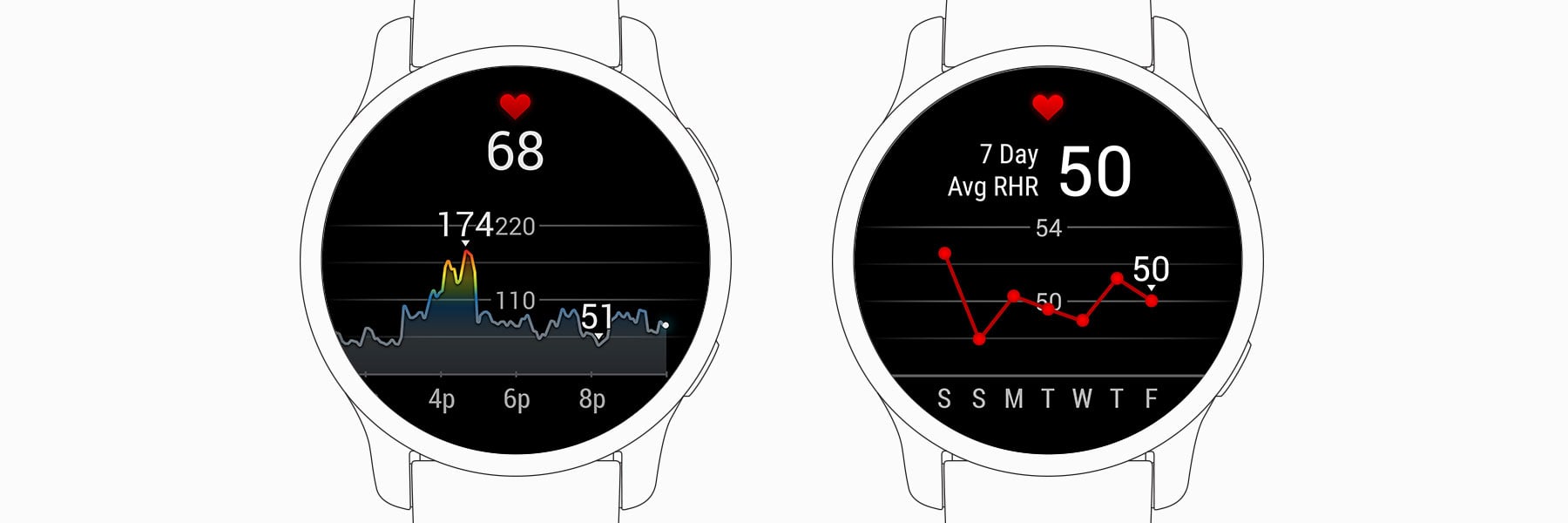
Garmin resting heart rate (RHR) is a daily figure taken from the wrist sensor’s all-day heart rate. Garmin’s support page defines it in one line: “Daily RHR is calculated using the lowest 30 minute average in a 24 hour period.” Some watches also show a 7-day average, which Garmin describes as a rolling value that does not reset at the start of each week.
Resting heart rate feeds several newer Garmin features, from Fitness Age to Health Status. Its limitation is the definition: a 30-minute low taken from any part of the day usually comes from sleep, so it sits below the seated morning figure a doctor or coach would measure. Overnight wear makes the figure more consistent from day to day, not closer to that seated check.
What resting heart rate actually means
A lower resting heart rate usually goes with better aerobic fitness, because a trained heart moves more blood with each beat. Garmin’s support page gives 60 to 100 bpm as the average range, with very fit people as low as 40 bpm. That range describes what is common, not what is ideal: population studies link a lower resting heart rate with lower risk of heart disease, with risk rising above about 60 bpm. Garmin publishes no age or sex bands for resting heart rate, and its blog advises that a very low figure in someone who is not active should be checked with a doctor.
How Garmin calculates resting heart rate
Garmin publishes the rule, the lowest 30-minute average from the optical sensor, but not the detail behind it. It does say that the estimate is less accurate for people who do not wear the watch overnight, and recommends wearing it to bed for several nights.
Garmin does not say which part of the day the 30-minute window usually comes from. Heart rate is normally lowest during sleep, so for a wearer who sleeps in the watch the daily figure is most likely an overnight value. Garmin does not publish how it handles a day with gaps in wear or where the 24-hour period starts and ends.
What affects the reading
Garmin’s technology page lists fitness, recovery status and dietary choices as the things that move resting heart rate, in contrast to maximum heart rate, which stays stable and declines slowly with age. Garmin’s blog adds illness and infection, and unusually active or inactive weeks.
Wear pattern changes the result as well. A watch taken off at night has to find its 30-minute low during the waking day, which raises the figure and makes day-to-day comparisons unreliable.
How accurate is Garmin resting heart rate
Casanova-Lizón and colleagues (2026) compared a Forerunner 955 with a hospital-grade ECG in 23 adults, using Garmin’s two-minute Health Snapshot while participants lay down and then sat still. Heart rate agreed closely with the ECG: the average difference was +0.52 bpm lying down and -0.55 bpm seated. Single readings spread further, from -2.4 to +3.4 bpm lying down and -6.4 to +5.3 bpm seated. The5krunner’s report on the study covers the heart rate variability results from the same test, which were far less accurate.
The study tested a resting spot check, not the daily figure itself, but it shows the sensor reads a still pulse well. Different brands define resting heart rate differently, so a Garmin figure should only be compared with other Garmin figures.
Competitor equivalents
- Polar shows the lowest heart rate of the day and of the night, but says these are not resting heart rate, which it asks athletes to measure on waking and enter in Polar Flow.
- Apple Watch shows a Resting Rate in the Heart Rate app, and Apple does not publish how it is calculated.
- COROS predicts a seated resting heart rate from heart rate during sleep, because it says a figure taken from sleep can sit well below the awake value and skew training zones.
- WHOOP measures resting heart rate each night as an average of heart rate during sleep, weighted toward the last period of slow-wave sleep.
- Oura reports an average and a lowest overnight resting heart rate, sampled every 10 minutes, against a personal average from about the past two months.
Suunto uses a resting heart rate setting entered by the wearer, and no automatic daily figure was found in its documentation.
Which Garmin devices support resting heart rate
Garmin’s support page states the rule: every Garmin device with an optical heart rate sensor calculates a daily resting heart rate, and some also show a 7-day average.
Where to find resting heart rate on Garmin
- On the watch: the heart rate glance shows the current heart rate and, on watches that have it, the 7-day average resting heart rate.
- Garmin Connect: the daily resting heart rate and its averages over weeks, months and a year, which Garmin recommends for judging long-term change.
Common problems and misreadings
A figure that is higher than usual for a day or two is the most common question. See Quick answers above.
A Garmin resting heart rate several beats below a manual check taken sitting up in the morning is expected, because the watch can use a half hour of sleep and the manual check cannot.
Missing nights produce erratic figures. Garmin says estimates are less accurate without overnight wear, so a week with the watch on charge at night is a poor guide to any change.
How to improve resting heart rate
Aerobic training lowers resting heart rate over months, and Garmin’s own user data shows the figure falling as logged hours of running, cycling and swimming rise, up to about 15 hours. Garmin’s support page puts it down to the heart becoming better conditioned and more efficient. Good sleep and recovery days keep the short-term figure down, while illness and hard training blocks push it up.
Scientific basis
Fox K and colleagues. Journal of the American College of Cardiology, 2007. PMID 17719466. Reviewed the evidence that resting heart rate independently predicts heart disease and death from all causes, with risk rising above about 60 bpm.
Casanova-Lizón A, Sarabia JM, Aracil-Marco A, Martínez-García M, Moya-Ramón M and Manresa-Rocamora A. Sensors, 2026. DOI 10.3390/s26206549. Found the Forerunner 955 within about half a beat per minute of an ECG at rest.
How resting heart rate connects to other Garmin features
Resting heart rate is one input to Fitness Age, and overnight heart rate is one of the five vitals in Health Status, which flags a night outside the wearer’s usual range. HRV Status reads the variation between the same heartbeats, and the two often move in opposite directions after hard training or illness. Abnormal heart rate alerts can warn when the pulse stays above or below a chosen level while the wearer is still, and max heart rate sits at the other end of the range.
2026 Seasonal Gifts
- Garmin CIRQA: Garmin’s screenless band, which uses your phone as the display. I tested it and sometimes use it as a backup on the site.
- HoloSwim 3 Pro: Swim goggles with GPS and your pace in the lens, so you can swim without a watch. Code THE5KRUNNER takes 10% off. I tested them.
- Kineon MOVE+: Red and infrared light for sore knees, Achilles and other joints after hard training. I use it.
- Fitbit Air: A screenless band for steps, sleep and heart rate, with no subscription needed. It was closest to a manual 9,000-step test. I use it as a backup sometimes.
Small things I always use
- Garmin 90-degree charging adapter: Charges your Garmin with any USB-C cable. Essential when travelling. I use one.
- Body Glide: The blue anti-chafing stick swimmers and runners carry. I use it.
- Speedo earplugs: Fewer ear infections and no cold-water dizziness. I use them.
- Dryrobe Advance: My winter changing robe for open-water swims. I use one. A cheaper option is the AONYIYI changing robe.
- Maurten: Race fuel that stays easy on the stomach. I use them.
- Beet It Sport nitrate shots: Beetroot shots I take in the days before a race. I use them.
- Garmin charging puck: The quickest way to top up before a session. I use one.
- Injinji: Toe socks that stop rubbing, so you run more. I use them.
- Ultimate toe protectors: Stop black toenails on long runs. They work. I use them.
- Compressport R2 v2 calf sleeves: My calf sleeves of choice. I use them.
- Cellucor C4: My pre-workout before hard sessions.
- TPU tubes: Schwalbe Aerothan, Tubolito and Pirelli SmarTube. Light, tiny spares. I use all three.
- G8 insoles: Adjustable arches, perfect position. I use them.
- Cycplus Cube: A 97g electric pump that gets a road tyre rideable in two minutes. I carry one. 5% off with code THE5KRUNNER.
Health, recovery and sleep
- FreeStyle Libre 3 Plus: Shows how my blood sugar responds to diet. Occasional use.
- hDrop: Measures my sweat loss in summer and indoors. I use it.
- Fourth Frontier Zone: Checks my heart under load in hard sessions.
- Oura Ring 5: My partner’s recovery tracker of choice.
- Eight Sleep: A cooling mattress cover my partner and I use nightly (see next).
- Chilipad 2.0: Cools or heats your side of the bed on a schedule, with no subscription. US only. I am testing it; it seems pretty good.
Watches and sensors
- Polar H10: My daily driver for waking HRV.
- Polar Verity Sense: My backup arm-worn HR sensor.
- Nomad bedside charger: Charges my iPhone and Apple Watch overnight. I use it, and many of their bands.
- Train.Red: The best muscle oxygen sensor I’ve used. Occasional use.
- Tymewear: Accurate heart rate and reliable ventilatory zones. I use it to pace endurance rides over an hour.
- Garmin Forerunner 970: A pro-grade triathlon watch. I use this.
- Apple Watch Ultra 4: My daily smartwatch. No phone needed on rides.
On the bike
- Continental GP5000 for everyday riding, and Aero 111 on the front for special occasions. I use both.
- Helmets: Specialized S-Works Evade 3 for road riding, and Rudy Project Wing for TT-style races. I use both.
- Ravemen FR300: A front light that mounts under your Garmin or Wahoo. I use one.
- Ravemen FR1000: The light and the computer mount in one unit, so nothing else goes on the bars. Better than mine.
- Ravemen FR1500SE: 1,500 lumens hanging under your Garmin, for proper night rides.
- Ravemen FR1100SE: 1,100 lumens under your Garmin, and up to 46 hours on slow flash.
- Ravemen FR500: A brighter FR300 with the same mount.
- Wahoo TRACKR Radar: I use it on one bike and Varia on the other. They perform the same.
- Garmin Varia RTL515: Radar that warns you of cars from behind. I use this model.
- Wahoo ELEMNT Roam 3: The bike computer that’s easy to use. I use mine on most rides.
- Favero Assioma Pro RS2: Accurate power pedals that swap easily between bikes. I use this model.
Home and indoor training
- NPE Runn: Makes my basic treadmill smart, sending more accurate speed and distance to my watch and Zwift. I use it.
- Google Wifi: Keeps Zwift connected in my pain cave. I use it.
- Apple TV 4K (4th generation): Zwift on the big screen. I use two.
- Google Nest Doorbell (wired, 2nd gen): My video doorbell, running in both Google Home and Apple Home via Starling. I use it.
Reader-Powered Content

This content is not sponsored. It’s mostly me behind the labour of love, which is this site, and I appreciate everyone who supports it.
Support the site: Follow (free, fewer ads) · Subscribe (paid, ad-free) · Buy Me A Coffee
Written by real people, with AI assistance. Fact-checked and verified for originality. See the Editorial Policy. FTC: Affiliate Disclosure — some links pay commission. As an Amazon Associate, I earn from qualifying purchases.
