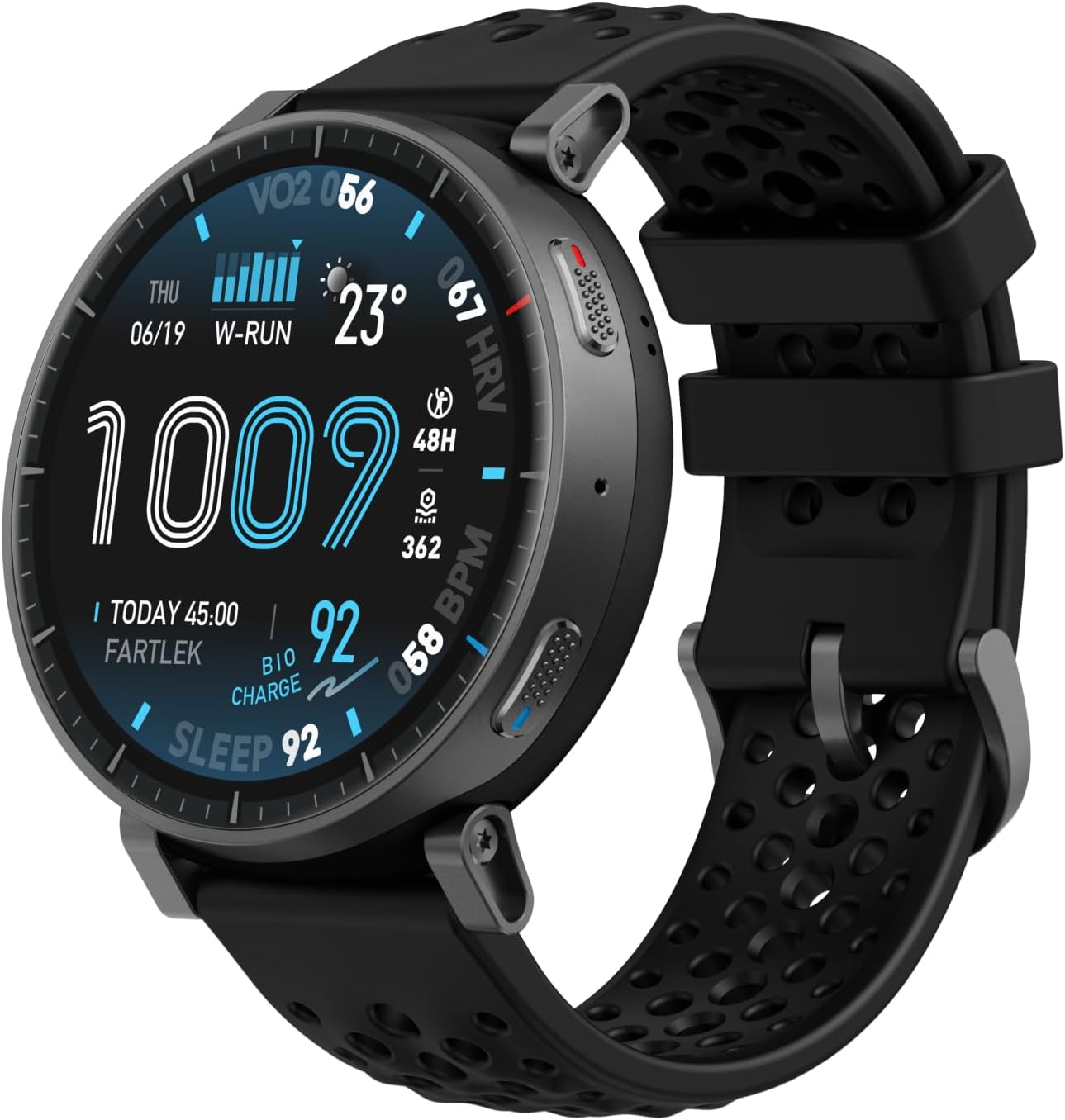
Full specifications, features and battery life for the Amazfit Active Max, the brand’s mid-range GPS sports watch positioned above the Active 2.
| Manufacturer | Amazfit |
| Type | GPS sports and lifestyle watch |
| Series | Active |
| Released | December 2025 |
| Price at launch | $169 / £169 / €169 |
| Predecessor | None specific. Sits above the Active 2 in Amazfit’s range. |
| Successor | — |
| Dimensions | 48.5 x 48.5 x 12.2mm |
| Weight | 39.5g, excluding strap |
Specifications and features as at launch.

Expert opinion | Specifications | Battery life | Features | Further reading
Expert opinion
The Active Max scored 81% on tfk’s standard 10-mile GPS accuracy test, a second-tier result behind the best current dual-frequency chipsets such as the Suunto Vertical and Coros Pace 3 at 92%, but ahead of typical single-frequency watches at this price. Its Airoha AG3352B chipset performed well in a road tunnel and in sections prone to multipath error near buildings, weaker on some easy-reception sections than expected. Heart rate accuracy was inconsistent: some workouts matched a reference to within 1%, others showed workout-level errors up to 10% from underreporting during harder efforts. Amazfit claims up to 64 hours of continuous GPS recording; real-world estimation during testing suggested closer to 40 hours at minimum brightness with the always-on display disabled, though this remains competitive at the price. The watch has no ANT+ support, cannot control a smart trainer, and does not sync inbound Strava routes, though it does sync structured TrainingPeaks workouts and supports Stryd running power.
Specifications
| Display | |
|---|---|
| Type | AMOLED |
| Size | 1.5in |
| Resolution | 480 x 480px |
| Brightness | Up to 3,000 nits peak |
| Physical | |
| Dimensions | 48.5 x 48.5 x 12.2mm |
| Weight | 39.5g, excluding strap |
| Case material | Aluminium alloy case and bezel, strengthened glass lens (not sapphire), polymer backplate |
| Water resistance | 5 ATM / 50m (ISO 22810:2010). No separate case or lens durability claim. |
| Buttons | 2, physical, plus touchscreen |
| Sensors and positioning | |
| GNSS | Single-frequency, Airoha AG3352B chipset |
| Optical heart rate | BioTracker PPG sensor. Accuracy inconsistent in testing; underreporting seen during harder efforts. |
| Other sensors | Barometric altimeter, SpO2, skin temperature, HRV |
| © the5krunner. Link required. | |
| Connectivity and battery | |
| Wireless | Bluetooth, NFC (Zepp Pay, EMEA). No ANT+. |
| Calls | Bluetooth calls via built-in speaker and microphone, phone must be in range |
| Storage | 4GB, for offline maps and music/podcasts (up to 100 hours claimed) |
| Maps | Onboard, downloadable, with turn-by-turn directions and street names. No automatic rerouting. |
| App ecosystem | Zepp OS third-party mini-app store |
| Battery | 658mAh |
| Battery, smartwatch mode | Up to 25 days claimed |
| Battery, continuous GPS | Up to 64 hours claimed |
| Charging | Approximately 2 hours for a full charge |
Battery life
Amazfit claims up to 25 days of typical smartwatch use and up to 64 hours of continuous GPS recording, figures enabled by the single-frequency chipset, a lightweight OS and a large 658mAh cell. In mixed real-world use including regular GPS workouts, a week between charges was comfortably achievable. Estimated continuous GPS battery life from testing was closer to 40 hours at minimum brightness with the always-on display disabled, still competitive against rivals at this price. Charging is not fast: roughly 2 hours for a full charge, with around 50% reached in an hour.
Features
Full feature detail is covered on the Amazfit specifications index.
Sport modes
- 170+ sport profiles, including a dedicated HYROX race mode with correct station sequencing and audio prompts
- Custom multisport profiles for triathlon and brick training, with transitions and customisable metrics
- Only one fixed triathlon profile (swim, bike, run, all outdoor) and one custom multisport slot; the two cannot be combined or saved separately
- Stryd running power support, including a pre-built metrics screen; no auto-calibration or critical power sync
- Structured workout sync from TrainingPeaks
Navigation
- Onboard maps with turn-by-turn directions and street names
- Route import requires manually exporting and sending a GPX file to the Zepp app; no automatic sync from Garmin Connect, Strava or Komoot
- No automatic rerouting if a rider or runner leaves the planned route
- Single-climb information shown during navigation, though not a full climb-by-climb profile view
Smart features
- NFC payments via Zepp Pay (EMEA); requires a compatible card or a Curve card intermediary
- Bluetooth calls via built-in speaker and microphone
- Zepp OS third-party mini-app and watch face store
