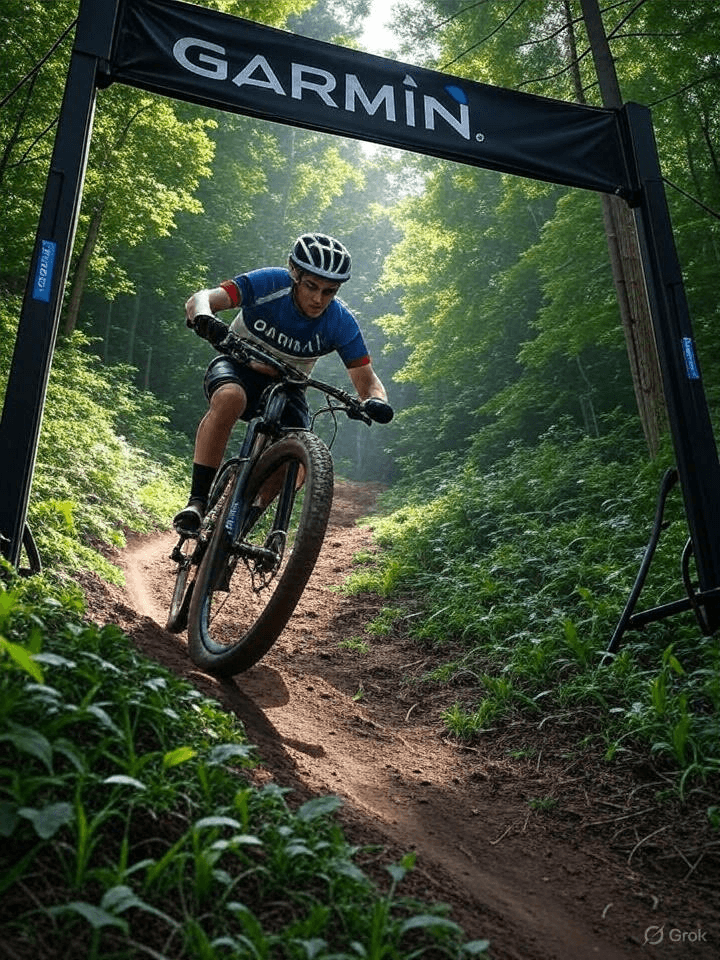
Garmin will add Game-Changing Features for Downhill Mountain Biking
Source: @JohnW, thank you
TL;DR – 5Hz Data Recording and 10 Timing Gates per Series to be added
Garmin is about to roll out an interesting update for downhill mountain biking enthusiasts – higher frequency data recording at 5Hz and the ability to record at timing gates on (race) routes. These features will enhance the precision of fast-paced downhill stretches, providing riders with deeper insights into their performance.
The details so far are sketchy, but there are two known features: MTB Timing Gates and increased precision recording for MTB.
I assume the two are linked and should materialise as something like this…
New Feature: 5Hz Data Recording
Garmin’s new 5Hz data recording feature enables five additional data points per second compared to the existing 1Hz GNSS/GPS recording. Thus, high-speed downhill sections can now record more accurate tracks.
5Hz Data Recording also Increases Battery Consumption
Garmin appears to be fine-tuning this new mode so that it only activates when descending quickly, thereby conserving battery in your regular riding mode. The feature appears to be unavailable when running a battery-saving mode on your device.
5Hz Data recording: Why now?
I’m not sure if this frequency of GNSS position capture was always possible. Perhaps it’s been recently enabled with Garmin’s switch to the Synaptics GNSS chipset.
As background, there are issues with the number of records the FIT file format can store per second. When recording HRV/HR, a maximum heart rate of 250 beats per minute (bpm) is supported due to the 5 Hz recording frequency limit. I imagine the FIT file schema would apply the same limit to any other data, explaining why this GNSS recording feature also supports 5Hz.
Note that this does NOT mean that accuracy is to 0.2 seconds (5×0.2=1.0sec). The five records can be recorded at arbitrary intervals; therefore, the timing accuracy is limited to the clock time, not the recording frequency. ie from a Google search, accuracy could be ±1 ms (0.001 seconds) if triggered at the right point.
There are no Edge Devices with Synaptics Chipsets.
Exactly so! They use Airoha. How can this new feature be utilised in mountain biking with a Garmin Edge?
This new feature is about to be released, and I imagine the launch would coincide with the Edge 850/550. Other intel corroborates a new Edge release in June or July.
If the 5Hz recording only works with Synaptics chipsets, Fenix 8, its derivatives, Instinct 3, and Forerunner 970/570 could get it too.
More on Timing Gates
Context: Garmin has already released a feature to the Forerunner 970 called “Auto Lap by Timing Gates”, used to align your recorded lap times of a running race with official course mile/kilometre markers. This feature has an unusual name for its intended use. I believe, because it is intended for other uses…like MTB racing…ie a feature that has Timing Gates 😉
Anyway, there IS a mountain bike-specific feature called timing gates about to land.
It looks like you can create up to 10 timing gates. But HOW you place them is where it gets interesting.
The gates are placed by GPS position on the watch/edge. You stand at the gate and face the direction of the course, then press a button to create the gate as part of the series. You then add up to 9 more.
Triathletes: Any triathletes listening in will now be paying attention. This feature could easily be adapted to set GPS positions of up to 4 transition gates for triathlon to complete Garmin’s multiport feature puzzle, giving proper timing to auto-multisport.
Road Riders: You should already be able to autolap by GPS position when riding loops. It’s a longstanding Garmin feature.
I’m unclear how the Edge/watch will use the Gate Series. It seems that you choose the Gate Series in the same way you would a course and ride it, rather than adding the Gate Series selection as an option to your MTB profile.
Take Out
I like the innovation that Garmin shows here. They’ve conducted their market research and are adding two features that will be utilised – three, if you include the Triathlon Timing Gate I speculated about.
I question how accurate the timing will be under trees. It’s one thing to collect more data points, and another to collect them accurately. When travelling downhill through trees on bumpy terrain, GNSS accuracy is likely to be more challenging to obtain, so it remains to be seen how accurate the route and timings will be.
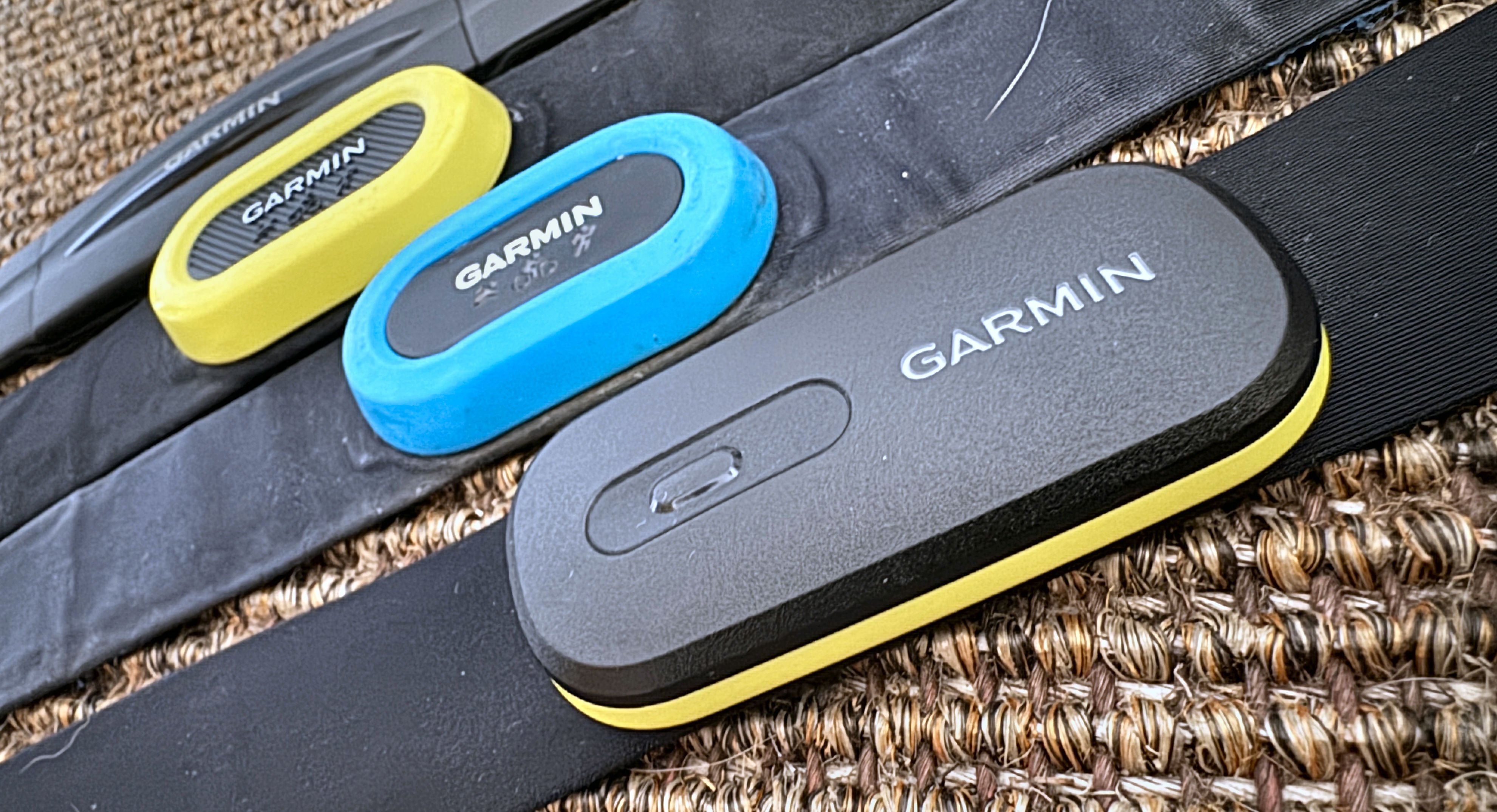
Garmin HRM 600
High-end, watch-free heart rate recording strap.
 +other retailers
Last Updated on 29 January 2026 by the5krunner
My favourite kit and nutrition
- Garmin Fenix 9 Pro — I’ve just bought one.
- Injinji – Runners protect your toes. Avoid discomfort and minor injury. Run more. Run faster. I use them.
- Garmin 90-degree charging adapter — A small keyring adapter you can use anywhere. Essential when away. I use one.
- Garmin charging puck — the fastest and most reliable way to top up your Garmin before a session. I use one.
- Ravemen FR300 — Front light that mounts directly under your Garmin or Wahoo head unit. Keeps your bars clean and your beam pointed where it matters. I use one.
- Body Glide – The blue anti-chafe stick that all swimmers and many runners use. I use it.
- Maurten — The race nutrition trusted by elite athletes. Gels and drink mixes engineered to be easy on the stomach. I use them.
- Garmin Varia RTL515 — A radar rear light that alerts you to vehicles approaching from behind. Pairs with your Edge or Wahoo. I use this model.
- Favero Assioma Pro RS2 — The power-meter pedals most serious cyclists choose. Accurate, easy to move between bikes. I use this model.
- Garmin Forerunner 970 — A serious choice for a pro-grade triathlon watch. I use this.
- Polar H10 — My daily driver for accurate, waking HRV readings.
- Wahoo ELEMNT Roam 3 — The bike computer that has the feature Garmin lacks: usability. I use mine on most rides.
Reader-Powered Content

This content is not sponsored. It’s mostly me behind the labour of love, which is this site, and I appreciate everyone who supports it.
Support the site: Follow (free, fewer ads) · Subscribe (paid, ad-free) · Buy Me A Coffee ❤️
All articles are written by real people, fact-checked, and verified for originality. See the Editorial Policy. FTC: Affiliate Disclosure — some links pay commission. As an Amazon Associate, I earn from qualifying purchases.

tfk is the founder and author of the5krunner, an independent endurance sports technology publication. With 20 years of hands-on testing of GPS watches and wearables, and competing in triathlons at an international age-group level, tfk provides in-depth expert analysis of fitness technology for serious athletes and endurance sport competitors. ID

Does that mean we can also record other data a the higher rate?
(My power meter broadcasts at 4hz but Garmin only samples at 1hz)
I can’t wait for more leaks as we get closer to launch
I’ve been looking into higher Hz recording with some other reviewers from other sports and its quite interesting.
what benefit do you expect from higher-Hz bike power meter recording (there is one!! I’m just wondering if you know what it is 😉 ) – but i have no intel on new higher Hz data for other sensors. That data could already be written in any case by CIQ apps? eg dfa a1
My thought was to prevent aliasing because 1hz is below the Nyquist frequency for a 90 rpm cadence.
Which now that I think about it more you’re getting 2 inputs with each full revolution.
So you’d likely need to broadcast and sample at 6hz in order to properly capture that at a cadence of 90.
Are there other reasons as well?
that is the issue.
but dont forget that the sensor has a sampling rate as well. so the sensor could quite easily be sampling at 50hz (fifty, or whatever) but only sending out an average to the receiver at 1Hz. that would be ‘correct’ (with caveats)
for cadence i dont think it would make a difference to the accuracy almost all readers here need.
for things like power it could make a difference but only over very short durations (couple of seconds). i’d have to do the maths (or google it) but i would imagine that a 2-3 second average power (or average whatever) sort out most errors. BUT such an average would also mask true averages.
so, silly example, in one second you could have a power of 900w, 800w, 800w, 800w, 800w. what is your maximum power? Clearly its 1000w@5Hz but the device will show 820w @1Hz
so 5Hz would make my power curve more accurate at 0-2 second durations…but do I really care?…A: no. Others might.
I think these issues are mostly irrelavent for normal endurance-focussed readers of this blog but anything invovling fast speed changes or where a ‘true’ maximum is needed it will be a factor.
Is the 1050 on the new chipset already, or will this feature be 550/850 only due to the 1050 using a previous GPS chipset?
sorry i dont know that.
whether its synaptics or airoha it SHOULD be capable of this feature. that’s my guess.
But it’s possible the slightly older AIROHA might not be, the edge 1050 probably has the airoha chip.
Cheers, I’ll wait for the official announcement before I choose a new unit then 👍