Garmin Elevate 6 might include these new sensing methods to boost accuracy and scope
Several factors currently impact the current generation of optical heart rate sensors’ abilities to produce different and more accurate physiological data.
The simple story: Elevate 5’s LEDs shine light into the skin and measure what is reflected to infer things like HR and SpO2.
Problems include: The light will be scattered, and this diffused light is hard to read correctly. Different wavelengths have different properties; some do not penetrate deep enough, and the characteristics of the light are changed by motion.
There are already some solutions out there to these problems. For example, Rockly Photonics essentially shines ‘laser’ light, which can be more precisely controlled, and the power required to do that is lowered compared to traditional LEDs. Then, we saw a patent from Garmin a few weeks ago that included a pressure sensor to adjust the sensor’s understanding of the light paths as the wrist flexed.
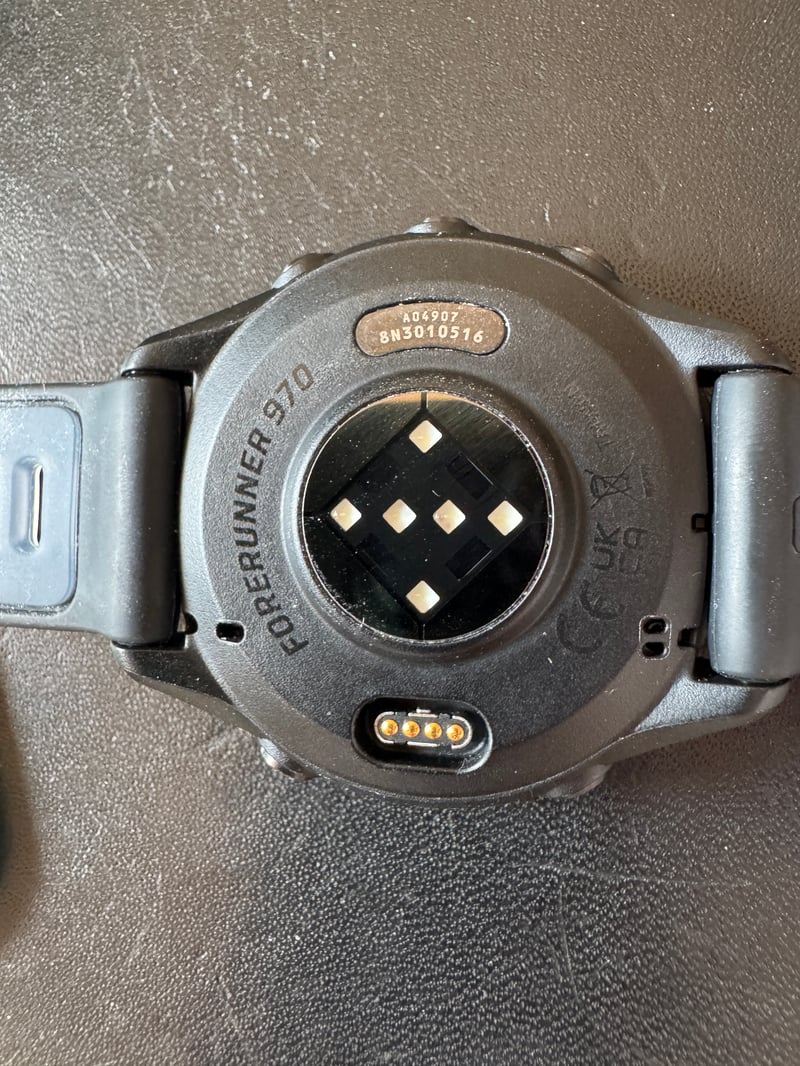
The latest Garmin patent is interesting. It uses an array of light source pairs, each handling different wavelengths. The principle here is conceptually similar to what we have seen with dual-frequency GNSS chipsets. The two frequencies have different characteristics if they follow different routes (multi-path) through the skin; knowing this gives Garmin the chance to focus on more accurate, less diffused signals.
When the proposed sensor employs a multi-path method to determine reading accuracy, it primarily compares and correlates characteristics derived from multiple photoplethysmogram (PPG) signals obtained through different light paths within the human tissue. Specifically, this involves analysing the reflected optical signals at various wavelengths, as well as waveform parameters such as frequency, bandwidth, amplitude, and phase of these signals, which inherently account for the different distances light travels through tissue to filter out noise and motion artefacts, thereby improving the accuracy of physiological measurements.
I first read Garmin’s latest patent, US 12,343,124 B2, after it was talked about by a few sites, including Gadgets & Wareables and thought there might be some deeper uses beyond the blood-related metrics, like SpO2, it aimed to read (there weren’t). The proposed sensor emits a broader range of frequencies of light than existing sensors, covering the 400nm to 1300nm range, targeting HR, SpO2, Motion, Hydration via Hematocrit, and blood glucose via glycated haemoglobin (HbA1c).
Garmin Patent’s Advanced Sensor System – How It Works In More Detail
Garmin’s patent outlines a fitness device that uses optical signals to measure several blood-related physiological metrics by analysing absorption characteristics. A new sensing process is different because it employs multiple wavelengths and light paths to improve accuracy. This could increase the accuracy of metrics established and widely used by other methods, but, more importantly, new metrics that couldn’t previously be determined accurately now can be.
The device uses several optical transmitters and receivers to improve reliability and reduce errors caused by motion or tissue variability, creating multiple light paths through the skin. A built-in processing component receives photoplethysmograph (PPG) signals from the optical receivers. Using correlation and signal filtering techniques, this approach helps remove noise and motion interference. The system can adjust its filters dynamically based on the signal-to-noise ratio (SNR) or signal-to-motion-noise ratio (SMNR), which helps maintain accurate readings while the user moves.
Comparison with Other Optical Sensors
To better understand the distinctiveness of Garmin’s patent approach, comparing it to other optical sensors on the market that measure similar physiological parameters is helpful.
- PLUX Biosignals SpO2 Sensor: This sensor is designed to estimate the oxygen saturation level of the finger (SpO2). It utilises a dual-frequency design, one in the red region (660nm) and the other in the infrared region (950nm). A photodiode absorbs the reflected light from these LEDs and converts it into a digital value from which SpO2 is derived. This is a simpler dual-wavelength approach for SpO2 using one pair.
- Moxy Monitor (Muscle Oxygenation): The Moxy Monitor is a non-invasive solution that specifically measures muscle oxygen saturation (SmO2 – not covered in the Garmin patent) and total haemoglobin index (tHb) in capillaries and muscle tissues. It’s crucial to note that SmO2 is distinct from SpO2; SmO2 refers to oxygen levels in the muscle itself, whereas SpO2 typically measures arterial blood oxygenation. Moxy uses near-infrared spectroscopy (NIRS) technology. It employs four separate light sources covering wavelengths from 630 to 850 nm (specifically 680nm, 720nm, 760nm, and 800nm). Light is emitted at one location and detected at two distinct locations (12.5 mm and 25 mm from the emitter). To overcome the complex issue of unknown light path lengths through varying tissue layers (skin, fat, muscle), Moxy uses a proprietary mathematical model based on how light propagates through tissue, including a Monte Carlo model for correcting the readings.
What This Means
Having released two patents within months of each other, Garmin could be protecting its IP in a sensor it is about to release – this would be ELEVATE 6. That’s possible. Perhaps more likely is that Garmin has filed these patents at its earliest opportunity, and it’s merely a coincidence that we have two at a similar time. It makes sense for a company to protect its IP as soon as possible, especially at a company like Garmin, whose information security is far from market-leading.
Being able to capture more accurate SpO2 rates highly on the ‘can’t hurt’ scale. It will hardly transform Garmin’s products. But patents can be a great source of income, so if you invent something, you might as well patent and license it.
A patent for a working method that non-invasively detects blood glucose via glycated haemoglobin (HbA1c) would be a game-changer for Garmin, making the company a small fortune. However, there are regulatory hoops of the highest order to navigate, and I suspect we may never see a medical version of this sensor. However, suppose it ‘kinda works’ and, more importantly, is not claimed to be medical grade. In that case, it shows promise as a sports-grade device (akin to Supersapiens, a medical-grade device) or a wellness device that can report trends over time. Though I’m unsure of the usefulness of the latter for blood glucose, intra-day rather than inter-day measurements are key.
This site’s readers will be athletes interested in hydration tracking via Haematocrit detection. That sort of usage would fit Garmin’s products nicely, matching a clear market need, but it isn’t easy to achieve accurately. However, again, there are significant medical uses for hydration trackers with proven accuracy. Dehydration is a widespread compounding factor for death in elderly populations, both at home and in hospitals. Garmin could be tempted to produce a medical-grade device for this, but is far more likely to produce trend measurements, at least at first. These measurements would be wellness over time rather than specific points during a workout.
The general method described in the patent is far more likely to be seen in Elevate 6, combined with the recent pressure-compensation patent to improve accuracy overall. Garmin’s Elevate 5 sensor is pretty good compared to its competitors, but I would NOT classify it as ‘accurate’ or ‘mostly accurate’. A device that improves the metrics we know and love (hmm) would be great.
What do you think?
Source: Garmin Patent US 12 343 124 B2
Last Updated on 3 October 2026 by the5krunner
Small things I always use
- Garmin 90-degree charging adapter: Charges your Garmin from any USB-C cable. Essential when travelling. I use one.
- Body Glide: The blue anti-chafe stick swimmers and runners carry. I use it.
- Speedo earplugs: Fewer ear infections and no cold-water dizziness. I use them.
- Dryrobe Advance: My winter changing robe for open-water swims. I use one. A cheaper option is the AONYIYI changing robe.
- Maurten: Race fuel that stays easy on the stomach. I use them.
- Garmin charging puck: The quickest way to top up before a session. I use one.
- Injinji: Toe socks that stop rubbing, so you run more. I use them.
- Ultimate toe protectors: Stop black toenails on long runs. They work. I use them.
- Compressport R2 v2 calf sleeves: My calf sleeves of choice. I use them.
- Cellucor C4: My pre-workout before hard sessions.
- TPU tubes: Schwalbe Aerothan, Tubolito and Pirelli SmarTube. Light, tiny spares. I use all three.
- G8 insoles: Adjustable insoles that are good. I use them.
- Cycplus Cube: A 97g electric pump that gets a road tyre rideable in two minutes. I carry one. 5% off with code THE5KRUNNER.
Watches and sensors
- Polar H10: My daily driver for waking HRV.
- Polar Verity Sense: My backup arm-worn HR sensor.
- Nomad bedside charger: Charges my iPhone and Apple Watch overnight. I use it, and many of their bands.
- Train.Red: The best muscle oxygen sensor I’ve used.
- Tymewear: Accurate heart rate and reliable ventilatory zones. I use it to pace endurance rides over an hour.
- Garmin Forerunner 970: A pro-grade triathlon watch. I use this.
- Apple Watch Ultra 4: My daily smartwatch. No phone needed on rides.
- Garmin Fenix 9 Pro: I’ve just bought one.
On the bike
- Continental GP5000 for everyday riding, and Aero 111 on the front for special occasions.
- Helmets: Specialized S-Works Evade 3 for road riding, and Rudy Project Wing for TT-style races. I use both.
- Ravemen FR300: A front light that mounts under your Garmin or Wahoo. I use one.
- Wahoo TRACKR Radar: I use it on one bike and Varia on the other. They perform the same.
- Garmin Varia RTL515: Radar that warns you of cars from behind. I use this model.
- Wahoo ELEMNT Roam 3: The bike computer that’s easy to use. I use mine on most rides.
- Favero Assioma Pro RS2: Accurate power pedals that swap easily between bikes. I use this model.
Home and indoor training
- NPE Runn: Makes my basic treadmill smart, sending more accurate speed and distance to my watch and Zwift. I use it.
- Google Wifi: Keeps Zwift connected in my pain cave. I use it.
- Apple TV 4K: Zwift on the big screen. I use two.
- Google Nest Doorbell (wired, 2nd gen): My video doorbell, running in both Google Home and Apple Home. I use it.
Health, recovery and sleep
- FreeStyle Libre 3 Plus: Shows how my blood sugar responds to diet.
- hDrop: Measures my sweat loss in summer and indoors.
- Fourth Frontier Zone: Checks my heart under load in hard sessions.
- Oura Ring 5: My partner’s recovery tracker of choice.
- Kineon MOVE+: Red light therapy for niggles. It works.
- Eight Sleep: A cooling mattress cover my partner and I use nightly.
Reader-Powered Content

This content is not sponsored. It’s mostly me behind the labour of love, which is this site, and I appreciate everyone who supports it.
Support the site: Follow (free, fewer ads) · Subscribe (paid, ad-free) · Buy Me A Coffee ❤️
Written by real people, with AI assistance. Fact-checked and verified for originality. See the Editorial Policy. FTC: Affiliate Disclosure — some links pay commission. As an Amazon Associate, I earn from qualifying purchases.
tfk is the founder and author of the5krunner, an independent endurance sports technology publication. With 20 years of hands-on testing of GPS watches and wearables, and competing in triathlons at an international age-group level, tfk provides in-depth expert analysis of fitness technology for serious athletes and endurance sport competitors. ID

Is the watch more accurate than the fitbit 6 charge and how much will this watch be
Not sure mentioning a flawed rockley photonics here is a fair thing. When I was working as a senor architect at a very big Austrian sensor company they where always seen as the biggest leader in the optical skin measurement domain for literally everything but failed to show data. Also their big investor (apple) pulled the plug. The biggest problem with any photonics device is the etendu of collecting the scattered light, the coupling is so poor you need to insert a lot into the skin to start. We used miniature optics (wafer level optics), extremely special spectral filters that where very light permiable. I like that Garmin is actually progressing and like their direction of thinking. Probably using GINAs CMOS technology to get to the 1300 nm, yes looking forward to see these developments. (Currently not working in this field directly anymore but still supporting former colleague).
Additionally the distance between the sectors could also imply they are using spatial distributed or spatial offset Raman technology. Rather than looking at the very wide NIR or SWIR bands just looking at a few Raman bands might be beneficiary.
yes, i linked above to an old story i posted about rockley’s bankruptcy
i find the different approaches to the scattering problem interesting.
I defer to your far greater knowledge on the Raman point!