I’ve followed microLED tech for this site for about two years, as it became apparent that it represented a big leap forward for the industry. I’ve made a few expert contacts who know far more than I ever will on this subject.
It was no surprise that AUO was the supplier to Garmin, as the company announced today in a press release.
We are proud to collaborate with Garmin to launch the first Micro LED smartwatch. This milestone not only showcases the innovation of Micro LED in wearable applications but also marks a significant step toward commercialization. With AUO’s deep expertise in Micro LED R&D and streamlined process integration, we work with our partners to bring differentiated, high-performance wearable solutions to market. [Wei-Lung, CTO, AUO]
Both Wei-Lung and Garmin’s Shrick stated the benefits of the technology in the joint press release as they apply to the Garmin Fenix 8 Pro MicroLED.
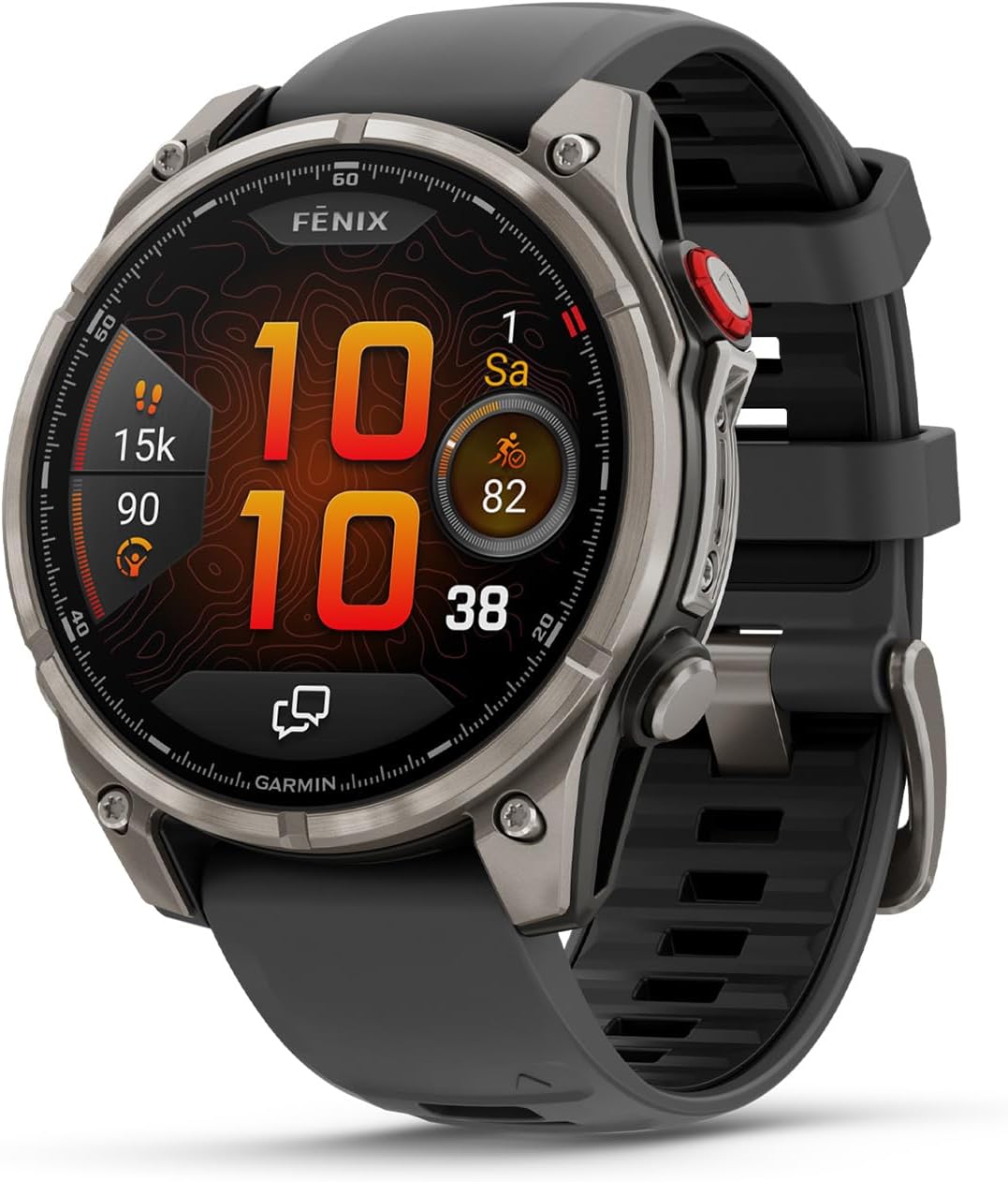
- Exceptional Brightness and Clarity: The 1.4-inch MicroLED display delivers outstanding brightness and unprecedented clarity, particularly in bright outdoor conditions, making it ideal for elite athletes and outdoor adventurers.
- High Dynamic Contrast and Vivid Colours: The display provides high dynamic contrast and vivid colour saturation, contributing to a superior visual experience.
- High Pixel Density: With a pixel density of 326 PPI, the display matches the resolution of Garmin’s other premium smartwatches, ensuring sharp and detailed visuals.
- Superior Image Quality: The MicroLED display, driven by AUO’s proprietary LTPS active matrix backplane, offers exceptional image quality.
- Rapid Response Time: The display has a fast response time, enhancing performance for dynamic activities and user interactions.
- Extended Lifespan: MicroLED technology is claimed to have a longer lifespan than other display technologies.
- Environmental Adaptability: The display performs exceptionally well across diverse environments, from sun-drenched mountain trails to nighttime runs and extreme sports conditions.
That is a positive and compelling list. Particularly, the environmental adaptability, speed and general image quality. But something is missing.
More generally, it is broadly accepted that the additional benefits of microLED are that it:
- Consumes less power due to self-emissive pixels that don’t require a backlight.
- Minimal burn-in risk because they use inorganic materials.
- Maintain consistent colour and brightness at wide viewing angles.
- Generate less heat, which is ideal for compact devices.
OK, the last two might have been overlooked for a press release. However, the mitigated burn-in risk is a big one. Why wasn’t that mentioned? And that’s made more ominous by the blatant omission of the daddy of all benefits – lower power consumption. That’s the whole point of microLED on a wearable. Almost.
The lack of a battery performance claim in the press release then backs up what we see in the Fenix 8 Pro microLED specs – battery consumption is decimated in almost all modes.
So I investigated further, starting with AUO’s site to see what claims they make about their product’s energy efficiency. Energy savings from microLEDs are an industry-wide feature that will be splashed all over their site, right? You guessed it, I couldn’t find anything anywhere. At least not easily. I dug more deeply into a few of their blogs…phew! I wasn’t imagining things; there it was
Direct Quotes from AUO
-
From May 13, 2024: AUO states, “Micro LED display technology stands out with its high resolution, high brightness, low power consumption, and high reliability features, positioning it as the best solution for next-generation displays.” auo.com

-
From May 22, 2023: AUO describes MicroLED as offering “higher resolution, increased brightness, lower power consumption, and enhanced reliability.” auo.com

I wonder if those posts will be edited in a few days? Luckily, I’ve added a screenshot, above ;-). Let’s see.
Industry Expert Speaks
Let’s clear a few things up first.
Firstly, the brightness performance isn’t unique to microLED. Whilst Garmin’s 4,500 nit claims are market-leading and super-impressive, it’s not linked to the tech per se. Existing AMOLED displays can and have gone even higher than that, albeit not on wearables. For example, some smartphones have 6,000 nit AMOLED displays. The tech can do it.
Similarly, Garmin claims in its marketing materials that visibility is good from tight angles.

This claim is further backed up by Dcrainmaker’s images comparing different Garmin models, which show that angled visibility is superior. Great, I’m not doubting that.
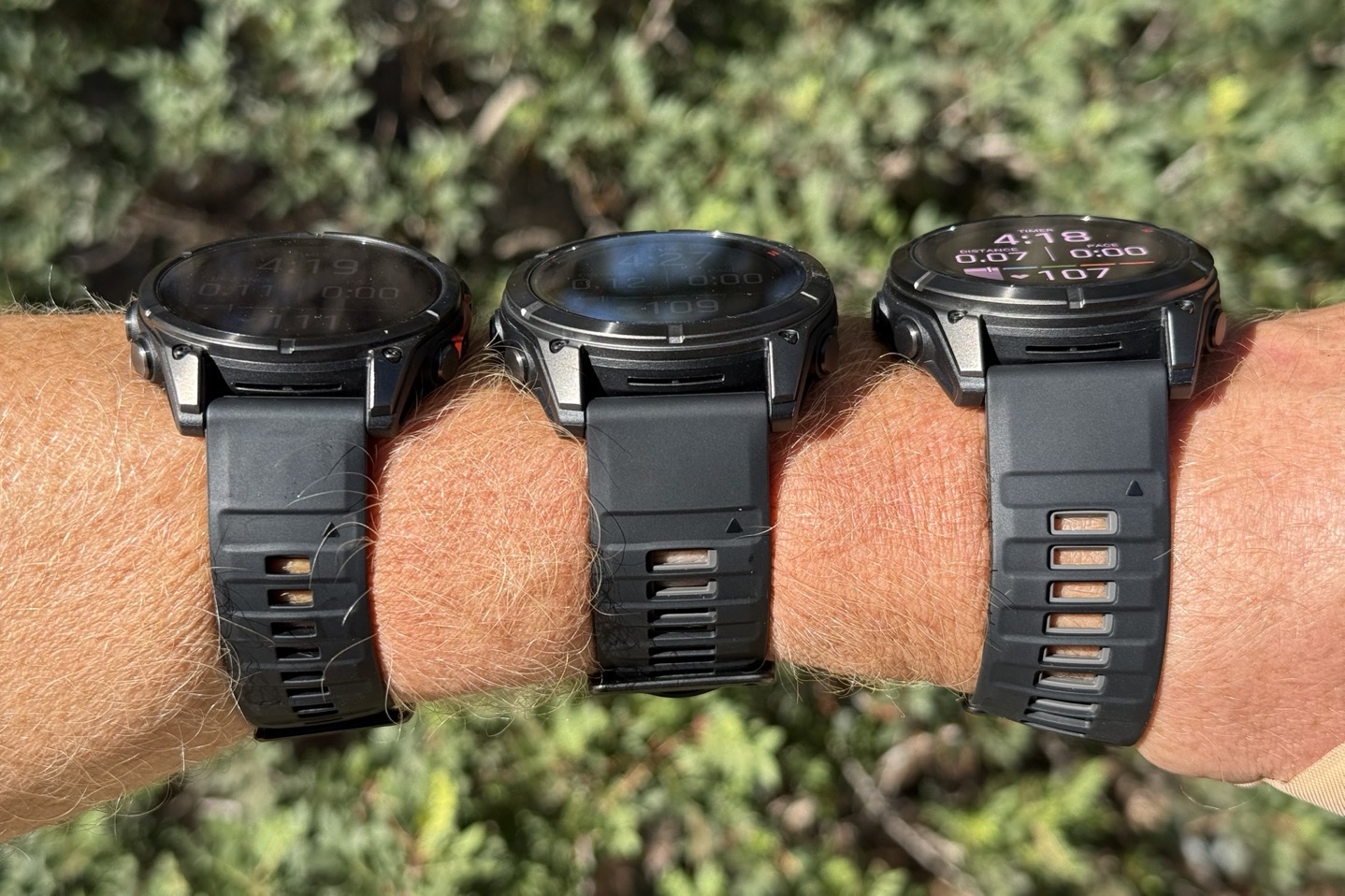
But this is also not an inherent feature unique to microLED. AMOLED can do it as well.
Battery Performance
So we wanted to try to work out the reasons why battery life deteriorated, and this is what we (he!…my contact) came up with:
- The specs imply the microLED consumes about 3x the energy of an AMOLED display of the same size
- Garmin may measure battery performance at full brightness and compare it to the full brightness from AMOLED; the latter would be below 3,000 nits. However, this is unlikely as Garmin has already introduced brightness-reducing techniques when the watch is in various states. Full brightness for extended periods is not a real-world scenario, but this could play a part when brightness is cranked to the max.
- microLED prototypes have been tested by companies and shown to have lower consumption. I guess the clue is in the word ‘prototype’.
- The assumption is that the main problem is immature production lines and supply chains yielding subpar displays that are not yet on par with AMOLED
- In these kinds of wearable displays, 70% of the energy is typically lost in the backplane, with only 30% consumed by the light-emitting frontplane. If the backplane of the microLED display is unoptimised, it could lead to significantly higher system power consumption. The guess is that the problem lies here.
Other battery problems and fixes are tracked in the watch battery life hub.

Take Out
There’s no definitive takeout here for once.
Through firmware, it’s possible that Garmin could make display integration and fine-tuning fixes that will boost performance to ‘normal’ levels.
More likely, the issue is in the quality of the display. After all, these are known to suffer high failure rates, too. Perhaps, as the source says, the entire manufacturing supply chain needs improvements at multiple points.
It seems unlikely that Fenix 8 Pro microLED’s battery life will improve through firmware. So we await the next wearable to try their luck with this new tech, perhaps Samsung or one of the Chinese companies will be next?
Perhaps these issues also explain why Apple last year backed out of its contractual commitments to microLED on Watch Ultra (3/4)
This is a big disappointment for me.
Tech is hard to do sometimes. Perhaps sometimes, we overlook the difficulties of creating technological wonders on our wrists.
Samsung Demonstrates microLED Watch – Garmin & TAG to follow
Full specifications and battery life for all three Pro variants: Garmin Fenix 8 Pro specifications.
Sources:
- AUO Press release
Last Updated on 3 October 2026 by tfk the5krunner
Small things I always use
- Garmin 90-degree charging adapter: Charges your Garmin from any USB-C cable. Essential when travelling. I use one.
- Body Glide: The blue anti-chafe stick swimmers and runners carry. I use it.
- Speedo earplugs: Fewer ear infections and no cold-water dizziness. I use them.
- Dryrobe Advance: My winter changing robe for open-water swims. I use one. A cheaper option is the AONYIYI changing robe.
- Maurten: Race fuel that stays easy on the stomach. I use them.
- Garmin charging puck: The quickest way to top up before a session. I use one.
- Injinji: Toe socks that stop rubbing, so you run more. I use them.
- Ultimate toe protectors: Stop black toenails on long runs. They work. I use them.
- Compressport R2 v2 calf sleeves: My calf sleeves of choice. I use them.
- Cellucor C4: My pre-workout before hard sessions.
- TPU tubes: Schwalbe Aerothan, Tubolito and Pirelli SmarTube. Light, tiny spares. I use all three.
- G8 insoles: Adjustable insoles that are good. I use them.
- Cycplus Cube: A 97g electric pump that gets a road tyre rideable in two minutes. I carry one. 5% off with code THE5KRUNNER.
Watches and sensors
- Polar H10: My daily driver for waking HRV.
- Polar Verity Sense: My backup arm-worn HR sensor.
- Nomad bedside charger: Charges my iPhone and Apple Watch overnight. I use it, and many of their bands.
- Train.Red: The best muscle oxygen sensor I’ve used.
- Tymewear: Accurate heart rate and reliable ventilatory zones. I use it to pace endurance rides over an hour.
- Garmin Forerunner 970: A pro-grade triathlon watch. I use this.
- Apple Watch Ultra 4: My daily smartwatch. No phone needed on rides.
- Garmin Fenix 9 Pro: I’ve just bought one.
On the bike
- Continental GP5000 for everyday riding, and Aero 111 on the front for special occasions.
- Helmets: Specialized S-Works Evade 3 for road riding, and Rudy Project Wing for TT-style races. I use both.
- Ravemen FR300: A front light that mounts under your Garmin or Wahoo. I use one.
- Wahoo TRACKR Radar: I use it on one bike and Varia on the other. They perform the same.
- Garmin Varia RTL515: Radar that warns you of cars from behind. I use this model.
- Wahoo ELEMNT Roam 3: The bike computer that’s easy to use. I use mine on most rides.
- Favero Assioma Pro RS2: Accurate power pedals that swap easily between bikes. I use this model.
Home and indoor training
- NPE Runn: Makes my basic treadmill smart, sending more accurate speed and distance to my watch and Zwift. I use it.
- Google Wifi: Keeps Zwift connected in my pain cave. I use it.
- Apple TV 4K: Zwift on the big screen. I use two.
- Google Nest Doorbell (wired, 2nd gen): My video doorbell, running in both Google Home and Apple Home. I use it.
Health, recovery and sleep
- FreeStyle Libre 3 Plus: Shows how my blood sugar responds to diet.
- hDrop: Measures my sweat loss in summer and indoors.
- Fourth Frontier Zone: Checks my heart under load in hard sessions.
- Oura Ring 5: My partner’s recovery tracker of choice.
- Kineon MOVE+: Red light therapy for niggles. It works.
- Eight Sleep: A cooling mattress cover my partner and I use nightly.
Reader-Powered Content

This content is not sponsored. It’s mostly me behind the labour of love, which is this site, and I appreciate everyone who supports it.
Support the site: Follow (free, fewer ads) · Subscribe (paid, ad-free) · Buy Me A Coffee ❤️
Written by real people, with AI assistance. Fact-checked and verified for originality. See the Editorial Policy. FTC: Affiliate Disclosure — some links pay commission. As an Amazon Associate, I earn from qualifying purchases.
tfk is the founder and author of the5krunner, an independent endurance sports technology publication. With 20 years of hands-on testing of GPS watches and wearables, and competing in triathlons at an international age-group level, tfk provides in-depth expert analysis of fitness technology for serious athletes and endurance sport competitors. ID

Don’t worry, once the Fenix 9 will be released, Garmin will ditch the F8 (never to be mentioned again), cut almost all of the support and all of the future updates, and will present a new MicroLed dispaly with far better battery life. Once the FX is released and the priced raised to 2499$, all is bright and shiny ;-).
All in all, this was another disappointing release from Garmin.
“The display has a fast response time, enhancing performance for dynamic activities and user interactions.”
Great, we will be able to take even better advantage of the laggy maps and outdated CPU of this 2000$ watch 😀
you’re being harsh on garmin.
the laggy map rendering will likely increase from 10 seconds to 9.8 with this new screen tech.
Display response times are in milliseconds.
So now when we increase speed for an interval, instead of taking 5 seconds to show the speed change, it will only only take 4.999 seconds. Game changing lol!
So, in conclusion, feels like Garmin should have invested more into next gen battery tech first and not try to one up Apple.
Oh well, to anyone liking the tech I hope you enjoy it, but at that price I’m worried the base Fenix 9 is going to be 1.5k or more and not sure if it’s going to be worth it in the end (I really hope it is tho).
Sadly it would seem I’ll have to look elsewhere afer my F7x Pro dies out.
maybe
garmin has to do r&d and invests hevily in that, perhaps why it is the market leader. this could be one of those occasions where they wanted to try to recoup some of the investment
it’s also a good move to put the tech out there and see how it fares. it appears to be in a workable condition albeit not delivering the benefits we hoped for. (power saving)
apple supposedly decided against the tech over a year ago. maybe this is why.
i cant see microled being the base screen display for fenix 9. it wont be available at that scale even in 18 months time. it will be an option. maybe 9 pro or 1o (I cant beleive i just wrote about fenix 10!! I like a bit of specualtion and future thinking but that is a model number too far)
Let’s face it – this watch is a disaster on multiple fronts:
– battery
– thickness
– same old „C64“ CPU
– price
As some people pointed out in the Garmin forum, the only explanation is it’s not really meant to be bought. Just a tech demonstration / prototype – maybe the CEO was obsessed over it and forced his engineers to build it no matter what.
Refined version:
Totally agree. But it’s also a deliberate marketing move. Garmin has long focused on incremental display updates while keeping most of the hardware unchanged. Now they can frame it as an “improvement” and justify a higher price.
Most people would be totally fine with Garmin just focusing on incremental display updates and changing little else, but unfortunately they haven’t even really been doing that. The 8 pro screens are the same as the epix pro screens. The microled is innovative (on paper) but 300% faster battery drain it causes makes it a no go for almost everyone, I suspect hardly anyone is going to buy it.