
Fitbit’s New AI Coach is Here: Why Catching Whoop Changes Everything.
Google’s new Fitbit app and AI-powered Coach are rolling out now, signalling a fundamental shift in how health and fitness tech works in mainstream wearable apps.
I want to argue that this is more than an update—it represents the turning point where LLM-based AI becomes a core, non-negotiable feature for any serious health and fitness application.
Most of the stories you will read about the Fitbit app are feature-focused, not future-focused and not experience-focused.
Industry commentators too often overlook the fundamental behavioural changes that have already started between consumers and their health and fitness apps. We are moving from repetitive data interactions to dynamic conversations driven by personal insights.
The core premise, that Google seems to have grasped, is that we have moved from the ‘Data Capture’ era into the ‘Health and Fitness Knowledge’ era. For over two decades, fitness tech has presented us with ever more pages of information, lines of data, and new unfathomable metrics. The tech companies now have the tools to cut through information overload and start to give us truly actionable insights and a deep understanding of our bodies and capabilities.
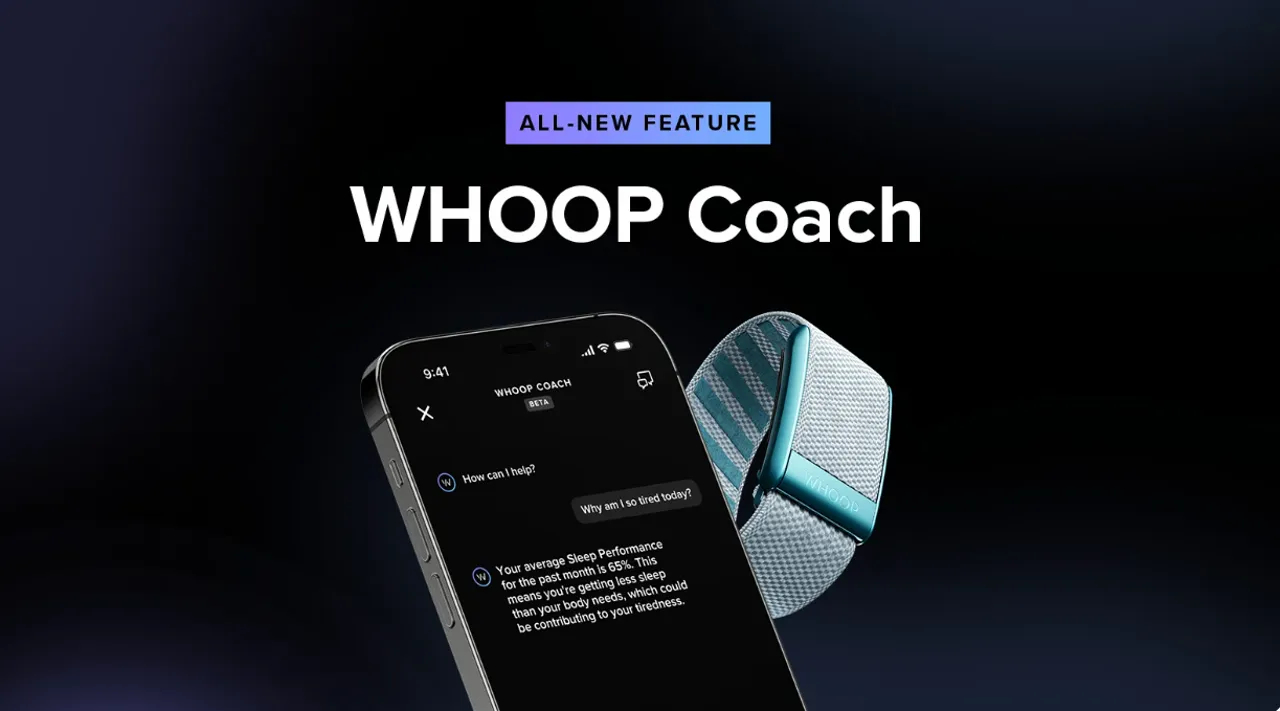
Whoop grasped that over two years ago with Whoop Coach. Google’s Fitbit Coach appears to take a similar approach today. The competition will keep producing more, ever-prettier charts tomorrow, that only a minority of consumers have the time and ability to understand and digest.
This marks a fundamental shift.
The Core Similarity: AI-Powered Conversational Coaching
Google’s Gemini AI powers Fitbit’s new Coach, whereas Whoop Coach is powered by OpenAI’s GPT-4. The precise AI tool is largely irrelevant; what is relevant is the interaction mechanism and ‘intelligence’ of the AI.
Fitbit Coach relies on conversational access. The precise mechanism of the interaction also doesn’t matter – it can be voice or keyboard. What matters is that the AI understands the intent (question), looks at your real-time and historical data, and responds with conversational recommendations, such as “How to improve your VO2max.” More complex associations can also be queried, such as when you ask Fitbit Coach, “How has my recent stress management score correlated with my average deep sleep duration and my training readiness for my long runs over the last two weeks?” – that’s a highly involved question which couldn’t easily be answered by old tech.
Understanding that these types of AI responses are not hallucinated is key. It’s your actual data with relatively straightforward math applied by the AI. In Whoop’s case, the knowledge and insights are bound by a library of scientific papers, and I would assume something similar from Google.
Over the last few years, you may have seen just about every other wellness and sports data company introducing their AI solution, which often amounts to “Yay, you ran 5% faster than normal today.” These systems are typically based on traditional Machine Learning (ML) or simple algorithms. This approach does not leverage the conversational and contextual intelligence of a true LLM, and it is often a finite, pre-defined decision tree rather than a dynamic coach.
The Shift from Daily Metrics to Holistic Planning
The new Fitbit and Whoop coaches both structure data around long-term load (cumulative effort), readiness and dynamic adaptation, a far cry from simple tracking of calories and logging of steps.
Fitbit is subtly repositioning its emphasis towards weekly trends and aggregate shifts rather than day-to-day insights, e.g. Cardio Load is changed to a Weekly Value, and its Coach dynamically adjusts your plan based on changes to training load, readiness, and overnight recovery data.
Several of the latest changes (e.g. adaptive training) are not new, but how they are layered with an LLM is the approach that most companies will eventually need to take.
The New Look and Missing Pieces
The Fitbit app features a sleek makeover that organises a unified experience over four main tabs: Today, Fitness, Sleep, and Health. The organisation makes sense and differs from the layout adopted by Whoop – there’s nothing especially new there. However, each component has Gemini baked in – for example, the training plans are adapted weekly, Sleep incorporates conversational answers to questions like “Why did I wake up tired?” or summarises sleep patterns and their impact on fitness metrics.
Fitbit’s app is far from finalised, and the company notes several omissions currently ‘in the works’, including Stress Management Score, Cardio Fitness Score, Friends, groups, leaderboards, and manual editing of sleep sessions.
Key challenges for Google-Fitbit
I like where the company is heading. However, many of its existing customers will be acutely concerned about privacy and data security. In contrast, others will love their current experience and not want to change (for now).
Google has offered reassurances on the former and the ability to switch back to the old app – at least for now. They explicitly stated the AI Coach data will not be used for Google Ads—a critical reassurance for their user base.
Conclusion and Outlook
We have all heard that AI will change the world we experience, and we all believe or fear it to varying degrees.
Fitness and wellness companies appear to have reacted to the seismic change currently happening to their business through a spectrum of responses, ranging from:
- Basic ML/Algorithms: Pretending to their customers that algorithms and Machine Learning (ML) are AI (e.g., with pre-canned responses).
- Token Inclusion: Token inclusion of AI (e.g., a single chat box feature), a tick box to justify a marketing campaign.
- Core LLM Integration: Seamlessly baking in a large language model (LLM) throughout the core app experience (e.g., Whoop, Fitbit).
The key here is that AI is not another menu option. It is a foundational conversational model that drives the entire experience. Whoop seemed to ‘get it’ two years ago; Google Fitbit appears to have ‘got it’ too.
Whether other major sports and fitness companies have truly got it remains to be seen. I’ve seen nothing from Coros, Garmin, Strava, Suunto, Polar and many others to convince me they understand the needed change to their apps or that the smaller legacy brands have the resources to deliver it. What have they done in the last two years? Certainly, Strava and Garmin have already released AI features. Still, using their AI tools, you are left with the realisation that they cover discrete, pre-defined aspects of health/fitness and live behind a paywall, rather than offering a true conversational and holistic experience.
Google seems to be following a cunning plan. The latest Pixel watches and Wear OS place the company in a good place after years of neglect following the Fitbit acquisition (2019). Baking in AI to the app experience and renewing Fitbit hardware in 2026 might put Google-Fitbit in a surprisingly better place a year from now.
The Fitbit brand will be an interesting one to watch. For the full picture of the Google Fitbit ecosystem including Pixel Watch and Google Health: Google Fitbit and Wear OS hub.
Photo: Jeremy Lapak, Unsplash
Last Updated on 13 June 2026 by the5krunner
My favourite kit and nutrition
- Garmin Fenix 9 Pro — I’ve just bought one.
- Injinji – Runners protect your toes. Avoid discomfort and minor injury. Run more. Run faster. I use them.
- Garmin 90-degree charging adapter — A small keyring adapter you can use anywhere. Essential when away. I use one.
- Garmin charging puck — the fastest and most reliable way to top up your Garmin before a session. I use one.
- Ravemen FR300 — Front light that mounts directly under your Garmin or Wahoo head unit. Keeps your bars clean and your beam pointed where it matters. I use one.
- Body Glide – The blue anti-chafe stick that all swimmers and many runners use. I use it.
- Maurten — The race nutrition trusted by elite athletes. Gels and drink mixes engineered to be easy on the stomach. I use them.
- Garmin Varia RTL515 — A radar rear light that alerts you to vehicles approaching from behind. Pairs with your Edge or Wahoo. I use this model.
- Favero Assioma Pro RS2 — The power-meter pedals most serious cyclists choose. Accurate, easy to move between bikes. I use this model.
- Garmin Forerunner 970 — A serious choice for a pro-grade triathlon watch. I use this.
- Polar H10 — My daily driver for accurate, waking HRV readings.
- Wahoo ELEMNT Roam 3 — The bike computer that has the feature Garmin lacks: usability. I use mine on most rides.
Reader-Powered Content

This content is not sponsored. It’s mostly me behind the labour of love, which is this site, and I appreciate everyone who supports it.
Support the site: Follow (free, fewer ads) · Subscribe (paid, ad-free) · Buy Me A Coffee ❤️
All articles are written by real people, fact-checked, and verified for originality. See the Editorial Policy. FTC: Affiliate Disclosure — some links pay commission. As an Amazon Associate, I earn from qualifying purchases.
tfk is the founder and author of the5krunner, an independent endurance sports technology publication. With 20 years of hands-on testing of GPS watches and wearables, and competing in triathlons at an international age-group level, tfk provides in-depth expert analysis of fitness technology for serious athletes and endurance sport competitors. ID

Are they insights though? Or is it just a new interface on top of old models that adds all that “artificial confidence” of hallucinations…
Not that this would not be completely without value, there’s a huge amount of placebo in training plans. In particular on the lower 80% of the load spectrum, where the simple truth is that just about anything that makes you train more and/or harder will make you stronger and the difference between the best and the worst training plan (or perhaps call or training instruction, to reflect the nature of stuff that is more dynamic than a plan) is much smaller than sellers of training science would want to make us believe. When we accept that, the next question is how successful an LLM will be at convincing us to the point of placebo kicking in, compared not only to human intelligence, but also to automated training instruction that does not pretend, that’s openly algorithmic.
But from a good human trainer I’d expect three qualities: (q1) the actual quality of the instruction, and by proxy the mathematical model chosen to create the instruction (this is the Big Unknown that training science is forever chasing), (q2) how well q1 is “sold”, be it actually good q1 or mostly placebo as in “even the worst training is much better than no training” and (q3) how well the model used for q1 is protected from bad data, as in garbage in/garbage out. A good human trainer will look at inputs and prevent bad data from entering the formulas. An HRM completely missing short intervals (typical error of OHRM), logging way too high heart rates due to a loose jersey flapping in the wind, a powermeter having a bad day and logging bogus numbers. Conventional mathematical models can only ever be as good as the data source has no errors, garbage in/garbage out. AI could be super helpful in detecting bogus data for exclusion. But is that something the makers of this new generation of ai training software even try? I suspect they don’t, just wrapping Old “q1” models in fancy llm frontends (not really that much different from the trash babble feature on Strava), *perhaps* trying to also make q2 more “intelligent”. But that q3 thing, input QA? I kind of don’t it…
the unbound LLMs obviously do hallucinate.
however, these kinds of tools work on your fixed data sets and are controlled. i’ve never SEEN one hallucinate (they might, IDK)
bogus data: that is a good point i hadn’t thought of. I would imagine that the GIGO principle applies. so AI would be needed to clean the data as it is recorded or soon after. Whoop and polar do something like that (maybe not AI).
Is the true value of AI simply to motivate people to exercise more? So it’s more a marketing tool than delivering new insights that make a physiological difference (maybe)
the point i’m trying to make in the article (maybe i failed!!) is that what constitutes a normal interface is changing.
how we interact with apps will change/is changing
there will be no one single way it changes but, for example, you might change from manually scrolling through your 21x1km laps in a hm and verbally ask the AI to show the outlier performances and reasons for the performnace change eg hill, cadence, weather, wind: if there was more exotic data like SmO2 and hydration then you can perhaps imagine more profound insights. point being you wouldn’t have to scroll though numerous pages and charts or construct your own analyses.
The single key ingredient of motivation is trust. That’s true about any training instruction, across the whole field, no matter if it’s a human coach, a glorified spreadsheet coaching algorithm, a fancy ai construct combining conventional rules and generative AI, a simple babblebot LLM (hello Strava 🙄) or even something as mundane as a training plan in a printed magazine. When the instruction succeeds at creating trust it will have effect relative to absence of instruction, if it fails, well, that’s it.
Will people trust AI? (current incarnations of AI?) That remains to be seen. The thing with trust is that it’s much easier lost than gained. If it reminds me even the tiniest bit of the embarrassment that is Strava’s venture into LLM, I might end up trusting it less than training by diceroll (which I presume has never been scientifically tested because it would be so hard to make money off)