Garmin ECG Accuracy Beaten by Amazfit Reports Meta-Analysis
Garmin takes a medical-grade approach to detecting Atrial Fibrillation (AFib). Its heart rhythm checking tool, the ECG app, is approved by the FDA and other regulators to reliably detect AFib.
In official clinical tests, the Garmin ECG app demonstrated extremely high accuracy, detecting AFib 99.5% of the time and a normal rhythm 100% of the time when the signal was clear.
There’s one major catch.
The Garmin ECG test is “on-demand“—you must manually start it. The watch does not continuously monitor your heart rhythm in the background. This limits its ability to catch AFib events that are intermittent or happen while you sleep.
Active vs. Passive AFib Monitoring
AFib is often intermittent, meaning it comes and goes. For many users, a watch that constantly scans the heart rhythm in the background (Passive Monitoring) is more valuable than one that relies on manual readings (Active Monitoring) only when the wearer feels symptoms.
Several of Garmin’s competitors, notably Apple and Amazfit, employ a similar passive approach. Instead of an ECG (which measures electrical signals), they analyse the PPG waveform. PPG, or Photoplethysmography, is the method used by traditional optical heart rate monitors to check for irregular pulse rhythms indicative of AFib.
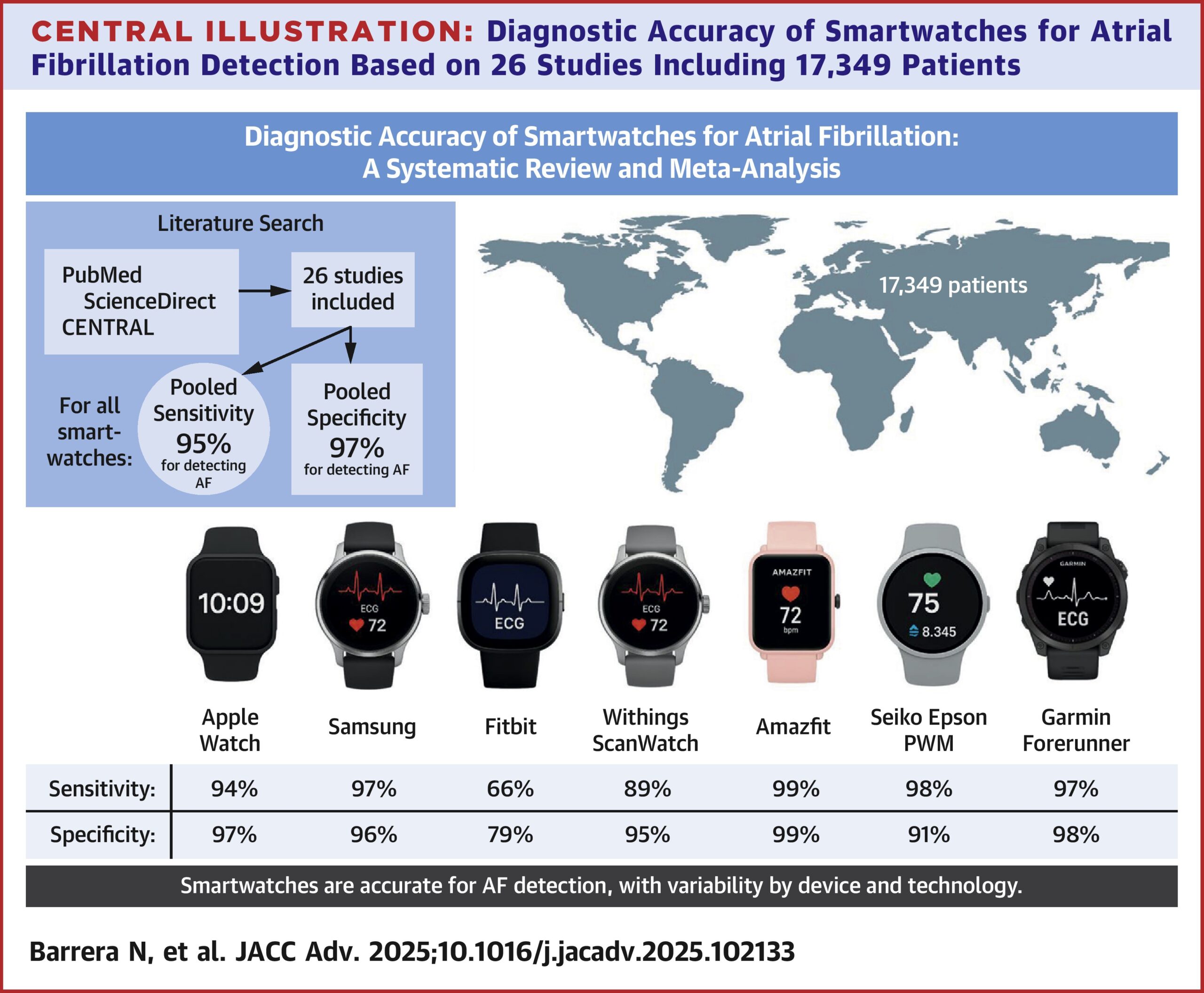
The large-scale meta-analysis by Barrera et al. (2025) confirmed that the PPG-based method achieves diagnostic accuracy comparable to that of ECG. Specifically, one high-quality study of an Amazfit PPG device included in the analysis reported excellent overall diagnostic accuracy for AFib detection.
Amazfit: Superior Performance in Meta-Analysis
The Barrera et al. (2025) meta-analysis found that the Amazfit brand showed excellent overall diagnostic accuracy for AFib detection.
Amazfit: Key Stats
| Metric | Result | Meaning |
|---|---|---|
| Overall Accuracy | 98% (AUC = 0.98) | How often does the watch correctly identify AFib or a normal rhythm? |
| Sensitivity | 98.68% | The chance of correctly identifying AFib when AFib is present (avoiding false negatives). |
| Specificity | 98.87% | The chance of correctly identifying a normal rhythm when one is present (avoiding false positives). |
The Head-to-Head Comparisons
The analysis suggested Amazfit’s superior performance, including:
- Significantly higher odds of diagnosing AFib than both the Apple Watch and Withings.
- Comparable accuracy to the leading Samsung smartwatch.
Crucially, the study also found a clear advantage over some older Garmin devices that rely only on PPG. For instance, Amazfit’s 98.87% specificity was significantly better than the 88.24% recorded for the Garmin Forerunner 945 (which uses an older Gen 4 PPG sensor, not the newer Elevate Gen 5 ECG).
Note: It’s important to remember that most of the head-to-head results cited above compare Amazfit’s PPG-based detection to other manufacturers’ PPG detection. Garmin’s approved, on-demand ECG remains a separate, highly accurate test with its own limitations. The analysis only supports the idea that the better-implemented PPG systems (like Amazfit’s) can rival ECGs for general diagnostic accuracy.
Noise, False Alarms, and Trust
A major challenge for all smartwatches is the high rate of false alerts. These often happen because the watch confuses actual AFib with harmless irregular heartbeats (like a premature contraction) or simple noise from movement and poor skin contact.
False AFib alerts can be harmful. Studies show that repeated false positives can lead to a significant decrease in a patient’s self-reported physical health, making them less confident in managing their chronic symptoms [Tran et al., 2023].
Even the highly accurate Garmin ECG app is not immune to signal issues. Garmin correctly instructs users to remain still and ensure good contact, but one clinical study still found 11.5% of recordings were inconclusive. It is challenging to get a clean reading in a real-world setting.
Mathematical Gymnastics
I’m not entirely convinced.
I’m sure the researchers understand statistics better than I do. However, I can’t see how using Garmin’s prior-generation Elevate 4 PPG sensor, along with other PPG sensors, is a good way to determine accuracy against ECG.
- What kind of accuracy or agreement between the PPG sensors is determined en masse for it to be compared to ECG?
- Presumably, Garmin’s Elevate Gen 5 offers better PPG and, as noted, accurate on-demand ECG.
Conclusion: Active ECG vs. Passive PPG — The Real-World Winner
The distinction between Active ECG and Passive PPG monitoring determines real-world diagnostic success for intermittent conditions, such as AFib.
- Garmin’s Limitation: While the Garmin ECG app offers near-perfect accuracy (99.5% AFib detection) when manually initiated with a perfect signal, its on-demand nature limits the chances of catching intermittent AFib events.
- Amazfit’s Advantage: The Barrera et al. meta-analysis supports the notion that a well-executed, continuous PPG system provides superior overall diagnostic performance in real-world settings.
The Key Takeaway: For a consumer seeking the highest probability of detecting an AFib event throughout the day and night, a continuous system, such as Amazfit, Samsung, or Apple, provides a better overall diagnostic solution than a highly accurate but manual one.
Last Updated on 30 January 2026 by the5krunner
Reader-Powered Content

This content is not sponsored. It’s mostly me behind the labour of love, which is this site, and I appreciate everyone who supports it.
Support the site: Follow (free, fewer ads) · Subscribe (paid, ad-free) · Buy Me A Coffee ❤️
All articles are written by real people, fact-checked, and verified for originality. See the Editorial Policy. FTC: Affiliate Disclosure — some links pay commission. As an Amazon Associate, I earn from qualifying purchases.

tfk is the founder and author of the5krunner, an independent endurance sports technology publication. With 20 years of hands-on testing of GPS watches and wearables, and competing in triathlons at an international age-group level, tfk provides in-depth expert analysis of fitness technology for serious athletes and endurance sport competitors.

Why choose Garmin for the title when you fawn over Apple so much. Amazfit beats Garmin just but is way above Apple and Fitbit?
It’s good to see Amazfit doing so well in the fitness and health market, it would be better if they didn’t “one and done” on their watch software but offer long term updates.
With the cost of living biting, the bigger brands will starting losing out more, hopefully they become more established like coros in the sports market
more people here are interested in the Garmin angle.
Garmin is great for my sports.
Apple is great for the rest of it.
Apparently I was a Garmin fanboy a few years ago. #Shrug
hi, not sure what you did to the website but I can’t open the articles in a new tab, like the right click is not working on the tiles. It makes navigating through the website very difficult, you have to enter each link separately, read, go back and enter next link, instead of just quickly opening the links you want to read in new tabs and reading them in separate tabs
inadvertent impact from another change
shoudl work as before now
ty for the heads up
yeah it is ok now. big thanks!
Several comments on the meta-analysis in the article under discussion:
1. GARMIN watches were used in a single article (published in 2022) for 128 monitored events
2. AMAZFIT watches were used in two articles (published in 2025 = this year) for 15,687 monitored events.
https://www.jacc.org/cms/asset/ea8fc876-5f23-4e93-bfa8-ee0f91848572/gr3.jpg
Hi,
What is the exact reference of this Amazfit connected watch ?
Regards
exact models are not referenced in the source: https://www.jacc.org/doi/10.1016/j.jacadv.2025.102133
That is dumb
That is science. Hmmm!!!!!
I find it interesting in wider society that many people are often shut down by others who point out, “Oh but science says XYZ”.
I’m obviously pro science but have the feeling that a significant of it does not follow the scientific method. (and therefore is not science…IDK just brain dumping – cherry picking a good result from a multivariate data gathering exercise, ai produced and filed science, commerically influenced science, people who don’t name the devices they use in testing, etc)