Wahoo’s Mental Capacity Assessment: Measuring Cognitive Readiness
Wahoo’s Mental Capacity Assessment is a daily 2-3 minute cognitive test in a 90-second game format that scores your mental readiness from -100 (drained) to +100 (peak), directly adjusting your Training Capacity by up to ±12 points.
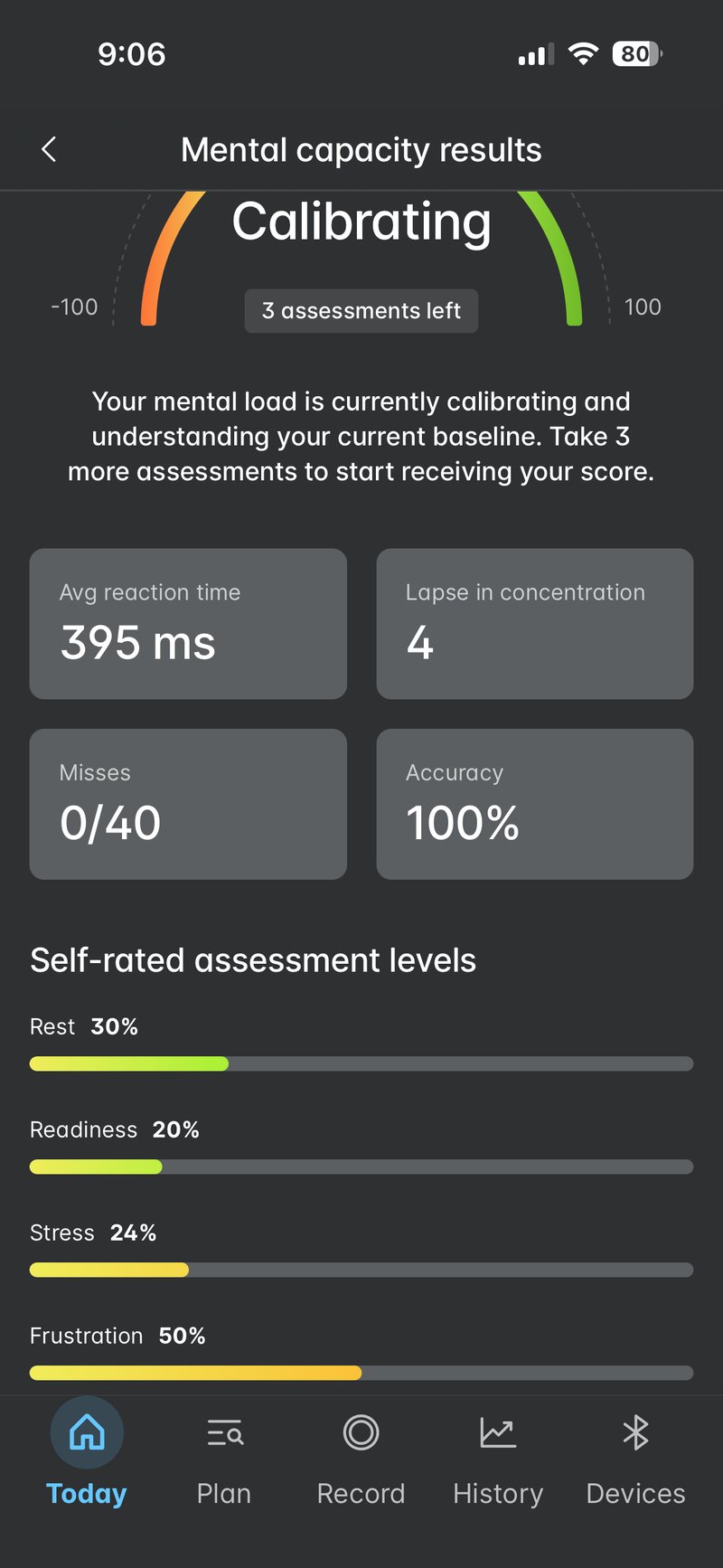
You’ll need the Wahoo app (v6.73.0) and 2 minutes a day to complete the game and answer four questions. The first 4 test results serve as a baseline and are fully calibrated after a month.
I tested it and here’s what I found.
What This Means For Your Training
This approach is a novel addition to scoring training readiness (training capacity) that I hadn’t come across before. The claimed benefit is that the results are used to adjust what the Wahoo ecosystem believes your training capacity is, and they appear to slightly adjust training goals.
This…
- Adjusts Training Capacity recommendations based on cognitive readiness
- Personalised to your baseline—compares you to yourself, not other athletes
- Quantifies mental fatigue from stress, poor sleep, and life demands
- One test per day—take it consistently at the same time for best results
How the Assessment Works
The Mental Capacity Assessment consists of two parts that take about 2 minutes.
Go/NoGo Reaction Test
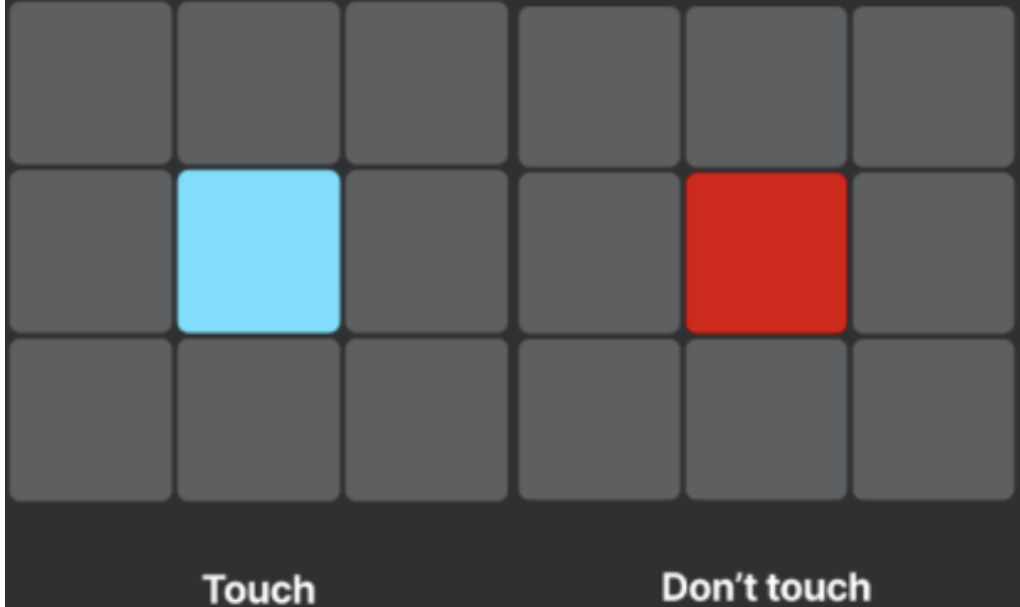
You’ll see 40 shapes appear sequentially—30 blue and 10 red. Tap the blue shapes, but don’t tap the red ones. This measures reaction time, cognitive lapses (responses slower than 500ms), and impulse control errors. It’s a simple test, and you can tell your reactions vary (the system quantifies that).
Emotional Survey
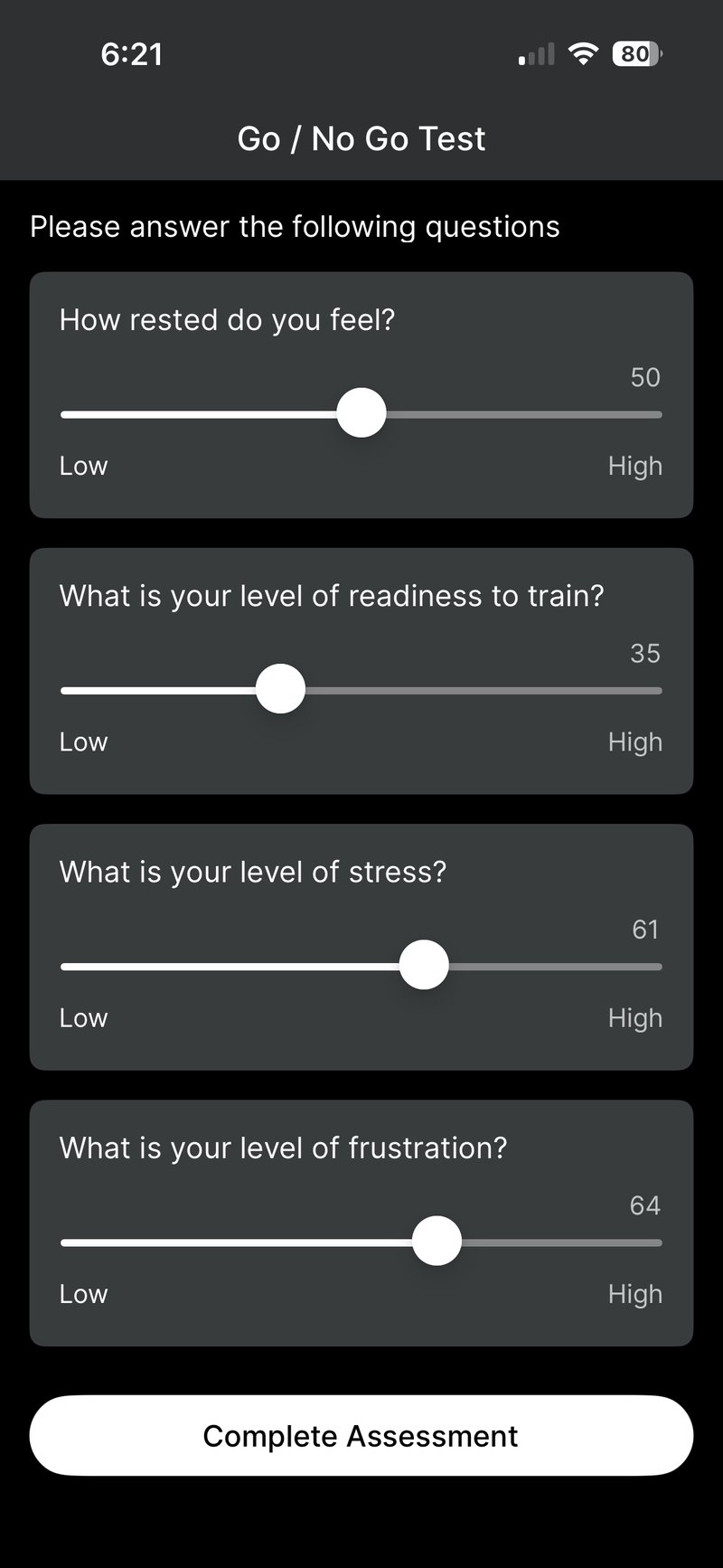
After the reaction test, you’ll rate four factors on a 0-100 scale:
- Rest: How recovered do you feel physically and mentally
- Perceived Readiness: Your motivation and eagerness to train hard
- Perceived Stress: Current stress levels from work, life, or training
- Frustration: Emotional state and mental clarity
These subjective ratings, combined with your objective reaction data, generate your daily score.
Understanding Your Score
The -100 to +100 scoring system provides immediate feedback about your mental readiness:
- +75 to +100 (Peak): Exceptional mental readiness. Ideal for breakthrough workouts, race-pace efforts, or technical work requiring sharp focus
- +25 to +74 (Above Baseline): Better than average. Ready for hard training—intervals, tempo, challenging rides
- -24 to +24 (Baseline): Normal function. Proceed with scheduled training
- -25 to -74 (Below Baseline): Mental fatigue detected. Stick to easy aerobic work or modify the intensity downward
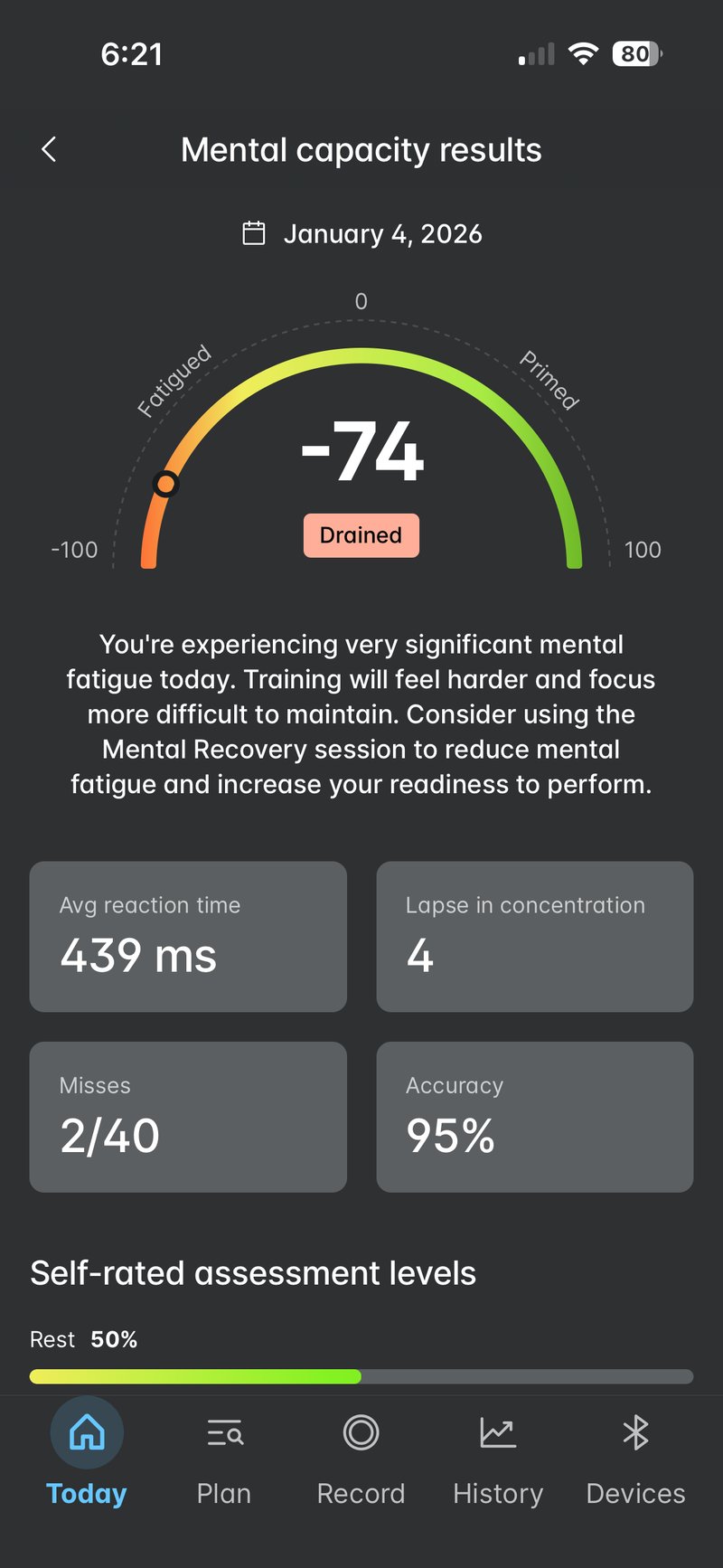
- -75 to -100 (Drained): Significant mental fatigue. Strong recommendation for rest or recovery rides only.
The Seven Data Points
Every Mental Capacity score derives from seven measurements recorded by the app:
- Trained Reaction Time: Average response speed for reactions between 100-500ms
- Lapses: Number of reactions slower than 500ms
- Misses: Taps on red shapes, false starts, or complete misses
- Subjective Rest Level: Self-reported recovery (0-100)
- Subjective Readiness Level: Self-reported motivation (0-100)
- Subjective Stress Level: Self-reported stress (0-100)
- Subjective Frustration Level: Self-reported emotional state (0-100)
I don’t know the algorithm that combines them.
Calibration Timeline
The scores essentially build a moving average score, which is assessed with your trended range – a similar approach used with many other sports physiology metrics.
- Days 1-3: Initial calibration—no score yet while the system learns your baseline cognitive patterns.
- Day 4+: You’ll receive your first personalised score. The algorithm now compares each assessment to your emerging baseline.
- Day 30+: Full calibration achieved with a rolling baseline that accounts for natural variations in your cognitive performance.
How It Impacts Training Capacity
Mental Capacity can increase or decrease your Training Capacity by up to 12 points. If you’re mentally drained (negative score), your recommended training load decreases to prevent overtraining. If you’re mentally peaked (positive score), you might be cleared for harder efforts than usual.
This integration acknowledges what athletes have always known: some days you feel “on” mentally and can push harder, other days?…less so.
My Test Results
My reaction times usually ranged from 350ms to 430ms.
If I really focused and gamified the experience in my mind, I could get my reaction times down to 200-250ms for a few goes, but I definitely couldn’t keep that up for the whole test.
After the first few tests, the novelty wore off somewhat. I made no mistakes in the earlier tests, but in the later ones, I wasn’t as focused and usually made at least one mistake per test. My worst test (shown below) was after a moderately strenuous workout, when I made 2 incorrect presses and had several reaction times over 500ms when my mind wandered. My hand was a bit cold, which may have slowed down my reaction time.
Practical Tips for Best Results
It helps to want to do well. Gamify your test. You get the fastest times when mentally pre-empting a positive press, but you then make mistakes by being unable to stop in time, resulting in a miss press. That then seems to change the nature of the randomness (!) that appears – more pauses and more red squares to not press.
- Test at the same time each day: ideally, in the morning before training and before caffeine intake.
- Don’t overthink the survey: Your first instinct is meant to be the most accurate for subjective ratings.
- Wait for calibration: Don’t make major training decisions based on scores during the first 30 days.
- Track patterns: Do Mondays always score low? Mid-week?
Limitations to Consider
Will you really do this every day? I take a morning waking HRV reading for 1-3 minutes in total. If you add the minutes up over your life, it becomes a number of days. I don’t want to double that by adding this test.
- Requires consistent testing: Miss several days and your baseline accuracy suffers. The system needs daily data to work properly.
- Single daily assessment: You can’t retest if conditions change throughout the day. Morning score sticks for training recommendations.
- Subjective components: Four of seven inputs are self-reported ratings, which can vary based on how you interpret the scales.
I tend to be sceptical of many of these kinds of tests and feedback – especially ones that combine objective and subjective measures to get a score. This particular test is based on the NASA Task Load Index (TLI). I would assume that implies there’s quite a bit of scientific research underpinning it, and the TLI is supposed to be widely used by higher-level athletes.
Bottom Line
Wahoo’s Mental Capacity Assessment quantifies an invisible factor in training readiness—your cognitive state. After 30 days of calibration, it provides personalised daily scores that directly adjust Training Capacity recommendations. The 2-3 minutes daily test gives you objective data to optimise tricky training timing, prevent overtraining, and acknowledge that mental fatigue is as real as physical fatigue.
It seems like another tool that could be useful to someone somewhere, but it’s not for me. I won’t regularly devote the time to it and prefer more objectively focused daily tests like waking HRV. Even if I did do the test, I would want a binary train/no-train outcome. Maybe some of you would like a middle ground where the targets are slightly modified?
If you’ve tested Wahoo’s Mental Capacity system, how accurate do the scores feel compared to how you actually perform?
Last Updated on 3 October 2026 by tfk the5krunner
Small things I always use
- Garmin 90-degree charging adapter: Charges your Garmin from any USB-C cable. Essential when travelling. I use one.
- Body Glide: The blue anti-chafe stick swimmers and runners carry. I use it.
- Speedo earplugs: Fewer ear infections and no cold-water dizziness. I use them.
- Dryrobe Advance: My winter changing robe for open-water swims. I use one. A cheaper option is the AONYIYI changing robe.
- Maurten: Race fuel that stays easy on the stomach. I use them.
- Garmin charging puck: The quickest way to top up before a session. I use one.
- Injinji: Toe socks that stop rubbing, so you run more. I use them.
- Ultimate toe protectors: Stop black toenails on long runs. They work. I use them.
- Compressport R2 v2 calf sleeves: My calf sleeves of choice. I use them.
- Cellucor C4: My pre-workout before hard sessions.
- TPU tubes: Schwalbe Aerothan, Tubolito and Pirelli SmarTube. Light, tiny spares. I use all three.
- G8 insoles: Adjustable insoles that are good. I use them.
- Cycplus Cube: A 97g electric pump that gets a road tyre rideable in two minutes. I carry one. 5% off with code THE5KRUNNER.
Watches and sensors
- Polar H10: My daily driver for waking HRV.
- Polar Verity Sense: My backup arm-worn HR sensor.
- Nomad bedside charger: Charges my iPhone and Apple Watch overnight. I use it, and many of their bands.
- Train.Red: The best muscle oxygen sensor I’ve used.
- Tymewear: Accurate heart rate and reliable ventilatory zones. I use it to pace endurance rides over an hour.
- Garmin Forerunner 970: A pro-grade triathlon watch. I use this.
- Apple Watch Ultra 4: My daily smartwatch. No phone needed on rides.
- Garmin Fenix 9 Pro: I’ve just bought one.
On the bike
- Continental GP5000 for everyday riding, and Aero 111 on the front for special occasions.
- Helmets: Specialized S-Works Evade 3 for road riding, and Rudy Project Wing for TT-style races. I use both.
- Ravemen FR300: A front light that mounts under your Garmin or Wahoo. I use one.
- Wahoo TRACKR Radar: I use it on one bike and Varia on the other. They perform the same.
- Garmin Varia RTL515: Radar that warns you of cars from behind. I use this model.
- Wahoo ELEMNT Roam 3: The bike computer that’s easy to use. I use mine on most rides.
- Favero Assioma Pro RS2: Accurate power pedals that swap easily between bikes. I use this model.
Home and indoor training
- NPE Runn: Makes my basic treadmill smart, sending more accurate speed and distance to my watch and Zwift. I use it.
- Google Wifi: Keeps Zwift connected in my pain cave. I use it.
- Apple TV 4K: Zwift on the big screen. I use two.
- Google Nest Doorbell (wired, 2nd gen): My video doorbell, running in both Google Home and Apple Home. I use it.
Health, recovery and sleep
- FreeStyle Libre 3 Plus: Shows how my blood sugar responds to diet.
- hDrop: Measures my sweat loss in summer and indoors.
- Fourth Frontier Zone: Checks my heart under load in hard sessions.
- Oura Ring 5: My partner’s recovery tracker of choice.
- Kineon MOVE+: Red light therapy for niggles. It works.
- Eight Sleep: A cooling mattress cover my partner and I use nightly.
Reader-Powered Content

This content is not sponsored. It’s mostly me behind the labour of love, which is this site, and I appreciate everyone who supports it.
Support the site: Follow (free, fewer ads) · Subscribe (paid, ad-free) · Buy Me A Coffee ❤️
Written by real people, with AI assistance. Fact-checked and verified for originality. See the Editorial Policy. FTC: Affiliate Disclosure — some links pay commission. As an Amazon Associate, I earn from qualifying purchases.
tfk is the founder and author of the5krunner, an independent endurance sports technology publication. With 20 years of hands-on testing of GPS watches and wearables, and competing in triathlons at an international age-group level, tfk provides in-depth expert analysis of fitness technology for serious athletes and endurance sport competitors. ID
