Apple’s Q.ai Acquisition Reshapes Apple Watch
The Tech Behind Apple’s $2 Billion Bet on understanding the intent behind your speech in any environment – Silent Speech Recognition (SSR).
Apple just made its second-largest acquisition ever. Here’s what it means for your wrist.
On 29 January 2026, Apple confirmed it had acquired Israeli startup Q.ai for approximately $2 billion, the second-largest acquisition in Apple’s history, second only to the Beats deal in 2014. The purchase signals where Apple sees the Watch heading: away from smartphone dependence and toward greater autonomy.
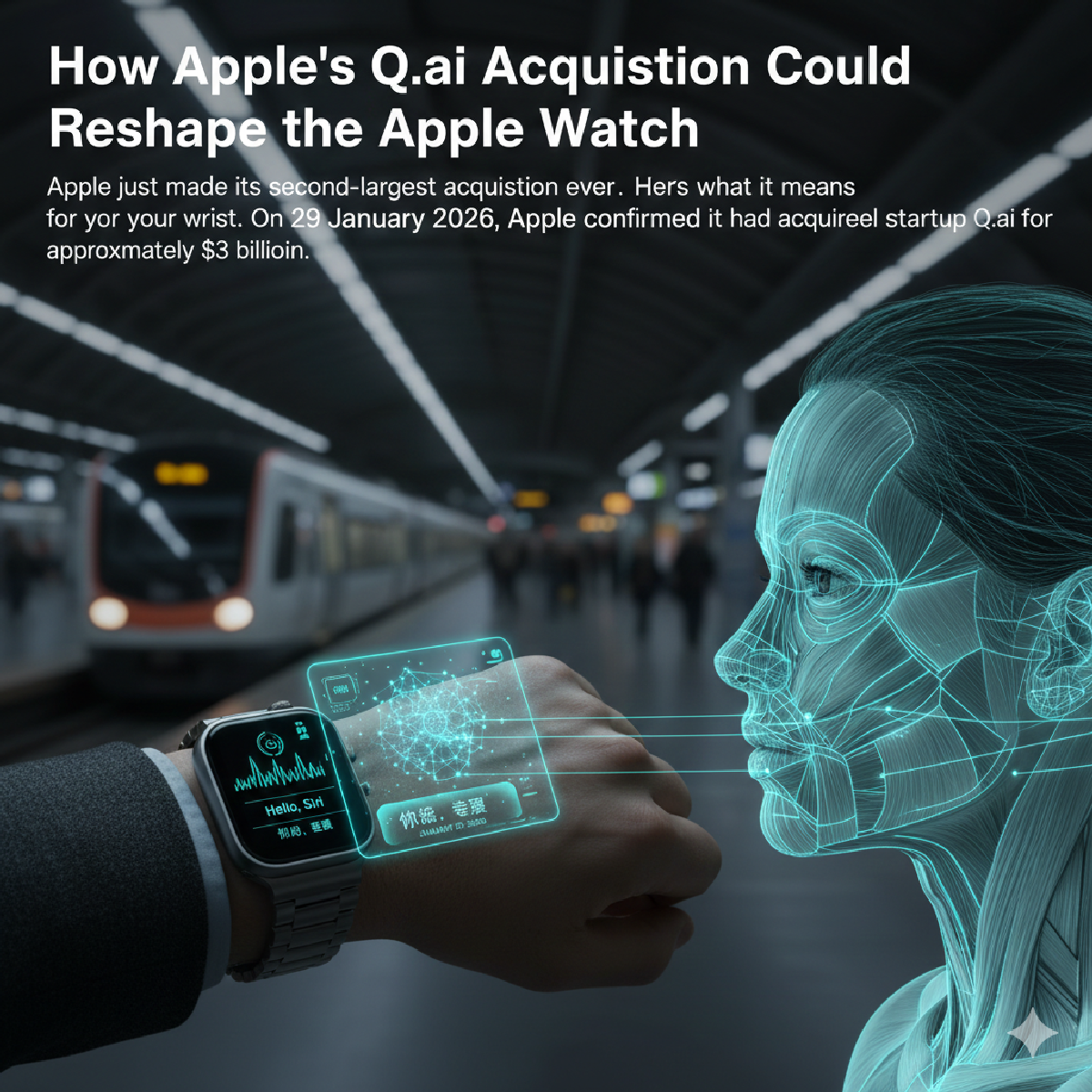
What Q.ai Actually Does
- Optical Speech Reading: Interpret muscle movement
- Audio Reconstruction: Whisper-to-text
- Environment Isolation: Filter noise
Q.ai refers to its technologies as “silent speech recognition.” Using machine learning and optical sensors, the technology interprets words by analysing micro-movements of facial muscles and skin—even when no sound is produced.
The company’s core capabilities include imaging-based speech recognition that reads muscle movements rather than listening to audio, whisper-to-speech algorithms that reconstruct intelligible commands from nearly silent input, and environmental audio cleaning that isolates your voice in challenging conditions such as wind or crowds—and crucially, can signal intent or nuance beyond the spoken word
Where Apple Watch Is Heading
Recent reports suggest Apple is developing Watch models with cameras—built under the display—expected around 2027. The goal appears to be bringing iPhone 16’s Visual Intelligence features to the wrist.
Building on Existing Translation Features
Apple only spends billions to create wholly new capabilities or push existing features into previously impossible places.
The timing here is notable. watchOS 26 introduced Live Translation in Messages, allowing the Apple Watch to automatically translate incoming messages into your preferred language and translate your responses back into it. The Translate app supports around 20 languages, with Live Translation in Messages and Calls mainly in European languages, with support for some Asian languages planned.
The Problem Q.ai Solves
Currently, reliably using Siri on an Apple Watch in noisy environments requires lifting your wrist to your face. It’s functional but hardly discreet, and doesn’t always work.
Q.ai’s technology potentially changes this equation in several ways. The camera could “read” jaw and cheek movements from wrist level, interpreting commands at a distance. You could mouth “Send a text to John” on a crowded train without saying anything aloud. The system combines optical movement data with audio to maintain accuracy when the Watch is in windy (noisy) conditions.
Beyond Voice Commands
Q.ai’s facial movement analysis can detect stress or physical exertion through micro-tensions—data that could inform health features such as Vitals or workout coaching. That might seem far-fetched, but the real future use will be transformational rather than merely improving existing features. More likely, it would create a feedback loop with your future personal AI, which would moderate its interactions with you based on its interpretations of your stress levels.
The Beats Precedent: A Timeline for Integration
Apple’s history of major acquisitions provides insight into when Q.ai’s technology might appear in its products. The Beats acquisition closed in August 2014 for $3 billion. While Beats Music was relatively quickly transformed into Apple Music by June 2015, the hardware integration took longer. The first Beats headphones featuring Apple’s W1 chip—the Powerbeats3, Solo3 Wireless, and BeatsX—didn’t arrive until September 2016, coinciding with the launch of the iPhone 7 and AirPods. That’s roughly two years from acquisition to meaningful product integration.
If a similar timeline applies, Q.ai’s core technology might begin appearing in watchOS features around 2028, potentially aligning with next-generation camera-equipped Watch models. Of course, Apple may move faster, given that Q.ai’s technology is software-focused rather than requiring the manufacturing and supply chain integration that Beats’ hardware demanded. That said, many other technologies may need to fall into place before Q.ai’s features can be effectively integrated.
What This Means
Today, most Apple Watch interactions are taps and button presses—you might ask Siri the occasional question, but it’s rarely your first choice. Apple sees this changing. For voice to become the primary input, the Watch needs to reliably detect speech across more scenarios and discern meaning beyond the spoken words.
Apple has been gradually repositioning the Watch as more than an iPhone accessory. The Q.ai acquisition suggests a future in which the Apple Watch becomes the primary device for recognising voice intent.
Whether that future arrives in 2027 or later remains to be seen, but Apple clearly believes that silent speech recognition is worth $2 billion to pursue.
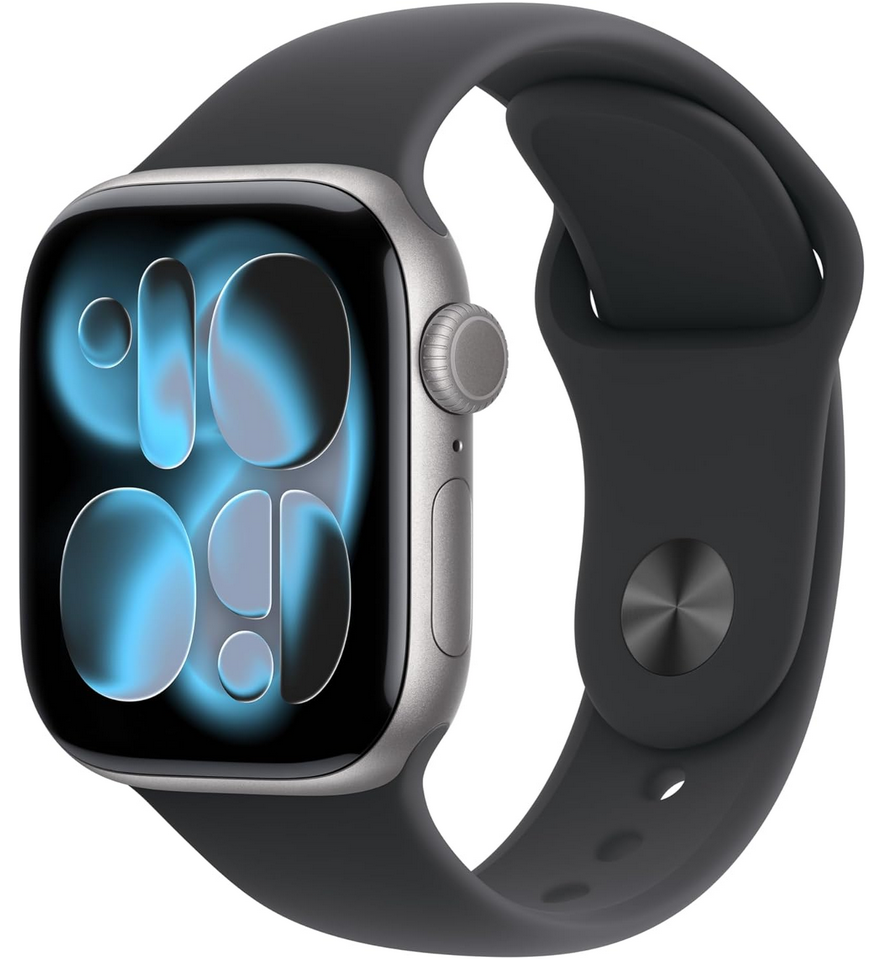

This post is part of the Apple Watch guide for endurance sport on this site, which covers the full lineup, watchOS, accuracy data, the medical roadmap, and the complete set of articles.
Last Updated on 3 October 2026 by tfk the5krunner
Small things I always use
- Garmin 90-degree charging adapter: Charges your Garmin from any USB-C cable. Essential when travelling. I use one.
- Body Glide: The blue anti-chafe stick swimmers and runners carry. I use it.
- Speedo earplugs: Fewer ear infections and no cold-water dizziness. I use them.
- Dryrobe Advance: My winter changing robe for open-water swims. I use one. A cheaper option is the AONYIYI changing robe.
- Maurten: Race fuel that stays easy on the stomach. I use them.
- Garmin charging puck: The quickest way to top up before a session. I use one.
- Injinji: Toe socks that stop rubbing, so you run more. I use them.
- Ultimate toe protectors: Stop black toenails on long runs. They work. I use them.
- Compressport R2 v2 calf sleeves: My calf sleeves of choice. I use them.
- Cellucor C4: My pre-workout before hard sessions.
- TPU tubes: Schwalbe Aerothan, Tubolito and Pirelli SmarTube. Light, tiny spares. I use all three.
- G8 insoles: Adjustable insoles that are good. I use them.
- Cycplus Cube: A 97g electric pump that gets a road tyre rideable in two minutes. I carry one. 5% off with code THE5KRUNNER.
Watches and sensors
- Polar H10: My daily driver for waking HRV.
- Polar Verity Sense: My backup arm-worn HR sensor.
- Nomad bedside charger: Charges my iPhone and Apple Watch overnight. I use it, and many of their bands.
- Train.Red: The best muscle oxygen sensor I’ve used.
- Tymewear: Accurate heart rate and reliable ventilatory zones. I use it to pace endurance rides over an hour.
- Garmin Forerunner 970: A pro-grade triathlon watch. I use this.
- Apple Watch Ultra 4: My daily smartwatch. No phone needed on rides.
- Garmin Fenix 9 Pro: I’ve just bought one.
On the bike
- Continental GP5000 for everyday riding, and Aero 111 on the front for special occasions.
- Helmets: Specialized S-Works Evade 3 for road riding, and Rudy Project Wing for TT-style races. I use both.
- Ravemen FR300: A front light that mounts under your Garmin or Wahoo. I use one.
- Wahoo TRACKR Radar: I use it on one bike and Varia on the other. They perform the same.
- Garmin Varia RTL515: Radar that warns you of cars from behind. I use this model.
- Wahoo ELEMNT Roam 3: The bike computer that’s easy to use. I use mine on most rides.
- Favero Assioma Pro RS2: Accurate power pedals that swap easily between bikes. I use this model.
Home and indoor training
- NPE Runn: Makes my basic treadmill smart, sending more accurate speed and distance to my watch and Zwift. I use it.
- Google Wifi: Keeps Zwift connected in my pain cave. I use it.
- Apple TV 4K: Zwift on the big screen. I use two.
- Google Nest Doorbell (wired, 2nd gen): My video doorbell, running in both Google Home and Apple Home. I use it.
Health, recovery and sleep
- FreeStyle Libre 3 Plus: Shows how my blood sugar responds to diet.
- hDrop: Measures my sweat loss in summer and indoors.
- Fourth Frontier Zone: Checks my heart under load in hard sessions.
- Oura Ring 5: My partner’s recovery tracker of choice.
- Kineon MOVE+: Red light therapy for niggles. It works.
- Eight Sleep: A cooling mattress cover my partner and I use nightly.
Reader-Powered Content

This content is not sponsored. It’s mostly me behind the labour of love, which is this site, and I appreciate everyone who supports it.
Support the site: Follow (free, fewer ads) · Subscribe (paid, ad-free) · Buy Me A Coffee ❤️
Written by real people, with AI assistance. Fact-checked and verified for originality. See the Editorial Policy. FTC: Affiliate Disclosure — some links pay commission. As an Amazon Associate, I earn from qualifying purchases.
tfk is the founder and author of the5krunner, an independent endurance sports technology publication. With 20 years of hands-on testing of GPS watches and wearables, and competing in triathlons at an international age-group level, tfk provides in-depth expert analysis of fitness technology for serious athletes and endurance sport competitors. ID
