120,000 Triathletes — But Is the UK Sport Really Recovering?
February 2026 | Industry Analysis
120,000.
That’s the headline number from the Triathlon Industry Alliance’s 2025 Participation Analysis Report. More than 120,000 active racing triathletes in Great Britain last year. It’s an impressive number, but worth some context before you celebrate too hard.
Let’s get into it.
The Recovery Is Real. So Is the Gap.
After a 2024 that saw participation fall again, 2025 delivered a genuine rebound. More athletes. More starts. More momentum. The TIA’s report characterises it cautiously as a “new normal” rather than a return to form. The sport is definitely not broken. But it isn’t back either.
In 2019, GB triathlon had a participation base of roughly 148,000 active racing athletes. Then came COVID, the predictable crash, a slow rebuild, a dip in 2024, and now a bounce. At 120,000-plus, it’s moving in the right direction. But if you’re an event organiser, a club running a membership drive, or a sponsor reviewing your investment against the sport’s pre-pandemic footprint, you are probably hoping for better.
The British Triathlon Annual Report (FY2023/24) adds more granularity. Across 723 events, the federation recorded 112,075 participants. Adult participation was down 2% year over year, while youth participation was up 1%. Meanwhile, British Triathlon membership sat at 28,586, with Triathlon England adding 23,308 members. Female membership accounted for 31% of the total.
Each of those numbers tells a story. Some of them are better stories than others.
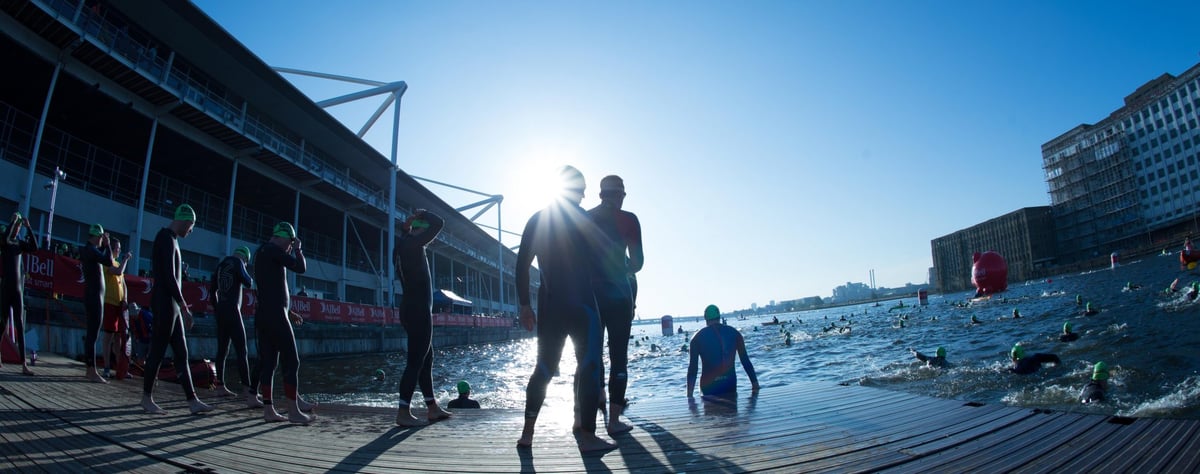
The Event Landscape Has Thinned Out
Here’s a number from the BT Annual Report that doesn’t get enough attention: 112 events were cancelled in FY2023/24, compared with only 71 new or returning events. Net negative. The event calendar contracted as most of us realised.
This isn’t necessarily a crisis — consolidation can be healthy, making the remaining events more likely to continue, and leaving some whitespace on the calendar for innovators to fill.
The causes are well understood: rising venue costs, volunteer fatigue, planning permission headaches, insurance, and the basic maths of lower participation numbers and fees. A race that operated with 800 athletes in 2018 may struggle to survive with 550 in 2024.
The implication for those still operating — and for sponsors evaluating reach — is that the market has rationalised. The survivors are generally stronger. But the loss of feeder events and local club races has consequences for the pipeline of new athletes coming into the sport.
How GB Compares Internationally
Approximately 1 in 565 people here are active racing triathletes. The equivalent figures (using different methodologies) are approximately 1 in 1,110 for the USA and 1 in 1,030 for France. GB punches well above its weight.
The more instructive comparison is trajectory. The USA and GB share the same post-peak narrative: both remain below their respective highs, and recovery is slow. France is doing the opposite — growing consistently for a decade, then seeing a 32% surge in new licensees following Paris 2024. The Olympic host effect is real and time-limited, but the underlying French growth was there before the Games.
Where the Growth Signal Is Coming From
Early 2026 registration data is where this gets interesting and encouraging. The TIA states that registrations are up, and the demographic profile of registrants skews younger and less experienced with the sport.
The BT data on youth participation nudging up 1% adds a small piece of corroborating evidence. Youth numbers are small in absolute terms but heading in the right direction.
This is also where the strategic priorities outlined in the TIA report start to look coherent rather than aspirational. Four levers are being pulled:
- Converting runners. The UK running community is vast and active. Many of those athletes are already swim-curious, bike-aware, and fit enough. The barrier isn’t fitness — it’s logistics, jargon, and the perception that triathlon is expensive and complicated. Lowering that barrier is likely the industry’s highest-leverage opportunity for participation growth – aquathlon?
- Engaging younger athletes. The sport’s historical age profile is a structural drag on long-term growth. Younger entrants extend participation curves, bring social networks, and are more likely to become coaches and club officers in the next generation. But they may have less disposable income today. The early 2026 registration data suggests some of this is happening organically. The question is whether the industry can accelerate it deliberately.
- Growing female participation. At 31% of BT membership and 37% of UK race participants, women remain underrepresented. Research from Women in Tri UK found that 84% of women were more likely to enter races that felt welcoming and inclusive, suggesting this is a marketing and culture problem – ultimately…a race is a race.
- Strengthening the charity and fundraising dimension. This one often gets treated as peripheral to the “serious” participation conversation. Charity entrants bring motivation and social proof and often stay in the sport after their first race. The fundraising route into triathlon has historically been underdeveloped relative to running. This is a definite growth opportunity – just have a look at the London Marathon in a few weeks’ time to see the number of charity places!
The Finances Tell a Story Too
The British Triathlon Federation ran a £239,000 deficit in FY2023/24. A governing body running a deficit while adult participation is declining and the event landscape is contracting has limited room for big strategic bets.
This matters for the industry because BTF’s capacity to invest in growth programmes, coach education, event support, and participation initiatives is constrained.
What This Means If You’re In The Room
For event organisers: the consolidation isn’t finished. The athlete pipeline remains fragile. Invest in the first-timer experience. The 50% attrition rate for first-time triathletes who never race again is a participation problem disguised as a retention problem.
For clubs and coaches: the youth uptick is your cue. Capture them. The runners-to-triathletes pipeline remains an opportunity. Both require active outreach rather than passive door-opening. Act now before your local running club develops its triathlon arm (many have).
For sponsors, the participation recovery is real, but the audience has shifted. Younger, more diverse, and more digitally native than the traditional triathlon demographic. This remains a massive opportunity – the older hardcore athletes continue to spend the money, but the growing youth markets in triathlon and other sports give you access to new and emerging micro sport communities (a recently growing trend).
Across the industry, 2025 was a better year than 2024. Early 2026 looks promising. But the gap to 2019 is 28,000 athletes. That’s a lot.
Take Out
The TIA’s framing of “recovery, then recalibration” is about right. The sport is no longer simply trying to get back to where it was. It likely can’t return to exactly where it was, and it probably shouldn’t try.
The 2019 peak was itself a perfectly positive storm. A product of specific conditions: post-Olympic enthusiasm, a certain affluent demographic cohort hitting their peak participation years, and a proliferation of events that outpaced sustainable demand.
120,000 active racing triathletes is a solid foundation. The question for 2026 and beyond is whether the industry can build on it in ways that the 2019 version of the sport didn’t.
The data suggests the ingredients are there. It’s time to mix and prosper, folks. For the technology picture serving the athletes who make up those numbers, from watch choice to training ecosystems, see the triathlon and multisport technology hub.
Sources: Triathlon Industry Alliance 2025 Participation Analysis Report; British Triathlon Annual Report FY2023/24; Women in Tri UK research, 2024; USA Triathlon 2024 Impact Report; Cal Tri Events 2024 participation analysis; Fédération Française de Triathlon licence data, January 2025; Deutsche Triathlon Union membership data, 2025. Note: international participation figures use different methodologies and are not directly comparable.
Related reading: Site News January 2026 Newsletter, Follower Fix & Updates.
For the technology picture serving those athletes, from watch choice to training ecosystems, see the triathlon and multisport technology hub.
Last Updated on 3 October 2026 by tfk the5krunner
Small things I always use
- Garmin 90-degree charging adapter: Charges your Garmin from any USB-C cable. Essential when travelling. I use one.
- Body Glide: The blue anti-chafe stick swimmers and runners carry. I use it.
- Speedo earplugs: Fewer ear infections and no cold-water dizziness. I use them.
- Dryrobe Advance: My winter changing robe for open-water swims. I use one. A cheaper option is the AONYIYI changing robe.
- Maurten: Race fuel that stays easy on the stomach. I use them.
- Garmin charging puck: The quickest way to top up before a session. I use one.
- Injinji: Toe socks that stop rubbing, so you run more. I use them.
- Ultimate toe protectors: Stop black toenails on long runs. They work. I use them.
- Compressport R2 v2 calf sleeves: My calf sleeves of choice. I use them.
- Cellucor C4: My pre-workout before hard sessions.
- TPU tubes: Schwalbe Aerothan, Tubolito and Pirelli SmarTube. Light, tiny spares. I use all three.
- G8 insoles: Adjustable insoles that are good. I use them.
- Cycplus Cube: A 97g electric pump that gets a road tyre rideable in two minutes. I carry one. 5% off with code THE5KRUNNER.
Watches and sensors
- Polar H10: My daily driver for waking HRV.
- Polar Verity Sense: My backup arm-worn HR sensor.
- Nomad bedside charger: Charges my iPhone and Apple Watch overnight. I use it, and many of their bands.
- Train.Red: The best muscle oxygen sensor I’ve used.
- Tymewear: Accurate heart rate and reliable ventilatory zones. I use it to pace endurance rides over an hour.
- Garmin Forerunner 970: A pro-grade triathlon watch. I use this.
- Apple Watch Ultra 4: My daily smartwatch. No phone needed on rides.
- Garmin Fenix 9 Pro: I’ve just bought one.
On the bike
- Continental GP5000 for everyday riding, and Aero 111 on the front for special occasions.
- Helmets: Specialized S-Works Evade 3 for road riding, and Rudy Project Wing for TT-style races. I use both.
- Ravemen FR300: A front light that mounts under your Garmin or Wahoo. I use one.
- Wahoo TRACKR Radar: I use it on one bike and Varia on the other. They perform the same.
- Garmin Varia RTL515: Radar that warns you of cars from behind. I use this model.
- Wahoo ELEMNT Roam 3: The bike computer that’s easy to use. I use mine on most rides.
- Favero Assioma Pro RS2: Accurate power pedals that swap easily between bikes. I use this model.
Home and indoor training
- NPE Runn: Makes my basic treadmill smart, sending more accurate speed and distance to my watch and Zwift. I use it.
- Google Wifi: Keeps Zwift connected in my pain cave. I use it.
- Apple TV 4K: Zwift on the big screen. I use two.
- Google Nest Doorbell (wired, 2nd gen): My video doorbell, running in both Google Home and Apple Home. I use it.
Health, recovery and sleep
- FreeStyle Libre 3 Plus: Shows how my blood sugar responds to diet.
- hDrop: Measures my sweat loss in summer and indoors.
- Fourth Frontier Zone: Checks my heart under load in hard sessions.
- Oura Ring 5: My partner’s recovery tracker of choice.
- Kineon MOVE+: Red light therapy for niggles. It works.
- Eight Sleep: A cooling mattress cover my partner and I use nightly.
Reader-Powered Content

This content is not sponsored. It’s mostly me behind the labour of love, which is this site, and I appreciate everyone who supports it.
Support the site: Follow (free, fewer ads) · Subscribe (paid, ad-free) · Buy Me A Coffee ❤️
Written by real people, with AI assistance. Fact-checked and verified for originality. See the Editorial Policy. FTC: Affiliate Disclosure — some links pay commission. As an Amazon Associate, I earn from qualifying purchases.
tfk is the founder and author of the5krunner, an independent endurance sports technology publication. With 20 years of hands-on testing of GPS watches and wearables, and competing in triathlons at an international age-group level, tfk provides in-depth expert analysis of fitness technology for serious athletes and endurance sport competitors. ID
