Is Your Runna AI Marathon Training Plan Pushing You Towards Injury?
Runna, the Strava-owned running coaching app, has attracted 2 million monthly users and a valuation that reflects investors’ soaring confidence in AI-powered fitness technology. Potentially great news as Strava heads for its IPO.
Runna has also attracted something less welcome: a growing body of evidence, anecdotal and clinical alike, suggesting that its algorithmically generated training plans are, for a significant number of people, simply too aggressive.
Listen to the discussion
WSJ reported earlier this month that physical therapists had been seeing multiple Runna-related injury cases each week and that the company was now adding features to let its customers dial back the intensity of their plans. Runna, which costs $120 per year and saw monthly active users grow 74 per cent year-on-year according to Sensor Tower data, uses a combination of human coach inputs, machine learning algorithms and generative AI to construct and adapt personalised training schedules. The injuries being reported — stress fractures, shin splints, Achilles tendinopathy — are the classic markers of training load applied too quickly to bodies not yet prepared to absorb it.
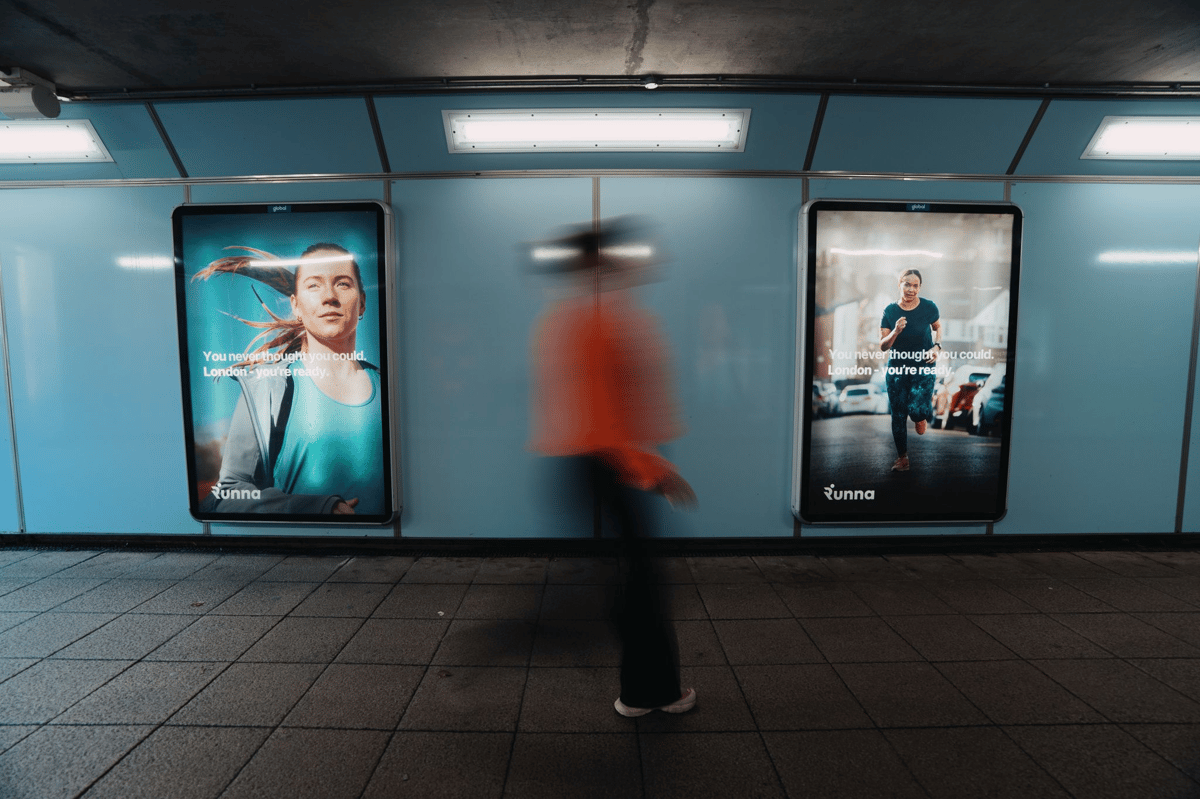
A Running Boom With a Sting In The Tail (Foot)
Britain and the United States are in the middle of a running boom of unusual proportions. In the UK, approximately one in five adults (19.4%) reported running at least once a month in 2024, with the 35–44 age bracket leading participation at over 30%. Running club membership on Strava grew an astonishing 59 per cent in 2024 alone, and the running event market expanded by 23 per cent over the same period. The 2025 London Marathon drew more than 56,600 finishers and received over one million ballot applications for 2026. Into this surge of enthusiasm has walked a generation of new runners, many of them ill-equipped to judge whether the plan on their phone is asking too much of their bodies too soon.
Research is unambiguous. Marathon training is hard and injures people at high rates, regardless of the planning method used. One study of Utrecht Marathon and Half Marathon participants found that 9 in 10 reported an injury or illness during a 16-week training period. A separate analysis of New York City Marathon runners found that 48 per cent experienced training-impeding injuries, with around 9 per cent sustaining injuries severe enough to prevent them from finishing. Against that baseline, attributing injury specifically to algorithmic plans is difficult. No comparative peer-reviewed study has yet established that Runna athletes get hurt at higher rates than those following a PDF from the internet or advice from a running club. The anecdotes on TikTok, Reddit, and Threads are real, but unproven.
What is not in dispute is that AI-generated plans have structural limitations that experienced coaches do not. A peer-reviewed study published in the Journal of Sports Science and Medicine in 2024 by researchers at Technische Universität Braunschweig and the University of Würzburg found that ChatGPT-generated training plans for runners were not rated optimally by coaching experts, though quality improved meaningfully when more detailed athlete information was provided. The finding points to both the current ceiling of AI coaching and a route beyond it.
Testing the Limits: A Duathlon Case Study
I am a multisport athlete and have trained a handful of age-group duathlon world and national champions. I’m currently self-training for a national duathlon championship and wanted to test AI firsthand. I constructed what I believed to be a highly detailed, multi-page prompt incorporating my training history, current fitness markers, available training hours, equipment, injury history and periodisation targets. Everything. I ran the draft plan through one AI system, then cross-checked the resulting plan against two others until there was consensus. On first inspection, the plan looked impressive. It passed a cursory glance through as a test.
A duathlon plan is substantially harder to construct than a marathon plan. A marathon programme is, for the experienced coach, a relatively well-mapped problem: there are proven methodologies, established weekly mileage progressions and a clear single-sport periodisation arc. A duathlon demands the simultaneous management of run fitness, cycling fitness, brick session sequencing, transition physiology and the careful calibration of which discipline receives priority load at which point in the training cycle. The AI handled the surface architecture of this competently. The difficulty emerged as the plan began ramping up.
Either the plan was too hard, or I was less able than my detailed self-assessment had suggested — both are possible, and honestly, the latter cannot be ruled out. What became clear was that the progression was being applied in ways that a human coach would have moderated. I picked up a slight injury, though I should note it was a historic one that has recurred before and for which the AI cannot be fairly blamed. The point stands: in a complex multi-sport scenario, the plan’s periodised ramp felt miscalibrated. Given that I provided precise ability data and clear timeframes, this is a limitation of the technology’s current capacity to model individual response, not a failure of information supplied.
My conclusion, drawn from that experience, my own training and years of coaching others, is this: AI training plans are not yet ready for complex scenarios applied at scale to general populations. They are, however, closer than their critics often acknowledge.
Some points to reflect on.
- I could have given the AI feedback on difficulty as the plan progressed. Just like I would to a human coach. I didn’t.
- Human coaches make mistakes. AI coaches make mistakes.
- Athletes make mistakes and can incorrectly execute.

What Runna Can and Cannot Do
It would be a misreading of the evidence to conclude that Runna is a defective product. For the vast majority of recreational runners, following a structured marathon or half-marathon plan with clearly defined goals and a reasonable training history appears to deliver genuine value. Its App Store reviews document substantial personal bests and first-time finishes. The app integrates with Garmin, Apple Watch, and Strava, provides pacing targets grounded in an understanding of the athlete’s current fitness, and has an in-house physiotherapy library covering the most common running injuries in clinical detail. That is more than most runners have ever had access to for $120 a year.
The problem is that Runna is used by runners in the early stages of the sport who struggle to accurately self-assess their fitness, have pre-existing conditions they may not fully understand, and treat the app’s output as authoritative rather than advisory. This is not a failure unique to Runna. Academic research on AI-generated training plans consistently identifies the same gap: the algorithm takes the runner at their word, and the novice runner rarely knows themselves as well as they think they do.
The fitness industry is well aware of the demand for AI. A 2024 industry survey found that 84 per cent of fitness clients wanted AI integrated into their workout plans. That commercial pressure makes the consequences of ignoring the technology’s limitations larger.
The Road Ahead
Runna’s decision to introduce features that allow athletes to reduce plan intensity is a sensible response. However, I note that this has been forced externally rather than anticipated internally. A platform with 2.1 million monthly active users and access to wearable data has, in principle, the capacity to detect patterns of overtraining load at a population level long before physical therapists begin observing the clinical consequences. It is equally capable of adding periodic feedback questions to assess injury risks. Whether those capabilities will be used remains an unanswered question.
The broader picture for AI coaching is cautiously encouraging. The academic literature identifies significant potential in AI’s ability to process physiological data, identify biomechanical risk factors and personalise training at a scale no human coach could manage. The gap between that potential and the current consumer product, however, is real. A company with Runna’s data assets, its parent Strava’s 150 million-user base, and its team of human coaches behind the algorithms is well-positioned to close that gap. The current controversy reflects clear evidence that the current iteration of one well-resourced product has not yet fully solved the problem of knowing when to pull back.
I would add a further worry. Many people are certainly already asking AI to produce a training plan. As my own example shows, even someone who should know the principles of training cannot craft the perfect AI prompt. It is inevitable that the average runner in 2026, constructing their own AI plan, is opening themselves up to injury risk. One way to see a relatively cheap Runna service is that its plans are almost certainly more carefully crafted. Though not infallible.
Looking further ahead, I worry about the training platforms. As Apple and Google have opened up their health platforms to AI — meaning ChatGPT could see your training data and write a plan based on the principles it knows, and learn from population-level mistakes — the clear future is that AI training plans will become better, cheaper, bundled with annual AI subscriptions or simply free. The platforms won’t be able to compete with Agentic AI plans.
The author has trained age-group world and national duathlon champions and won a national age-group championship.
Last Updated on 21 February 2026 by the5krunner
Reader-Powered Content

This content is not sponsored. It’s mostly me behind the labour of love, which is this site, and I appreciate everyone who supports it.
Support the site: Follow (free, fewer ads) · Subscribe (paid, ad-free) · Buy Me A Coffee ❤️
All articles are written by real people, fact-checked, and verified for originality. See the Editorial Policy. FTC: Affiliate Disclosure — some links pay commission. As an Amazon Associate, I earn from qualifying purchases.
tfk is the founder and author of the5krunner, an independent endurance sports technology publication. With 20 years of hands-on testing of GPS watches and wearables, and competing in triathlons at an international age-group level, tfk provides in-depth expert analysis of fitness technology for serious athletes and endurance sport competitors.

I used Runna for a year, I set three 10k pb’s last year. But alas I’ve moved over to coopah. Runna is great for seeing real results, but the training paces were always borderline too fast for me, I get it, To run faster you need to run faster! However I also weight train 3-4 days a week, nothing fancy mainly compound moves with some isolation work sprinkled in. But following the Runna plan left me wasted most of the time, even a easy day was a grind.
On coopah I can add my strength sessions, it does not seem to change the suggested run paces. but the paces are achievable.
Going against the grain of the article. Last year was my best injury wise vs coaching myself. I can only assume I was doing too much junk mileage. Also now I’ve tweaked the coopah AI so only easy runs are scheduled after lower body resistance training days to maximise the mTOR/AMPK interaction.
FWIW I did try TRAINASONE back when it launched way back. It may have, and I hope it has improved.
8-9 years ago I’d quite often get pie faced and have a few impromptu days off (3-5), which I don’t do now!!! but the damn thing would reset to doing 12 minute runs after every instance of my lack of accountability, despite having always completed a 10 mile run within the last two weeks history.
Personally I think they went went way to conservative in there aim to reduce injury.