Updated: 27 October 2025
In an FT.com article (13 Oct), Strava’s CEO, Michael Martin, confirms the company’s intention to go public with an IPO in the USA.
Rumours elsewhere suggest it will occur in early 2026, following news that both Goldman Sachs and JPMorgan have been invited to pitch for roles to help secure Strava easier access to capital and the ability to make further acquisitions.
Readers might find it a coincidence that Strava’s odd legal case against Garmin was announced at a very similar time to the initial interview between its CEO and FT. The timing is highly coincidental and throws doubt on the motivations behind the Garmin case, adding suspicion that this was a PR stunt designed to raise awareness of the company’s wider profile.
IPO – Why Now, What’s Changed?
Strava launched in 2009 and steadily grew from its initial concept, allowing cyclists to compete virtually over sections of public roads — segments. Leaderboards were added, advanced rider statistics and plans helped performance athletes improve, and the maps used to show the segments were quickly repurposed and developed into a route creation ecosystem. Strava expanded, covering sports beyond cycling and bringing in completed activities from original device makers and market leaders like Garmin.
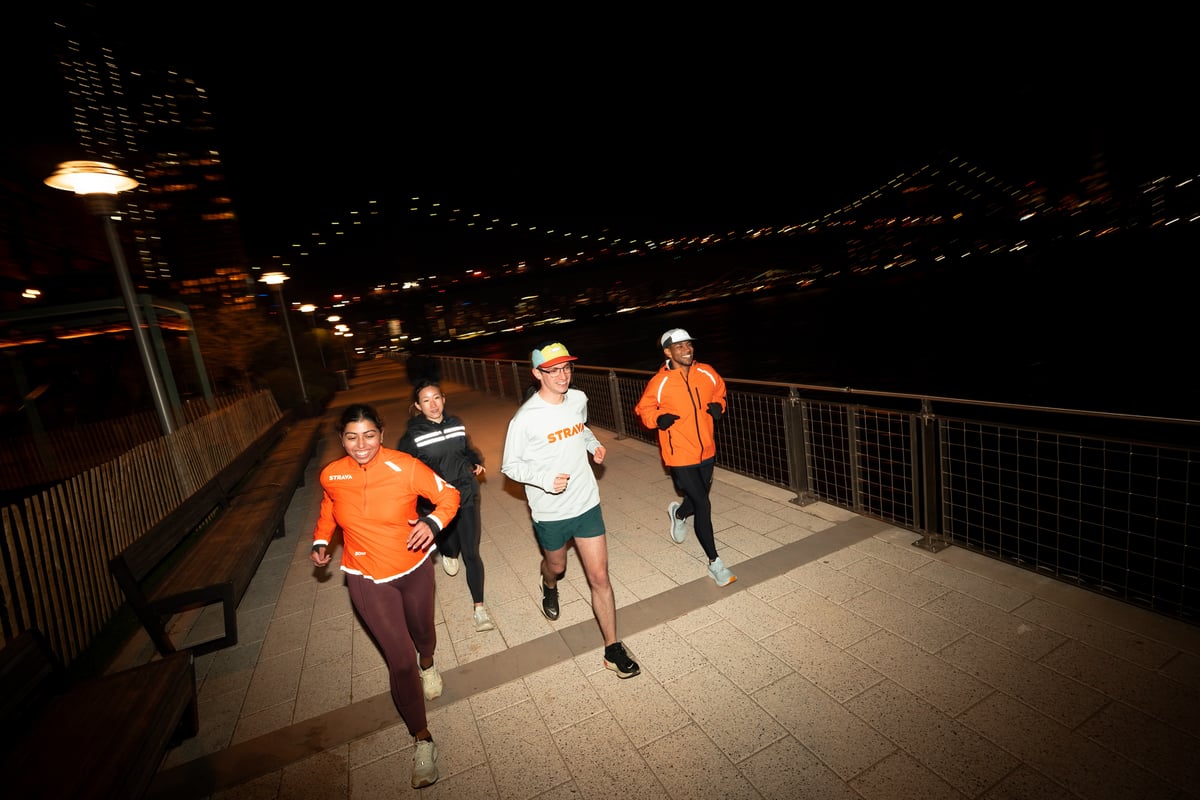
The company experienced the same growth spurt as other parts of the fitness industry during COVID-19 and has been a further beneficiary of Gen Z’s significant interest in running activities. Sensor Tower now estimates that Strava had 50 million monthly active users in 2025 and a staggering 80% year-on-year increase in app downloads.
Strava’s Revenue
Strava’s most important revenue source is its paid subscription (Strava Premium), adding useful but not strictly necessary features. Subscriptions are $11.99/month ($79.99/year). Strava also receives revenues from partner-led athletic challenges and brand partnerships (e.g. Airbnb).
A recent report by Sensor Tower estimated Strava’s revenue to September 2025 to be $180 million, with between two and two and a half million subscribers, further suggesting that about 5% of Strava’s active users pay a subscription.
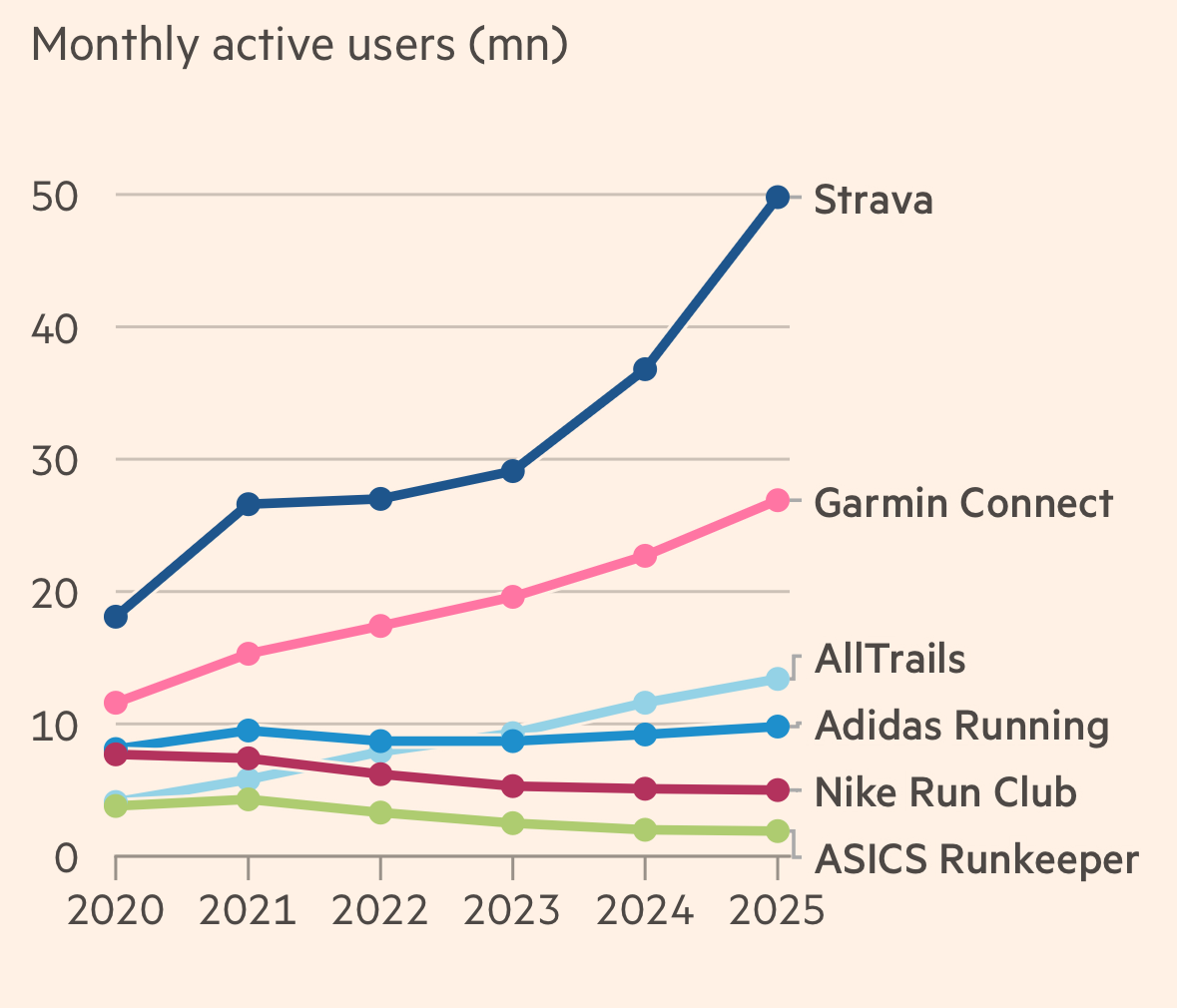
Source: Sensor Tower, via FT.com, to Sep 23rd, 2025
Claim: A company representative was reported by the FT to claim the real revenues are ‘far higher’, but declines to elaborate further.
Strava and its history of acquisitions
Strava has developed many features internally and used external consultants for specialist areas, such as the introduction of Relative Effort (Dr. Marco Altini, HRV4Training, 2018). It’s better known for strategically acquiring key capabilities:
- RaceShape (heatmap, October 2012)
- Beacon (safety features, 2018)
- Recover Athletics (injury prevention app, pre-2023)
- Fatmap (3D mapping, January 2023)
- Runna (running training plans, April 2025)
- The Breakaway (cycling training assets, May 2025)
Market Trends and Market Saturation
Strava’s growth is driven by mass participation in sports (running, cycling) and low-level activities (hiking). The key current mass sporting trends are increased participation of women in sports and an increase in the number of runners, particularly from Gen Z. The prime motivations are fitness and well-being rather than competition. London Marathon 2026 attracted 1.1 million applicants (+31% YoY), and NYC Marathon 2026 drew 200,000+ applicants (+22% YoY).
Strava’s Major Strength
Strava’s major strength is that it is the de facto sports social and performance platform. Its vast number of active users gives it a commercial inertia that is hard to stop. Furthermore, it is app and device-agnostic for its sources. Every new sports app immediately secures a link to Strava.
Strava’s Major Risks
Strava’s fundamental risk is that it has little original data and relies on its biggest partnership, Garmin. If Garmin turned off the data one day, Strava would not have a viable business the next day; it is that simple.
[Strava] relies on its biggest partnership, Garmin.
Secondary risks include Strava’s loss-making status and burning cash, as evidenced by multiple funding rounds. Many subscribers are also unconvinced by the benefits of subscription. This is a chronic risk that Strava continually struggles to manage.
Competition and conflict with Garmin
Strava’s closest competitor by service is Ride with GPS; the two platforms offer similar services. However, its biggest threat is also its biggest supplier — Garmin. Garmin Connect has all of the key features that Strava has, including more. What Garmin lacks is device agnosticism. Only Garmin device owners can use the Garmin Connect platform.
Let’s turn to the recent legal action initiated by Strava against Garmin. Given the above facts, the move seems reckless and superficially likely to jeopardise its potential IPO in 2026. The essence of the case is that there are two patent infringement actions, both of which appear spurious to most commentators, and then there are claims of a breach of contract, which may have merit.
However, Strava has gone on record to say that these claims do not represent its true grievance. It then erroneously states as a grievance that Garmin requires Strava to place the Garmin logo on every workout sourced from Garmin Connect. That claim is untrue, as evidenced by Garmin’s API guidelines. Strava then announced that its data suppliers must comply with the same Garmin API guidelines.
Edit: Strava has now stated it will comply with Garmin’s guidelines and dropped its legal case (22 Oct 2025).
Leadership and Investors
CEO Michael Martin (since 2024) has been focused on user and subscriber growth and has come from a successful stint leading Nike’s connected fitness apps. Investors include Sequoia Capital and Jackson Square Ventures. The last funding round valued the company at $2.2 billion (May 2025).
More: Strava files for 2026 IPO
Outlook
Strava’s credibility depends on user growth and increased sports participation. The outlook for the foreseeable future looks promising, boosted by demographic profiles and a general trend amongst the young toward healthier lifestyles. The lack of competition at a similar scale is also helpful.
However, its ability to be attractive to investors depends on subscriber growth, and the company is notoriously secretive about these figures. In the longer term, there is a prevalent mantra among many athletes, said half jokingly but with truth behind it.
If it isn’t on Strava, it wasn’t done.
Opinion
Strava would not have started the court case without thought and advice. It was a calculated decision.
Strava has already signalled a de facto end to the litigation by instructing its suppliers to obey Garmin’s rules, which require the attribution of Garmin’s data transfer mechanisms. The coincidental timing of a major interview between FT.com and Strava’s CEO suggests that last week’s events were merely a stunt to raise awareness of Strava.
One conclusion is that this has all been a PR stunt, and we all fell for it.
Perhaps the only real downside to the stunt is that it highlights to potential investors the significant dependency of Strava on data from Garmin. So don’t be surprised if the two companies announce a long-term partnership agreement next week; then, we will know for sure that this has all been orchestrated.
- More: Strava vs Garmin – the Climbdown Part I – It’s Over
- More: Strava vs Garmin – the Climbdown Part II – Downfall
Last Updated on 3 October 2026 by tfk the5krunner
Small things I always use
- Garmin 90-degree charging adapter: Charges your Garmin from any USB-C cable. Essential when travelling. I use one.
- Body Glide: The blue anti-chafe stick swimmers and runners carry. I use it.
- Speedo earplugs: Fewer ear infections and no cold-water dizziness. I use them.
- Dryrobe Advance: My winter changing robe for open-water swims. I use one. A cheaper option is the AONYIYI changing robe.
- Maurten: Race fuel that stays easy on the stomach. I use them.
- Garmin charging puck: The quickest way to top up before a session. I use one.
- Injinji: Toe socks that stop rubbing, so you run more. I use them.
- Ultimate toe protectors: Stop black toenails on long runs. They work. I use them.
- Compressport R2 v2 calf sleeves: My calf sleeves of choice. I use them.
- Cellucor C4: My pre-workout before hard sessions.
- TPU tubes: Schwalbe Aerothan, Tubolito and Pirelli SmarTube. Light, tiny spares. I use all three.
- G8 insoles: Adjustable insoles that are good. I use them.
- Cycplus Cube: A 97g electric pump that gets a road tyre rideable in two minutes. I carry one. 5% off with code THE5KRUNNER.
Watches and sensors
- Polar H10: My daily driver for waking HRV.
- Polar Verity Sense: My backup arm-worn HR sensor.
- Nomad bedside charger: Charges my iPhone and Apple Watch overnight. I use it, and many of their bands.
- Train.Red: The best muscle oxygen sensor I’ve used.
- Tymewear: Accurate heart rate and reliable ventilatory zones. I use it to pace endurance rides over an hour.
- Garmin Forerunner 970: A pro-grade triathlon watch. I use this.
- Apple Watch Ultra 4: My daily smartwatch. No phone needed on rides.
- Garmin Fenix 9 Pro: I’ve just bought one.
On the bike
- Continental GP5000 for everyday riding, and Aero 111 on the front for special occasions.
- Helmets: Specialized S-Works Evade 3 for road riding, and Rudy Project Wing for TT-style races. I use both.
- Ravemen FR300: A front light that mounts under your Garmin or Wahoo. I use one.
- Wahoo TRACKR Radar: I use it on one bike and Varia on the other. They perform the same.
- Garmin Varia RTL515: Radar that warns you of cars from behind. I use this model.
- Wahoo ELEMNT Roam 3: The bike computer that’s easy to use. I use mine on most rides.
- Favero Assioma Pro RS2: Accurate power pedals that swap easily between bikes. I use this model.
Home and indoor training
- NPE Runn: Makes my basic treadmill smart, sending more accurate speed and distance to my watch and Zwift. I use it.
- Google Wifi: Keeps Zwift connected in my pain cave. I use it.
- Apple TV 4K: Zwift on the big screen. I use two.
- Google Nest Doorbell (wired, 2nd gen): My video doorbell, running in both Google Home and Apple Home. I use it.
Health, recovery and sleep
- FreeStyle Libre 3 Plus: Shows how my blood sugar responds to diet.
- hDrop: Measures my sweat loss in summer and indoors.
- Fourth Frontier Zone: Checks my heart under load in hard sessions.
- Oura Ring 5: My partner’s recovery tracker of choice.
- Kineon MOVE+: Red light therapy for niggles. It works.
- Eight Sleep: A cooling mattress cover my partner and I use nightly.
Reader-Powered Content
This content is not sponsored. It’s mostly me behind the labour of love, which is this site, and I appreciate everyone who supports it.
Support the site: Follow (free, fewer ads) · Subscribe (paid, ad-free) · Buy Me A Coffee ❤️
Written by real people, with AI assistance. Fact-checked and verified for originality. See the Editorial Policy. FTC: Affiliate Disclosure — some links pay commission. As an Amazon Associate, I earn from qualifying purchases.
tfk is the founder and author of the5krunner, an independent endurance sports technology publication. With 20 years of hands-on testing of GPS watches and wearables, and competing in triathlons at an international age-group level, tfk provides in-depth expert analysis of fitness technology for serious athletes and endurance sport competitors. ID

I wouldn’t directly invest my pension in to Strava, as I can’t imagine a path to meaningful profitability just because of a share offering. The quickest and easiest way to monetise it is to have app advertising. I don’t see new investment is needed to make that happen.
that’s a recurring themese for the last 10 years
i am very surprised theyve never done that…i wouldn’t even mind
I could see this more as a Suunto-Strava partnership (branded watch?), the timing of the lawsuits being a bit strange…
there’s an outside chance there maybe
but who in their right minds sues their best supplier, regardless of how much you like or dislike them
Interesting take on this. The timing between the lawsuit and the IPO news does feel a bit too neat to be a coincidence. I use both Strava and Garmin daily for training, and honestly, I just want them to keep working well together. With marathon prep already giving me enough to think about, the last thing runners need is tech drama getting in the way