Huawei Watch Fit 5 Pro Review: A Thinner Apple Ultra Lookalike at a Fraction of the Price
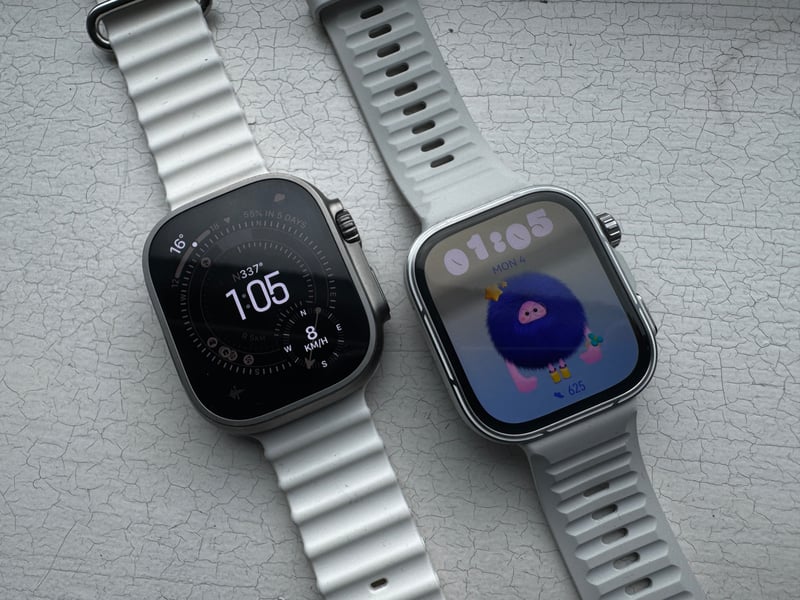
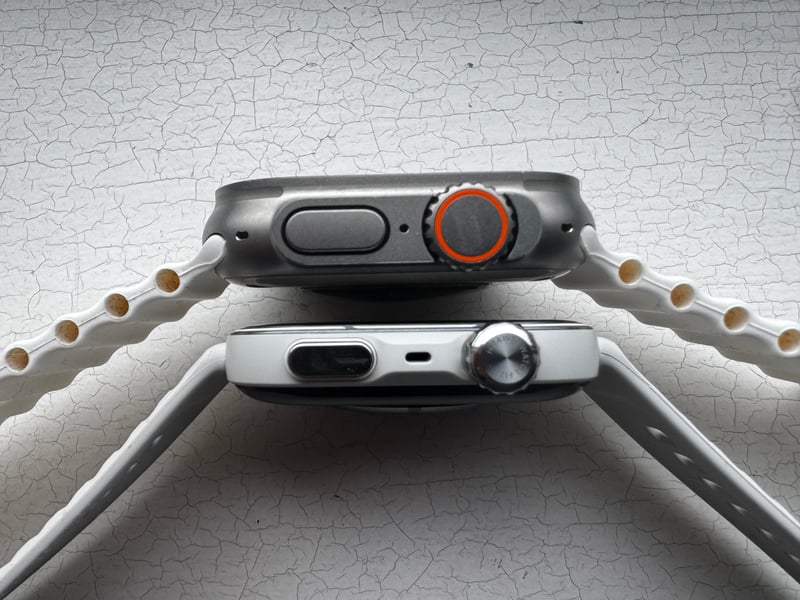
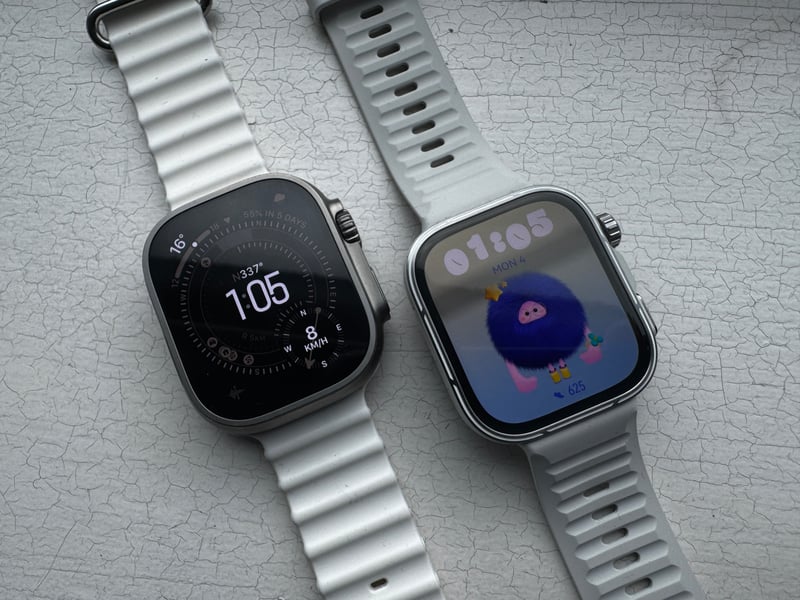
Side by side, the Huawei Watch Fit 5 Pro and the Apple Watch Ultra 3 are close enough that a casual glance would not separate them. Closer inspection shows the Fit 5 Pro is thinner, lighter, significantly cheaper, lasts longer on a charge, and works with Android, HarmonyOS, and iOS.
Huawei has produced a watch that looks the part of a flagship adventure sports watch but really is a fitness watch for smaller wrists at a reasonable mid-range price, and I have spent the last four weeks finding out how far that price-and-looks combination extends in the areas that matter for fitness training.
This is a very long and detailed review, with in-depth test results. Please check the summary first and then use the table of contents to skip to the sections that most interest you.
Testing context. Four weeks of daily wear, including multiple city runs, trail runs, road rides, a pool swim, gym sessions and everyday life. Tested against reference-grade devices: Apple Watch Ultra 3, Garmin Forerunner 970, Polar Sense, Garmin HRM 600. Full testing methodology is published at the5krunner.com/testing-methodology.
Independence. The watch is a media loaner supplied by Huawei, and this review is not paid for by the brand. Tests, results and opinions are my own. If you want to support an independent content creator, please buy from the links or become a supporter.
Listen to the discussion
https://open.spotify.com/episode/6YdbnsBwaaPWvUt4GD5qKu?si=I433hTSKSEmRQJuUiE_ZZA
Huawei Watch Fit 5 Pro: Apple Watch Ultra 3 looks at less than half the price.
Ultra 3 styling at Fit-line price, with strong sensors and a maturing sports stack
Best recommended for Huawei phone owners and cross-platform fitness buyers seeking a rectangular all-rounder. Here’s why.
The heart rate sensor is one of the best I have tested; you can train with it without a chest strap. Sleep tracking landed within 20 minutes of an Apple Watch Ultra 3 across 10 paired nights. The altimeter holds up against reference bike computers. Curve Pay, ECG, arterial stiffness, CE-certified pulse wave arrhythmia analysis and 40-metre freediving are all on the wrist at this price.
Then the inevitable “but.” GPS accuracy scored 63 per cent on my standard 10-mile route vs. the GT Runner 2’s 90 per cent: that’s a noticeable difference to anyone who races by GPS, broadly invisible to anyone who does not. Virtual Cycling Power is best treated as a relative effort indicator: 10 per cent error or more in stable conditions makes it more interesting than precise. The Huawei Health app remains visually cluttered for a Western audience.
So, who else is this watch for?
- The endurance athlete who races by GPS or trains by power? No, look at the GT Runner 2 instead.
- The all-round lifestyle buyer wanting Pixel Watch or Apple Watch capability at half the price? Yes, with the deepest integration on a Huawei phone.
- A buyer on Android or iPhone seeking a better-value alternative to Apple? Yes, this is definitely a watch to consider.
Pros
- Apple Watch Ultra 3 look-and-feel at roughly a third of the price
- Great for thin wrists – unlike Apple Watch Ultra 3
- 1.92-inch LTPO AMOLED at 3,000 nits, great in direct sunlight
- Quality titanium bezel, sapphire glass and aluminium body all contribute to the low weight
- Works with Android, HarmonyOS and iOS, unlike any Apple Watch
- Watch interface is generally highly usable and intuitive
- Claimed 7-day typical battery, 25-hour GPS battery in trail-run mode, 60-minute wireless fast charge
- New 6-LED 6-PD optical heart rate module was generally accurate, one of the best wrist sensors I have tested
- Excellent barometric altimeter, closely matching reference bike computers
- Sleep tracking within 20 minutes of Apple Watch Ultra 3 across ten paired nights, and closer than the Ultra 3 to the Eight Sleep mattress sensor
- ECG, arterial stiffness and CE-certified pulse wave arrhythmia analysis, rare at this price point
- Trail run mode with checkpoint and destination markers, Pro only
- Curve Pay for contactless payments across the UK and EEA (UK live from May 2026)
- Third-party ecosystem now includes Strava, Komoot, Intervals.icu, FiiT, URUNN, Naviki, Clue and Life Period Tracker, with Huawei Health MultiPass bundling free trials
Cons
- GPS accuracy sub-par against the GT Runner 2 (63 per cent vs 90 per cent on the standard 10-mile test)
- Pool swim heart rate detection fails with consistent dropouts, the same pattern is observed on the Runner 2
- VO2max reads high for me, with the race predictor 4 minutes off, and the two figures internally inconsistent
- Phone app organisation is cluttered for a Western audience and benefits from familiarity
- Virtual Cycling Power carries a 10 per cent error margin in ideal conditions, useful only as a relative effort indicator
- No manual FTP entry, leaving cyclists with a known FTP unable to anchor their power zones
- Running power not exportable from the Huawei Health app for detailed analysis
- URUNN app installation on iPhone via AppGallery did not work in my testing, despite being a marketed Fit 5 Pro feature
User Review
( votes)What’s New vs the Fit 4 Pro
The Fit 5 Pro is a meaningful step up in hardware and software, though the headline battery life figures are unchanged. As a rule, you probably won't benefit greatly from an upgrade if your existing Huawei Fit watch is less than 3 years old. Here are the latest changes compared to the previous model, and a detailed comparison with other rectangular watches is provided further below.
- Display. Fit 4 Pro: 1.82-inch AMOLED, 480 x 408, 3,000 nits. Fit 5 Pro: 1.92-inch LTPO AMOLED, 480 x 408, 3,000 nits, 83 per cent screen-to-body ratio, 1.8mm bezels on all four sides.
- Case. Fit 4 Pro: 44.5 x 40.0 x 9.3mm, 30.4g. Fit 5 Pro: 44.5 x 40.8 x 9.5mm, 30.4g. The White Pro edition adds aerospace-grade nanoceramic metal, with a claimed 130 per cent increase in surface hardness.
- Battery capacity. 400mAh to 471mAh, a claimed 18 per cent capacity uplift and 14 per cent density uplift using superior high-silicon battery chemistry.
- Battery life (headline). Unchanged at 7 days typical use and 10 days light use. New headline battery sports mode: 25 hours in trail-run mode with GPS active.
- Cycling features. Virtual Cycling Power, Virtual Cadence, real-time gradient with 3D speed and distance, FTP, third-party cycling accessory connection, phone-as-bike-computer mode with route import.
- Running features. Running power on the watch, Single Running Ability Index. Trail running adds checkpoint (CP) and destination markers, Pro only. Grade-adjusted pace.
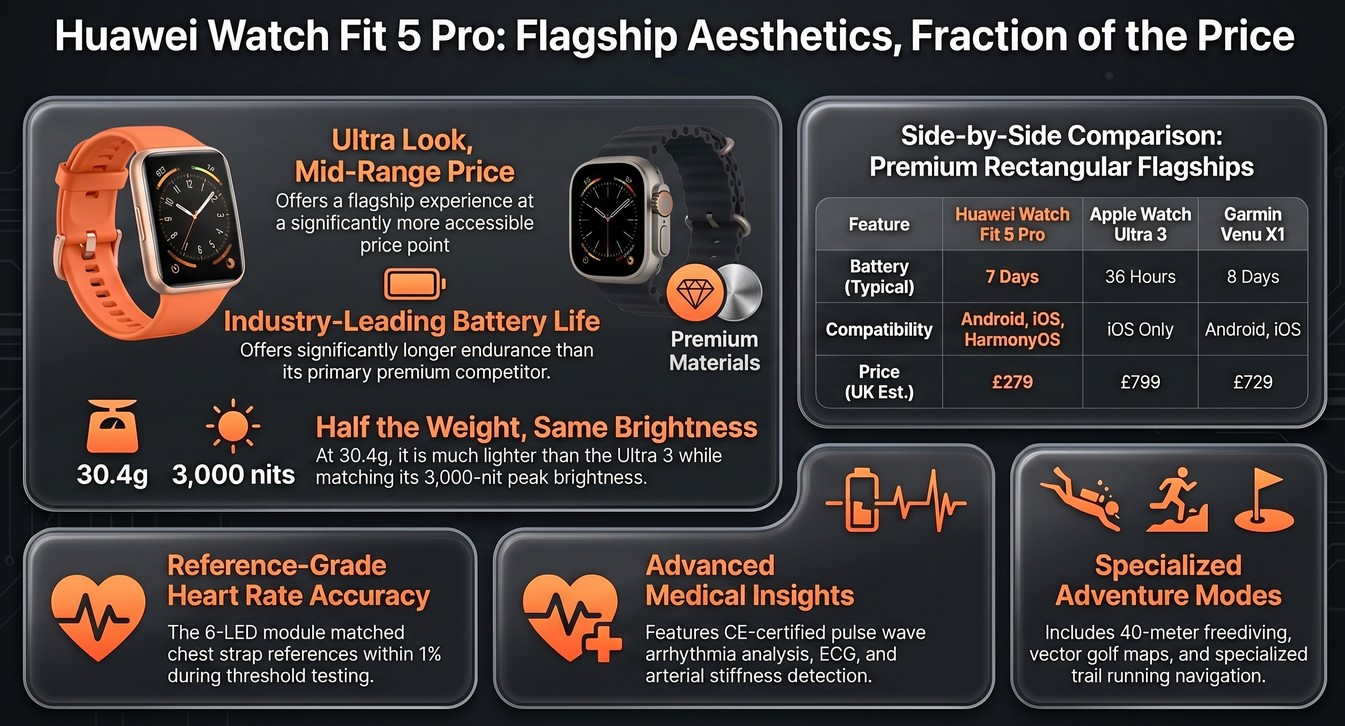
- Golf mode. New on Pro. Over 17,000 course maps, Driving Range mode, Course mode, custom distance measurement, green view with auto-rotation, custom flagstick, Live Scorecard, Competition mode.
- Fall detection. New high-range IMU sensor, supporting detection up to 32g.
- GPS antenna. Upgraded Sunflower antenna, upgraded positioning algorithm, keeping L1/L5 dual frequency reception over multiple constellations.
- Optical heart rate sensor. New 6-LED, 6-PD module. Claim: more accurate heart rate and SpO2 monitoring. Test results below.
- Sleep monitoring. Upgraded sleep staging to clinical N1/N2/N3 labels. Nap mode added.
- Sleep Breathing Awareness. Now available outside China for non-medical use.
- Cardiovascular health. Pulse wave arrhythmia analysis CE-certified in Europe on both Fit 5 and Fit 5 Pro. PPG-based atrial fibrillation detection has also been added.
- Payments. Curve Pay for NFC contactless across the UK and most of the EEA. UK support from May 2026.
- Third-party app ecosystem. Significant expansion. Strava, Komoot, Naviki, Intervals.ICU, FiiT, URUNN, Kotcha, RacePace, Clue, Life Period Tracker. On-watch Workout Service launches with Goodshot, Tennix, PickleX and KeepStrong. Huawei Health MultiPass bundles time-limited free memberships.
- Mini-workouts. Thirty guided movements covering ten body regions, paired with an animated panda companion watch face that reflects activity and inactivity states.
Basics and Daily Use
The first impression of any watch is how it sits on the wrist and how intuitive the interface feels before any sport profile is opened.
The Fit 5 Pro looks and feels very similar to its 4 Pro predecessor. There are differences, but the slightly larger screen area is one of the more meaningful improvements.
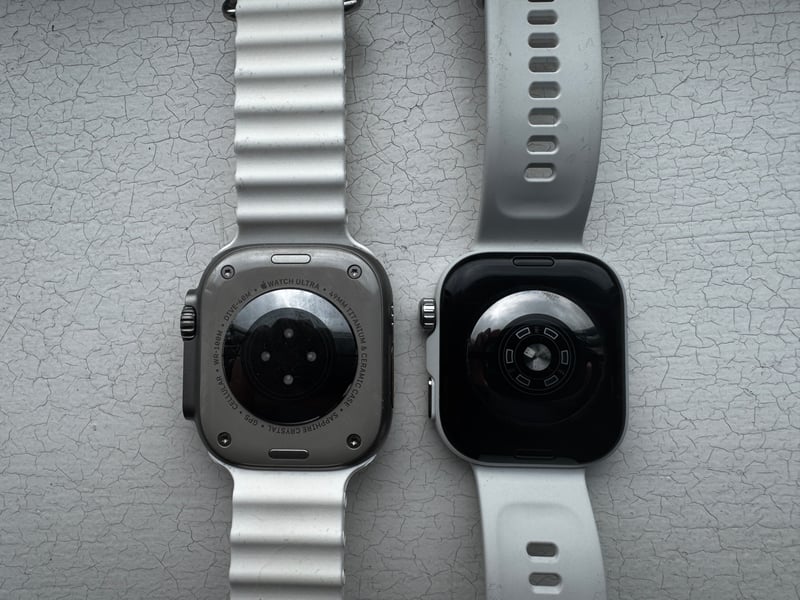
Side by side on the wrist, Apple's Ultra 3 is different to the Fit 5 Pro. Yet there is more than a passing resemblance, and someone could quite easily think you're wearing a smaller Apple Watch Ultra. That's the idea. Apple's Watch Ultra 3 is a beast. I've worn the Apple as my daily watch for 6 months and grown accustomed to its bulk on my relatively thin wrist. What stands out most here is that the Fit 5 Pro really makes the Apple look oversized, especially in terms of thickness.
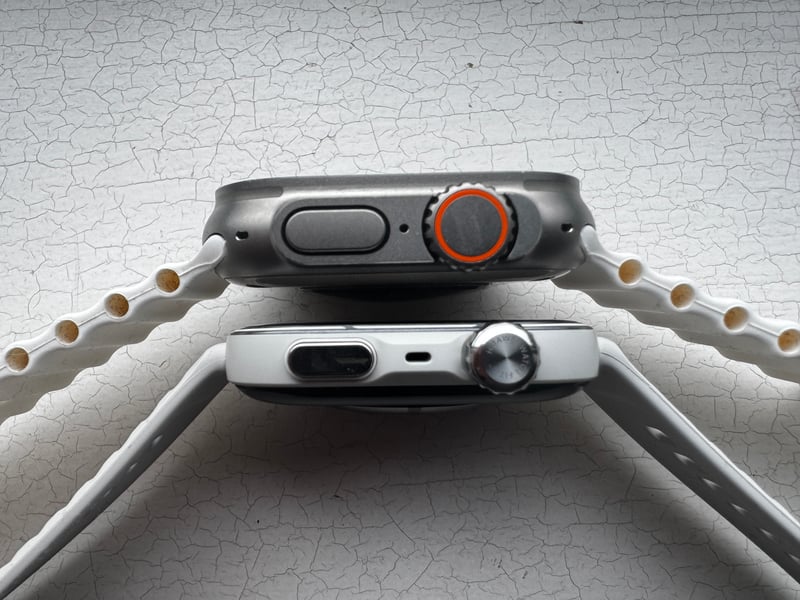
The woven strap is comfortable and super-light, but I've mostly stuck with the supplied fluoroelastomer (rubber) one. It has a slightly cheap feel, but it's fine and certainly comfortable to wear in any situation, from running and cycling for over 12 hours to sleeping. Changing the strap is a tad harder than on the Apple, but perfectly fine for the occasional daily change.
The rotating crown, button and touchscreen all work very well. No criticisms here at all. A larger-handed person might find the button harder to press than I did, but that person would probably be better suited to a larger watch in any case. An oddity for me, as a regular Garmin wearer, is that I would expect the top button (the crown in this instance) to have the 'do it' action, rather than the bottom button.
The always-on display is excellent and generally highly readable. I did have one occasion where I unexpectedly depleted the battery. It was a very sunny day, and I'm unsure whether that caused the display's brightness to increase to compensate for the glare and improve readability. Huawei's published battery figure of 4 days with always-on display enabled likely explains the faster drain. The watch face selection is OK, and some paid-for options are bundled in when you get the watch. If you like to change faces, you will inevitably end up buying new ones over time, each for a few dollars. The new panda-themed Fluffy watch face and inactivity states seemed highly gimmicky to me, but perhaps fun for kids. One specific criticism I had of this face was that the font had poorly defined edges and contrast, making it hard to read in many light conditions.
Running and Training Features
The Fit 5 Pro arrives with running power on the wrist, the Running Ability Index, an upgraded trail-running mode with checkpoint and destination markers, grade-adjusted pace, and connections to the new Huawei Health training ecosystem, including Mo Farah's URUNN personalised coaching, FiiT, and Kipchoge's Kotcha.
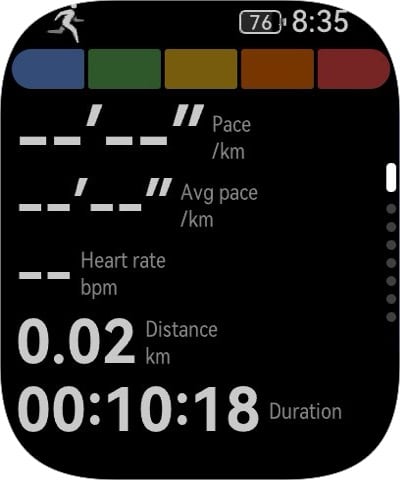
Starting a run. Press the crown, tap the workout icon, and choose the sport. Simple. You are shown four customisable exercise screens, each with up to six metrics, drawn from a long list that includes time, distance, pace, heart rate, running power, elevation, calories, zones, and variants, presented in both numeric and graphical formats. By default, the numbers are left-aligned rather than in grids - a little odd, or Apple-like, but fine.
Those of you interested in understanding training will find some good-quality course videos. The app's Periodisation Masterclass for a Marathon is worth watching to understand what data markers and responses to look for during each training phase.
I followed a Steady Progress 5K Plan as best I could. The plan had two flaws. The target time was constrained by what the app thought my 5K capability was - it was wrong. The fastest target time I could set was one I could easily do tomorrow. The plan itself was well organised, but the per-workout goals were general and a little sports-sciencey, for example, "2x 1.2km lactate threshold run". I know exactly what that means and how hard it should be, but I suspect many newer runners will be left clueless. That said, once you drill down into the workout, all is well, with more precise, quantified instructions.
Huawei's VO2max calculation does not work for me and is at least 6 points higher than it should be, perhaps more. To compound this, its 5K predicted time was 4 minutes slower than I could run this weekend with a mini taper. Even if it were 2 minutes slower, that would be a significant difference. Neither the VO2max nor the predicted times can be correct.
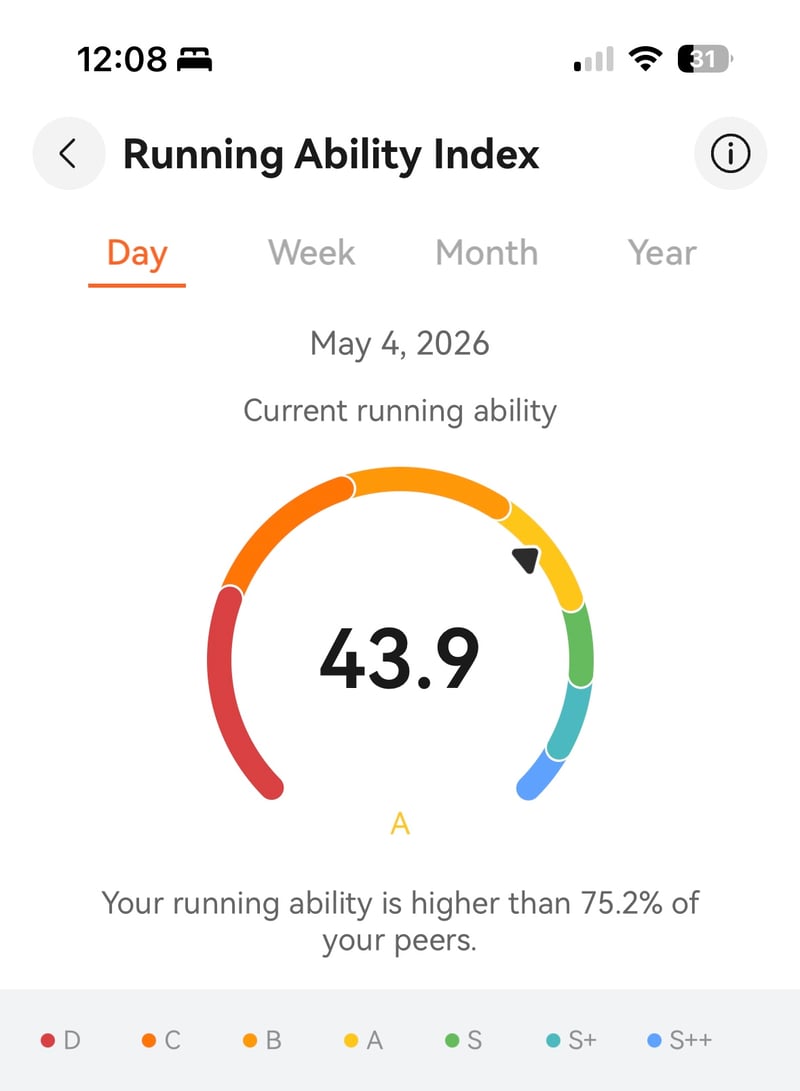
Huawei scores my Running Ability Index as higher than 75% of my peers. This can't be true. Even on the day that I wrote this, I ran at an extended steady pace with a constant heart rate for over an hour, and my average pace was over 90% of my peers (who are runners) and over 99% of my population age group. Even if the calculation were somehow based on VO2max for my age that can't be correct either as Huawei's stated VO2max would place me in the top 0.5% of my age group, not the top 25%.
Huawei calculates my LTHR (LT2) as 165 bpm, which agrees precisely with Garmin's assessment. The Huawei app shows several points over the last month where it has revised the figure downwards. This proves it is recalculating automatically for qualifying runs. The value it calculates is plausible, though likely on the high side.
I have the App Gallery, but could not find the Mo Farah URUNN app for the watch. The marketing implies URUNN as a Fit 5 Pro feature, but the actual implementation depends on AppGallery support, which is iPhone-restricted on some watches.
City Running — Everyday Use
City running is where the Fit 5 Pro will spend most of its life. Huawei's marketing frames the watch as covering both beginner metrics (real-time heart rate, pace, calories) and advanced metrics (running power, Single RAI). It auto-detects walking, running, and cycling without requiring manual workout initiation, which works well enough.
There were no issues with the watch that prevented me from enjoying it as my go-to suburban and urban running watch for a week. The screen layout met my personal tastes, the autopause behaviour was fine, but I turned it off because I like to record true averages.
Auto-detection is triggered as follows, and for walking, that's sooner than it would happen with the Apple Watch, which may be a good thing to avoid missing too much of your activity. That said, Apple Watch does seem to record silently before you start to tell it to officially record.
- Running Auto-Trigger. A steady pace of 8 minutes per kilometre or faster (roughly 7.5 km/h or above), maintained for 3 to 5 minutes, with natural arm swing and minimal stopping.
- Walking. At least 80 steps per minute, sustained for around 10 minutes, with natural arm swing.
I found the voice feedback as similarly annoying as on competitor watches. I just don't like it, so I turned it off. If you like that sort of thing, the computerised voice will be right up your street.
GPS Accuracy — Standard 10-Mile Test
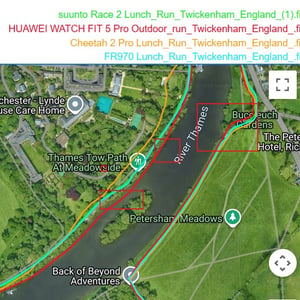
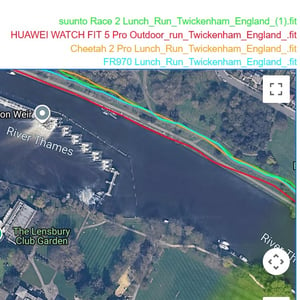
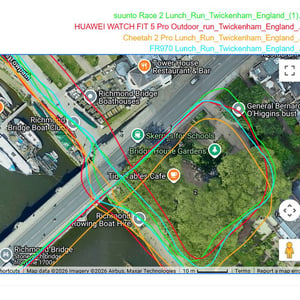
The standard 10-mile test is the anchor comparison across all sports watches tested at the5krunner, using the same route run with +/- 1m precision and the same reference devices. The full methodology is documented at the5krunner.com/testing-methodology.
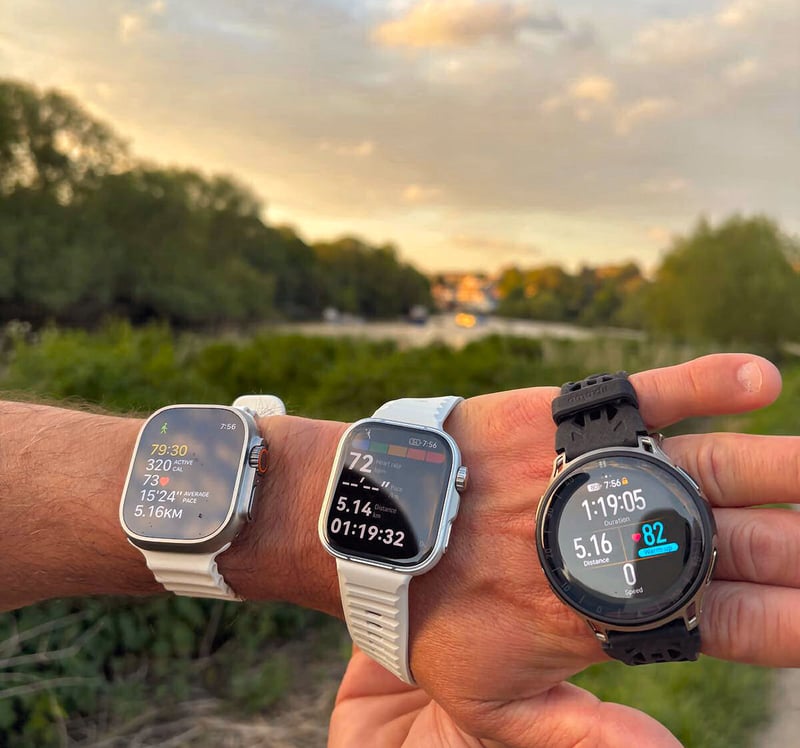
Huawei's GT Runner 2 is a near-reference-grade watch in this test, and the Fit 5 Pro did not match it, coming in with a below-par 63% overall score against the Runner 2's 90%. GPS performance across the board was not there on the day. Strangely, the Suunto Race 2 and the Amazfit Cheetah 2 Pro, tested on the same day, also produced unexpectedly mediocre results.
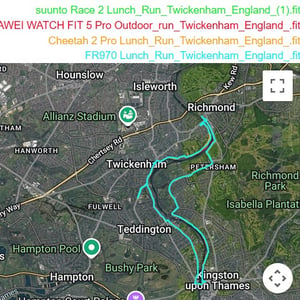
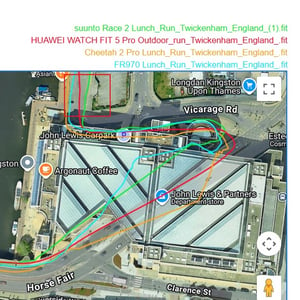
In the overview chart, the Huawei red line is hidden by the blue track of the Forerunner 970, indicating the trace is roughly correct at the macro level. The devil is in the details, and most readers and casual reviewers will not look for them. The Fit 5 performed best on test in the most difficult underpass section, but elsewhere was repeatedly an annoying 3 metres or so from the other devices, whether in the open, under trees, or near buildings. These are the sorts of errors most people would not notice wearing only one watch. Generic reviews of the watch describe the GPS as "good" or "similar tracks" without rigorous comparison. The standard 10-mile test reveals the details those reviews miss. To explore the results in more detail, check this link to the dcranalyzer files.
GPS Accuracy — Tunnel and Tall Buildings
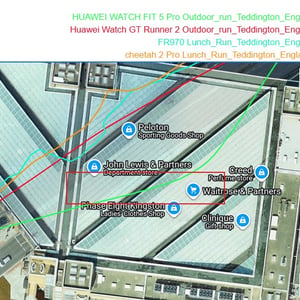
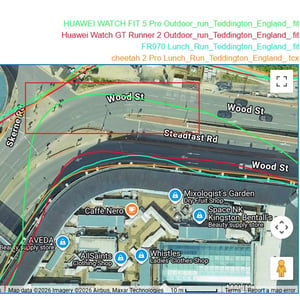
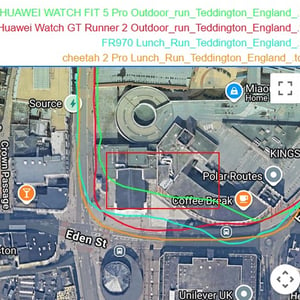
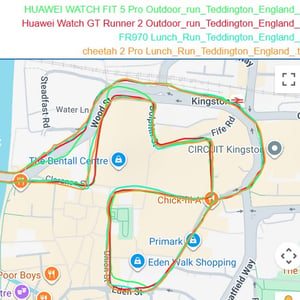
The tunnel and tall-building tests exposed the Runner 2 as the most accurate GPS watch I have tested in difficult conditions. The Fit 5 Pro uses a different antenna architecture, an upgraded Sunflower antenna rather than the dielectric bezel design of the Runner 2. This is the single most interesting comparison in the review, and a poorer picture emerges close to buildings and through tunnels. The general tall-building performance was OK and not too dissimilar from the non-Huawei devices on test, the Amazfit Cheetah 2 Pro and the Forerunner 970. The Huawei GT Runner 2, by contrast, is clearly accurate and clearly the best on test. The antenna architecture makes a difference - a big one.
GPS Accuracy — Suburban Grid
The Huawei GT Runner 2, Forerunner 970 and Amazfit Cheetah 2 Pro all performed similarly to the Huawei Fit 5 Pro on a residential grid layout of semi-detached and detached houses. The Runner 2 was again clearly the best device on test, with the other three each having good moments and less good moments. Those three were broadly equal to each other overall.
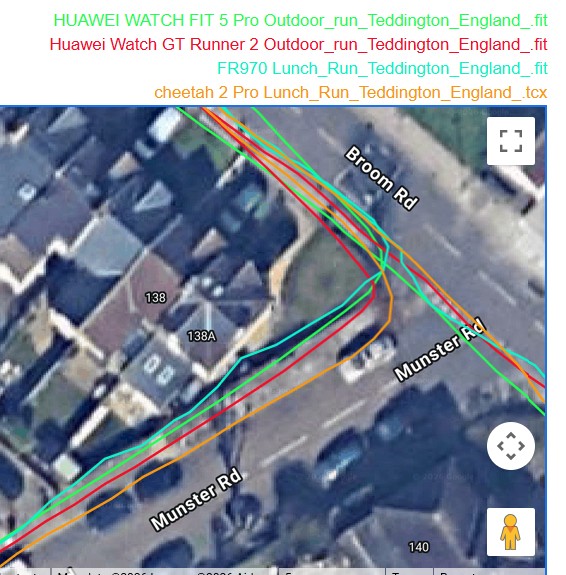
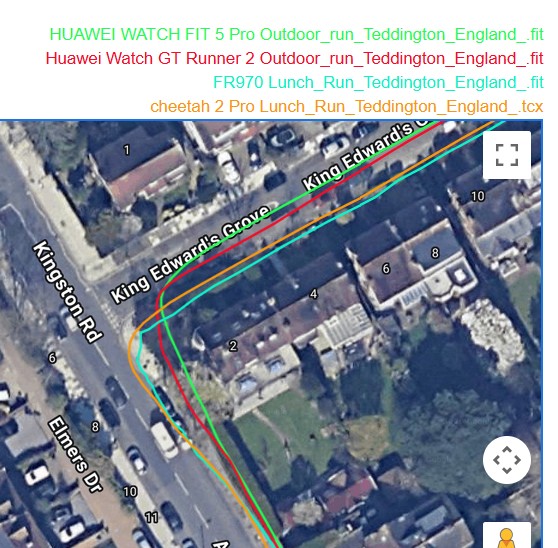
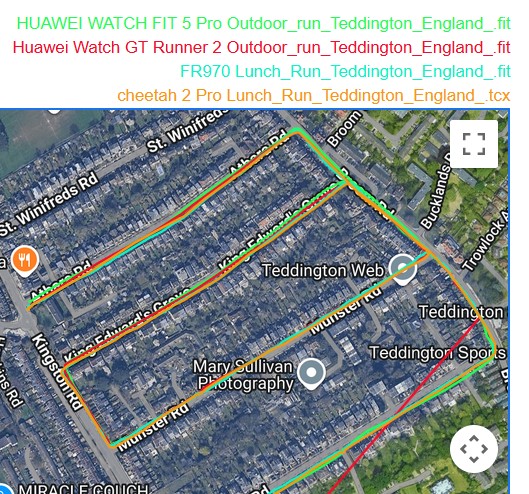
Note: Runner 2 was accidentally paused at the start.
GPS Accuracy — Mountain Cycling Route
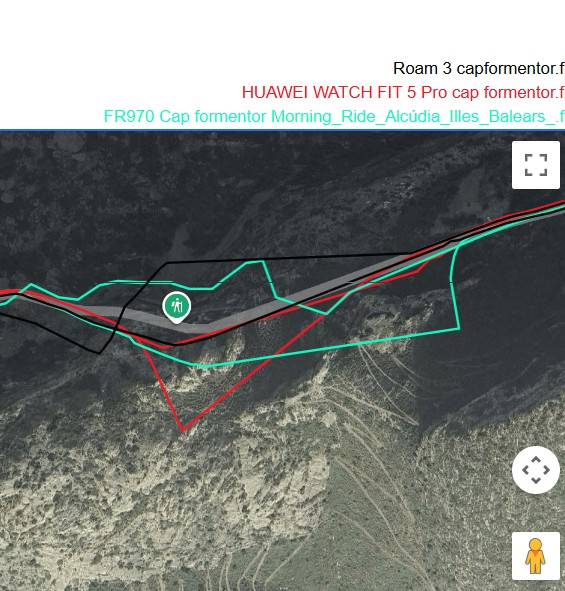
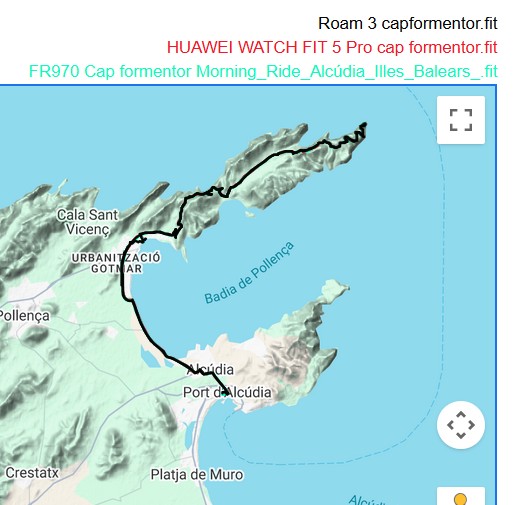
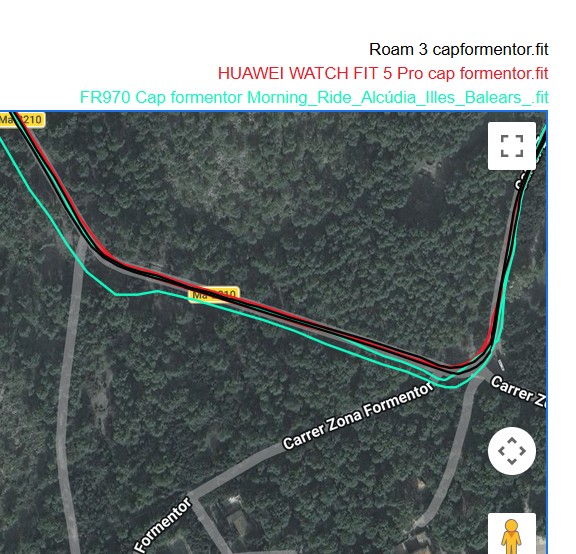
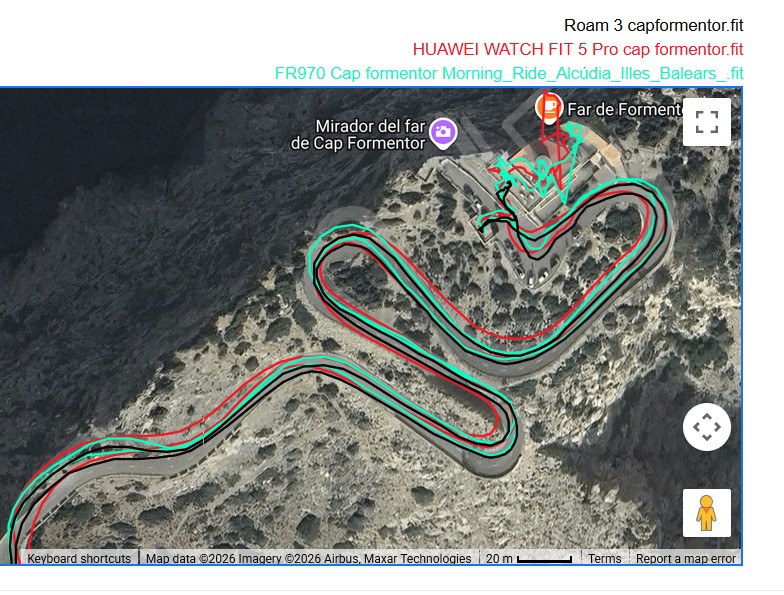
A moderately difficult ride in Mallorca to Cap de Formentor.
The Garmin Forerunner 970 has repeated errors here, and at times, all three devices struggled simultaneously for no apparent reason. The Fit 5 Pro handled the switchbacks and gradients well, with no obvious mountain-specific issues.
Heart Rate Accuracy
The Fit 5 Pro uses a new 6-LED, 6-PD optical heart rate module, a significant upgrade from the Fit 4 Pro.
Reference devices used: Garmin HRM 600, Polar Verity Sense worn on the upper arm, Apple Watch Ultra 3 and Whoop MG. Tests span running indoors and outdoors, cycling indoors and outdoors, pool swimming, strength and mixed-gym cardio, and yoga, across steady-state, threshold, and short-interval efforts. You name it, I did it.
Over a long, steady run, the heart rate track was excellent, with a tiny blip at the start.
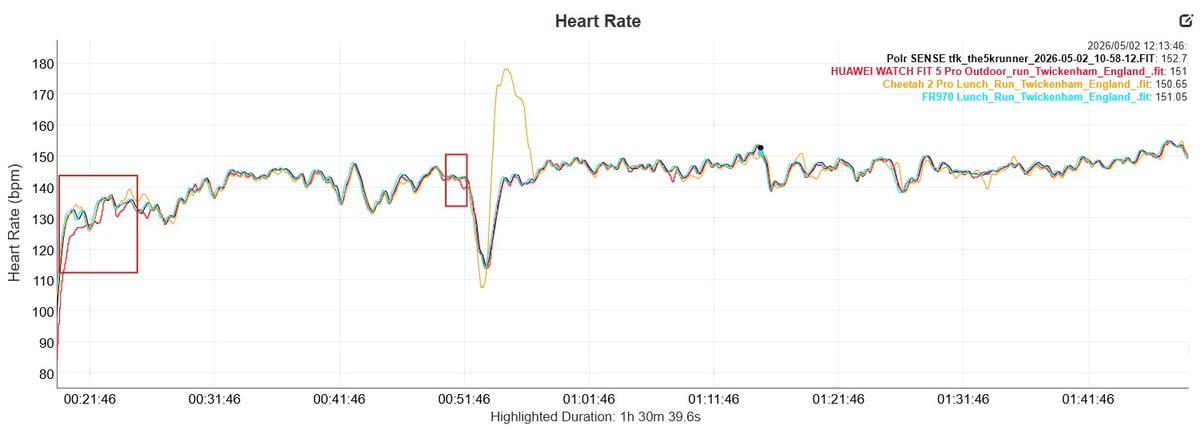
Performance during short running intervals was very good, albeit with a slightly jagged curve, perhaps linked to data recording frequency.
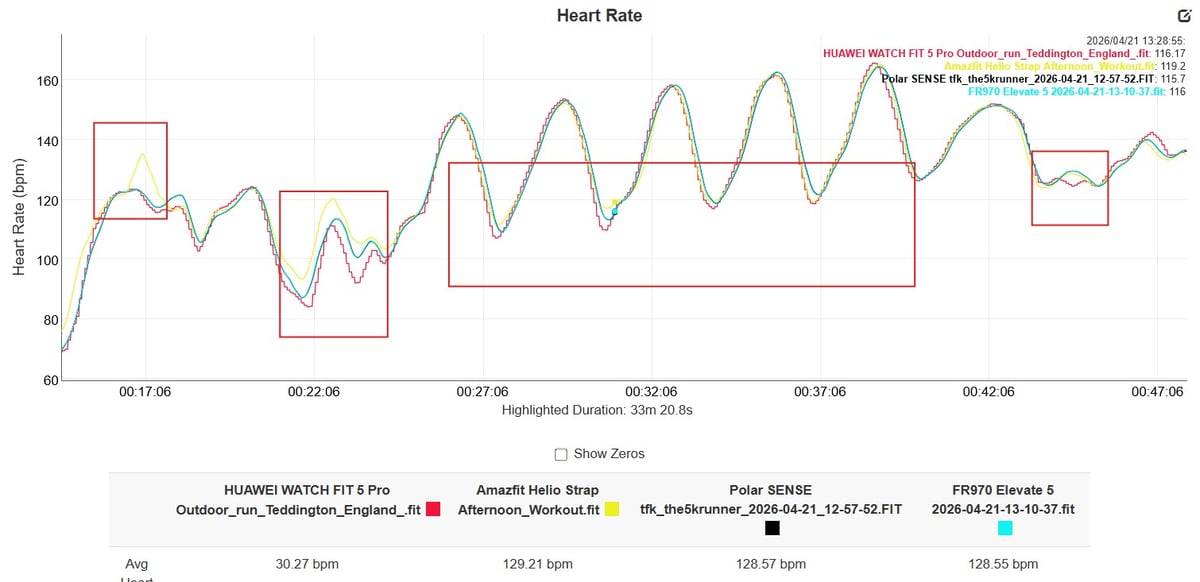
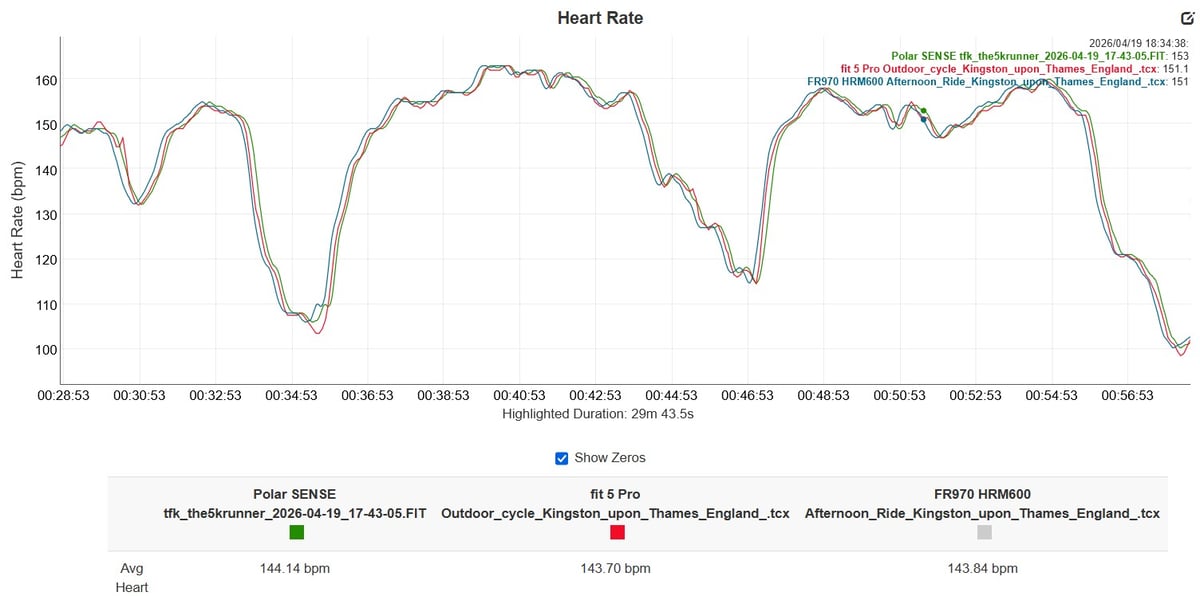
On an outdoor road ride with threshold-like efforts, the heart rate track was excellent, within 1% of the reference values from the Garmin HRM 600 and Polar SENSE.
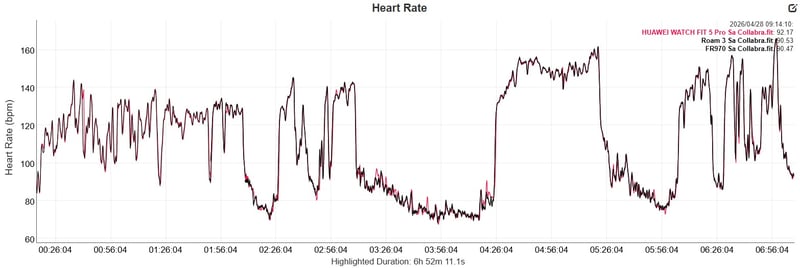
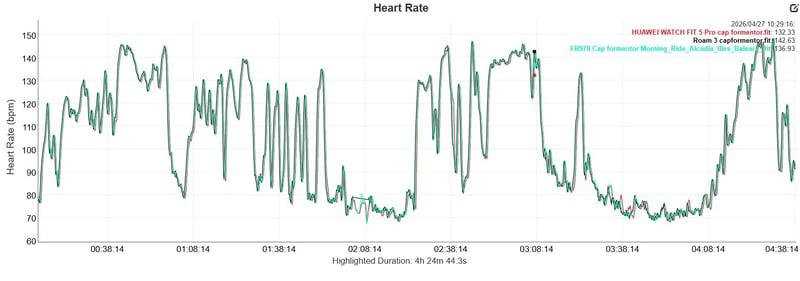
In Mallorca, I performed several long, mountainous rides with Fit 5 Pro, compared to Garmin's reference HRM 600. The road conditions were excellent (smooth), and the weather was hot, offering the best conditions for an optical HRM to perform well with the blood near the surface and few road vibrations. Huawei did not disappoint, producing surprisingly excellent heart rate tracks, as these two charts unambiguously show.
Turning to perhaps the most benign environment, indoor cycling, I made the recording slightly harder by adding intervals. The track recorded by Huawei exactly matched the reference standard and the Apple Watch Ultra 3. This demonstrates that the core sensor readings and processing are sound, and the previous examples therefore reflect how well the filtering algorithms remove noise rather than any underlying sensor weakness.
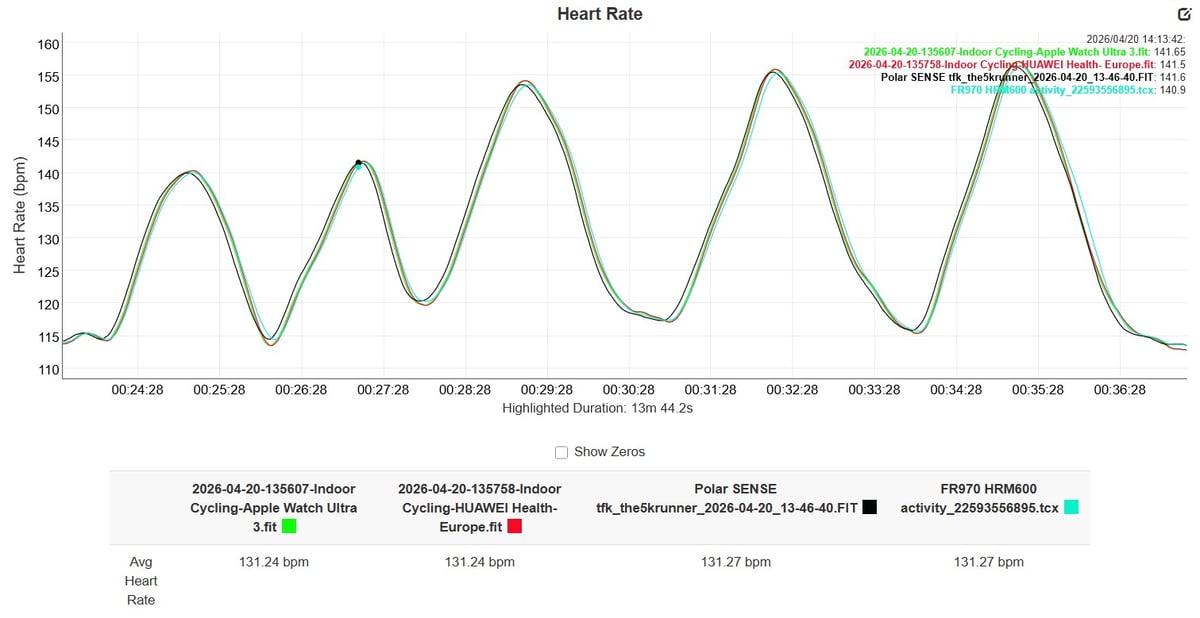
The Fit 5 Pro's heart rate sensor is one of the best wrist-based units I have tested. You can rely on it for your training without a chest strap, which is rare praise.
I would temper that by saying my tests were in warm weather. Cold weather introduces confounding factors by restricting blood flow near the skin, making it harder to obtain readings. The wider issue with optical heart rate accuracy is that it varies by person and use case, so your results may differ.
Elevation Accuracy
The barometric altimeter's accuracy is good compared to numerous watches and bike computers. The example below shows a slightly lower initial calibration that remains broadly steady over an hour, which is the correct behaviour (kinda).
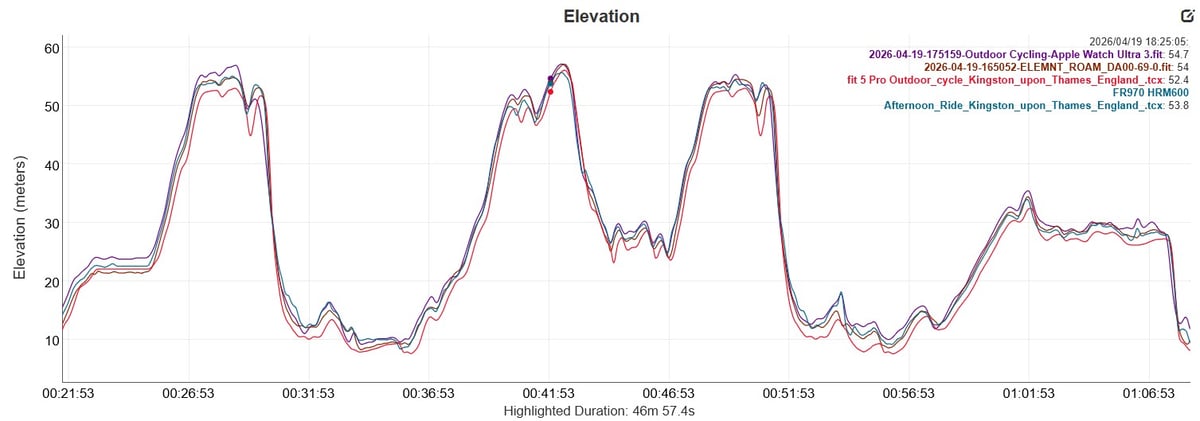
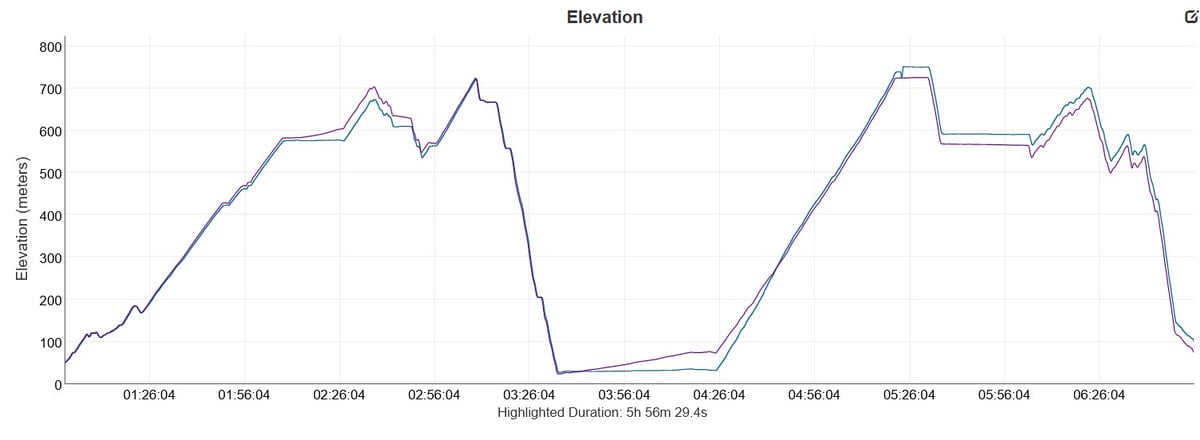
If those climbs look tiny, the next chart compares the Fit 5 Pro to a Wahoo Roam 3 on Sa Calobra, Mallorca. It is hard to say which is right, but the two are close enough. The Roam 3 (purple) registers an altitude change while stationary at a coffee stop, which is most likely wrong. Maybe the Fit 5 is best here?
Cycling — Urban Mode and Phone Bike Computer
The Fit 5 Pro introduces phone-as-bike-computer mode. The watch records activity while the smartphone, mounted on the handlebars, acts as a full-screen mirrored display of speed, heart rate, power, distance, elevation, and the live route. It can also pair third-party sensors. I tried the Helio Strap heart rate monitor and the power broadcast from my KICKR Bike Pro, both of which paired successfully, although on more than one occasion, the live link dropped after the watch had auto-paused.
You came here to read about the phone on the handlebars. With the Huawei Health app open on an iPhone, the iPhone ride display appeared as soon as the workout was started on the watch. It works similarly to the way an Apple Watch interacts with an iPhone; if anything, the Huawei Health phone display is richer and more interesting.
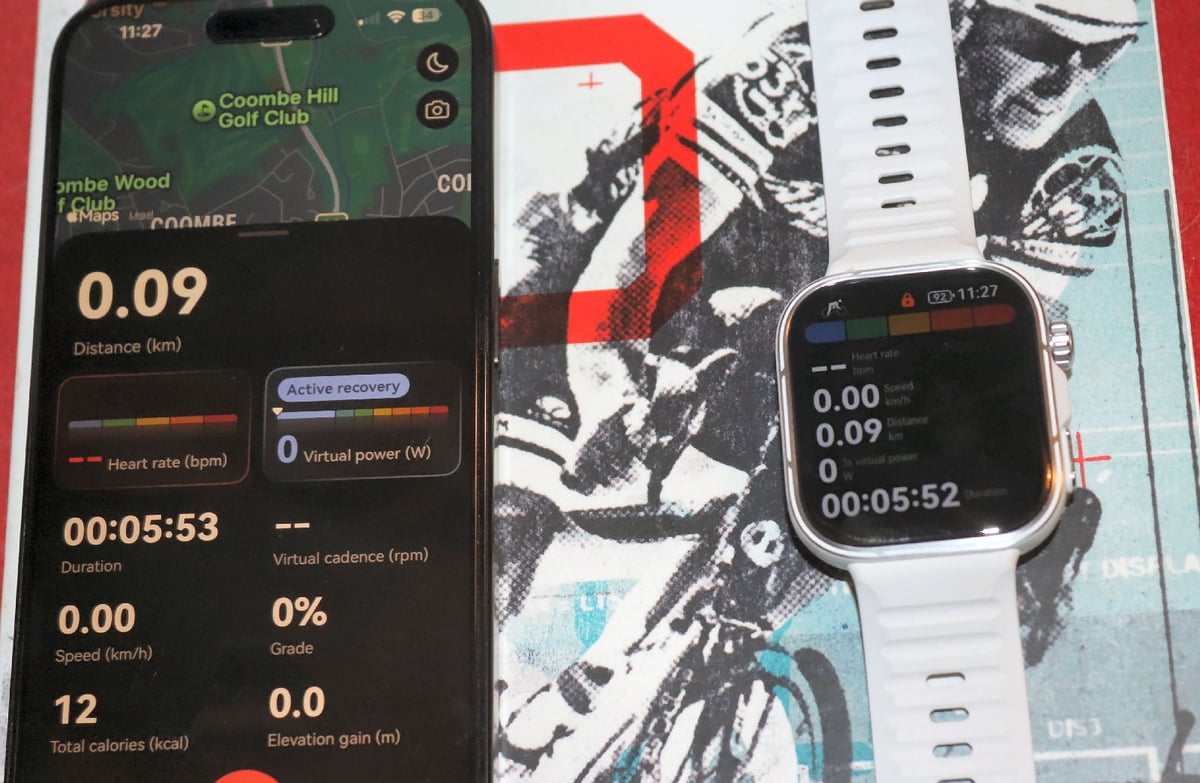
For casual riding, this is a great way to use a phone without buying a dedicated bike computer. You get all the metrics and a map for free. The downsides are several:
- You risk losing your phone, damaging it, or having it stolen.
- Battery consumption on the phone, which I did not measure, is likely to be aggressive, particularly in direct sunlight with always-on display enabled.
- Mounting to handlebars requires a trustworthy mount.
Of course, the upside is that there is no need to buy a bike computer!
Cycling Virtual Power
To be clear, virtual bike power cannot be correct. On the occasions I tested this, there was at least a 10% error in stable, ideal conditions. As a minimum, you need to set your age, weight, sex, bike type and bike weight correctly. Many other factors that impact the power calculation are outside your control and cannot be read by the Fit 5.
Q: What is Huawei's virtual cycling power useful for?
A: Riding on your own in windless conditions with a constant bike position, virtual power will give you a half-decent indication of relative changes in effort. If you speed up or climb, those factors are taken into account to some degree by the power figure you see.
Q: What primary factors impact virtual power's usefulness?
A: Wind changes, following another rider or vehicle, and changing your riding position are the main factors that make virtual power inconsistent within a single ride.
Q: What other factors are involved?
A: Road surface, rapid changes in conditions, tyre pressure, rolling resistance and other variables influence the reported power, and they are out of your control or knowledge.
Cycling FTP
FTP is a useful measure of the maximum power you can sustain for an hour(ish). Huawei estimates it automatically based on roughly 40 minutes of quality ride time, including at least 15 minutes above 80% of maximum heart rate. It calculates the figure from virtual power, which makes it close to useless. It also calculates using a real power meter paired with the watch, so FTP becomes a meaningful number that defines training zones. I could not find a way to manually adjust the FTP figure.
Running Power
Huawei's running power metric was not available in the data exported from its app, but was visible in the app along with averages. So I could not perform detailed comparisons on a chart and could only compare visually.
For a long steady-state run, the power was visually similar to the Suunto Race 2 and Stryd power curves but was significantly lower than the Cheetah 2 Pro. Even if I had been able to overlay the data, it is common for different manufacturers to present different power curves and levels; there is no gold standard to compare against. With a few short stops, I paced the run shown below on mostly flat terrain, and there is a close match to heart rate, which is expected in this case.
The similarity of the curves shows that Huawei probably uses the same method as Suunto and Stryd, which is likely different to the method used by Garmin and Amazfit for on-the-wrist calculations.
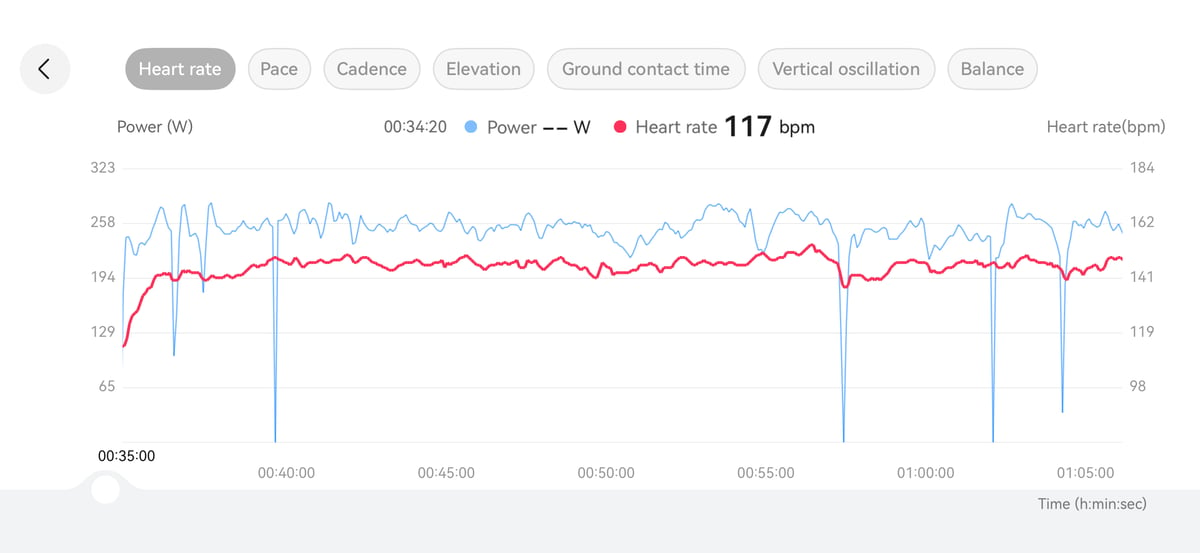
To be clear: whilst cycling's virtual power is of little use, running power calculated from the wrist is significantly more usable and actionable and is found on almost every sports watch these days.
Swimming and Other Low-Intensity Sports
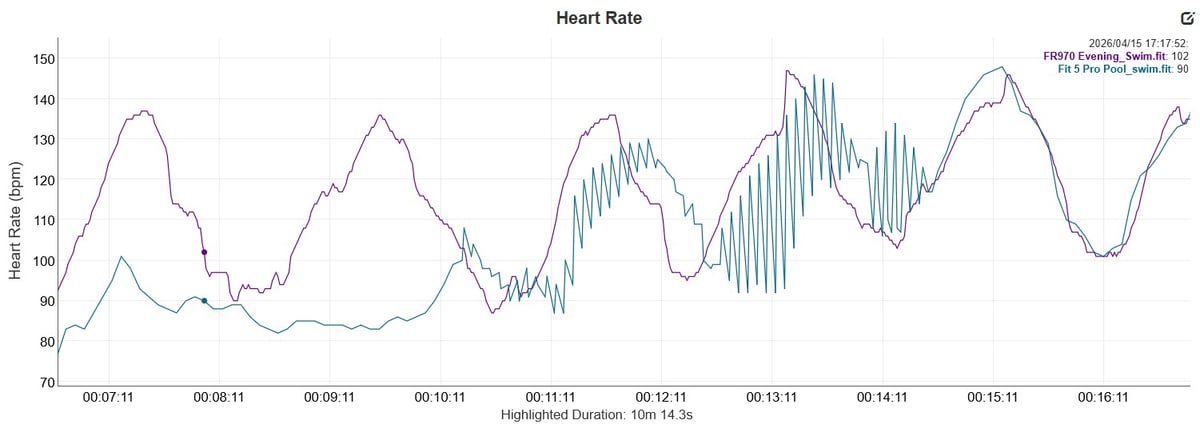
For pool swimming, lap detection was good. The Fit 5 Pro counted crowded-lane laps perfectly correctly, unlike the Garmin FR970, which miscounted and added an incorrect lap. On the heart rate side, things were not great, with poor detection as the chart below shows. I noticed a similar dropout pattern with the Runner 2, so this is almost certainly a sensor or algorithm issue that needs to be addressed.
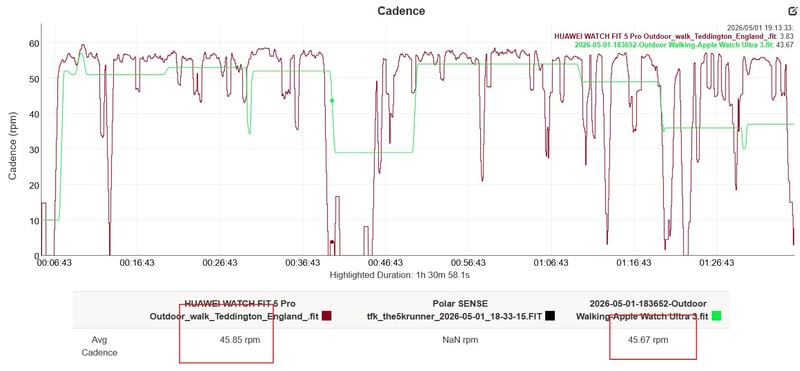
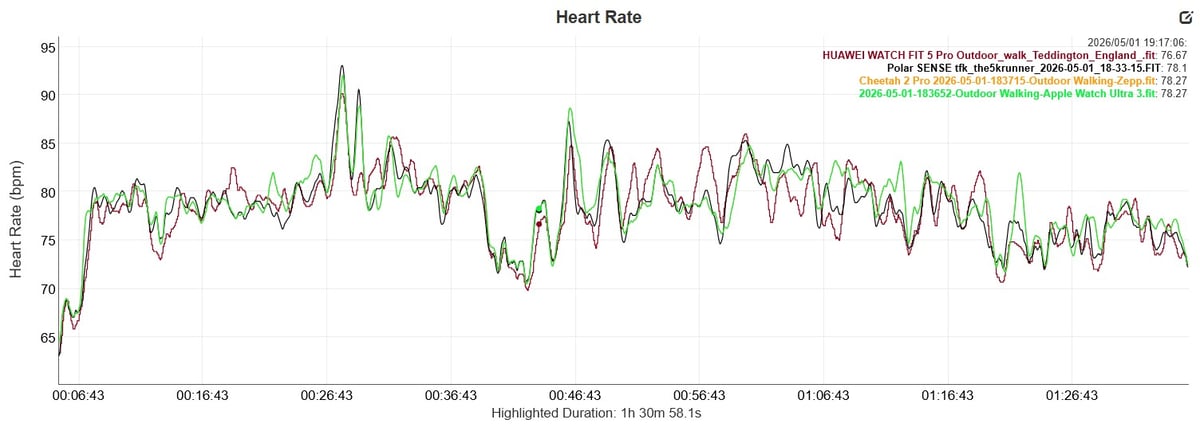
For low-grade walking, the heart rate readings agreed with the Apple Watch Ultra 3 and Polar SENSE. Interestingly, the walking cadence was very similar between Huawei and Apple, strongly suggesting that the step counts match.
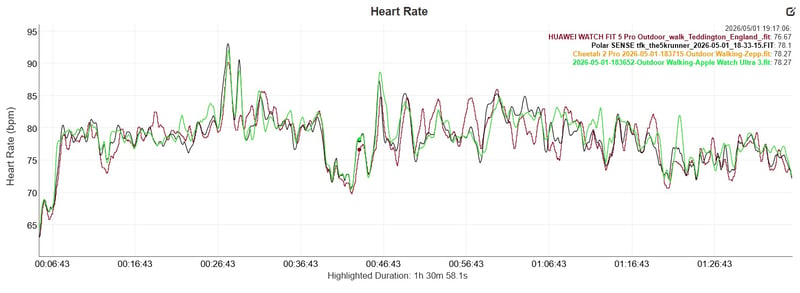
Turning to a yoga workout, the heart rate track was excellent, with only a tiny discrepancy relative to reference-grade sources. This was a relatively hard yoga session for me and similar in difficulty to a low-grade strength workout. Some of yoga's more extreme and unusual movements cause minor issues with the wrist HR sensor; this is also true of the Apple Watch Ultra 3.
Huawei has introduced some mini-workouts. If you are super-fit, it is easy to scoff at being told to shrug your shoulders or make modest micro-movements like wriggling your ankles on a long drive. However, this is, at worst, harmless and, at best, offers a level of benefit similar to that of existing Stand alerts on many watches. Keeping the body moving is good.
Curve Pay and NFC Payments
Curve Pay is Huawei's current path for European NFC payments. It is a payment aggregator: financial glue that sits between your existing card and the Huawei watch. I've used it for years, and there is currently a time-limited 3% cashback deal for signing up and using Huawei. Download the Curve app through the smartphone's AppGallery if you don't already have a Curve card. Set up your card in Devices > Wallet. Double-press the rectangular button to use it. Sorted.
My testing for this review was before the watch launched, and Curve Pay was unavailable to test. I have seen a firsthand working demonstration of it by a company rep, who was buying a real product.
Note to self: Update once firmware is live
City Navigation
City navigation and adventure navigation are two different ways to avoid getting lost. The former relies on working closely with your smartphone map app to get directions to a place, then uses haptics and visuals on your wrist to guide you there, with periodic turn-by-turn guidance. Apple Watch excels at that, using Apple Maps
Adventure navigation is when you grab a course from a friend, a race organiser, Strava, or Komoot and then follow it almost exclusively on your watch (or bike computer). You'll be looking at the map more frequently, and contours and other points of interest (POI) will play a big part in the experience.
Also, the ability to reroute when you get lost comes into the equation.
The Huawei Watch has room for improvement here. Like most watches, it doesn't have on-device rerouting capabilities; more expensive Garmin watches do. But it does a pretty decent job with the on-wrist alerts and visuals. It also lacks a proper tie-in with its own Petal Maps app in the same way that the Apple Watch links closely with Apple Maps.
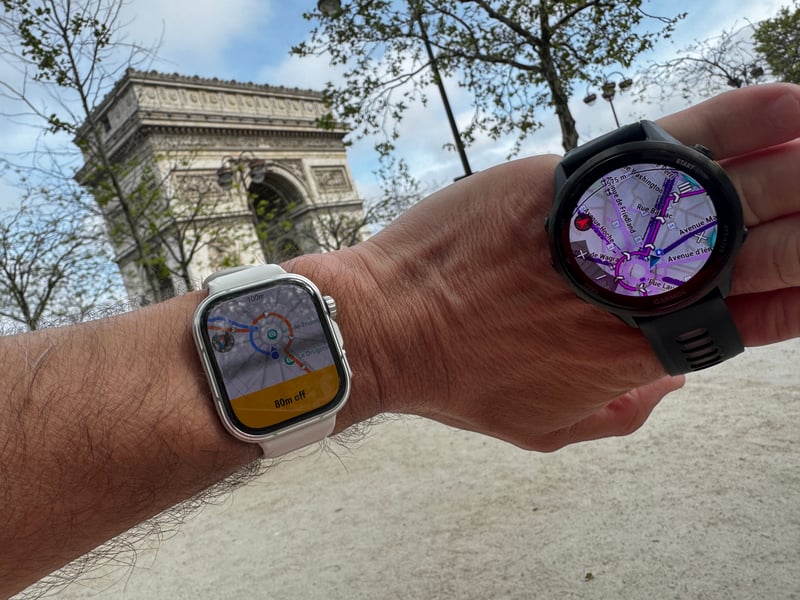
It's somewhat of a mystery to me how to get routes onto the watch for adventure navigation. I have done it a couple of times, but the route seems to disappear once I've followed it, or I forget where it was. The correct location for it is in the sport profile options before you start an activity.
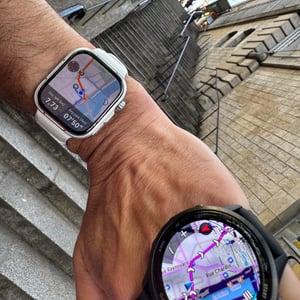
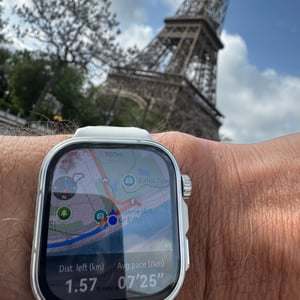
As you can see from the image above, I really did manage to follow a manually uploaded GPX route; the Fit 5 Pro's track display is very clear, much more so than the coloured monstrosity on the Garmin Forerunner. Huawei's lines are clearly coloured, and the off-route indication is also super clear. I did a fairly complex pre-planned run around the sites in Paris for over 10k and managed to avoid getting lost in unfamiliar territory. Job done.
Sleep Monitoring and Nap Recap
The Fit 5 Pro upgrades sleep monitoring with a new algorithm, Huawei has badged as True Sleep 5.0, deployed initially on the Fit 5 Pro and other newly released models rather than rolled back to existing devices. It carries clinical N1/N2/N3 staging and a new Nap Recap feature, the latter sensibly advising a 40-minute maximum.
I don't nap, but if you do, the pros and cons roughly even out. Bottom line: do it if you want to. That said, short naps under 30 minutes leave you alert and have proven benefits for memory and concentration. Naps over an hour, and late-afternoon naps in particular, tend to disrupt the following night's sleep and are linked to a higher risk of heart disease. Huawei's 40-minute cap sits in the sweet spot the research supports.
Sleep Accuracy
Across ten paired nights against the Apple Watch Ultra 3, the Fit 5 Pro tracked total sleep time within an average of 20 minutes, and against the Eight Sleep mattress sensor on two paired nights, it was the closer of the two devices. Deep sleep tracking showed reasonable agreement, including the same identification of an unusual night of deep sleep. REM detection consistently ran around 45 per cent lower than the Ultra 3, which is a weakness in the data and consistent with the wider consumer category's known difficulty with REM identification. Independent testing by The Quantified Scientist against an EEG sleep-study reference on the Fit 5 Pro found similar REM under-detection, suggesting this is an algorithm-level issue with True Sleep 5.0 rather than a peculiarity of my testing.
Bottom line: No consumer watch detects sleep stages with clinical accuracy. The most useful approach is to track total sleep time and consistency. The Fit 5 Pro does this well.
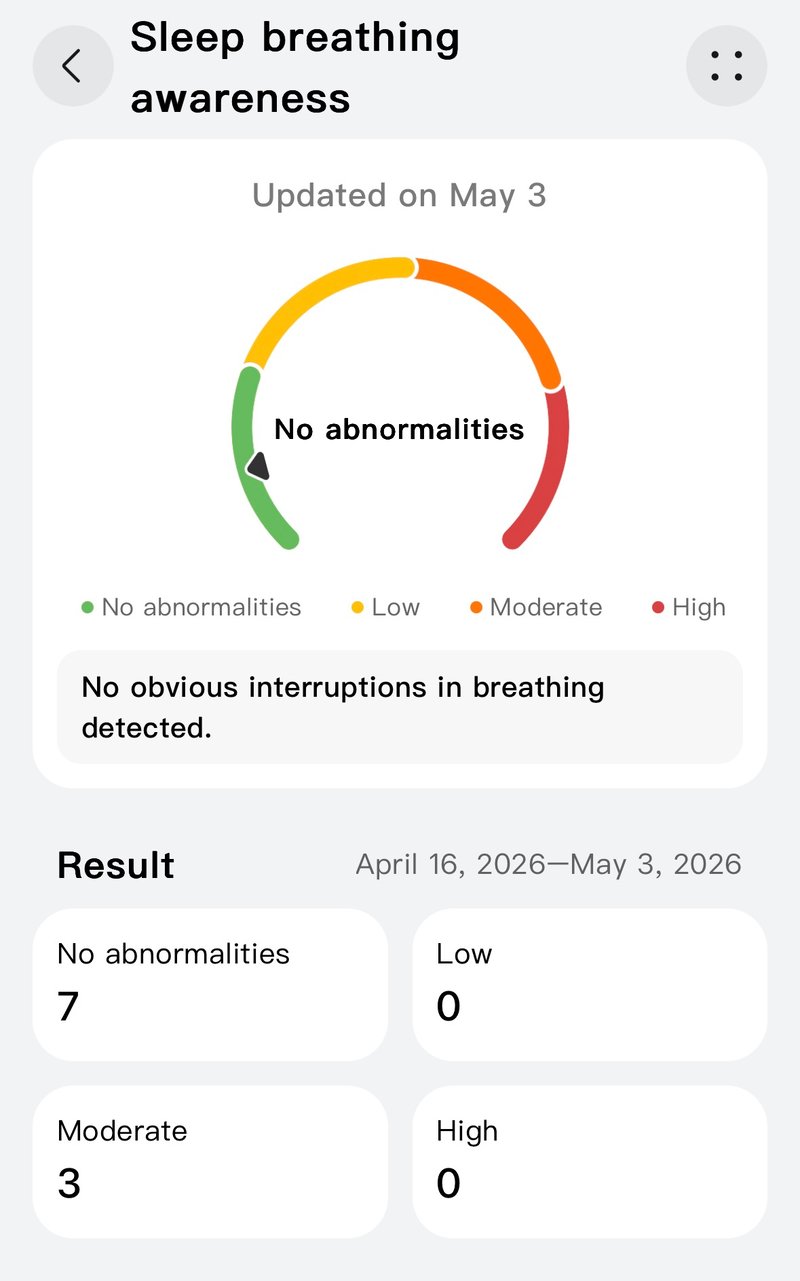
Sleep Breathing Awareness is a new nightly feature that runs in the background and, so far, reports no abnormalities for me, as expected. The metric is AHI (apnea-hypopnea index): under 5 is normal, 5 to 14 is mild, 15 to 29 is moderate, and 30 or above is severe. The watch derives it from heart rate variability, SpO2 dips and motion. Outside China, it is labelled non-medical, but the algorithm has been validated against polysomnography in peer-reviewed work and works reasonably well for moderate-to-severe cases. For most readers, it sits silently and reports normal. Repeated abnormal flags would be worth taking to a GP.
Cardiovascular Health — ECG, Arterial Stiffness, Pulse Wave Arrhythmia
The Fit 5 Pro carries ECG and arterial stiffness detection, both Pro-only features, both inherited from the Fit 4 Pro. The newly prominent feature is pulse wave arrhythmia analysis, CE-certified in Europe, on both Fit 5 and Fit 5 Pro. There is a good range of wellness features on show here, some of which are less useful due to the need to take a manual reading.
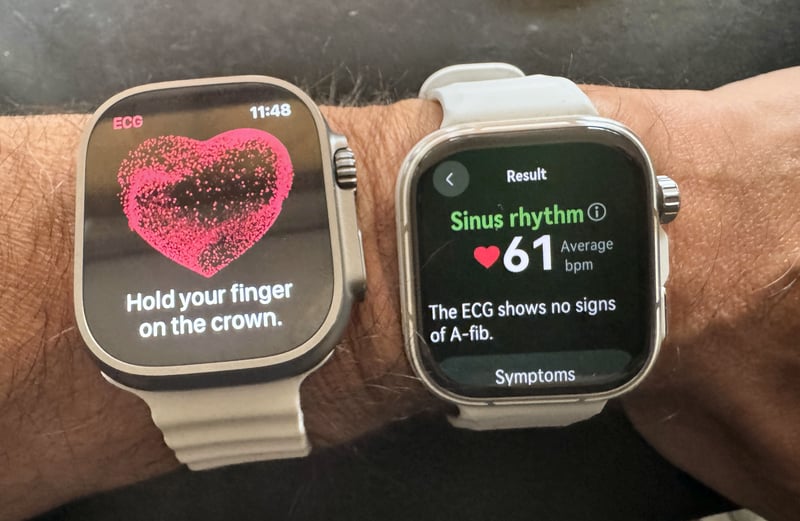
A handful of ECG tests showed my normal sinus rhythm, as expected, and were confirmed by readings taken immediately afterwards by the Apple Watch Ultra 3. Abnormalities are hard to detect with these manual tests, as they require you to be testing when the abnormalities present themselves. For continuous background checking with a consumer-grade device, try something like Fourth Frontier X2.
Three manual measurements on different days were in the range 8.8-9.1, classed as slightly stiff, which is of some concern to me, and I will investigate further. The Oura Ring has a similar feature called Cardiovascular Age (CVA), which is based on estimated pulse wave velocity (PWV), but this has not historically flagged any issues for me.
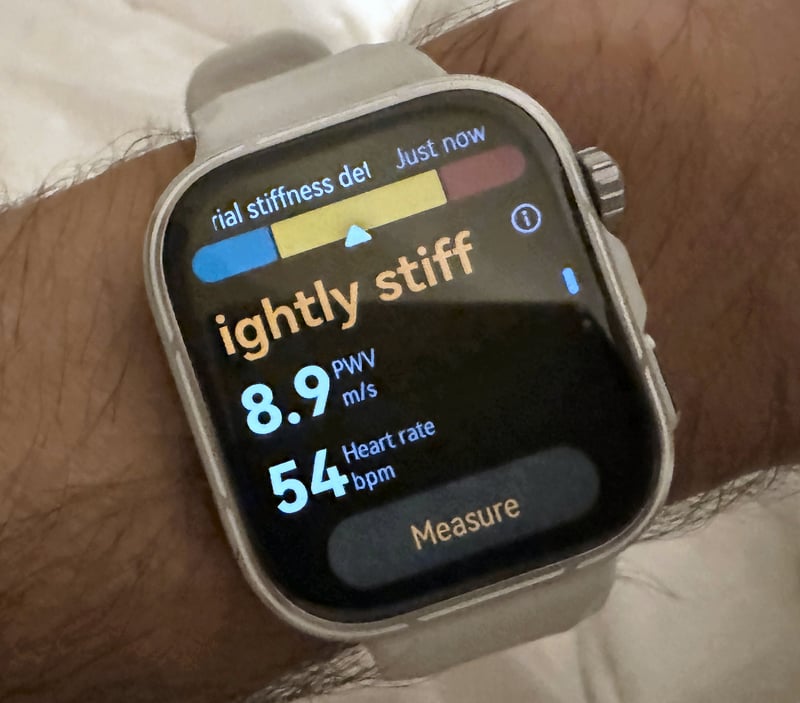
I will follow up on this with a clinical test at my doctor's and report back in a future article.
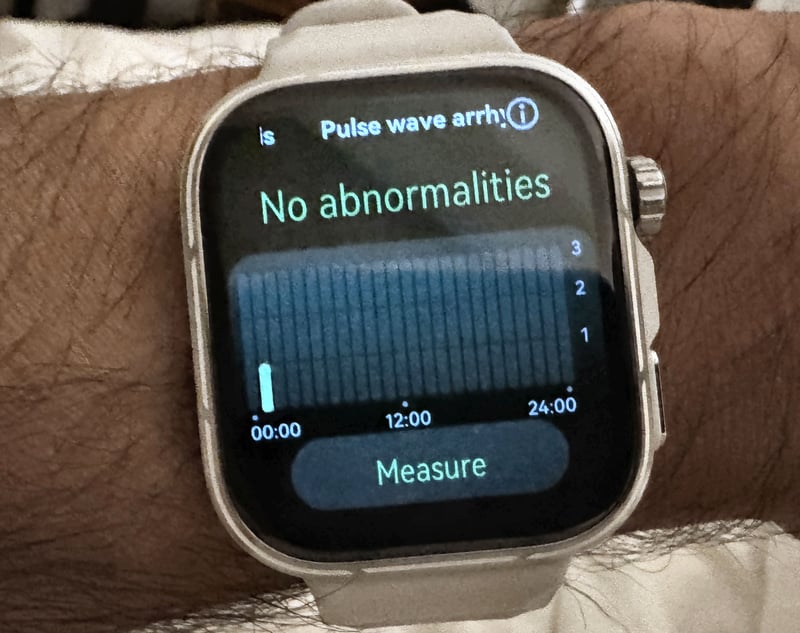
Pulse Wave Arrhythmia (PWA) works automatically in the background, taking a reading every couple of hours, and reports no abnormalities.
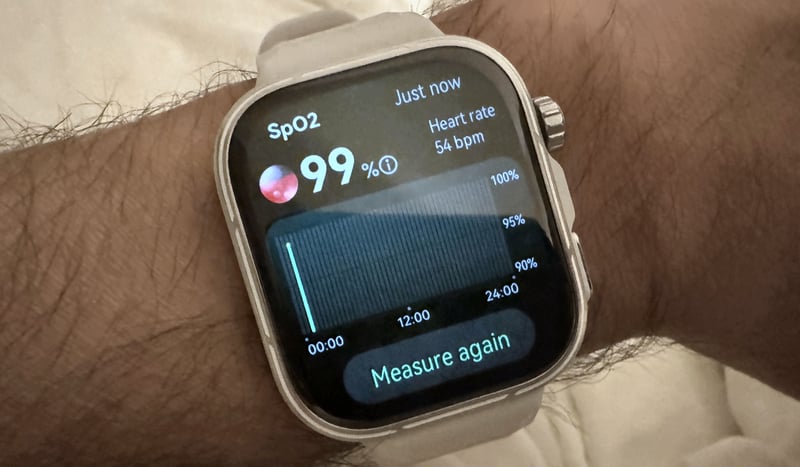
SpO2 is a vital sign. As a healthy person, this was typically in the expected range for me, above 95%. There were differences from Apple Watch readings taken at similar times, but both were within 1-2% of each other.
App, Ecosystem and Third-Party Apps
The Fit 5 Pro ships with a meaningfully expanded third-party app list compared to the Runner 2 launch state: Strava, Komoot, Naviki, and Intervals.icu, FiiT, URUNN, Kotcha, RacePace, Clue, Life Period Tracker. A new Huawei Health MultiPass bundle offers free memberships for Komoot (two months), Naviki (three months), URUNN (three months), FiiT (three months) and Life Period Tracker (three months), plus Huawei Health+ for one month on Fit 5 and three months on Fit 5 Pro.
The on-watch Workout Service launches alongside the Fit 5 Pro and features four third-party apps: Goodshot (badminton), Tennix (tennis), PickleX (pickleball), and KeepStrong (strength training).
Since reviewing the Runner GT 2 a few months ago, I've noticed increased reliability with Strava syncing of completed workouts. This is clearly a work in progress, and I noted remaining issues, for example, workouts not syncing when two Huawei watches were paired to the Huawei app and recorded the same workout. Admittedly, an issue that will affect only me! But perhaps symptomatic of other niche cases across the various platforms. (Delete the one that has synced, and the other then syncs)
I also tested uploading completed workouts to Intervals.icu and Komoot, and it worked.
There is a degree of data syncing to Apple Health, which my HealthFit app syncs elsewhere, including Dropbox. However, Huawei does not properly write GPS tracks back to Apple Health, so for me, the reliable way to access GPS data was through Huawei data exports from Strava. #PITA.
The Huawei app remains a little cluttered and needs better organisation and colour to improve its appearance and usability. There remains a large number of permissions that need to be granted and approved at every turn, which spoils the experience, as does a large amount of screen real estate set aside for various paid-for additions like watch faces, apps, and some training plans (courses).
Permissions are also required at times on the watch. In contrast to the app, the watch interface is generally very good and highly usable.
Battery Life
Huawei's headline numbers for the Fit 5 Pro: 4 days with always-on display enabled, 7 days of typical use, 10 days of light use, 25 hours in trail-run mode with GPS active, and 60 minutes of wireless fast charge. The battery is 471mAh, an 18 per cent capacity increase over the Fit 4 Pro's 400mAh cell.
I noted the battery drain over 5 days, during which I had up to 2 hours of workouts per day. The battery drain varied between about 14% and just over 20% per day. So this would fit in with Huawei's claims of 7 days of typical use. I got less than 7 days for sure, but I was probably using it more heavily than their reference scenarios, and it was very sunny every day. Hence, the screen brightness was higher, and the battery drain was commensurately higher.
For one specific 90-minute run, I used trail-run mode (it wasn't on a trail, but Huawei quotes performance for that mode). The battery was 100% at the start and down to 95% by the end. This was better than Huawei's claim. I would speculate that the battery is new and that Huawei makes conservative claims to account for battery-life degradation in normal use, or that the battery's charge-state calibration could be incorrect.
I had a couple of abortive attempts to measure fast charging. Once I forgot I was testing it and left it, and another time it took over an hour to charge. I discovered I was using a lower-rated socket, so I was merely charging it rather than fast charging it. Other reviewers have reported full charges from a low battery in roughly 40 minutes, suggesting Huawei's 60-minute claim is conservative.
What about the non-Pro Fit 5?
The non-Pro Fit 5 launched alongside the Pro on 7 May 2026 at £159.99. It carries the same 6-LED 6-PD heart rate sensor, the same Sunflower antenna, and the same 471mAh battery, but trades the Pro's titanium bezel, sapphire glass, ECG, arterial stiffness, 40-metre freedive certification and trail-running checkpoint markers for an aluminium body and glass lens. The Pro earns its £90 premium for the materials and the wellness layer, not for the sensors.
Who It’s Competing With
Huawei has not provided an explicit list of competitors for the Fit 5 Pro, and the most useful starting point for me is to narrow down the choices for people who've decided on the rectangular format. The main contenders are Apple Watch (Ultra 3 by looks and Watch 11 by price), Garmin Venu X1, Fitbit Versa 4, and Amazfit Active 2 (square). Here are some overview thoughts before we dig in.
- Apple Watch Ultra 3 - clearly the best option for iPhone users, but at a high price. The watch's bulk and short battery life will deter many. The 5G and satellite autonomy will be a must for others.
- Apple Watch Series 11 - the price competitor for the Fit 5 Pro at £249. AOD, ECG, significantly worse battery, aluminium body and Ion-X glass at this price (Series 11 Titanium with sapphire is £699).
- Apple Watch SE 3 - the price competitor for the non-Pro Fit 5 at £159.99. No AOD, significantly worse battery, poorer-quality materials.
- Garmin Venu X1 - a great option for iOS and Android phones, and the best for anyone wanting a deep sports ecosystem. Good but limited smart features and a high price tag.
- Fitbit Versa 4 - In the absence of a square Pixel watch, this would be Google's Android offering. However, it's a dated model and likely will be superseded soon. So I'll stop there.
- Amazfit Active 2 (square) - this is probably the closest competitor on paper. I've never tested one, but I have extensively used its smartphone app with the brand's other watches.
- Huawei Watch Fit 5 Pro - the best and obvious choice if you have a Huawei phone, as it has the deepest integrations. Less of an obvious choice on Android or iOS.
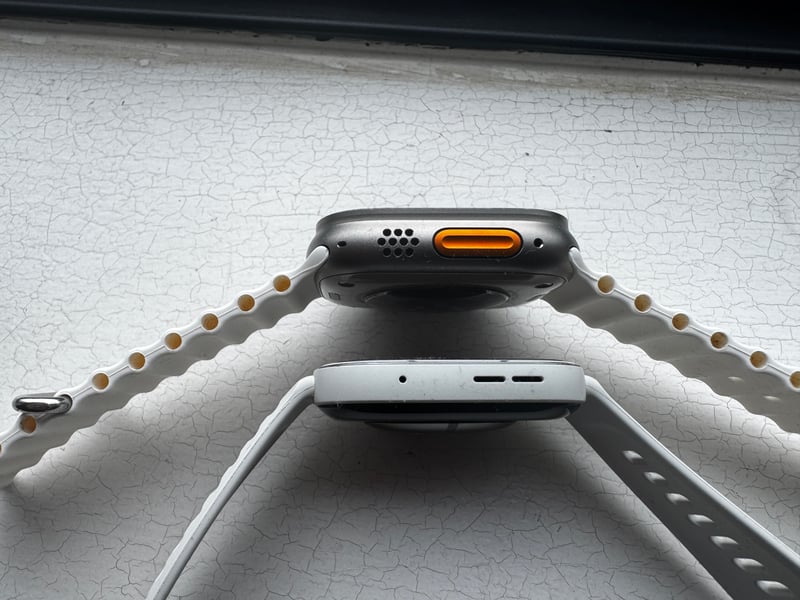
How the Huawei Watch Fit 5 Pro Compares
The Apple Watch Ultra 3 is the headline comparison and the one to beat. The Fit 5 Pro looks strikingly like an Ultra 3 from a distance, weighs roughly half as much, lasts substantially longer on a charge, works on both Android and iOS, and costs less than half as much. The other comparators sit either above the Fit 5 Pro in price (Garmin Venu X1) or below it (Amazfit Active 2 Square, Fitbit Versa 4), framing the value picture from both sides.
Comparison: Fit 5 Pro vs Premium Comparators - Competing on looks
Huawei's price is its strongest point compared to broadly similar-quality watches. For most people, the choice is simple: Huawei = price, Garmin = sports, Apple = iPhone owner.
| Huawei Watch Fit 5 Pro | Apple Watch Ultra 3 | Garmin Venu X1 | |
|---|---|---|---|
| Case (mm) | 44.5 x 40.8 x 9.5 | 49 x 44 x 14.4 | 46 x 41 x 7.9 |
| Weight | 30.4g | 61.8g | 34g |
| Display | 1.92" LTPO AMOLED | 1.92" LTPO3 OLED | 2" AMOLED |
| Display details | 3,000 nits, 480 x 408 | 3,000 nits | 448 x 486 |
| Lens | Sapphire | Sapphire | Sapphire |
| Case material | Titanium bezel,
Aluminium body |
Titanium | Polymer
Titanium back |
| Battery (typical) | 7 days | 36 hours | 8 days |
| Battery (GPS) | 25 hours | ~20 hours | 16 hours |
| Connectivity | Bluetooth | Bluetooth
LTE + 5G |
Bluetooth |
| Platform | HarmonyOS
iOS, Android |
iOS only | iOS, Android |
| Price UK | £249 | £799 | £729 |
| Price EU | €299 | €899 | €799 |
Comparison: Fit 5 Pro vs Apple's Price-Comparable Watches - competing at similar prices
The Fit 5 at £159.99 matches Apple's SE 3 at £249. The Fit 5 Pro at £249 matches the Series 11 at £399. Huawei undercuts Apple by 35 to 40 per cent.
| Huawei Watch Fit 5 Pro | Apple Watch Series 11 (aluminium) | Apple Watch SE 3 | |
|---|---|---|---|
| Case (mm) | 44.5 x 40.8 x 9.5 | 46 x 39 x 9.7 / 42 x 36 x 9.7 | 44 x 38 x 10.7 / 40 x 34 x 10.7 |
| Weight | 30.4g | 37.8g (46mm) / 30.3g (42mm) | ~32g |
| Display | 1.92" LTPO AMOLED | LTPO3 OLED, AOD | Retina LTPO OLED |
| Display details | 3,000 nits, 480 x 408 | 2,000 nits | 1,000 nits, no AOD |
| Lens | Sapphire | Ion-X glass | Ion-X glass |
| Case material | Titanium bezel,
Aluminium body |
Aluminium | Aluminium |
| Battery (typical) | 7 days | 24 hours | 18 hours |
| Battery (GPS) | 25 hours | ~6 hours | ~6 hours |
| Connectivity | Bluetooth | Bluetooth (LTE optional) | Bluetooth (LTE optional) |
| Platform | HarmonyOS
iOS, Android |
iOS only | iOS only |
| Price UK | £249 (est.) | £399 | £249 |
| Price EU | €299 | €449 | €249 |
Comparison: Fit 5 Pro vs Budget Comparators - competing against cheaper models
At the budget end, Huawei stands as clearly the best-quality hardware package, with the most sports, health, and smart features. You pay a premium for that. Amazfit has a cleaner app and better usability.
| Huawei Watch Fit 5 Pro | Amazfit Active 2 Square | Fitbit Versa 4 | |
|---|---|---|---|
| Case (mm) | 44.5 x 40.8 x 9.5 | ~44 x 38 x 10 | 40.5 x 40.5 x 11.2 |
| Weight | 30.4g | ~32g | 37.6g |
| Display | 1.92" LTPO AMOLED | 1.75" AMOLED | 1.58" AMOLED |
| Display details | 3,000 nits, 480 x 408 | 2,000 nits | n/a |
| Lens | Sapphire | Sapphire | Glass |
| Case material | Titanium bezel,
Aluminium body |
Stainless steel | Aluminium |
| Battery (typical) | 7 days | 10 days | 6 days |
| Battery (GPS) | 25 hours | ~21 hours | n/a |
| Connectivity | Bluetooth | Bluetooth | Bluetooth |
| Platform | HarmonyOS
iOS, Android |
iOS, Android | iOS, Android |
| Price UK | £249 (est.) | £149 | £199 |
| Price EU | €299 | €149 | €229 |
Quick answers
Is the Huawei Watch Fit 5 Pro a good alternative to the Apple Watch Ultra 3?
Yes, with the caveat that the Ultra 3 retains a stronger link to its third-party app ecosystem, LTE/5G/Satellite connectivity and tighter iPhone integration. For iPhone users prioritising fitness tracking and long battery life on a tight budget, the Fit 5 Pro is the rectangular sports watch to look at.
Does the Huawei Watch Fit 5 Pro work with an iPhone?
Yes, via the Huawei Health app. Watches sync reliably, but the app must be open for the connection to hold. Owners of multiple Huawei watches must manually switch between them in the app, as only one watch can sync at a time.
How accurate is the Huawei Watch Fit 5 Pro for running?
Heart rate accuracy is very good, but GPS accuracy is subpar when examined closely.
Does the Huawei Watch Fit 5 Pro support Strava?
Yes. Strava is listed as a first-party supported partner via Huawei Health. This is a one-way workout sync, not a route sync.
Does the Huawei Watch Fit 5 Pro support contactless payments in the UK?
Yes, via Curve Pay starting in May 2026. The service works across the UK, Ireland and most of the European Economic Area.
What is the battery life of the Huawei Watch Fit 5 Pro?
Huawei quotes 7 days of typical use, 10 days of light use, 4 days with the always-on display enabled, 25 hours in trail-run mode with GPS active, and a 60-minute wireless fast charge. In my testing, the real-world drain ran slightly higher than these claims, most likely due to sunny conditions pushing the screen brightness up.
Does the Huawei Watch Fit 5 Pro have a built-in power meter for cycling?
No. Virtual Cycling Power is a model-based estimate using height, weight, bike type, real-time speed, gradient and environmental data. It is not a replacement for a paired power meter, though it is useful in edge cases for cyclists without one.
Can the Huawei Watch Fit 5 Pro detect sleep apnea?
The Sleep Breathing Awareness feature checks for potential sleep apnea hypopnea syndrome using Apnea-Hypopnea Index estimation. Huawei positions this explicitly as non-medical, not a clinical diagnosis. It is now available in global markets, including the UK, for non-medical commercial use.
How does napping affect nighttime sleep?
Daytime naps reduce sleep pressure, which in turn reduces slow-wave activity at night. Short naps under 30 minutes avoid the grogginess of deep sleep and have cognitive benefits. Habitual naps over an hour a day, particularly late in the afternoon, are associated with fragmented night sleep and higher cardiovascular risk. Huawei's Nap Recap 40-minute advisory aligns with the evidence-based sweet spot.
Price And Availability
Available in Europe (€299, £249) and across South-East Asia. Full specifications and the complete battery table are listed on the Watch Fit 5 Pro specifications page.

Verdict
The Huawei Watch Fit 5 Pro is the rectangular sports watch to watch in the mid-range market. Hardware is genuinely impressive: a 1.92-inch LTPO AMOLED with best-in-class brightness, a titanium bezel, sapphire glass, a new optical heart rate module, 40-metre freedive, CE-certified pulse wave arrhythmia analysis, a 471mAh battery rated for 25 hours of GPS on the trail, and Curve Pay for EU/UK contactless payments. The third-party platform links are a decent reason to consider the watch, with Strava, Komoot, and Intervals.icu, Naviki, FiiT and URUNN all supported, though other brands do the same.
The Fit 5 Pro succeeds at its core ambition. It looks like an Apple Watch Ultra 3, weighs half as much, lasts twice as long on a charge, works on both Android and iOS, and costs less than a third as much. The 6-LED 6-PD heart rate sensor is one of the best wrist sensors I have tested across steady running, threshold cycling, indoor cycling and walking. The barometric altimeter holds up against reference bike computers. Sleep tracking lands within 20 minutes of the Apple Watch Ultra 3 across 10 paired nights, and closer to the Eight Sleep mattress sensor than to the Ultra 3. For a watch at this price, that is a genuinely strong sensor package.
Where it falls short is partly hardware and partly software. The upgraded Sunflower antenna does not deliver the GPS accuracy of the Runner 2's dielectric bezel design, and the watch scored 63 per cent accuracy on my standard 10-mile test, compared with the Runner 2's market-leading 90 per cent. Virtual Cycling Power carries a 10 per cent or greater error and is useful only as a relative effort indicator in solo riding, with no manual FTP option. Pool swim heart rate fails with the same dropout pattern as the Runner 2. The Huawei Health app remains cluttered for a Western running audience, the running power metric is not exportable for detailed analysis, and AppGallery restrictions on iPhone appear to have blocked the URUNN coaching app, which is one of the watch's marketed features.
So who should buy it? For an Android user looking for a rectangular sports watch with serious sensor credentials at a budget price, this is a watch to consider. For an iPhone user prioritising fitness tracking and battery life over deep iPhone integration, this is also worth a hard look, with the caveat that the Apple Watch ecosystem (LTE/5G/Satellite, watchOS apps, Apple Pay, native iPhone integration) remains the better choice if budget allows. For a Huawei phone owner, this is the obvious choice. For a serious endurance athlete who races on GPS-dependent courses or trains by power on the bike, the GT Runner 2 remains Huawei's offer. For everyone else considering a rectangular fitness watch under £300, the Fit 5 Pro is now the one.
Discussion: see the community thread on r/the5krunner.
Further Opinions and Forward-Looking Views
Log in to read the rest
For reviews, the summary verdict and key findings appear near the top of every post and remain free for everyone. The takeaways below the paywall are personal thoughts, opinions, and forward-looking views. They are protected against AI scraping and content theft.
Genuine readers can create a WordPress account and log in for free as a FOLLOWER to read the full text on some subscriber posts, plus get a reduced-ads experience.
If you use this site for your job, please use the correct tier and subscribe as a COMMERCIAL supporter. Industry professionals expect to be paid for their work. So do I.
This content will become fully available to everyone at some point in the future.


I’ve been a Garmin guy since 2017 and have used many different Garmin models so far — around 15 watches in total. My last device was the Venu 3, and about a month ago I switched to the Huawei Watch GT 6.
– Huawei is significantly ahead of Garmin when it comes to SpO2 measurements. Garmin tends to underestimate oxygen saturation most of the time.
– Huawei responds faster to heart rate spikes, but it’s not perfect. In some cases, it actually performs slightly worse than Garmin until I restart the watch. I mainly use it during my weightlifting sessions. I’ve also noticed that when I take the watch off and place it face down, the heart rate sensor keeps blinking continuously, which suggests a possible software bug.
– Stress tracking is completely useless. It likely measures HRV correctly — possibly even more accurately than Garmin — but it fails to translate that data into meaningful insights. There are no alerts, no useful trends, no daily, monthly, or yearly averages, and no actionable guidance — just vague labels like “Pleasant,” “Neutral,” or “Unpleasant.” It’s hard to tell whether my average stress level is increasing or decreasing compared to previous weeks or months. Overall, it’s a total crap.
– One thing I do like is that Huawei doesn’t add extra steps or floors while driving — something all of my Garmin devices used to do.
At the end of the day, I’ll be going back to Garmin. Huawei has great sensors, but it still can’t compete with Garmin due to its poor data presentation.
the new watches (this one and runner 2) have a new optical sensor. i’d never tested prior generation ones, so these might be even better?
There is a graph like garmin offers for stress. The App also offer weekly, monthly, yearly averages etc
Very interesting! Garmin should really start getting worried—and sooner rather than later—when I consider the price point at which Huawei and Amazfit (and maybe others) are offering watches with such excellent hardware; plus, the included software, available apps, and features are certainly nothing to scoff at. Garmin’s prices have really only gone in one direction over the last few years…
Oh does this have the same heart rate sensor as runner 2? I’m not sure I saw you test that in your earlier review, I could be mistaken though. I’m struggling to decide between these two watches. I’m casual, so I’m questioning if the runner 2 is just too fancy for me. On the otherhand, fit 5 pro seems so large for my small wrist, but I might just be over thinking it. Which one would you prefer?
Never mind, found it! I somehow managed to skip over the heart rate part of your runner 2 review, that’s on me. Glad to see Huawei performing well in this area nowdays!